
What Is Wise? Understanding the Global FinTech and Cross Border Payments Platform
Sending money across borders has traditionally involved banks, foreign-exchange markets, intermediary institutions, and different payment systems. For someone receiving a salary from another country, paying an overseas supplier, supporting family abroad, or spending money while traveling, an international payment can be far more complicated than a domestic transfer.
Wise was built around a straightforward idea: moving money internationally should be easier, faster, and more transparent.
Founded in 2011 as TransferWise, the company has grown from a specialist money-transfer service into a broader financial technology platform. Today, Wise allows customers to send and receive money internationally, hold and convert multiple currencies, and spend abroad with a wise card. Businesses can also use its services for international payments and multi-currency financial management.
The company has grown significantly. In its fiscal 2026 results, Wise reported 18.9 million active customers, $243.5 billion in cross-border transaction volume, and $2.5 billion in net revenue. (owners.wise.com)
So, what exactly is Wise, how does it work, and how does it differ from a traditional bank?
What Is Wise?
Wise is a financial technology company focused on international money transfers, currency conversion, multi-currency accounts, and cross-border payments.
It is not a conventional bank. Instead, Wise provides digital financial services that connect customers to payment infrastructure across different countries and currencies.
Its main products include:
- International money transfers
- A multi-currency Wise Account
- Currency conversion
- Local account details for receiving certain currencies
- Wise Business accounts
- Wise debit cards
- International spending and payments
The central idea is to reduce some of the friction involved in moving money between countries.
Traditional international payments can pass through correspondent banking networks, where banks maintain relationships with financial institutions in other jurisdictions. The Bank for International Settlements has identified cost, speed, transparency, and interoperability as persistent challenges in cross-border payments. (bis.org)
Wise approaches the problem with payment infrastructure designed specifically around international money movement.
The company also separates its exchange rate from its transfer fee. Wise says it uses the mid-market exchange rate for currency conversion and charges a separate fee that varies according to the currencies, amount, and payment method. (wise.com)
That matters because the visible transfer fee is only one part of the total cost of an international transaction.
How Does Wise Work?
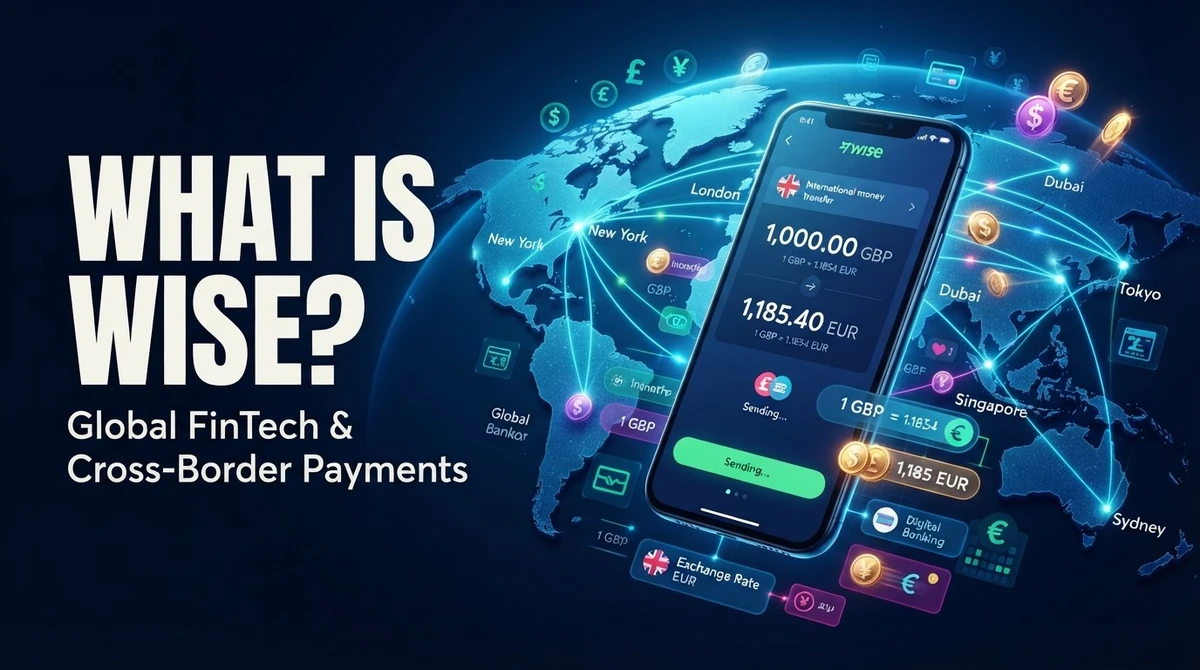
Suppose someone in the United States wants to send $1,000 to a person in Europe who needs euros.
The sender enters the amount, selects the destination currency, and sees the exchange rate, fee, and expected amount the recipient will receive.
Wise then processes the transaction through its payment infrastructure.
The important point is that an international transfer does not necessarily require the exact dollars sent by one customer to physically travel through every country involved. Payment providers can use local banking and payment systems to complete transactions in different currencies.
This can reduce some of the complexity associated with traditional international payment chains.
The BIS describes correspondent banking as an essential part of global cross-border payments, while newer technologies and payment models are being developed to improve the process. (bis.org)
Wise operates within this broader financial ecosystem rather than replacing the global banking system entirely.
The exact cost and delivery time still depend on the currencies, payment method, destination, and transaction details. Wise’s pricing information states that transfer costs vary according to factors including the amount sent, currencies involved, and payment method. (wise.com)
What Is a Wise Account?
The Wise Account is a multi-currency account designed for people who regularly deal with money in different countries.
Customers can hold more than 40 currencies and convert between supported currencies. Eligible customers can also receive certain currencies using account details that can be shared with employers, customers, or other businesses. (wise.com)
Consider a freelancer who lives in one country but works with clients in the United States and Europe.
Instead of receiving every payment and immediately converting it into their home currency, the freelancer may be able to receive supported currencies, hold them, and convert them when needed.
The same concept can help international businesses that receive money in one currency and pay suppliers or contractors in another.
However, availability varies by country. Wise supports more than 40 currencies for holding, but account details and receiving features differ depending on the currency and customer’s location. (wise.com)
What Is the Wise Card?
Wise also offers a debit card linked to the Wise Account.
Eligible customers can use the card internationally and spend money held in their Wise balances. If the customer already holds the currency being spent, the transaction can generally use that balance. Otherwise, Wise can convert another available currency according to its applicable pricing.
This can be useful for travelers and people who regularly make purchases in foreign currencies.
The card is not available in every country, and ATM allowances and fees can vary by market.
Customers should also pay attention when an ATM or merchant offers to convert a transaction into their home currency. Choosing the local currency can help avoid an unfavorable third-party conversion rate.
How Does Wise Make Money?
Wise earns revenue from the financial services it provides, including fees associated with international transfers and currency conversion. The exact cost varies by transaction.
But the business has expanded beyond basic transfers.
In fiscal 2026, Wise reported $2.5 billion in net revenue, with almost half coming from non-cross-border revenue, including interest income, card revenue, and other sources. (owners.wise.com)
That reflects the company’s evolution from a specialist transfer service into a broader financial platform.
Wise also provides infrastructure through Wise Platform, allowing other financial institutions and businesses to access parts of its international payment capabilities.
Wise for Businesses
International payments are increasingly important for small businesses as well as large corporations.
A company may have customers in several countries, pay overseas suppliers, or hire contractors in different jurisdictions. Managing those transactions can create additional currency and payment costs.
Wise Business provides multi-currency functionality and international payment services for eligible businesses. Depending on the market, businesses can hold currencies, receive money through supported account details, convert funds, and make international payments.
This is part of a broader change in the global economy. Freelancers, online businesses, software companies, and remote workers can now operate across borders without being traditional multinational corporations.
For these businesses, cross-border payment infrastructure has become part of everyday operations.
Wise vs. Traditional Banks
The biggest difference between Wise and a traditional bank is the range of services they are designed to provide.
Banks offer deposits, loans, mortgages, credit cards, overdrafts, investment products, and other financial services. Wise is much more focused on payments, currencies, and international financial activity.
That specialization can make Wise useful for customers whose main requirement is moving money internationally.
Exchange-rate pricing is another important difference. Wise says it uses the mid-market exchange rate and charges a separate fee rather than adding its own markup to that exchange rate. (wise.com)
However, customers should not compare providers using the advertised transfer fee alone.
For example, Provider A might charge a $5 fee but offer a weaker exchange rate, while Provider B charges $10 but gives the customer a better rate.
The better comparison is:
Amount sent → total fees → exchange rate → amount received → delivery time
That gives a more accurate picture of the real cost.
When Wise May Not Be the Cheapest Option
Wise should not automatically be assumed to be the cheapest provider for every transaction.
The total cost depends on the currency pair, payment method, transaction size, destination, and the pricing offered by competing providers.
A bank might offer a special rate to an existing customer. Another payment company may have promotional pricing. For larger business transactions, negotiated rates may also change the comparison.
The most useful approach is therefore to compare the final amount received rather than focusing only on the advertised fee.
This becomes especially important for large transfers because even a small difference in the exchange rate can have a significant effect on the final amount.
Why Cross Border Payments Are Complicated
Domestic payments normally operate within one country’s financial infrastructure. International payments may involve multiple currencies, payment networks, financial institutions, regulations, compliance requirements, and banking systems.
The BIS continues to identify interoperability, cost, speed, and transparency as important issues in cross-border payments. (bis.org)
This explains the problem Wise is trying to address.
The challenge is not simply moving money from one app to another. It is coordinating financial systems that were largely built around national borders.
Wise’s role is to simplify parts of that process through technology and connections to local payment infrastructure.
Is Wise a Bank?
The short answer is no, not in the traditional sense.
Wise provides services that can resemble banking, including holding money, receiving payments, converting currencies, and spending through a debit card. But its business model and product range differ from those of a conventional bank.
One important distinction concerns how customer money is protected.
Wise says customer money is safeguarded rather than treated as conventional bank deposits covered by traditional bank deposit-protection schemes. It also states that customers cannot obtain an overdraft or loan through the Wise Account. (wise.com)
That means Wise can complement a bank without necessarily replacing one.
Someone who needs international payments and currency management has different requirements from someone looking for a mortgage, business loan, or full-service banking relationship.
What Are the Main Advantages of Wise?
Wise’s appeal comes from combining several international financial services in one platform.
Multi-currency functionality: Customers can hold and convert more than 40 currencies, subject to regional availability.
International receiving: Eligible customers can receive certain currencies through local account details, which can be useful for international workers, freelancers, and businesses.
International spending: The Wise card allows eligible customers to spend internationally using their Wise balances and currency-conversion functionality.
Transparent pricing: Wise separates its exchange rate from its applicable transfer and conversion fees, making it easier to see the components of the transaction cost.
Digital access: Most services can be managed online or through the Wise app without relying on branch-based banking.
What Are the Limitations of Wise?
Wise is not a complete replacement for a traditional financial institution.
Product availability varies by country, and a feature offered in one market may not be available in another.
International transfers and currency conversions can also carry fees. Customers need to check the actual cost for their specific transaction rather than assuming a fixed price.
Wise also does not offer the full range of financial products available from banks. Customers who need loans, overdrafts, mortgages, or other conventional banking services may still need a bank.
There are also compliance requirements. Cross-border financial institutions must verify customers and monitor transactions under applicable regulations, which can sometimes delay or restrict a payment.
Why Wise Matters to FinTech
Wise is significant because it addresses a structural problem in global finance rather than simply putting an existing banking service into an app.
Cross-border payments have historically involved multiple institutions and financial systems. Fintech companies are trying to reduce some of that friction through digital platforms, payment infrastructure, multi-currency accounts, and alternative payment networks.
Wise has followed that path from a focused money-transfer service toward a broader financial platform.
Its scale illustrates the size of the opportunity. In FY2026, Wise reported $243.5 billion in cross-border transaction volume, up 31% from the previous year, while active customers increased 21% to 18.9 million. (owners.wise.com)
Those figures do not mean traditional banks are becoming irrelevant. Instead, they show that consumers and businesses are increasingly using specialized platforms for specific parts of their financial lives.
Wise and the Changing Global Economy
The growth of Wise also reflects how economic activity is becoming more international.
A freelancer can live in one country and work for clients in another. An online business can sell products worldwide. A software company can employ workers across several jurisdictions. Families can receive remittances from relatives working overseas.
Each activity creates a need to move money across borders.
That connects fintech directly with international trade and the wider global economy. Economic Reader’s guide to How Does International Trade Work? explains how businesses, currencies, financial institutions, and countries interact through cross-border commerce.
Wise does not eliminate currency risk or replace the institutions that regulate international finance. Its role is more specific: simplifying parts of the process of holding, converting, sending, receiving, and spending money across borders.
Wise’s Evolution from Transfer Service to Financial Platform
One of the most notable aspects of Wise is how its business has evolved.
The company began as TransferWise with a focused proposition: make international money transfers cheaper and more transparent.
Over time, that proposition expanded into multi-currency accounts, receiving capabilities, cards, business services, and infrastructure for other financial institutions.
The FY2026 results show this broader business model. Almost half of Wise’s net revenue came from non-cross-border revenue, including interest income, card revenue, and other sources. (owners.wise.com)
Cross-border payments remain at the center of the company, but they now support a much broader financial platform.
What Is Wise? The Bottom Line
Wise is a financial technology company built around a specific problem: making international money movement easier to manage.
It began as TransferWise and has developed into a broader platform offering international transfers, multi-currency accounts, currency conversion, debit cards, business services, and financial infrastructure.
Its key distinction is its focus on cross-border finance. Wise says it uses the mid-market exchange rate for currency conversion and charges separate fees for applicable services, although the total cost varies by transaction. (wise.com)
It is equally important to understand what Wise is not. It is not a conventional full-service bank, and customers should not assume that Wise’s features and protections operate in exactly the same way as a traditional bank account.
For people and businesses that regularly deal with multiple currencies, Wise provides a digital way to manage international payments and money. But the right comparison should always consider the complete transaction: exchange rate, fees, amount received, speed, availability, and applicable protections.
Wise’s growth ultimately reflects a larger change in global finance. As work, trade, services, and personal finances increasingly cross-national borders, the infrastructure for moving money has to adapt as well.