

Pyramid Scheme vs Ponzi Scheme: What Is the Difference?
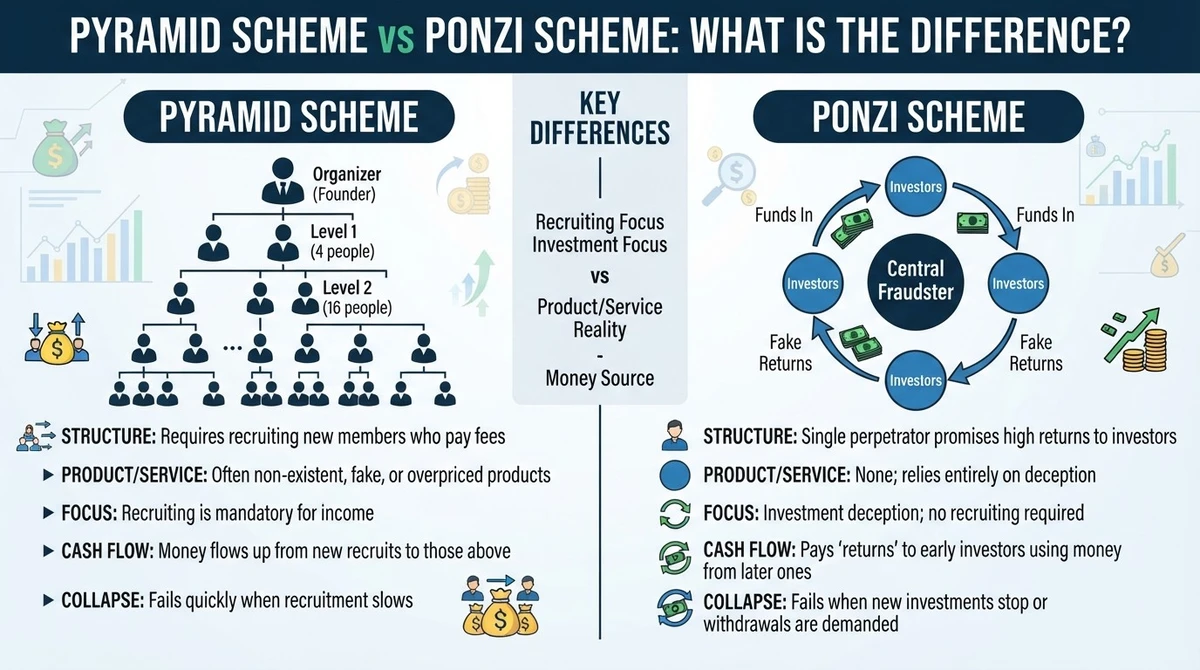
Pyramid Scheme vs Ponzi Scheme
Pyramid schemes and Ponzi schemes are often mentioned together because both depend on a continuing flow of new money. Both can also leave participants with major losses when that flow slows or stops.
But they are not the same type of scheme.
The main difference is how the scheme is structured and where the money comes from.
A pyramid scheme is built around recruitment. Participants are encouraged to bring in new members, and compensation is often connected to the growth of that network. A Ponzi scheme is usually presented as an investment opportunity. The operator collects money from new investors and uses some of it to make earlier investors appear to be receiving legitimate returns.
That difference matters because the two schemes can look very different from the outside.
A useful question is:
If new money stopped coming in tomorrow, what would actually keep the scheme alive?
Following the money can reveal the structure more clearly than the promises made by the promoter.
Pyramid and Ponzi Schemes Are Not the Same Thing
Both schemes depend on new participants or investors, but they use them differently.
In a classic pyramid scheme, the participant is part of the growth mechanism. They may be encouraged to recruit friends, relatives, customers, or other participants and receive commissions or other rewards connected to those recruits.
Investor.gov describes a pyramid scheme as an investment fraud in which new participants’ fees are typically used to pay existing participants for recruiting new members. Recruitment is therefore central to the model. (Investor.gov)
A Ponzi scheme works differently.
The investor does not necessarily have to recruit anyone. Instead, a central operator or promoter collects money and claims that it is being invested in a legitimate opportunity. If the claimed investment activity is not actually generating the promised returns, the operator may use money from newer investors to pay earlier investors.
Investor.gov defines a Ponzi scheme as investment fraud in which existing investors are paid with funds collected from new investors. (Investor.gov)
The simplest distinction is:
Pyramid = recruitment drives the structure.
Ponzi = new investor money creates the appearance of investment returns.
What Is a Pyramid Scheme?
A pyramid scheme is a fraudulent business or money-making structure that depends heavily on recruiting new participants.
The opportunity may be presented as a business, sales program, online income opportunity, or multi-level marketing arrangement. Participants may be told they can earn commissions by building a network underneath them.
The important question is not simply whether a product or service exists.
It is what actually drives the compensation.
If participants mainly make money by recruiting people who pay fees, purchase packages, buy inventory, or otherwise put money into the system, the structure can become a pyramid scheme.
The SEC’s Investor.gov notes that pyramid schemes often emphasize recruitment, promise fast returns or easy income, require a buy-in, or lack demonstrated revenue from genuine retail sales. (Investor.gov)
That is why the compensation structure matters more than the branding.
A program can have a professional website, products, training sessions, conferences, and social-media accounts. Those features do not by themselves establish that the underlying business model is legitimate.
The key question is:
Where does the participant’s compensation actually come from?
What Is a Ponzi Scheme?
A Ponzi scheme is primarily an investment fraud.
The promoter presents an opportunity and asks people to provide capital with the expectation of receiving investment returns. The story may involve trading, real estate, a private business, financial markets, or another supposedly profitable strategy.
The underlying investment activity, however, may not generate the claimed returns.
Instead, money from newer investors can be used to pay earlier investors. Those payments create the appearance that the investment is working.
An early investor who receives a payment may have little reason to suspect anything is wrong. They may then recommend the opportunity to friends or relatives, helping the operator attract more money.
Investor.gov notes that Ponzi schemes require a continuing flow of new money because they generate little or no legitimate earnings. When new investment becomes harder to obtain or many investors seek withdrawals, the structure can collapse. (Investor.gov)
This creates an important difference from a pyramid scheme:
A person can participate in a Ponzi scheme simply by investing money. They do not necessarily need to recruit anyone.
Where Does the Money Come From?
The easiest way to understand the difference is to follow the money.
Imagine a program where you pay $500 to join and are encouraged to recruit three people. Those three are then expected to recruit more people, while commissions move through the network.
Your potential income depends heavily on continued recruitment.
That is the basic structure of a pyramid scheme.
Now consider an opportunity where you are asked to invest $10,000 because a supposedly sophisticated trading strategy will generate high monthly returns.
You do not need to recruit anyone. You simply provide capital.
If the operator is actually using money from new investors to pay earlier investors rather than generating the claimed investment profits, the structure is a Ponzi scheme.
The difference is therefore not simply about how much money people are promised.
It is about what mechanism supposedly generates that money.
Pyramid Scheme vs Ponzi Scheme: Side-by-Side Comparison
| Feature | Pyramid Scheme | Ponzi Scheme |
| Main engine | Recruitment | New investor money |
| Typical participant role | Recruit other participants | Provide investment capital |
| Central operator | May organize the program, but the network is central | Usually central to collecting and controlling funds |
| Main promise | Income from building a network or making sales | Investment returns or profits |
| Money flow | Often linked to fees, purchases, or commissions within the network | New investor money is used to pay earlier investors |
| Product or service | May be nonexistent, secondary, or used to disguise the model | May be claimed as the source of investment returns |
| Need for new people | New recruits are essential to continued expansion | New investors are essential to maintaining the cash flow |
| Main pressure point | Recruitment slows | New investment slows or withdrawals rise |
Real-world frauds do not always fit perfectly into one category, but this framework captures the central difference.
Why Both Schemes Eventually Collapse
The problem is built into the mathematics.
A pyramid scheme needs its participant network to keep expanding. If every participant is expected to recruit several more people, the number of required recruits grows rapidly.
At first, expansion may seem easy.
One participant recruit five. Those five recruit 25. The next level requires 125 more.
The problem is that the pool of potential participants is finite.
Eventually, recruitment becomes harder. Some people have already been approached, others are unwilling to join, and others cannot afford the required payments.
Investor.gov explains that pyramid schemes ultimately collapse because continuous recruitment cannot continue indefinitely. (Investor.gov)
Ponzi schemes face a similar cash-flow problem, but through investment withdrawals.
If an operator has little or no legitimate investment income, money needed to pay existing investors must come from somewhere else. As more investors request their money, the operator needs an increasingly large amount of new capital.
Once incoming money is no longer enough to cover outgoing payments, the structure can break down quickly.
The two schemes therefore have different mechanisms, but the same underlying weakness: the system cannot sustain itself without a continuing flow of new money.
Why Pyramid Schemes Can Look Like Real Businesses
Pyramid schemes can be difficult to recognize because they may resemble legitimate multi-level marketing businesses.
The existence of a product does not automatically make a compensation model legitimate.
The more useful question is how the business actually generates revenue.
The FTC explains that legitimate MLM businesses can involve both retail sales and recruitment. A key distinction is whether participants can earn money from sales to customers outside the program rather than depending primarily on recruiting new distributors. (Consumer Advice)
Consider two simplified models.
Business A: Participants earn money by selling products to genuine outside customers. Recruitment may expand the sales organization, but retail sales are a meaningful source of revenue.
Business B: Participants are told that the real opportunity is to recruit people who pay to join, buy packages, or purchase inventory, while the product itself plays a secondary role.
Both models can have products.
Their economic structures are very different.
That is why looking at the product alone is not enough.
Why Ponzi Schemes Can Look Like Real Investments
Ponzi schemes often survive by creating evidence that appears to confirm the investment story.
An operator might provide:
- Account statements showing gains
- Regular payment histories
- Professional-looking websites
- Investment reports
- Complicated explanations of the strategy
- Testimonials from apparently successful investors
- Early withdrawals that appear to confirm the investment is legitimate
An early investor who receives a payment may reasonably assume that the payment came from investment profits.
If it actually came from another investor’s money, the payment is part of the mechanism keeping the fraud alive.
Investor.gov identifies characteristics commonly associated with Ponzi schemes, including unusually consistent returns, unregistered investments, unlicensed sellers, secretive strategies, paperwork problems, and difficulty receiving payments. (Investor.gov)
The important point is simple:
A payment is not necessarily proof that an investment is generating genuine returns.
Pyramid vs Ponzi: How the Participant Experience Differs
The person entering a pyramid scheme is often expected to become part of the recruitment network.
They may hear phrases such as:
- “Build your team.”
- “Recruit new members.”
- “Create your downline.”
- “Help your recruits build their networks.”
Their potential compensation is closely connected to network growth.
A Ponzi investor may have an entirely different experience.
They may simply be told to invest money and wait for returns. They may never meet other investors and may have little idea how the money is supposedly being used.
That difference can be useful when examining an unfamiliar opportunity.
If the central activity is bringing in more people, recruitment is a major part of the structure.
If the central activity is collecting investment capital and supposedly generating returns, the key question becomes whether those returns are actually coming from legitimate investment activity.
Real World Examples and What They Show
Historical cases show how these structures can operate in practice.
Charles Ponzi
The term “Ponzi scheme” comes from Charles Ponzi, who operated a major fraud in the 1920s.
Ponzi claimed investors could receive a 50% return within a few months through a strategy involving international mail coupons. Instead, money from newer investors was used to pay earlier investors. (Investor.gov)
The case became the historical example for a broader category of investment fraud.
BurnLounge
BurnLounge provides a useful example of why the underlying compensation structure matters.
The company presented an online music-related business opportunity through a multi-level marketing model. The FTC brought an enforcement action, and a federal court ultimately upheld the finding that BurnLounge operated as a pyramid scheme. The FTC said music sales represented only a small portion of the company’s sales and that participants were encouraged to buy into the organization and recruit others. (Federal Trade Commission)
The lesson is broader than the particular company.
A modern product or technology does not change the basic economics of a recruitment-driven scheme.
Can a Pyramid Scheme and Ponzi Scheme Overlap?
Yes.
Real-world frauds do not always fit neatly into one category.
A promoter could combine investment promises with recruitment incentives, creating elements associated with both models.
ZeekRewards is a documented example. The SEC described it as involving both a Ponzi scheme and a pyramid scheme. The operation used a business model involving subscriptions and penny auctions while allegedly using new customers’ funds to support payments and recruiting bonuses. (Investor.gov)
This is why the label alone is sometimes less useful than examining the actual money flow.
Ask:
What are participants being paid for?
Who controls the money?
What activity supposedly generates the returns?
Those questions can reveal more than the name used by the promoter.
How to Tell Which Structure You Are Looking At
When someone presents a new business or investment opportunity, start with the mechanics.
Who gives the money to whom?
Is money going to a central investment operator?
Or are participants paying fees, purchasing packages, or buying inventory as they enter a network?
What creates the promised income?
Is there a genuine business generating revenue?
Is there a real investment generating returns?
Or does the system mainly need more people to keep money flowing?
Is recruitment essential?
This is one of the clearest questions for a potential pyramid structure.
If participants cannot realistically earn money without continually recruiting new people, recruitment is not simply a marketing feature. It may be the economic engine of the program.
What happens if recruitment stops?
Imagine that nobody new joins for six months.
Does the business still have genuine customers?
Does it still generate revenue?
Can participants still earn money from actual sales?
If the answer is no, the model may depend heavily on continuous recruitment.
What happens when investors want their money back?
For an investment opportunity, ask what assets or activities generate the returns and how withdrawals are funded.
If those answers cannot be independently explained or verified, the investment deserves much more scrutiny.
The Money Flow Tells the Story
Pyramid and Ponzi schemes can share professional presentations, persuasive marketing, testimonials, and ambitious financial promises.
But the presentation is not the business model.
The more useful approach is to follow the money.
In a pyramid scheme, the central question is whether the opportunity depends on continually recruiting participants and receiving money from the expanding network.
In a Ponzi scheme, the question is whether reported investment returns are actually being generated by the claimed investment activity or whether new investors’ money is being used to pay earlier investors.
The two structures can overlap, but their core mechanisms remain different.
Understanding that difference gives investors and potential business participants a much clearer way to analyze unfamiliar opportunities. Instead of asking only whether something looks legitimate, ask who pays, who gets paid, why they get paid, and what happens when new money stops coming in.
Those questions get closer to the economic reality of the scheme and that is where the difference between a pyramid and a Ponzi becomes easiest to see.