How Commodities Affect Inflation: Economic Impact Explained
How Commodities Affect Inflation
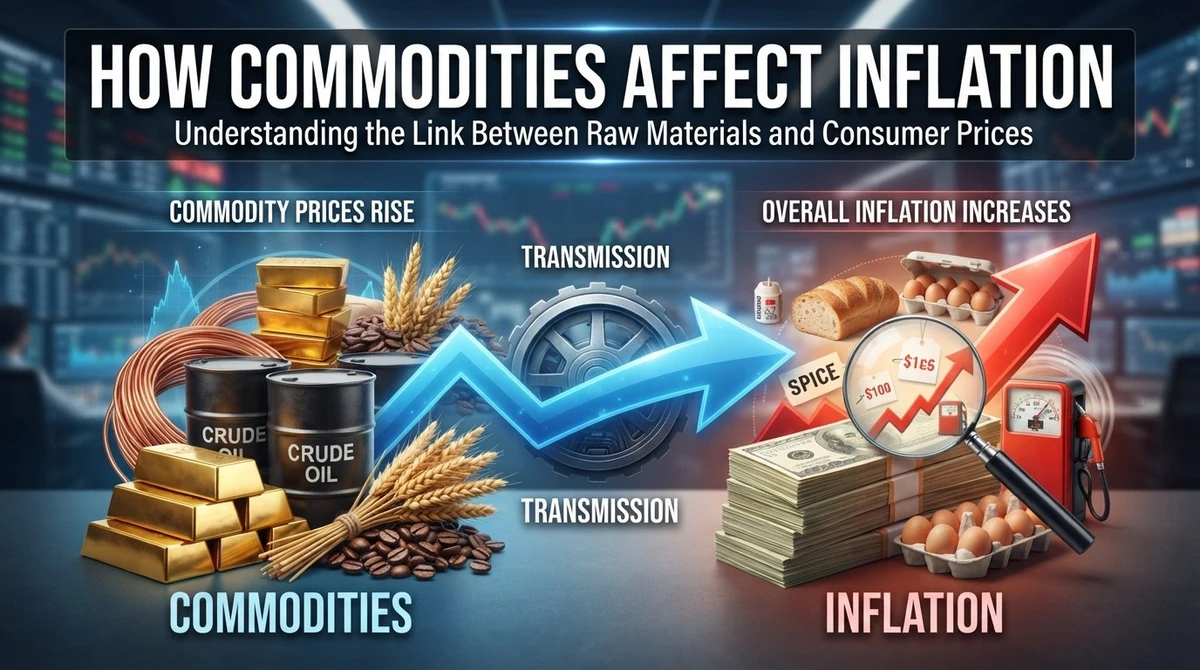
Commodity prices can have a powerful influence on inflation because many commodities sit near the beginning of the production and consumption chain.
Oil becomes fuel and transportation. Natural gas can be used for electricity generation, heating, and industrial production. Agricultural commodities become food and ingredients. Metals become inputs for construction, manufacturing, vehicles, electronics, and infrastructure.
When these prices change sharply, the effects can reach businesses and households well beyond the original commodity market.
The relationship, however, is not as simple as saying that higher commodity prices automatically create higher inflation.
The eventual effect depends on what caused the price move, how long it lasts, how much of the additional cost businesses pass to customers, and whether the initial shock spreads into other parts of the economy.
Economic Reader’s guide to What Is Inflation? explains the broader concept of inflation. This article focuses on one specific part of that story: how commodity prices move through the economy and influence inflation.
Why Commodities Matter for Inflation
Commodities are basic goods used directly or indirectly throughout the economy.
Energy commodities affect transportation, electricity generation, heating, manufacturing, and other activities. Agricultural commodities feed into food production. Industrial metals are used across construction and manufacturing.
That puts commodity prices close to the start of many pricing chains.
A simplified version looks like this:
Commodity price → Business input cost → Producer price → Consumer price → Inflation
The actual process is more complicated because businesses do not necessarily pass the entire increase to customers.
A company facing higher fuel costs might raise prices, accept lower profit margins, improve efficiency, renegotiate contracts, or use some combination of those responses.
The effect also varies considerably by industry. A trucking company may be highly sensitive to fuel prices, while a software company may have little direct exposure to commodity costs.
So, a commodity shock can have a large effect on some prices without pushing every price higher at the same rate.
How a Commodity Price Increase Reaches Consumers
Commodity-price transmission usually happens through several stages.
Consider crude oil:
Crude oil → Refined fuel → Transportation costs → Business costs → Consumer prices
A higher oil price can raise gasoline and diesel costs. More expensive fuel can increase the cost of moving goods by truck, ship, rail, or air.
Businesses that depend on transportation then face higher operating expenses.
Some absorb those costs. Others pass part of them to customers.
The effect can eventually show up in a wide range of goods and services.
Food provides another example:
Agricultural commodity → Processing → Food manufacturing → Distribution → Retail price
The process is rarely immediate or one-for-one. A food producer may absorb part of a higher input cost, change suppliers, reduce margins, or adjust its prices.
A recent IMF working paper examining international fuel and food price shocks found that pass-through to domestic prices is generally incomplete, with fuel showing faster and stronger pass-through than food. The study also found that the degree of pass-through varies across countries and between commodity exporters and importers. (IMF)
Energy Commodities Can Have Wide Inflation Effects
Energy is especially important because it is both a household expense and a production input.
Oil affects gasoline, diesel, jet fuel, shipping, and other transportation activities.
Natural gas can influence electricity generation, heating, fertilizer production, and industrial activity.
Businesses that are not directly involved in energy can still feel the effect through higher operating and transportation costs.
U.S. data from August 2026 illustrates how noticeable the energy channel can be. The Bureau of Labor Statistics reported that the energy component of the CPI was 16.3% higher than a year earlier, while energy commodities were up 28.0%. Gasoline prices were 27.4% higher over the same period. (Bureau of Labor Statistics)
That does not mean every increase in energy prices produces the same increase in overall inflation. In the same August data, headline CPI was up 3.4% over the year, while the index excluding food and energy rose 2.4%. (Bureau of Labor Statistics)
The difference illustrates an important point: commodity-driven price pressure can be substantial without moving every part of the inflation basket equally.
Food Commodities Can Push Up Grocery Prices
Food provides another direct connection between commodity markets and inflation.
Agricultural commodities such as wheat, corn, soybeans, sugar, coffee, and vegetable oils can enter food production at different stages.
A simplified chain might be:
Agricultural commodity → Processing → Food manufacturing → Distribution → Retail price
Suppose a disruption reduces wheat supplies.
The price of wheat may rise first. A food manufacturer then faces higher costs for flour or other wheat-based inputs. Transportation and packaging can add another layer before the product reaches a retailer.
The final consumer price depends on much more than the wheat price itself.
In August 2026, U.S. food prices were 2.7% higher than a year earlier, while food at home was up 2.2%. (Bureau of Labor Statistics)
That is a useful reminder that movements in agricultural commodity prices do not translate mechanically into grocery inflation. Processing, labor, transportation, retailer margins, inventories, and consumer demand all influence the final price.
Transportation Connects Commodity Prices to the Wider Economy
Transportation is one of the most important links between commodity markets and inflation.
Modern economies depend on moving raw materials, components, finished products, food, and energy across long distances.
Fuel is therefore embedded in the cost structure of many businesses.
Consider a product moving through this chain:
Raw materials → Factory → Warehouse → Distribution center → Retailer → Consumer
Several stages can involve transportation.
Higher fuel costs do not necessarily raise the final retail price by the same percentage because fuel is only one part of the total cost. Still, broad increases in transportation expenses can put pressure on business margins and pricing.
International trade adds another layer because imported goods may depend on ocean freight, trucking, warehousing, and other logistics services.
Economic Reader’s guide to How Does International Trade Work? explains how transportation, imports, exports, tariffs, exchange rates, and global logistics connect businesses and consumers across countries.
Industrial Commodities Raise Business Input Costs
Not all commodity-driven inflation comes from energy or food.
Industrial commodities such as copper, aluminum, and iron ore can affect production costs across manufacturing and construction.
A manufacturer may use metals in vehicles, machinery, appliances, electronics, buildings, or infrastructure.
If metal prices rise sharply, the effect can move through the production chain:
Metal price → Component cost → Manufacturing cost → Product price
The final consumer impact depends on the share of the commodity in the product’s overall cost and the ability of businesses to absorb or pass through the increase.
A company that uses relatively little copper may see only a modest effect. A business heavily dependent on metals may face much greater pressure.
That helps explain why commodity inflation can look very different across industries.
Direct vs. Indirect Effects on Consumer Prices
Commodity prices influence inflation through both direct and indirect channels.
Direct effects
Consumers may notice changes quickly in products closely connected to commodities.
Examples include:
- Gasoline
- Heating fuel
- Electricity
- Some food products
- Other household energy costs
These categories can respond relatively quickly when the underlying commodity moves.
Indirect effects
The second layer is broader.
Higher energy costs can increase transportation expenses.
Higher transportation costs can increase distribution costs.
Higher distribution costs can raise business expenses.
Businesses may then adjust their prices.
The resulting chain can look like:
Commodity shock → Input costs → Production and distribution costs → Retail prices
These indirect effects can take longer to appear and may be harder to identify because several other costs are changing at the same time.
Why Commodity Shocks Do Not Always Create Lasting Inflation
A commodity-price increase does not automatically produce persistent inflation.
Imagine oil prices rise sharply because of a temporary supply disruption. Gasoline prices increase, transportation becomes more expensive, and headline inflation moves higher.
If oil prices later fall back, some of that pressure can disappear.
That is different from a situation in which the original shock spreads into broader and more persistent price increases.
The Federal Reserve distinguishes between volatile categories such as food and energy and broader underlying inflation pressures. Its July 2026 Monetary Policy Report noted that core inflation can provide a useful measure of underlying inflation because food and energy prices can be particularly volatile. (The Economic Reader)
That does not make food and energy unimportant. Households still pay those bills, and large increases can materially reduce purchasing power.
The question is whether the shock remains concentrated in a few categories or begins affecting a wider range of prices.
Supply Shocks vs. Demand Driven Commodity Inflation
The reason commodity prices rise can matter almost as much as the size of the increase.
Supply-driven inflation
A supply shock occurs when production or availability falls.
Examples include:
- Geopolitical conflict
- Weather disruptions
- Natural disasters
- Production outages
- Export restrictions
- Transportation disruptions
If global oil supply suddenly falls, prices can rise even without a major increase in demand.
Demand-driven commodity inflation
Commodity prices can also rise because demand is unusually strong.
A manufacturing boom, construction surge, or rapid economic expansion can increase demand for energy and industrial metals.
In that situation, rising commodity prices may be part of a broader expansion in economic activity.
The distinction becomes important for policymakers because higher interest rates cannot directly create more oil, wheat, copper, or natural gas.
Monetary policy can influence demand and financial conditions, but it cannot repair a damaged pipeline, produce a failed crop, or immediately reopen a disrupted shipping route.
Commodity Prices and Inflation Expectations
Commodity shocks can affect inflation not only through current prices but also through expectations.
If households and businesses believe energy, food, or other input prices will remain elevated, they may adjust their behavior.
Businesses may revise pricing plans.
Workers may seek higher wages to offset higher living costs.
Consumers may bring forward purchases if they expect prices to increase further.
Those responses can make an initial commodity shock more persistent.
That outcome is not inevitable. The broader economic environment matters, including labor-market conditions, demand, monetary policy, and how long the commodity shock lasts.
The IMF has also studied the commodity-price channel of monetary policy and found that movements in oil, food, and base-metal prices can form an important part of how monetary policy affects headline inflation. (IMF)
How Central Banks Respond to Commodity-Driven Inflation
Central banks cannot control commodity production directly.
They cannot decide how much oil is pumped, how much wheat is harvested, or how much copper is mined.
Their tools mainly work through financial conditions and economic demand.
When inflation becomes persistent, a central bank may use monetary policy to influence:
- Interest rates
- Borrowing costs
- Consumer demand
- Business investment
- Financial conditions
- Inflation expectations
The challenge is especially difficult when inflation originates with a supply shock.
If oil prices rise because of a physical supply disruption, higher interest rates cannot increase oil production. Policymakers instead have to consider whether the shock is likely to fade or whether it is spreading into broader inflation.
Economic Reader’s guide to How the Federal Reserve Controls Inflation explains the monetary-policy transmission process in more detail.
Why Oil Can Matter Even When You Do Not Buy Oil
Most consumers never purchase crude oil.
Yet oil prices can still affect their daily expenses through:
- Gasoline
- Public transportation
- Airline tickets
- Food delivery
- Shipping costs
- Manufactured goods
- Heating
- Electricity
Oil is an input into many economic activities.
A restaurant does not need to purchase crude oil directly for higher oil prices to matter. Its suppliers may pay more to transport food. Delivery companies may face higher fuel expenses. Employees may spend more commuting.
Some of those costs can eventually feed into the prices businesses charge.
This is one of the clearest examples of how a commodity market can affect the wider economy without consumers ever buying the underlying commodity.
Commodity Prices Can Also Reduce Inflation Pressure
The relationship works in the opposite direction too.
When commodity prices fall, businesses can face lower input costs and consumers can receive relief in categories such as gasoline, heating fuel, and some food products.
Lower energy costs can also reduce transportation and production expenses.
The World Bank’s commodity-market analysis has repeatedly highlighted this two-way relationship between commodity prices and inflation. Its 2026 Commodity Markets Outlook projected that the year’s commodity shock would raise inflation and slow growth, while its broader commodity-market data tracks how changes in energy, food, metals, and other commodity groups feed through the global economy. (World Bank)
The important point is that “commodities” are not one single market.
Oil, natural gas, wheat, copper, and gold can respond to very different forces, so their effects on inflation can also differ.
How Commodities Affect Different Households Differently
Commodity-driven inflation does not affect every household equally.
Food and energy are necessities, so households that devote a larger share of their budgets to them can feel the impact of a commodity shock more strongly.
The Federal Reserve has noted that lower-income households are particularly sensitive to food and energy prices because those necessities account for a larger share of their expenditures. (The Economic Reader)
Consider two households.
One spends a relatively small share of income on gasoline and food.
Another spends a much larger share on those necessities.
A sharp increase in fuel and grocery prices can therefore reduce the second household’s purchasing power by more.
Commodity inflation is consequently more than a macroeconomic statistic. It can change household budgets and the amount of income available for discretionary spending.
Why Commodity Inflation Can Be Different Across Countries
Commodity prices are global, but their domestic effects are not identical.
A country that imports most of its oil may be highly exposed to rising energy prices.
A major oil exporter can experience a different effect because higher export prices may increase national income.
The same principle applies to food and industrial commodities.
A country that produces a commodity domestically may be less dependent on imports, although domestic prices can still respond to global markets.
Exchange rates add another channel.
If a country’s currency weakens against the U.S. dollar, imported commodities priced in dollars can become more expensive in local-currency terms even when the dollar commodity price is unchanged.
The result can be very different inflation outcomes across countries facing the same global commodity shock.
What Investors Should Watch
Investors do not need to track every commodity to understand inflation risk.
A few categories can provide useful signals.
Energy
Watch:
- Crude oil
- Natural gas
- Refined fuel prices
- Energy inventories
- Production disruptions
Agriculture
Watch:
- Wheat
- Corn
- Soybeans
- Food commodity indexes
- Crop conditions
- Weather
- Global inventories
Industrial metals
Watch:
- Copper
- Aluminum
- Iron ore
- Manufacturing activity
- Construction demand
- Inventories
The wider economy
Commodity prices make more sense alongside:
- Consumer inflation
- Producer prices
- Wage growth
- Economic growth
- Interest rates
- Exchange rates
- Shipping costs
- Consumer demand
The World Bank’s Commodity Markets data provides information on major commodity markets and its regular outlooks examine the relationship between commodity shocks, growth, and inflation.
For U.S. investors, the Bureau of Labor Statistics CPI data is useful for comparing movements in energy, food, and broader consumer prices. The August 2026 data, for example, showed a 3.4% annual increase in headline CPI alongside a 16.3% increase in the energy index.
Commodity Prices Are One Part of the Inflation Story
Commodity prices can become an important source of inflation pressure because commodities sit close to the beginning of many production and consumption chains.
A shock to oil can affect fuel and transportation. A disruption in agricultural markets can influence food production. Higher metal prices can raise manufacturing and construction costs.
But the relationship is neither automatic nor one-directional.
The eventual effect depends on the size of the commodity shock, its duration, the reason prices moved, business pricing decisions, consumer demand, exchange rates, inventories, and whether the initial increase spreads into broader inflation expectations.
A useful way to understand the process is:
Commodity market → Production costs → Business prices → Consumer prices → Inflation expectations → Monetary policy
That chain explains why a development in an energy, agricultural, or metals market can eventually appear in grocery bills, transportation costs, business margins, interest-rate decisions, and household purchasing power.
Commodities are therefore not separate from the inflation story. They are one of the channels through which global supply and demand conditions reach the wider economy.