How Commodity ETFs Perform During a Recession: What Investors Should Know
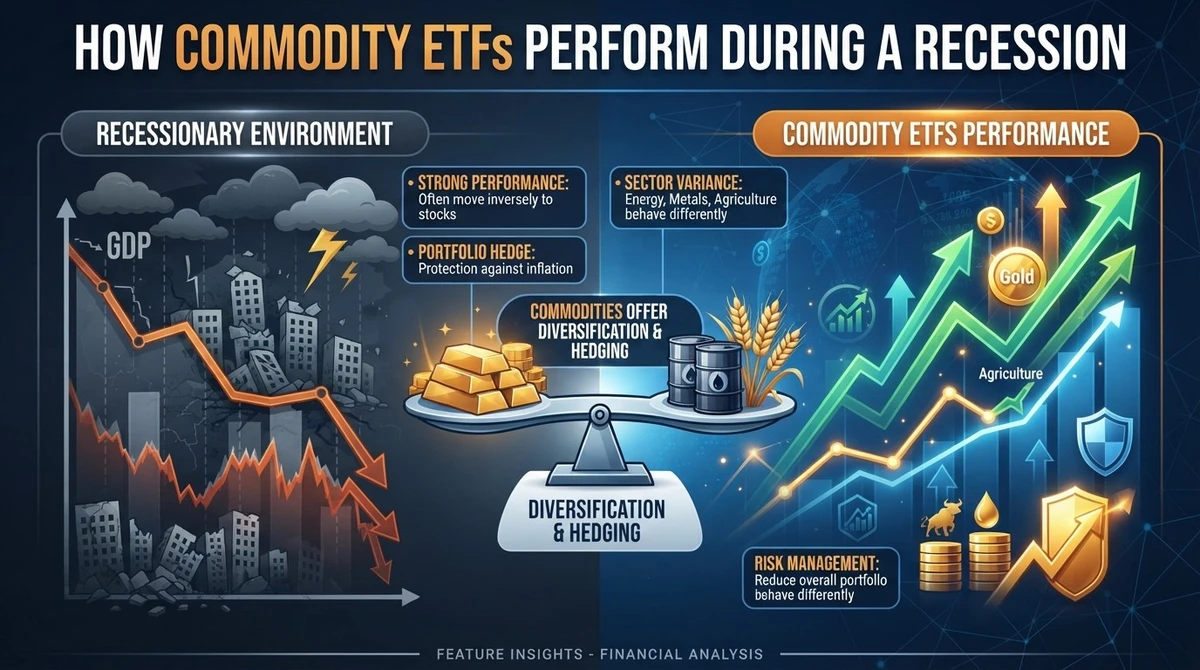
How Commodity ETFs Perform During a Recession
Commodity ETFs can behave very differently during a recession.
A downturn usually means weaker economic activity, softer business demand, and pressure on commodities tied closely to manufacturing, transportation, and construction. But commodities do not all respond to an economic slowdown in the same way. Oil, copper, gold, agricultural commodities, and broad commodity baskets can follow very different paths.
The ETF itself adds another layer.
A physically backed gold product can behave differently from an oil fund that uses futures contracts. A broad commodity fund can also combine assets that are moving in opposite directions.
So, there is no universal answer to the question, “How do commodity ETFs perform during a recession?”
A more useful approach is to ask three questions: What commodity does the ETF track? How does the fund obtain that exposure? And what is causing the recession?
Why Recessions Can Affect Commodity ETFs Differently
A recession generally involves weaker economic activity.
Businesses may reduce production. Consumers may cut discretionary spending. Construction and manufacturing can slow, while transportation demand may weaken.
Those changes can reduce demand for commodities that are closely linked to economic activity.
Oil is one example. If factories produce less and people travel less, demand for transportation fuel can weaken.
Industrial metals can face similar pressure. Copper, aluminum, and other metals are widely used in construction, manufacturing, infrastructure, and electrical equipment.
Agricultural commodities have a different demand profile. People still need food during a recession, so consumption can be less sensitive to economic growth. Weather, crop conditions, inventories, and supply disruptions can become more important.
Gold sits somewhere else again. Interest rates, real yields, the U.S. dollar, financial stress, and investor demand can all influence its price.
The result is a commodity market where a recession can create pressure in some areas while supporting others.
What Happens to Commodity Prices During a Recession?
Historical evidence shows that commodity prices often weaken during major global downturns, particularly when the recession causes a broad decline in industrial activity.
The World Bank’s historical analysis found that oil and copper prices typically fall during global recessions, while agricultural prices tend to be less affected. Gold has often followed a different path, initially benefiting from heightened uncertainty before sometimes retreating as financial pressures intensify. (World Bank)
The 2008–09 global financial crisis provides a particularly clear example.
During the 2009 global recession, the World Bank reported that oil and copper prices each fell by about 60% over three months, while agricultural prices declined by around 40%. Gold initially moved higher as uncertainty increased but later gave back some of those gains as investors sold assets to meet margin calls. (World Bank)
The 2020 recession looked very different.
The pandemic caused an exceptionally rapid collapse in economic activity and transportation demand. The World Bank reported that monthly average crude oil prices fell 50% between January and March 2020, while energy and metals were among the commodity groups most affected by the sudden stop in economic activity. Agricultural prices were comparatively less affected. (World Bank)
The historical record therefore does not point to one fixed recession pattern. The speed, cause, and financial conditions surrounding the downturn matter.
Energy ETFs and Weaker Economic Demand
Energy-focused commodity ETFs can face substantial pressure during recessions because oil and other energy commodities are closely connected to transportation and industrial activity.
When businesses produce less and consumers travel less, fuel demand can weaken.
That can affect oil prices and, in turn, the performance of ETFs designed to track oil or energy futures.
The 2020 recession was an extreme example. The sudden global reduction in travel and economic activity caused an unprecedented demand shock for oil. The World Bank said transportation-related commodities, particularly oil, experienced some of the steepest declines. (World Bank)
Supply conditions can change the picture, however.
Production cuts, geopolitical disruptions, inventory levels, and decisions by major producers can offset some of the demand weakness.
An oil ETF should therefore be viewed through both sides of the market: how much oil the economy needs and how much oil is available.
Gold ETFs Can Follow a Different Path
Gold often receives attention during periods of economic and financial uncertainty because its price is influenced by more than industrial demand.
Investors may increase gold exposure when they are concerned about financial stress, inflation, currencies, or market instability.
But gold is not guaranteed to rise during every recession.
The 2008-09 crisis demonstrates why. The World Bank found that gold initially benefited from the increase in uncertainty, but later declined as investors sold holdings to meet margin calls. (World Bank)
The 2020 episode was also unusual. Gold benefited from uncertainty and changing financial conditions even while other commodity markets were under heavy pressure.
For a gold ETF, the broader financial environment can therefore matter more than the recession label itself.
Industrial Metals ETFs and Manufacturing Activity
Industrial metals are among the commodities most closely tied to economic cycles.
Copper is used throughout construction, electrical equipment, manufacturing, and infrastructure. Aluminum also has extensive industrial applications.
When global production slows, companies may reduce orders for raw materials and postpone capital spending.
That can weaken expectations for industrial-metal demand.
The World Bank has noted that base metals are particularly affected by economic swings because of their heavy use in cyclical industries. (World Bank Blogs)
An industrial-metals ETF can therefore experience significant pressure during a deep global recession.
A shorter downturn can produce a different result, especially if government stimulus, infrastructure spending, or supply constraints support demand.
Agricultural Commodity ETFs Have Different Drivers
Agricultural commodities do not depend on economic growth in exactly the same way as oil or industrial metals.
Food remains a basic necessity, which can make agricultural demand relatively resilient.
But that does not make agricultural commodity ETFs recession-proof.
Their performance can depend heavily on:
- Weather
- Crop yields
- Inventories
- Fertilizer costs
- Export restrictions
- Transportation
- Global food demand
- Currency movements
During the early stages of the 2020 recession, the World Bank reported that agricultural prices were much less affected than energy and metals, although supply-chain disruptions created separate risks for food markets. (World Bank)
That difference is important when comparing commodity ETFs. A recession may weaken an oil fund while leaving an agricultural fund relatively less exposed to the same economic shock.
Broad Commodity ETFs Can Mix Opposing Forces
Broad commodity ETFs can provide exposure across several sectors, including energy, metals, agriculture, and precious metals.
That mix can produce a different recession profile from a single-commodity fund.
Imagine a downturn in which:
- Oil falls sharply.
- Copper declines.
- Agricultural commodities remain relatively stable.
- Gold rises.
A broad commodity fund may experience less pressure than an oil-focused product because its holdings are responding to different forces.
The opposite can also happen.
If energy represents a large share of the fund, weakness in oil may still dominate its overall performance.
This makes the fund’s methodology important. “Broad commodities” does not necessarily mean equal exposure to every commodity sector.
Why a Commodity ETF Can Fall Even When the Commodity Seems Strong
Commodity ETF performance does not always match the headline spot price of the underlying commodity.
The structure of the product matters.
The SEC notes that exchange-traded products include ETFs, exchange-traded commodity trusts, and ETNs. Commodity trusts can hold physical commodities or derivatives and are not necessarily registered as investment companies under the Investment Company Act, even when people commonly refer to them as ETFs. (Investor.gov)
Futures-based products introduce another layer.
A fund using futures contracts does not simply hold today’s spot price. Futures contracts expire, so the fund generally needs to replace them with later contracts.
If the replacement contracts are more expensive than the expiring contracts, the fund can experience a negative roll effect. This is associated with contango.
When later contracts are cheaper, backwardation can provide a more favorable roll environment.
The result is that a futures-based commodity ETF can produce a return that differs materially from the change in the spot commodity price.
Contango and Backwardation During Weak Markets
Recessions can change expectations about future supply and demand.
Those expectations can influence the shape of commodity futures curves.
Suppose investors expect weak oil demand for several months. Futures prices may reflect that expectation before the physical market fully adjusts.
For a futures-based ETF, those contracts are part of the investment result.
That is why recession analysis should not stop at asking whether oil, natural gas, or another commodity is rising or falling. The futures curve and the fund’s roll methodology can also affect the outcome.
The underlying commodity can move in one direction while the ETF’s return is affected by the cost or benefit of maintaining futures exposure.
Interest Rates, the Dollar, and Commodity ETFs
Commodity ETFs can also respond to financial conditions that are not directly related to the recession itself.
Interest rates influence borrowing costs, investment decisions, and the opportunity cost of holding certain assets.
The U.S. dollar matters because many major commodities are priced internationally in dollars. A stronger dollar can put pressure on commodity prices by making dollar-denominated commodities more expensive for buyers using other currencies.
Gold can be particularly sensitive to interest rates, real yields, and the dollar.
These forces can sometimes work against the straightforward recession narrative.
A weak economy might pressure copper while falling interest rates and heightened uncertainty support gold.
That is one reason two commodity ETFs can produce very different results during the same downturn.
What Historical Recessions Tell Us
The 2008-09 financial crisis and the 2020 pandemic recession are useful comparisons precisely because they were so different.
The global financial crisis involved a severe financial contraction and a broad collapse in economic demand.
The 2020 recession developed with extraordinary speed as governments imposed restrictions that sharply reduced travel, production, and economic activity. The subsequent recovery was also unusually fast.
The World Bank described the 2020 energy-price collapse as the steepest during a global recession in the previous five decades, while metal prices also experienced an unusually sharp decline followed by a rapid recovery. (World Bank Blogs)
That historical contrast matters.
A recession caused primarily by a banking crisis may affect commodities differently from one caused by a pandemic, supply disruption, or geopolitical shock.
The source of the downturn can be just as important as the fact that the economy is contracting.
Why Recession Performance Depends on the Type of Shock
Consider two broad scenarios.
Demand-driven recession
Economic activity falls, consumers spend less, factories reduce production, and businesses cut investment.
That environment can put significant pressure on:
- Oil
- Copper
- Aluminum
- Other industrial commodities
Supply-driven recession
Economic activity weakens while a major supply disruption simultaneously affects a commodity.
That can produce a very different outcome.
Oil prices, for example, could remain elevated despite weak economic demand if supply is severely constrained.
This is why there is no universal “recession commodity ETF.”
The economic cause, commodity exposure, fund structure, and financial conditions all influence performance.
What Investors Should Check Before Buying a Commodity ETF
Before using a commodity ETF during a recession, investors can examine several factors.
Underlying commodity: What exactly does the fund track?
Exposure method: Does it use physical holdings, futures, derivatives, or another structure?
Futures curve: If the fund uses futures, what are contango or backwardation doing to the exposure?
Concentration: How much of the portfolio is exposed to energy, metals, agriculture, or precious metals?
Costs: What are the expense ratio, trading costs, spreads, and potential roll costs?
Liquidity: How easily can the product be traded during volatile markets?
Historical behavior: How did the underlying commodity behave during previous downturns?
Investment objective: Is the product designed for long-term exposure, short-term trading, or a particular benchmark?
The SEC also advises investors to review an ETF’s prospectus and shareholder reports and understand its costs, risks, holdings, and investment strategy before investing. (Investor.gov)
For broader context, Economic Reader’s Best Commodity ETFs in the USA explains how different commodity products can use physical holdings, futures, or broad commodity indexes.
Commodity ETFs Are Not a Single Recession Trade
A recession does not automatically make commodity ETFs attractive or unattractive.
Their performance depends on what is happening underneath the economic headline.
Oil and industrial metals may face demand pressure when economic activity contracts. Agricultural commodities can be influenced more heavily by food demand, weather, and supply conditions. Gold can respond to uncertainty, interest rates, real yields, and the dollar.
The ETF structure adds another layer.
A physically backed precious-metals product and a futures-based commodity fund can produce different returns even when they are linked to the same broad market.
Historical recessions reinforce that point. During the 2008–09 downturn, energy and metals experienced severe declines, while gold initially followed a different path. During the 2020 recession, energy prices suffered an extraordinary demand shock while agriculture was comparatively more resilient. (World Bank)
For investors, the useful question is therefore not simply:
“Will commodity ETFs perform well during a recession?”
It is:
“Which commodity exposure does the ETF provide, what forces are affecting that commodity, and how does the fund’s structure translate those movements into investor returns?”
That framework gives investors a more useful way to evaluate commodity ETFs during an economic downturn than treating the entire category as one recession trade.