What Is Vantage Score? How the Credit Scoring Model Works
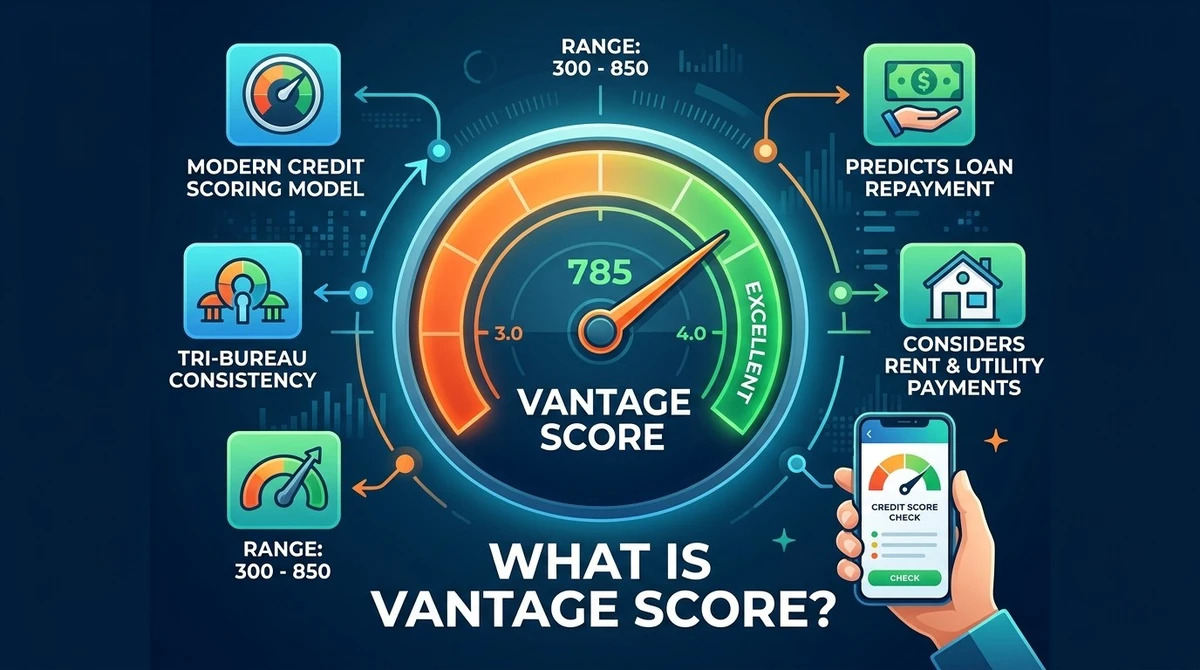
When people check their credit, they often expect to find one definitive number. In reality, consumers can have multiple credit scores because different scoring models can evaluate credit-report information in different ways.
Vantage Score is one of those scoring systems.
Developed by Vantage Score Solutions, Vantage Score models use information from consumer credit reports to estimate credit risk. Vantage Score was launched in 2006 through a collaboration involving the three major U.S. credit reporting companies: Equifax, Experian, and TransUnion. (Vantage Score)
Vantage Score is therefore not a credit bureau. It is a provider of credit-scoring models. Credit bureaus collect and maintain credit information, while a scoring model analyzes that information and produces a numerical assessment of credit risk.
That distinction helps explain why the same consumer can see different credit scores without one of them necessarily being wrong.
What Is Vantage Score?
Vantage Score is a family of credit-scoring models designed to evaluate a consumer’s creditworthiness using information in credit reports.
The models examine patterns in a person’s credit history, including payment behavior, credit utilization, account history, balances, and recent credit activity. They then produce a three-digit score intended to help predict credit risk.
The two Vantage Score models most widely used today are Vantage Score 3.0 and Vantage Score 4.0. Vantage Score 4.0 introduced several methodological changes, including the use of trended credit data, which allows the model to consider patterns in credit behavior over time rather than relying only on a single snapshot. (Vantage Score)
Like FICO, Vantage Score is based primarily on credit-report information. But it uses its own methodology. That is why a consumer’s Vantage Score and FICO Score can differ even when both are based on broadly similar credit information.
Why Was VantageScore Created?
Vantage Score was launched in 2006 through collaboration among Equifax, Experian, and TransUnion. One of the goals was to develop a scoring system that could be used consistently across the three nationwide credit reporting companies.
The roles in the credit system are easier to understand when separated:
Credit reporting companies collect and maintain information about credit accounts, payment history, balances, and other relevant data.
Scoring companies develop mathematical models that interpret information in those credit reports.
Lenders can then use credit scores, together with other information, to evaluate credit risk.
Vantage Score does not create a consumer’s credit history. It interprets information contained in credit files.
The model has also changed over time. Newer versions have been developed to reflect changes in consumer behavior, credit reporting, and statistical modeling.
How Does Vantage Score Work?
A Vantage Score model takes information from a credit file and uses statistical methods to estimate the likelihood of future credit problems.
The process can be simplified:
Credit-report information → scoring model → numerical risk signal
The model does not simply add up individual actions. Instead, it evaluates a collection of characteristics within the consumer’s credit profile.
For example, a consumer’s payment history may provide information about how reliably previous obligations were handled. Credit utilization can provide information about how heavily the consumer is using available revolving credit. The age and depth of the credit profile can provide more historical context.
The exact treatment of these factors depends on the VantageScore version being used.
That matters because Vantage Score is a family of models, not one permanent formula. Vantage Score says its models evolve as consumer behavior, credit-reporting standards, and data-modeling techniques change.
What Vantage Score 4.0 Emphasizes
Vantage Score 4.0 provides a useful example of how the model distributes its predictive contribution across broad categories:
| Factor | Approximate Contribution |
| Payment history | 41% |
| Depth of credit / age and mix | 20% |
| Credit utilization | 20% |
| Recent credit | 11% |
| Balances | 6% |
| Available credit | 2% |
These figures describe Vantage Score 4.0. They are not a universal formula for every Vantage Score model or every consumer. Vantage Score explains that the percentages represent average contributions across a reference population rather than a personal point-by-point calculation.
The model’s use of trended credit data is another important feature. Rather than looking only at whether a balance is high at one particular moment, the model can incorporate patterns in credit behavior over time.
What Is the Vantage Score Range?
Vantage Score 3.0 and 4.0 use a 300 to 850 scoring range.
For Vantage Score 4.0, the official credit tiers are:
| Vantage Score | Credit Tier |
| 300–600 | Subprime |
| 601–660 | Near Prime |
| 661–780 | Prime |
| 781–850 | Super prime |
These are Vantage Score’s model-specific categories. They should not be treated as universal definitions used by every lender or credit-scoring system.
A higher score generally indicates lower estimated credit risk. But a score by itself does not guarantee approval, a particular interest rate, or a specific credit limit.
Vantage Score vs. FICO Score
Vantage Score and FICO are both credit-scoring systems, but they are developed by different organizations and use different methodologies.
| Feature | Vantage Score | FICO Score |
| Developer | Vantage Score Solutions | Fair Isaac Corporation |
| Common range | 300–850 | 300–850 for many base scores |
| Model versions | Multiple | Multiple |
| Main data source | Credit reports | Credit reports |
| Methodology | VantageScore-specific | FICO-specific |
| Use | Depends on lender and model | Depends on lender and model |
The important point is that Vantage Score is not simply another name for a FICO Score.
Both models try to estimate credit risk, but they can process information differently. The Consumer Financial Protection Bureau notes that lenders use many different credit-scoring models and that consumers can have multiple scores depending on the model, reporting data, and timing. (Consumer Financial Protection Bureau)
So, the existence of two different numbers does not automatically mean one score is inaccurate.
Why Can Vantage Score and FICO Scores Be Different?
Different scores can result from several parts of the credit-scoring system.
Different formulas: VantageScore and FICO use different statistical models.
Different model versions: Both organizations have released multiple generations of scoring models.
Different credit-report information: Data held by Equifax, Experian, and TransUnion may not always be identical or updated at exactly the same time.
Different timing: A score calculated today may use information that was not present when another score was calculated.
Different purposes: Some lenders use scoring models designed for particular products or types of credit decisions.
The CFPB has noted that lenders can use different scoring models and that scores can vary depending on the underlying credit-report information and when the score is calculated. (Consumer Financial Protection Bureau)
So, asking, “Which score is my real score?” can be less useful than asking:
Which model is being used, what information does it rely on, and what credit decision is it designed to support?
What Affects a Vantage Score?
The previous section explained how the model works. Here, the focus is on what a consumer’s credit behavior means in practical terms.
Payment History
Payment history is the largest published contributor in VantageScore 4.0. A pattern of paying obligations on time provides evidence of reliable repayment behavior, while late payments can work in the opposite direction.
Credit Utilization
Credit utilization measures how much revolving credit is being used relative to available limits.
For example, if a credit card has a $10,000 limit and a $2,000 balance, the utilization is 20%.
The model considers utilization as part of the broader credit profile rather than treating one percentage as a universal cutoff.
Depth of Credit
The depth of a credit profile provides information about how long and how extensively a consumer has used credit.
Vantage Score 4.0 groups this area under depth of credit, which includes information related to the age and mix of credit accounts.
Recent Credit
New accounts and recent credit activity can change the information available in a credit report.
Vantage Score 4.0 assigns a separate contribution to recent credit activity, reflecting the model’s interest in changes in a consumer’s borrowing behavior.
Balances and Available Credit
Outstanding balances and the amount of unused credit provide additional information about a consumer’s current credit position.
These categories have smaller published contributions in VantageScore 4.0, but they remain part of the model’s broader assessment.
No single action guarantees a specific point increase or decrease. The model evaluates the consumer’s overall credit profile.
Why Does Vantage Score Matter?
Vantage Score matters because credit scores help transform complicated credit histories into standardized measures of risk.
Lenders may use credit scores when evaluating products such as credit cards, auto loans, mortgages, and personal loans. The exact model and its role depend on the lender and the product.
For consumers, this creates an important distinction between a credit report and a credit score.
A credit report contains detailed information about credit accounts and payment history.
A credit score summarizes selected information from that report through a mathematical model.
The model therefore acts as a bridge between raw credit data and a financial decision.
That is one reason credit scoring has become an important part of modern consumer lending.
How Can You Improve a VantageScore?
There is no shortcut that guarantees a specific score increase. Improving a VantageScore generally means improving the underlying credit profile.
Useful habits include:
- Pay credit obligations on time.
- Keep revolving-credit balances under control.
- Avoid unnecessary applications for new credit.
- Maintain established credit accounts responsibly.
- Monitor credit reports for inaccurate information.
- Give negative information time to become less influential as the credit history develops.
The goal should be to build a reliable credit history rather than chase a particular three-digit number.
Consumers can also review their credit reports for inaccurate information through the federally authorized AnnualCreditReport.com. The credit reports provide the underlying information that scoring models evaluate.
The Limits of VantageScore
A VantageScore is useful for evaluating credit risk, but it is not a complete measure of someone’s financial health.
It does not directly measure:
- Income
- Savings
- Investments
- Net worth
- Emergency funds
- Overall household cash flow
Someone can have a high credit score while having very little cash savings. Another person can have significant assets but a limited or damaged credit history.
The score is also model-dependent. A VantageScore 4.0 score, a VantageScore 3.0 score, and a FICO Score can differ because they use different methodologies and may rely on different information at different times.
Lenders can also consider information beyond the score when making a credit decision.
A credit score should therefore be viewed as one risk signal, not a complete financial identity.
For example, understanding how credit fits into a larger borrowing decision is useful when looking at mortgages. Economic Reader’s How Mortgage Loans Work explains how credit, interest rates, loan terms, and other factors fit together in home financing.
Why Multiple Credit Scores Exist
The existence of multiple credit scores can seem confusing, but it reflects a basic feature of financial risk assessment.
Credit reports contain large amounts of information. A scoring model takes that information and converts it into a numerical estimate of credit risk.
Different models can interpret similar credit histories differently.
The process can be simplified as:
Credit-report data → scoring model → risk signal → lending decision
With VantageScore, the model is one particular interpretation of the underlying credit information. With FICO, another model produces a different interpretation.
Neither number exists independently from the data and methodology behind it.
This also explains why a consumer should not automatically panic when two legitimate credit scores are slightly different. The difference may reflect the model, the data source, or the timing rather than an error.
VantageScore and the Cost of Borrowing
The importance of credit scoring becomes even clearer when it is connected to the cost of borrowing.
Lenders use information about credit risk when determining whether and on what terms to extend credit. A borrower’s credit profile can therefore become one input into the pricing of a loan or other credit product.
That does not mean VantageScore mechanically determines an interest rate.
Instead, the score is one component of a broader risk-assessment process.
Interest rates themselves are influenced by many factors, including market conditions, monetary policy, loan characteristics, and perceived credit risk. Economic Reader’s How Interest Rates Affect the Economy explains how borrowing costs can influence households, businesses, financial markets, and economic activity.
This creates a broader economic chain:
Credit history → credit score → risk assessment → borrowing terms → household or business financial decisions
The score is only one link in that chain, but it helps translate individual credit behavior into information that can be used in the credit market.
Why Multiple Scoring Models Matter to the Credit Market
The existence of VantageScore alongside FICO illustrates a broader feature of modern finance: risk can be measured in more than one way.
A credit report contains detailed information, but lenders need a way to interpret that information efficiently. Statistical models provide that bridge.
Different models can place different emphasis on particular patterns in the data. They may also be designed for different lending environments or updated as credit behavior and available data change.
That does not make the system meaningless. It means a credit score should always be interpreted together with its model, data, and purpose.
For consumers, this perspective is more useful than treating every three-digit score as a universal financial grade.
The Role of VantageScore in Modern Credit Decisions
VantageScore shows how the financial system turns large amounts of consumer credit information into a standardized risk signal.
A lender evaluating thousands or millions of applications cannot rely entirely on manual reviews. Credit-scoring models provide a scalable way to incorporate historical repayment behavior and other credit characteristics into underwriting.
But scoring does not eliminate uncertainty.
A VantageScore remains a statistical estimate of credit risk, not a guarantee of what a borrower will do in the future.
Its value comes from providing a consistent framework for interpreting credit information.
That is also why understanding the model behind a score is more useful than focusing only on the number itself.
Final Takeaway
There is no single universal credit score.
VantageScore is one family of credit-scoring models that evaluates information in consumer credit reports and converts it into a numerical assessment of credit risk.
Its methodology differs from FICO’s, and different VantageScore versions can also differ from one another. As a result, consumers can legitimately have multiple credit scores at the same time.
The useful way to understand those differences is to look beyond the number:
What model produced the score? What information did it use? When was it calculated? And what decision is it intended to support?
Once those questions are clear, VantageScore becomes easier to understand not as a simple financial grade, but as one of the statistical tools used to translate credit history into decisions within the broader credit market.