Roth IRA vs. 401(k): Which Retirement Account Is Better in 2026?

Planning for retirement may seem like something you can worry about later. But the truth is, the earlier you start saving, the easier it becomes to build long-term wealth. Even if retirement is decades away, the choices you make today can have a huge impact on your future financial security.
If you’ve started learning about investing or saving for retirement, you’ve probably come across two popular accounts: the Roth IRA and the 401(k). Both are designed to help people save money for retirement while offering valuable tax benefits. However, they work in different ways, and choosing the right one can feel confusing, especially if you’re just getting started.
So, which account is better?
The answer depends on your income, your employer’s retirement plan, your tax situation, and your long-term financial goals. For many Americans, the best strategy is not choosing one over the other it may be using both together.
In this beginner friendly guide, we’ll compare the Roth IRA and the 401(k) side by side. You’ll learn how each account works, their biggest advantages and disadvantages and how to decide which one fits your retirement plan in 2026.
By the end of this article, you’ll have a clear understanding of both retirement accounts and feel more confident about making smart financial decisions.
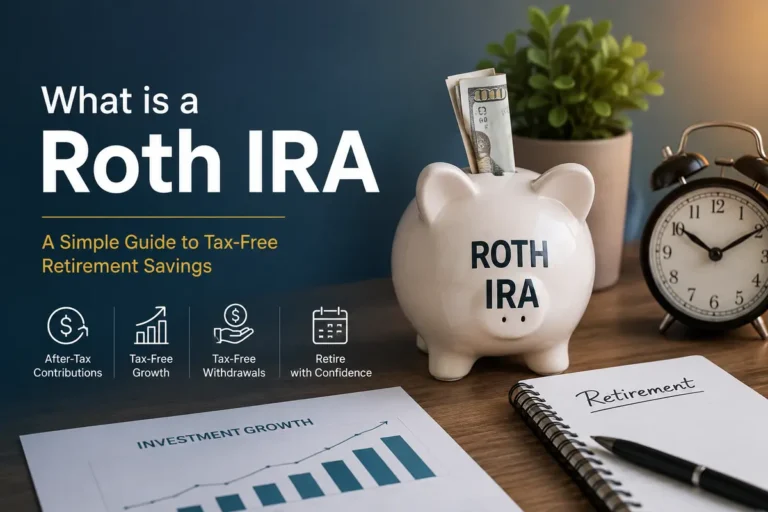
What Is a Roth IRA?
A Roth IRA or Roth Individual Retirement Account is a personal retirement savings account that allows your investments to grow tax free. Unlike many other retirement accounts, you contribute money that has already been taxed.
In simple terms, you pay taxes on your income today. Then you invest that money inside your Roth IRA. If you follow the IRS rules, your investments can grow for years and you won’t pay federal income taxes when you withdraw qualified money during retirement.
This tax free growth is one of the biggest reasons why millions of Americans choose a Roth IRA.
How Does a Roth IRA Work?
Here’s a simple example.
Imagine you earn $60,000 per year. After paying income taxes, you decide to contribute part of your paycheck to a Roth IRA.
Inside the account, you can invest in assets such as:
Over the next 20, 30, or even 40 years, your investments may grow through compound returns.
When you reach retirement age and meet the withdrawal requirements, you can generally withdraw both your original contributions and your investment earnings without paying federal income tax.
That’s what makes the Roth IRA so attractive for long term investors.
Who Can Open a Roth IRA?
Unlike a 401(k), which is offered through an employer a Roth IRA is opened by you.
You can open one through many banks, brokerage firms or online investment companies.
As long as you have earned income and meet the IRS income eligibility rules, you can usually contribute to a Roth IRA.
This means you’re in complete control of the account. Even if you change jobs or become self-employed, your Roth IRA stays with you.
Main Benefits of a Roth IRA
There are several reasons why financial experts often recommend a Roth IRA, especially for younger workers.
- Tax Free Retirement Income
Perhaps the biggest benefit is that qualified withdrawals are generally tax free.
This can be especially valuable if you expect your tax rate to be higher in retirement than it is today.
- Your Money Can Grow for Decades
Because you don’t pay taxes on qualified investment gains, compound growth can become incredibly powerful over a long investment timeline.
The earlier you start, the more time your investments have to grow.
- More Investment Choices
Most Roth IRA providers offer thousands of investment options.
You’re free to build a portfolio that matches your personal goals and risk tolerance.
- Flexibility
Unlike many workplace retirement plans, your Roth IRA isn’t tied to your employer.
You can keep the same account throughout your career.
Things to Consider
While the Roth IRA offers many advantages, it isn’t perfect.
There are annual contribution limits and higher income earners may not qualify to contribute directly.
Also, because contributions are made with after tax dollars, you don’t receive an immediate tax deduction like you might with some traditional retirement accounts.
Still, many investors consider these trade offs worthwhile because of the potential for tax free retirement income.
What Is a 401(k)?
A 401(k) is an employer sponsored retirement savings plan that helps employees save for retirement directly from their paycheck.
Instead of opening the account yourself, your employer provides access to the plan.
One of the biggest reasons people choose a 401(k) is convenience.
You simply decide how much of each paycheck you’d like to contribute and the money is automatically deposited into your retirement account.
Many employers also encourage retirement saving by matching part of an employee’s contributions.
This employer match is often described as “free money” because it’s additional money your employer contributes to your retirement savings if you meet the plan’s matching requirements.
How Does a 401(k) Work?
Let’s look at a simple example.
Suppose you earn $70,000 per year.
You choose to contribute 8% of every paycheck into your company’s 401(k).
Your employer offers a 100% match on the first 4% that you contribute.
Here’s what happens:
- You contribute 8% of your salary.
- Your employer contributes another 4%.
- Every year, your retirement savings grow faster because of the employer’s contribution.
Over several decades, those matching contributions and investment returns can significantly increase your retirement balance.
Traditional vs. Roth 401(k)
Many employers now offer two versions of a 401(k).
Traditional 401(k)
With a Traditional 401(k), contributions are usually made before income taxes are deducted.
This lowers your taxable income today.
However, you’ll generally pay income taxes when you withdraw money during retirement.
Roth 401(k)
A Roth 401(k) works differently.
Your contributions are made with after tax dollars.
In exchange, qualified withdrawals during retirement can generally be tax free.
Not every employer offers a Roth 401(k), but its popularity has continued to grow in recent years.
Main Benefits of a 401(k)
- Employer Matching Contributions
For many employees, this is the single biggest advantage.
If your employer offers matching contributions, it’s often considered one of the best financial benefits available at work.
Ignoring an employer match could mean leaving valuable retirement money on the table.
- Automatic Saving
Since contributions come directly from your paycheck, saving becomes simple and consistent.
You don’t have to remember to transfer money each month.
- Higher Contribution Limits
Compared with a Roth IRA, a 401(k) generally allows workers to contribute much more money each year.
This makes it an excellent option for people who want to maximize their retirement savings.
- Long Term Investing
Like a Roth IRA, your money can be invested in mutual funds, target date funds, index funds and other investment options available through your employer’s retirement plan.
Is a 401(k) Right for Everyone?
A 401(k) is an excellent retirement tool for millions of Americans, but it’s not perfect.
Investment choices are usually limited to the options selected by your employer’s plan.
Fees can also vary depending on the plan provider.
Still, if your employer offers matching contributions, financial professionals often recommend contributing enough to receive the full match before considering other retirement investment options.
Roth IRA vs. 401(k): Key Differences at a Glance
Now that you understand how both retirement accounts work, let’s compare them side by side.
Although both accounts are designed to help you save for retirement, they have important differences that can affect your taxes, investment options, flexibility and long term financial goals.
Here’s a simple comparison.
| Feature | Roth IRA | 401(k) |
| Who opens the account? | You | Your employer |
| Tax treatment | Contributions are made with after tax money | Usually pre-tax (Traditional 401(k)) or after-tax (Roth 401(k)) |
| Employer match | No | Often available |
| Investment choices | Usually thousands of options | Limited to your employer’s plan |
| Annual contribution limit | Lower | Higher |
| Income restrictions | Yes | Generally no for Traditional 401(k) participation |
| Account ownership | Always yours | Stays with you, but is linked to your employer’s plan while employed |
| Best for | Tax-free retirement income | Employer matching and higher savings limits |
Both accounts can be excellent choices. The better option depends on your personal financial situation.
Understanding the Biggest Differences
Let’s break down the most important differences one by one.
1. Taxes: Pay Now or Pay Later?
Taxes are one of the biggest differences between these retirement accounts.
Roth IRA
- With a Roth IRA, you pay taxes before you contribute your money.
- The reward comes later.
- If you follow the IRS rules, qualified withdrawals in retirement are generally tax-free.
- This means you won’t owe federal income taxes on your investment gains during retirement.
- Many younger workers like this approach because they believe they’ll be in a higher tax bracket later in life.
Traditional 401(k)
- A Traditional 401(k) works in the opposite way.
- Your contributions usually reduce your taxable income today.
- For example, if you earn $80,000 and contribute $8,000 to a Traditional 401(k), your taxable income may be reduced to $72,000 for that year.
- However, you’ll generally pay income taxes when you withdraw the money in retirement.
Which Tax Strategy Is Better?
There isn’t one correct answer.
A Roth IRA may be attractive if:
- You’re early in your career.
- Your current income is relatively low.
- You expect your income to increase significantly in the future.
- You want tax-free retirement income.
A Traditional 401(k) may make sense if:
- You’re currently in a high tax bracket.
- You want to lower your taxable income today.
- You expect your tax rate to be lower after you retire.
Many investors actually use both accounts to create tax flexibility during retirement.
2. Employer Match: One of the Biggest Advantages of a 401(k)
- One feature that makes a 401(k) stand out is the employer match.
- A Roth IRA does not include matching contributions.
- Many employers encourage retirement saving by contributing additional money to your 401(k).
Here’s a simple example.
Imagine you earn $60,000 per year.
Your employer offers a 100% match on the first 5% you contribute.
If you invest 5% of your salary:
- You contribute $3,000.
- Your employer also contributes $3,000.
Without investing any extra money yourself, your retirement account immediately receives a total of $6,000.
That’s an instant 100% return on your own contribution.
This is why many financial experts recommend contributing at least enough to receive the full employer match before investing elsewhere.
Ignoring the match could mean giving up part of your employee benefits.
3. Contribution Limits
- Another major difference is how much money you can contribute each year.
- A Roth IRA has a lower annual contribution limit.
- A 401(k), on the other hand, allows much larger annual contributions.
- For people who want to save aggressively for retirement, the higher limits offered by a 401(k) can be a significant advantage.
- Some workers even contribute enough to their 401(k) to receive the employer match and then invest additional money into a Roth IRA before returning to their 401(k) for extra retirement savings.
- This strategy can provide both tax diversification and higher overall retirement contributions.
4. Investment Choices
Investment flexibility is another important factor.
Roth IRA
When you open a Roth IRA through a brokerage firm, you’ll usually have access to thousands of investment options.
These may include:
- Individual stocks
- Index funds
- ETFs
- Mutual funds
- Bonds
- Money market funds
You decide exactly how your money is invested.
This level of control appeals to investors who enjoy managing their own portfolios.
401(k)
A 401(k) usually offers a smaller list of investments selected by your employer’s retirement plan.
Many plans include:
- Target-date funds Index funds Bond funds Large-cap stock funds
- International funds
While the selection may be more limited, many employer plans still provide enough diversification for long-term investing.
5. Income Rules
- Eligibility also differs between these accounts.
- A Roth IRA has income limits.
- As your income increases, your ability to contribute directly may be reduced or eliminated under IRS rules.
- A Traditional 401(k), however, generally doesn’t prevent employees from participating simply because they earn a higher salary.
- For many high-income professionals, this makes a 401(k) an essential retirement savings tool.
6. Portability
- Many people change jobs several times during their careers.
- Fortunately, both retirement accounts can continue benefiting you.
- A Roth IRA stays with you for life.
- It doesn’t matter where you work.
- A 401(k) is connected to your employer while you’re employed there.
- If you leave your job, you usually have several choices.
You may:
- Leave the money in the old employer’s plan (if allowed)Roll it into your new employer’s
- 401(k)
- Roll it into an IRA
This flexibility helps ensure your retirement savings remain invested over the long term.
Which Account Offers More Flexibility?
If flexibility is your top priority, many investors prefer the Roth IRA.
You choose:
- Where to open the account.
- Which investments to buy.
- When to change providers.
- How to manage your portfolio.
With a 401(k), your employer determines the plan provider and available investment options.
However, the convenience of automatic payroll deductions and employer matching often outweighs those limitations.
Can You Use Both?
Absolutely.
In fact, many financial planners recommend using both accounts whenever possible.
Here’s one common strategy.
1. Contribute enough to your 401(k) to receive the full employer match.
2. Next, contribute to a Roth IRA if you’re eligible.
3. If you still have money available for retirement investing, continue increasing your 401(k) contributions.
This approach allows you to benefit from:
- Free employer matching contributions.
- Tax-free retirement income through a Roth IRA.
- Higher overall retirement savings.
- Greater tax diversification in retirement.
Instead of asking, “Which account is better?” many successful investors ask, “How can I use both to build the strongest retirement plan?”
Roth IRA vs. 401(k): Contribution Limits, Withdrawals and Real Life Examples
So far, you’ve learned how Roth IRA and 401(k) accounts work and how they differ in taxes, employer matching, and flexibility.
Now let’s go deeper into the practical side of things how much you can contribute, how withdrawals work and how these accounts look in real life situations.
These are the details that often decide which account is better for your personal financial situation.
Contribution Limits: How Much Can You Save?
One of the biggest differences between a Roth IRA and a 401(k) is how much money you are allowed to contribute each year.
Roth IRA Contribution Limits
- A Roth IRA has relatively low annual contribution limits set by the IRS.
- This limit is designed to encourage long term investing but still keep the account accessible for regular investors.
- Because of this limit, a Roth IRA is often used as a supplemental retirement account, not the only one.
- Even though the limit is lower, the benefit is powerful: your money can grow tax free for decades.
401(k) Contribution Limits
- A 401(k) allows significantly higher annual contributions compared to a Roth IRA.
- This makes it one of the most powerful retirement tools for building wealth, especially for middle and high income earners.
- Because contributions come directly from your paycheck, it’s also easier to save large amounts consistently without thinking too much about it.
Why This Matters
- If your goal is to maximize retirement savings, the 401(k) gives you more space to invest.
- But if your goal is tax free retirement income and flexibility, the Roth IRA still plays a very important role.
- Many financial planners recommend using both together for a balanced strategy.
Withdrawals: When Can You Use the Money?
- Retirement accounts are designed for long-term savings, so there are rules about when you can withdraw money.
- Understanding these rules is very important to avoid penalties.
Roth IRA Withdrawals
A Roth IRA is known for its flexibility.
You can withdraw your original contributions at any time without penalties or taxes, since you already paid tax on that money.
However, earnings (investment growth) are different.
To withdraw earnings tax free, you generally must:
- Be at least retirement age, and
- Meet the required holding period rules
If you withdraw earnings early, you may face taxes and penalties.
This structure gives Roth IRA users a unique advantage: access to contributions if absolutely needed, while still protecting long-term growth.
401(k) Withdrawals
A 401(k) is more strict.
In most cases, you cannot withdraw money before retirement age without penalties.
Early withdrawals often come with:
- Income taxes
- Additional early withdrawal penalties
However, there are some exceptions in special situations, such as financial hardship or loans (depending on the employer plan).
Because of these rules, a 401(k) is best viewed as a long term retirement commitment rather than a flexible savings account.
Real Life Example: Roth IRA vs. 401(k)
Let’s make this very practical with a simple example.
Imagine two workers:
Worker A: Uses only Roth IRA
- Invests a small amount each year
- Enjoys tax-free growth
- Has full control over investments
- Limited by annual contribution cap
Worker B: Uses 401(k) + Employer Match
- Contributes through payroll
- Gets employer matching contributions
- Builds retirement savings faster
- Pays taxes later in retirement
After 25 – 30 years:
- Worker A has tax-free withdrawals and full flexibility.
- Worker B may have a larger total balance due to employer match and higher contributions.
Key Insight:
Worker B often ends up with more money overall, especially if employer match is strong.
But Worker A enjoys more control and flexibility with investments and withdrawals.
Common Mistakes People Make
Many beginners make simple mistakes when choosing between these accounts.
Let’s go over the most common ones so you can avoid them.
Mistake 1: Ignoring Employer Match
- One of the biggest mistakes is not contributing enough to get the full 401(k) employer match.
- This is basically leaving free money on the table.
- Even small contributions can unlock significant long term value.
Mistake 2: Thinking One Account Is Enough
- Some people believe they only need a Roth IRA or only a 401(k).
- In reality, combining both often creates a stronger retirement strategy.
- Diversification isn’t just for investments it also applies to tax planning.
Mistake 3: Not Considering Taxes in Retirement
- Many people focus only on current tax savings.
- But retirement planning is about long-term tax strategy.
- Roth IRA = tax-free withdrawals later
401(k) = tax-deferred withdrawals later - Understanding this difference is crucial.
Mistake 4: Withdrawing Too Early
- Early withdrawals can seriously damage long-term retirement growth.
- You lose compound interest and may pay penalties.
- Retirement accounts work best when left untouched for decades.
Investment Growth Over Time
One of the most powerful benefits of both accounts is compound growth.
Even small monthly contributions can grow into large retirement savings over time.
For example:
- Regular investing over 30 years
- Consistent contributions
- Market growth over time
This combination can turn modest savings into a strong retirement fund.
The key is consistency, not timing the market.
Why Both Accounts Work Well Together
Instead of choosing one, many people use both accounts strategically.
Here’s a simple approach:
- Contribute to 401(k) first to get employer match
- Add Roth IRA contributions for tax-free growth
- Increase 401(k) contributions if extra income is available
This strategy gives you:
- Immediate tax benefits (401(k))
- Future tax-free income (Roth IRA)
- Employer match bonuses
- Better financial flexibility in retirement
What You Should Remember from This Part
- 401(k) allows higher contributions
- Roth IRA offers more flexibility with withdrawals
- Employer match is extremely valuable
- Early withdrawals should be avoided
- Combining both accounts is often the smartest strategy
Roth IRA vs. 401(k): Final Decision Guide
Now you’ve seen how both Roth IRA and 401(k) accounts work, how they differ and how they perform in real life situations.
At this point, the big question is simple:
Which one should you choose?
The truth is, there is no single “best” answer. The right choice depends on your income, job situation, tax expectations and long term financial goals.
Let’s break it down in a simple way.
Who Should Choose a Roth IRA?
A Roth IRA is often a great choice if you are in one of these situations:
1. You Are Early in Your Career
- If you are young or just starting to earn money, your income is usually lower.
- This makes it a good time to pay taxes now and enjoy tax free withdrawals later.
- Many financial planners suggest that younger investors benefit more from Roth style accounts.
2. You Expect Higher Income in the Future
- If you believe your income will grow over time, a Roth IRA can be very powerful.
- You pay taxes today at a lower rate and avoid potentially higher taxes in retirement.
3. You Want Tax Free Retirement Income
- Some people prefer knowing that their retirement withdrawals will be completely tax free.
- This can create more certainty and peace of mind in the future.
4. You Want More Control
A Roth IRA gives you:
- More investment options
- More flexibility
- Full ownership regardless of job changes
This makes it attractive for independent minded investors.
Who Should Choose a 401(k)?
A 401(k) is often the better choice if you fall into these groups:
1. Your Employer Offers a Match
- If your employer provides matching contributions, this is one of the strongest reasons to use a 401(k).
- It is essentially free money added to your retirement savings.
- Most financial experts recommend contributing at least enough to get the full match.
2. You Want to Save More Money
Because 401(k) contribution limits are higher, it’s ideal for people who want to build retirement savings aggressively.
3. You Want Automatic Saving
A 401(k) is simple and automated.
Money is taken directly from your paycheck, making saving consistent and effortless.
4. You Want Tax Benefits Now
A Traditional 401(k) can reduce your taxable income today, which can help if you are in a higher tax bracket.
Can You Have Both a Roth IRA and a 401(k)?
Yes and in many cases, this is the best strategy.
Using both accounts gives you a powerful combination:
- Employer match from 401(k)
- Higher contribution limits
- Tax free growth from Roth IRA
- Tax flexibility in retirement
Simple Strategy Example
Here is a beginner friendly approach:
- Contribute enough to your 401(k) to get the full employer match
- Max out your Roth IRA if possible
- Increase 401(k) contributions when income grows
This creates a balanced retirement plan that works in different tax environments.
Why Using Both Is Powerful
Relying on just one account limits your flexibility.
Using both gives you:
- Tax diversification (tax free + tax deferred income)
- Better control over retirement withdrawals
- Stronger long-term financial security
In retirement, this flexibility can help you manage taxes more efficiently.
FAQ
1. Is Roth IRA better than 401(k)?
Not necessarily. Roth IRA is better for tax free withdrawals, while 401(k) is better for employer match and higher savings limits.
Most people benefit from using both.
2. What happens if I change jobs?
Your Roth IRA stays with you forever.
Your 401(k) can usually be rolled into a new employer plan or an IRA.
3. Can I lose money in these accounts?
Yes, if your investments go down in value. Both accounts depend on market performance, not guaranteed returns.
4. Should I invest in Roth IRA before 401(k)?
Most experts suggest this order:
- 401(k) up to employer match
- Roth IRA
- Additional 401(k) contributions
5. Can I withdraw money early?
Roth IRA allows withdrawal of contributions in some cases.
401(k) withdrawals usually have penalties unless under special conditions.
6. Do I pay taxes twice?
No. You either:
- Pay taxes now (Roth IRA), or
- Pay taxes later (401(k))
But not both on the same money.
7. Which is safer?
Both are equally safe in terms of account structure. The risk comes from your investments, not the account type.
8. What is the biggest mistake people make?
Not using employer matching contributions and not starting early enough.
Time is the most important factor in retirement growth.
Final Conclusion: Roth IRA vs. 401(k)
Both Roth IRA and 401(k) are powerful retirement tools.
They are not competitors. they are complements.
- Roth IRA gives you tax free retirement income and flexibility
- 401(k) gives you higher savings limits and employer matching
For most people in the USA, the strongest strategy is not choosing one over the other, but using both together in a smart way.
Simple Final Answer
If you are just starting:
Start with a 401(k) (especially to get employer match)
Then add a Roth IRA for long-term tax-free growth
If you are serious about retirement planning, combining both accounts is one of the most effective strategies available in 2026.
Building wealth is not about choosing the perfect account.
It’s about starting early, staying consistent and letting time do the work.
Please note: The information provided above is for educational and informational purposes only and should not be considered professional financial or investment advice. Always consult with a certified financial advisor before making any investment decisions.
If you want to know Top 10 Investment Opportunities in the USA (2026) please click here
If you want to know How to Invest $1,000 in 2026 (Beginner’s Guide for U.S. Investors) please click here
If you want to know weekly market recap please click here
Author Note: This article is crafted by “The Economic Reader editorial team”, dedicated to analyzing the latest market trends, financial updates, and global economic shifts to keep you informed with accurate and comprehensive insights.
Disclaimer: The information provided on this website is for educational and informational purposes only and should not be construed as professional financial, investment, or legal advice. Always consult with a certified financial advisor or professional before making any financial decisions based on this content.