Beginner vs Advanced Commodity Strategies: How Commodity Investing Approaches Differ
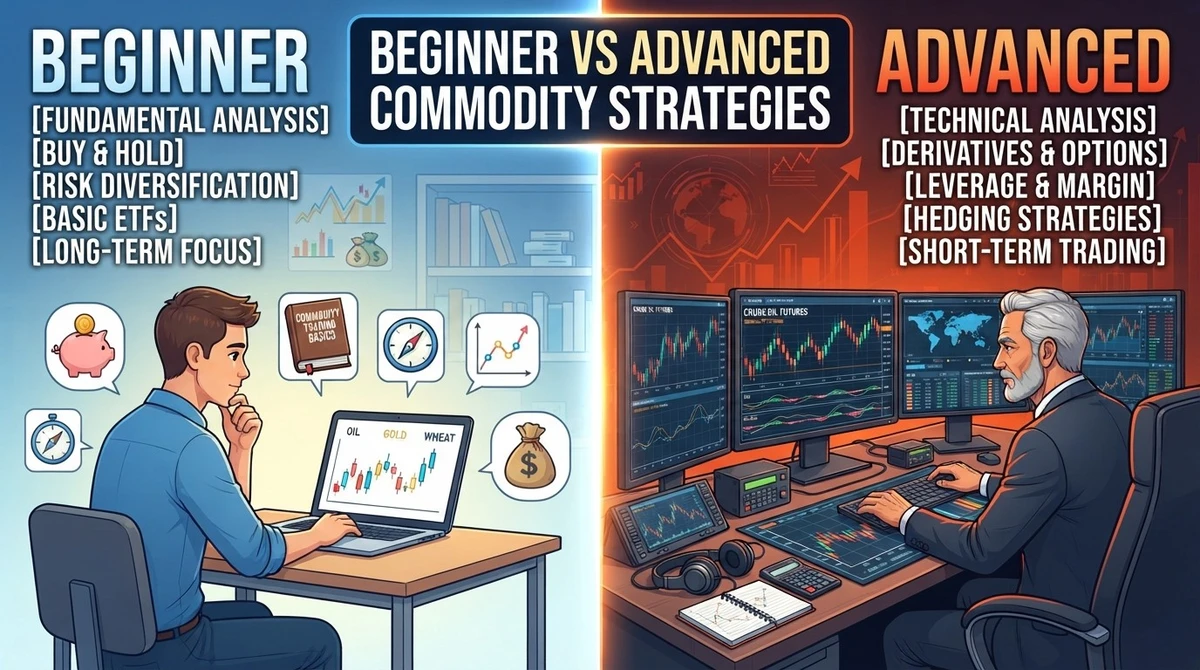
Beginner vs Advanced Commodity Strategies
Commodities can be accessed in several different ways, and the strategy chosen can significantly change the type of exposure, cost, and risk involved.
An investor who buys a broad commodity ETF faces a different set of considerations from a trader using futures contracts. Someone buying shares of a mining company is exposed not only to metal prices but also to production costs, debt, management decisions, and operating performance. A commercial producer, meanwhile, may use futures primarily to reduce price risk rather than to speculate.
That makes “beginner” and “advanced” useful labels for discussing complexity, but not for deciding which strategy is inherently better.
The more useful questions are: How direct is the commodity exposure? What drives the return? How much leverage is involved? What risks need to be managed? And what is the strategy actually designed to accomplish?
Commodity Exposure Can Take Several Forms
Gaining commodity exposure does not necessarily mean buying the physical commodity.
Investors can use:
- Commodity ETFs and other exchange-traded products
- Shares of commodity-producing companies
- Futures contracts
- Options on futures
- Spread strategies
- Hedging positions
Each approach creates a different connection between the underlying commodity and the investor’s return.
A futures-based commodity fund, for example, may not move exactly with the commodity’s spot price because futures contracts expire and must be replaced. A mining stock may benefit from higher gold prices but still decline because of rising operating costs or company-specific problems.
The distinction matters because commodity exposure is not the same thing as direct ownership of a commodity.
For a broader introduction to commodities themselves, see Economic Reader’s What Are Commodities?.
Start With the Objective, Not the Strategy
Before comparing individual strategies, it helps to separate investing from trading.
Commodity investing often involves gaining exposure over a longer period, diversifying a portfolio, or participating in long-term trends in energy, metals, or agriculture.
Commodity trading tends to focus more heavily on shorter-term price movements and may involve futures, options, or other derivatives.
The two can overlap, but the questions are different.
A long-term investor may care most about diversification, fees, tracking performance, and the effect of futures contracts rolling over time.
A trader may focus more on volatility, liquidity, margin requirements, contract structure, supply and demand, and the timing of entries and exits.
The objective should therefore come before the choice of instrument.
Commodity ETFs Offer a Simpler Route to Market Exposure
Commodity ETFs and similar products can provide exposure without requiring an investor to trade futures directly.
Some products hold physical commodities, while others use futures contracts or other instruments to track commodity prices or indexes.
That structure can make a major difference to returns.
A futures-based product must periodically replace expiring contracts. If the market is in contango, later-dated futures contracts are priced above nearer contracts, which can create a negative effect when positions are rolled forward. In backwardation, later contracts are priced below nearer contracts, creating the potential for a positive roll effect. (cmegroup.com)
The CFTC also warns that commodity-based exchange-traded products may not track the underlying commodity perfectly over time because they often use futures and other commodity interests rather than owning the physical asset itself. (cftc.gov)
This makes commodity funds relatively accessible, but they still require an understanding of what the fund actually owns and how its returns are generated.
Economic Reader’s Best Commodity ETFs: A Complete Guide to Investing in Commodity Funds covers the fund-based approach in greater detail.
Commodity Producer Stocks Add Business Risk
Another way to participate in commodity markets is through companies that produce or process commodities.
Examples include:
- Oil and gas producers
- Gold and copper miners
- Agricultural companies
- Steel producers
- Forestry companies
These stocks can benefit when commodity prices rise, but they are not direct substitutes for the underlying commodities.
Suppose copper prices increase significantly. A copper producer could benefit through higher revenue and potentially wider margins. But higher labor costs, energy expenses, debt payments, operational problems, or poor management decisions could offset some of those gains.
Producer stocks therefore combine commodity exposure with company-specific risk.
This can be useful for investors who want exposure to a commodity-related industry without trading futures, but the company’s financial and operating performance remains an important part of the investment.
Futures Provide More Direct Exposure
Futures contracts introduce a much more direct connection to commodity prices.
A commodity futures contract is an agreement to buy or sell a specified amount of a commodity at a future date under standardized terms. Many contracts are closed before delivery rather than resulting in physical delivery. (cftc.gov)
Futures also use margin.
Instead of paying the full notional value of the contract, a trader posts funds with a broker as collateral for the position. Futures margin is not a down payment and does not represent ownership of the underlying commodity. (cmegroup.com)
That structure creates leverage.
A relatively small movement in the commodity price can produce a much larger percentage gain or loss relative to the margin posted.
CFTC warns that futures and options trading can be highly volatile and that losses can exceed the amount initially deposited in some circumstances. (cftc.gov)
Futures therefore require more than an opinion about whether a commodity will rise or fall. Position size, margin, contract specifications, expiration, liquidity, and risk management all become part of the decision.
Options Add Another Layer of Complexity
Commodity options introduce additional flexibility but also additional variables.
A call option gives the holder the right, but not the obligation, to buy the underlying futures contract at a specified strike price. A put gives the holder the right to sell.
Options can be used for speculation, hedging, or strategies based partly on expected changes in volatility.
Their value depends on more than the direction of the commodity price. Time remaining until expiration, volatility, strike price, and the underlying futures price can all affect an option’s value.
An option buyer can lose the premium paid if the contract expires without sufficient value. Different option-selling strategies can create substantially different obligations and risks.
For that reason, options require an understanding of the contract itself as well as the commodity market behind it.
Spread Strategies Focus on Price Relationships
Advanced commodity traders do not always take a simple view that a commodity will rise or fall.
Some strategies focus on the relationship between two prices.
A calendar spread involves positions in different futures contract months for the same commodity. The trader is primarily concerned with how the price difference between those contracts changes.
That relationship can be influenced by:
- Inventory levels
- Seasonal demand
- Storage costs
- Transportation
- Financing costs
- Supply expectations
- Changes in market structure
Traders can also use inter-commodity spreads, which involve related but different commodities.
These approaches can reduce the importance of outright price direction in some situations, but they are not automatically low-risk. The CFTC’s futures guidance emphasizes that futures and options remain complex and risky instruments even when used in more sophisticated structures. (cftc.gov)
Understanding the relationship between prices is therefore just as important as understanding the commodities themselves.
Hedging Has a Different Purpose From Speculation
Not every advanced commodity strategy is designed to generate a trading profit.
Businesses that produce or consume commodities often use futures to manage price uncertainty.
A farmer may be concerned that crop prices will fall before harvest. An airline may want protection against rising fuel costs. A manufacturer may want greater certainty about the future cost of a key raw material.
Hedging can offset some of that price risk.
The CFTC describes hedging as a way for commodity producers and consumers to reduce the financial uncertainty created by changing prices. A producer can use futures to offset some of the risk that the physical commodity will decline in value, while a consumer can use futures to help manage the risk of rising input costs. (cftc.gov)
A hedge is therefore not necessarily intended to maximize returns.
Its purpose is risk management.
That distinction explains why commercial users can participate heavily in commodity derivatives without taking the same approach as a speculative trader.
What Actually Makes a Commodity Strategy Advanced?
“Advanced” does not simply mean complicated.
A strategy becomes more demanding when the participant needs to understand several interacting variables.
These can include:
- Leverage and margin
- Futures expiration
- Contango and backwardation
- Basis risk
- Options pricing
- Volatility
- Contract specifications
- Liquidity
- Position sizing
- Correlations between commodities
- Physical supply and demand
Consider natural gas futures.
A trader needs to understand more than the direction of natural gas prices. Weather, storage, production, pipeline capacity, electricity demand, and LNG exports can all influence the market.
That is a much more involved process than buying a diversified commodity fund and holding it as part of a broader portfolio.
The level of analysis required is one of the clearest differences between lower- and higher-complexity strategies.
Contango and Backwardation Can Change the Investment Result
The futures curve is especially important for anyone using futures-based commodity exposure.
Contango occurs when futures prices are higher than the spot price or when later delivery contracts are priced above nearer contracts. Backwardation describes the opposite relationship. (cmegroup.com)
The difference matters because futures contracts expire.
Suppose a fund holds a futures contract that is approaching expiration and needs to replace it with a later-dated contract. If the new contract is more expensive, the fund may experience a negative roll effect even if the spot price of the commodity has not fallen.
The CFTC specifically notes that repeated rolls into higher-priced contracts can reduce the annual return of commodity pools and exchange-traded products. (cftc.gov)
Backwardation can produce the opposite effect when later contracts are cheaper.
This is one reason investors should not assume that a commodity fund will simply reproduce the percentage change in the commodity’s spot price.
Leverage Changes the Risk Equation
Leverage is another major dividing line between commodity strategies.
With a futures contract, the initial margin represents only part of the contract’s total notional value. CME Group explains that futures margin is collateral for the position rather than a down payment on the underlying commodity. (cmegroup.com)
If the market moves against the trader, additional funds may be required to maintain the position. If the account falls below the required maintenance margin, the broker may require additional funds or reduce the position.
This makes position sizing critical.
A trader can be correct about the long-term direction of a commodity and still suffer substantial losses if the position is too large or the market moves sharply before the expected trend develops.
Leverage therefore changes not only the potential return but also the speed at which losses can accumulate.
How to Evaluate a Commodity Strategy
Rather than asking whether a strategy is “beginner” or “advanced,” investors can ask several more useful questions.
What Creates the Return?
Is the return driven by the commodity’s spot price, futures prices, company earnings, dividends, changes in volatility, or some combination?
How Direct Is the Exposure?
A gold ETF, a gold-mining company, and a gold futures contract can all respond differently to the same movement in gold.
What Are the Costs?
Potential costs include management fees, trading costs, bid-ask spreads, financing costs, commissions, and futures roll costs.
How Much Leverage Is Involved?
The greater the leverage, the more important margin management and position sizing become.
What Happens if the Market Moves the Other Way?
A strategy should be understood through its downside mechanics as well as its potential upside.
Which Market Conditions Matter Most?
Commodity markets can react differently to inflation, recessions, supply disruptions, weather events, geopolitical shocks, interest rates, and changes in global demand.
These questions often reveal more about a strategy than its “beginner” or “advanced” label.
More Experience Does Not Automatically Mean More Complexity
Commodity strategies do not need to become more complicated simply because an investor becomes more experienced.
A sophisticated investor may still prefer a diversified commodity fund because it fits a long-term portfolio.
A professional business may use futures primarily to reduce uncertainty rather than seek maximum returns.
A trader may use a spread because the relationship between two futures contracts matters more to the trading idea than the outright commodity price.
The objective determines the appropriate approach.
The important difference between lower- and higher-complexity strategies is the amount of market structure, leverage, pricing mechanics, and risk management involved.
Commodity markets reward that understanding because price movements are often driven by factors that are not obvious from the headline price alone.
Whether the exposure comes through an ETF, a producer stock, futures contract, option, spread, or hedge, the same principle applies: understand what drives the position’s return, what can cause it to lose money, and how it is likely to behave when market conditions change.
That framework is more useful than simply labeling one strategy “beginner” and another “advanced.”