What Is APY? Understanding Annual Percentage Yield and Compound Interest
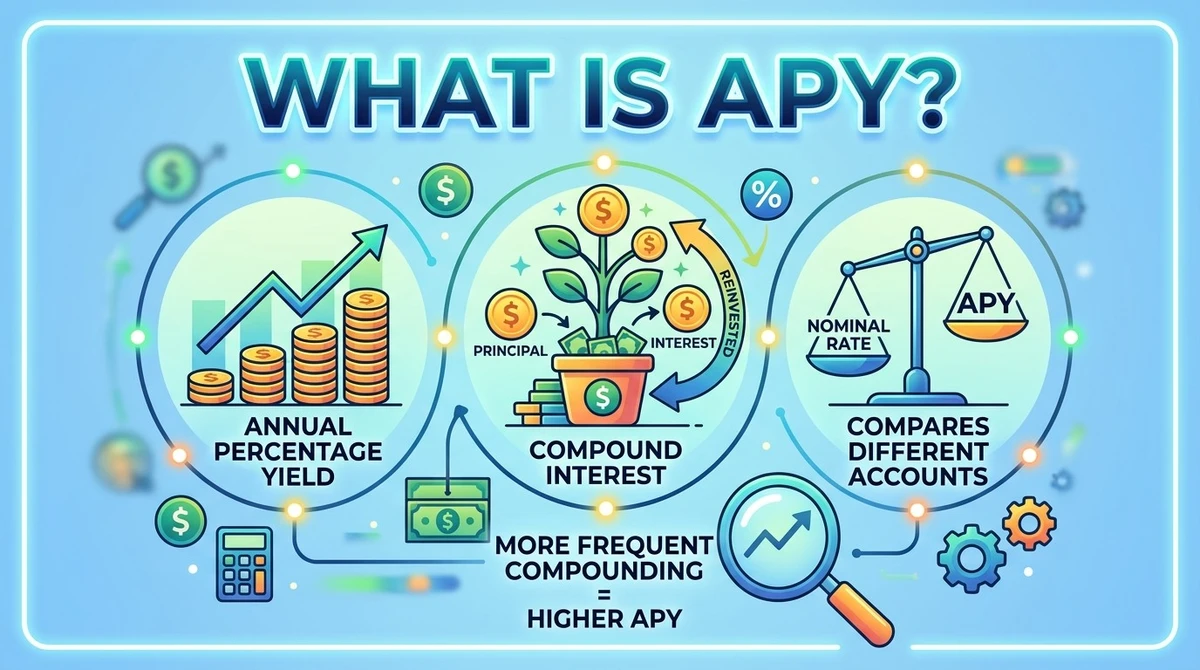
When you compare savings accounts, certificates of deposit (CDs), or other interest-bearing deposit accounts, one number appears again and again: APY.
A bank might advertise a savings account at 4.50% APY while another offers 4.25%. The difference may look small, but APY gives you a more useful way to compare the potential annual yield of deposit accounts because it reflects both the stated interest rate and the effect of compounding.
That makes APY an important number for anyone deciding where to keep their savings.
What Is APY?
APY stands for Annual Percentage Yield.
It is the annualized yield on an interest-bearing account, taking into account the account’s interest rate and the frequency with which interest compounds. Under U.S. Regulation DD, APY reflects the total interest paid over a 365-day period based on the interest rate and compounding frequency. (Consumer Financial Protection Bureau)
In practical terms, APY answers a simple question:
How much interest could this account generate over a year if the money remains in the account under the stated terms?
That makes APY especially useful when comparing deposit products with different compounding schedules.
APY vs. Interest Rate
The interest rate is the stated rate paid on your money.
The APY goes one step further by incorporating the effect of compounding.
Suppose two savings accounts both advertise a 5% interest rate. One compounds annually while the other compounds monthly. If all other terms are the same, the account compounding more frequently can produce a slightly higher annual yield.
That difference is reflected in the APY.
So when comparing savings accounts, looking at APY rather than the interest rate alone can give you a more meaningful comparison.
U.S. deposit-account rules specifically require institutions covered by Regulation DD to disclose both the interest rate and APY, along with other important account terms.
How Compounding Changes the Yield
The reason APY can differ from the stated interest rate comes down to compounding.
When interest is added to your account, that interest can become part of the balance used to calculate future interest.
For example, suppose you deposit $1,000 into an account paying 5% interest with annual compounding.
After one year:
$1,000 + $50 = $1,050
If the $50 remains in the account, the next year’s interest is calculated on $1,050 rather than the original $1,000.
At 5%, that would produce:
$1,050 × 5% = $52.50
Your balance would become $1,102.50.
The underlying concept is compound interest: previously earned interest remains in the account and can itself generate additional interest. Economic Reader explains this mechanism in more detail in its guide to compound interest.
APY essentially turns that compounding effect into an annualized figure that can be used to compare deposit products.
A Simple APY Example
Imagine you have $10,000 and are comparing two savings accounts.
Account A
- Interest rate: 4.00%
- APY: 4.00%
Account B
- Interest rate: 4.00%
- APY: 4.08%
The stated interest rate is identical, but the APYs are different because the compounding arrangements produce different annualized yields.
The difference might not seem significant on $10,000 over a short period. Over larger balances or longer periods, however, even relatively small differences in yield can become more noticeable.
The calculation used for regulatory APY disclosures is more precise than simply adding a percentage to the stated interest rate. Regulation DD provides a specific formula that accounts for the amount of interest, principal, and length of the account term.
Where APY Appears
APY is most commonly associated with deposit accounts.
Savings Accounts
Savings accounts pay interest on deposited money, making APY a useful measure for comparing different accounts.
A higher APY can help a savings balance grow faster, assuming the rate and other account conditions remain favorable.
High-Yield Savings Accounts
High-yield savings accounts generally compete by offering relatively attractive interest rates.
Because APY incorporates compounding, it can make comparisons between these accounts easier.
Still, the advertised yield is only one part of the decision. Fees, minimum balances, withdrawal conditions, and rate changes can affect the actual experience.
Certificates of Deposit
CDs generally hold money for a specified period in exchange for interest.
APY helps show the annualized yield, but the CD’s maturity period and early-withdrawal rules also matter.
Money Market Accounts
Money market accounts can also pay interest and disclose APYs. Their conditions may differ from ordinary savings accounts, including minimum-balance requirements or transaction restrictions.
Under Regulation DD, covered deposit accounts include savings accounts, checking accounts, money market accounts, CDs, and certain variable-rate accounts.
Why APY Is Useful When Comparing Accounts
Consider two banks offering savings accounts with similar features.
One offers a 4.25% APY.
Another offers a 4.75% APY.
The second account has the higher advertised annual yield, but that does not automatically make it the better choice for every saver.
Before opening an account, check:
- Minimum opening deposit
- Minimum balance requirements
- Monthly fees
- Whether the rate is fixed or variable
- Withdrawal restrictions
- Promotional conditions
- Whether the advertised APY applies to your entire balance
These details can change the practical value of an account.
Regulation DD is designed in part to help consumers comparison-shop by requiring standardized disclosures covering APY, interest rates, fees, and other account terms.
APY Can Change
A high APY today does not necessarily mean you will receive the same yield indefinitely.
Many savings accounts have variable interest rates. The bank can change the rate according to the account terms and broader market conditions.
That creates an important difference between:
the APY advertised today
and
the yield you may receive over several years.
For example, a savings account could offer a relatively high APY when market rates are elevated. If market rates later fall, the bank may reduce the account’s rate.
For variable-rate accounts, therefore, it is useful to think about APY as a current measure rather than a permanent promise.
Regulation DD also contains disclosure requirements when certain account terms change in ways that could reduce the APY or otherwise adversely affect consumers.
APY vs. APR
APY and APR are easy to confuse because both are annual percentage measures, but they describe different sides of personal finance.
APY is primarily used to describe the yield earned on deposit accounts.
APR is commonly used to describe the annual cost of borrowing.
For example:
- Savings account → APY
- CD → APY
- Money market account → APY
- Credit card → APR
- Personal loan → APR
- Mortgage → APR
Economic Reader’s guide to What Is APR? explains how APR is used to understand borrowing costs.
The easiest way to remember the difference is:
APY tells you what you can earn. APR helps describe what borrowing can cost.
APY Is Different From Investment Returns
APY should also not be confused with the expected return from investments such as stocks, ETFs, mutual funds, or cryptocurrencies.
A savings account can advertise a specific APY under stated account terms. An investment’s return can fluctuate with market prices and may be positive or negative.
For example, a stock portfolio could gain 10% in one year and lose value the next. That is fundamentally different from a bank account advertising an APY.
This distinction is particularly important when deciding where to keep money.
Savings accounts are generally used for liquidity and capital preservation, while investments are often used for longer-term growth and involve different levels of risk.
Economic Reader’s guide to What Is Investment? explores that difference in more detail.
What APY Does Not Tell You
APY is useful, but it does not capture every factor that affects the value of a deposit account.
For example, a higher APY may come with:
- A minimum balance requirement
- Account fees
- Limited access to funds
- A promotional period
- A variable rate
- Early-withdrawal penalties on certain time deposits
There is also an important assumption behind the regulatory APY calculation: unless specific account terms require otherwise, the calculation assumes that the principal and interest remain on deposit for the relevant period and that no additional deposits or withdrawals occur.
That means the APY displayed by a bank should be viewed as a standardized comparison measure, not a guarantee of exactly how much every customer will earn.
APY and the Value of Saving
APY becomes more meaningful when viewed alongside the purpose of saving.
Someone building an emergency fund may prioritize safety and easy access to money. Someone saving for a goal several years away may pay more attention to the yield available while still considering liquidity and account conditions.
Economic Reader’s guide to saving explains how savings can provide financial flexibility for emergencies, major purchases, and future goals.
Interest rates also connect savings decisions to the wider economy. When market interest rates rise, some deposit accounts may offer higher yields. When rates fall, savings yields can decline.
That creates an important link between monetary policy, financial markets, banks, and household decisions.
Economic Reader’s guide to how interest rates affect the economy explores how changes in rates can influence borrowers, savers, spending, investment, and economic activity.
How to Use APY When Choosing an Account
APY is most useful when it is considered together with the rest of an account’s terms.
If two accounts have similar fees, access, balance requirements, and rate structures, comparing their APYs can give you a clearer picture of their potential annual yield.
But the highest APY is not automatically the right account for everyone.
A slightly lower-yielding account with no monthly fee, easy access to funds, and no restrictive balance requirement may be more useful than an account offering a higher APY with conditions that do not fit your needs.
The practical approach is straightforward:
Compare APY first, then read the terms behind the number.
That gives you a better understanding of both the potential return on your savings and the conditions attached to it.
For savers, APY is more than another number in a bank advertisement. It is a standardized way to see how the interest rate and compounding structure translate into an annual yield and that makes it one of the most useful figures to understand when comparing where to keep your money.