What Is APR? Understanding Annual Percentage Rate and the True Cost of Borrowing
When people compare loans, the interest rate is usually the first number they notice. But it is not always the best measure of what borrowing will actually cost.
A loan advertised at 8% interest, for example, may also come with an origination fee or other charges. Another lender might offer a slightly higher interest rate but charge fewer fees.
This is where APR, or Annual Percentage Rate, becomes useful.
APR gives borrowers a broader measure of the cost of credit by incorporating the interest rate and certain fees associated with the loan. The Consumer Financial Protection Bureau (CFPB) describes APR as a way to compare borrowing costs across different loan offers. (Consumer Financial Protection Bureau)
For anyone considering a personal loan, auto loan, mortgage, or credit card, understanding APR can make it easier to look beyond the headline rate.
What Is APR?
APR stands for Annual Percentage Rate.
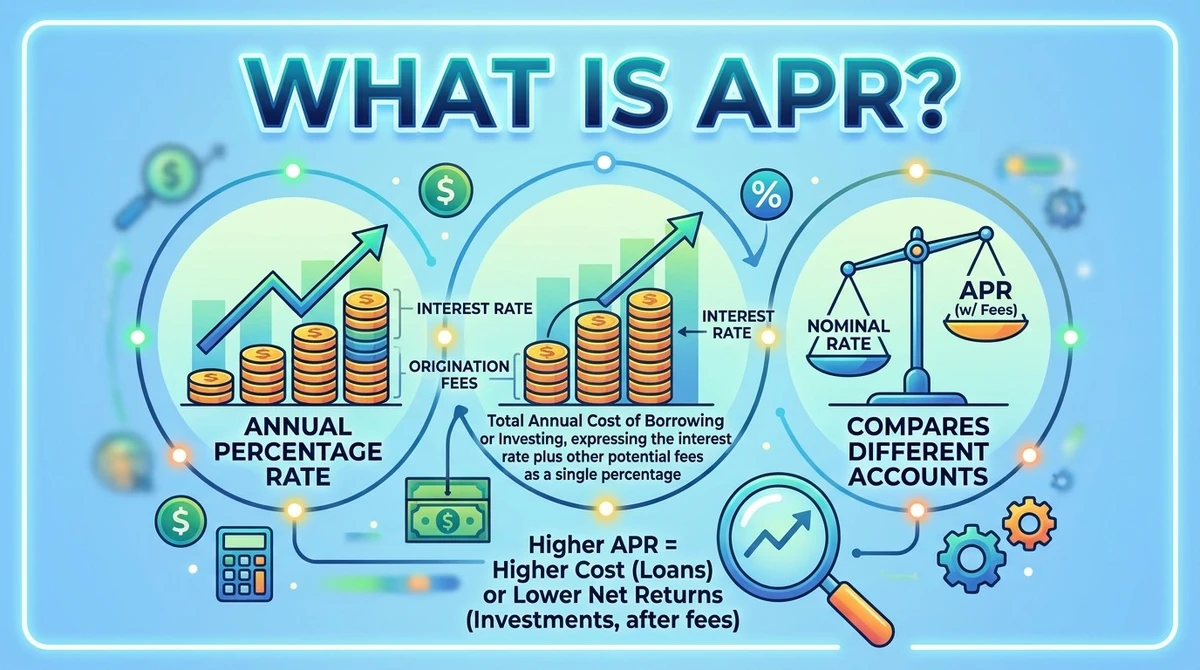
It expresses the cost of borrowing as an annual percentage. Unlike a basic interest rate, APR can include certain fees and charges associated with obtaining the credit.
Imagine two lenders offer similar loans:
- Lender A: 8% interest rate with low fees
- Lender B: 7.5% interest rate with higher fees
Looking only at the interest rates makes Lender B appear cheaper.
But the lower rate does not necessarily mean the lower overall borrowing cost. Once relevant fees are incorporated, the APR may tell a different story.
That is the main reason APR is useful: it gives borrowers another number to consider when comparing credit offers.
In the United States, federal lending rules require creditors to provide APR disclosures for covered consumer credit products. This allows consumers to make more meaningful comparisons between offers.
APR vs. Interest Rate
The two numbers are closely related, but they answer slightly different questions.
Interest rate: The rate charged for borrowing money.
APR: A broader measure of borrowing cost that incorporates the interest rate and certain applicable fees.
For example, suppose you borrow $10,000 at an 8% interest rate. The 8% tells you the rate used to calculate interest under the loan agreement.
Now imagine the lender also charges an origination fee.
That fee is another cost of obtaining the loan. Depending on the loan and applicable disclosure rules, it can be reflected in the APR.
The result is that a loan can have an 8% interest rate but an APR above 8%.
The exact difference depends on the loan’s structure, fees, repayment schedule, and the charges included in the APR calculation.
Economic Reader’s How Interest Rates Affect Loans provides a broader explanation of how interest rates influence monthly payments, total borrowing costs, and financial decisions.
What Does APR Include?
APR does not simply mean adding every fee to the interest rate.
The charges included depend on the type of credit and the applicable rules.
For mortgages, for example, APR can reflect the interest rate plus certain costs such as points, mortgage broker fees, and other charges associated with obtaining the loan.
This is useful because a lender’s advertised interest rate may leave out costs that still affect what the borrower pays.
At the same time, APR should not be treated as a complete list of every possible expense. Some charges may not be included, depending on the credit product and the rules governing its disclosure.
That is why a borrower should look at the APR and the actual loan terms.
How APR Works With a Simple Example
Consider two hypothetical three-year personal loans of $10,000.
| Loan A | Loan B | |
| Interest rate | 8.0% | 7.5% |
| Upfront fee | $100 | $400 |
| Loan amount | $10,000 | $10,000 |
| Term | 3 years | 3 years |
Loan B has the lower advertised interest rate, but it also has substantially higher upfront fees.
The APR calculation takes the relevant interest charges, fees, amount financed, and timing of payments into account. It is therefore more useful for comparing these two offers than simply looking at 8% versus 7.5%.
The important point is that APR is calculated rather than simply added to the interest rate. The timing and structure of the payments matter.
For this reason, borrowers should generally compare the APR disclosed by each lender instead of trying to estimate it by adding fees to the stated interest rate.
APR on Credit Cards, Personal Loans, and Mortgages
APR appears across several types of consumer credit, although its practical use differs by product.
Credit Cards
For credit cards, APR is generally the annualized rate associated with borrowing on the card.
A credit card can have different APRs for purchases, balance transfers, and cash advances. Promotional rates may also apply for a limited period.
There is another important feature of credit cards: depending on the card’s terms, consumers can generally avoid interest on purchases by paying the statement balance in full by the due date.
So the APR on a credit card does not necessarily mean every purchase will generate interest.
Personal and Auto Loans
For installment loans, APR is particularly useful when lenders offer different combinations of interest rates and fees.
The CFPB recommends comparing APRs with APRs rather than comparing one lender’s APR with another lender’s interest rate. (Consumer Financial Protection Bureau)
That makes the comparison more consistent.
Mortgages
Mortgage APR can include the interest rate plus certain costs such as points and mortgage-related fees. Because mortgages are usually large, long-term loans, even relatively small differences in borrowing costs can become significant.
However, APR should not be viewed in isolation. The CFPB warns that comparing APRs can become more complicated when loan structures differ, particularly when comparing fixed-rate and adjustable-rate mortgages. (Consumer Financial Protection Bureau)
APR vs. APY
APR and APY, or Annual Percentage Yield, are easy to confuse because both are expressed as annual percentages.
Their purposes are different.
APR is primarily used to describe the cost of borrowing.
APY is generally used to describe the annualized return earned on deposit accounts and reflects the effect of compounding.
A simple way to remember it is:
APR → borrowing cost
APY → savings return
The distinction becomes important when comparing financial products because a percentage describing the cost of a loan should not be interpreted in the same way as a percentage describing the return on a savings account.
Why APR Matters When Comparing Loans
APR is most useful when comparing similar credit products.
Suppose three lenders offer loans with different interest rates and fee structures. Looking only at the advertised interest rate could leave out part of the cost.
Comparing APRs provides a broader starting point.
But APR should not be the only number on the page.
Before accepting a loan, a borrower should also look at:
- Interest rate
- APR
- Monthly payment
- Loan term
- Total repayment amount
- Upfront fees
- Fixed or variable rate
- Late-payment charges
- Prepayment conditions
- Promotional periods, if applicable
A loan with a low APR can still be unsuitable if the repayment period, monthly payment, or other terms do not fit the borrower’s circumstances.
The CFPB similarly advises consumers to look beyond a single number when comparing mortgage and other credit offers. (Consumer Financial Protection Bureau)
The Limits of APR
APR is a useful comparison tool, but it is not a complete measure of every financial consequence of borrowing.
One reason is that different credit products can have very different structures.
An adjustable-rate mortgage, for example, can change over time. Its APR does not necessarily tell you the highest interest rate the loan could reach.
Loan duration also matters.
An upfront fee may have a very different effect on someone who keeps a loan for several years compared with someone who pays it off much earlier.
That means APR works best as one part of a broader loan comparison, rather than as a substitute for reading the loan agreement.
Why APR Matters to Consumers and the Economy
APR may look like a technical number on a loan disclosure, but it connects directly to real financial decisions.
For consumers, a clearer understanding of borrowing costs can make it easier to compare lenders and avoid choosing a loan simply because it advertises a low interest rate.
For businesses, borrowing costs can influence decisions about equipment, property, technology, expansion, and working capital.
At the wider economic level, credit conditions influence household spending, housing demand, business investment, and financial activity.
When borrowing becomes more expensive, some households may postpone major purchases and some businesses may delay investment. When financing becomes cheaper, borrowing and spending can become more attractive, although the actual response depends on economic conditions.
Economic Reader’s How Interest Rates Affect the Economy explains how changes in interest rates can spread through households, businesses, financial markets, and economic activity.
Interest rates are also closely connected to inflation and monetary policy. Economic Reader’s What Is Inflation? provides broader context on the relationship between inflation, interest rates, and purchasing power.
Why the APR Number Deserves a Second Look
APR is not just another percentage on a loan advertisement.
The interest rate tells you the rate charged for borrowing. APR goes a step further by incorporating the interest rate and certain applicable fees, giving borrowers a broader way to compare credit offers.
That does not make APR a perfect measure of every possible borrowing cost. Loan terms, repayment periods, rate structures, and fees still need to be examined.
But when two similar loans have different rates and charges, APR can reveal something that the headline interest rate may not.
The simplest rule is also one of the most useful:
Compare APR with APR, not APR with an interest rate.
For anyone shopping for credit, that small distinction can lead to a much clearer understanding of what the loan is actually going to cost.