What Is the Nasdaq Composite? Understanding the Nasdaq Composite Index
When financial news says the “Nasdaq” rose or fell, it is not always talking about the Nasdaq Stock Market itself. In many market reports, the number being discussed is the Nasdaq Composite Index.
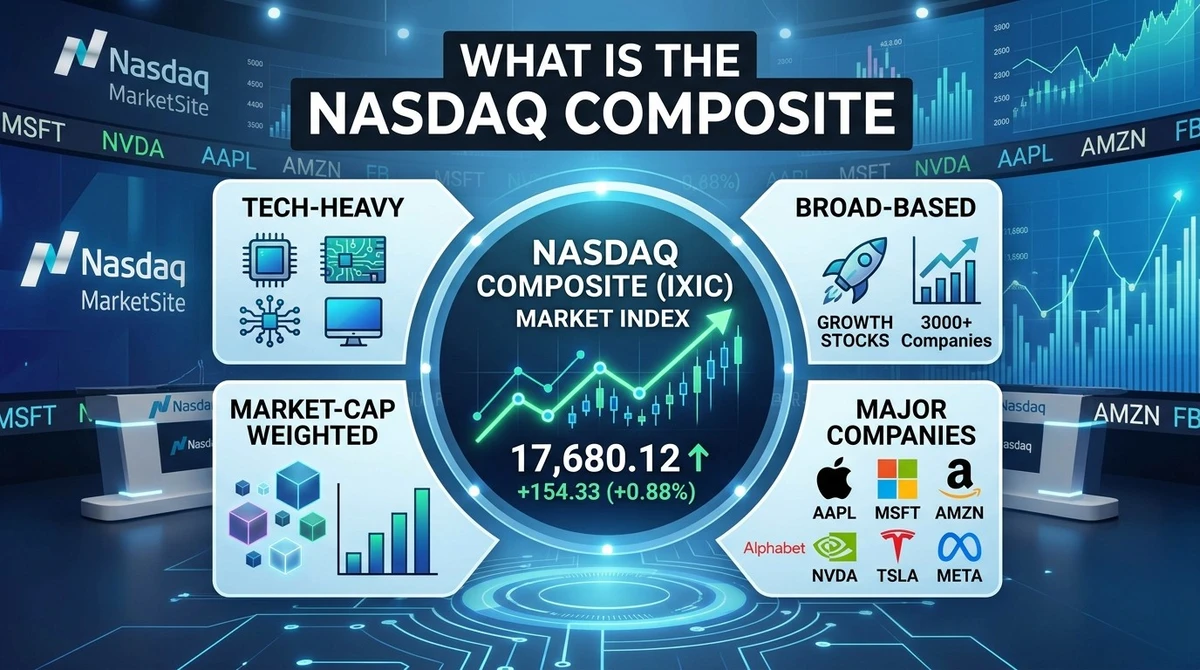
The Nasdaq Composite tracks thousands of eligible securities listed on the Nasdaq Stock Market. Its broad coverage makes it different from the Nasdaq-100, which focuses on 100 of the largest non-financial companies listed on Nasdaq. (Nasdaq)
The Composite is particularly associated with technology and growth-oriented companies, but it is not a technology-only index. Financials, health care, consumer companies, industrial businesses, and other sectors are also represented.
That combination of broad coverage and strong technology exposure makes the Nasdaq Composite one of the most closely watched measures of the Nasdaq-listed market.
What Is the Nasdaq Composite?
The Nasdaq Composite Index is a market-capitalization-weighted stock market index that includes eligible domestic and international common-type stocks listed on the Nasdaq Stock Market. Nasdaq’s methodology allows securities such as common stocks, ordinary shares, American Depositary Receipts (ADRs), and certain limited partnership interests, while excluding securities such as ETFs, preferred stocks, warrants, rights, and several other security types. (Nasdaq Global Index Watch)
The index was established in 1971. Nasdaq currently describes it as covering more than 2,500 stocks, giving it much broader coverage than many well-known U.S. stock indexes. (Nasdaq)
That breadth is the main point.
The Nasdaq Composite is not simply a list of the biggest technology companies on Nasdaq. It is designed to capture the performance of a much wider group of eligible securities listed on the exchange.
That is also why the Nasdaq Composite and Nasdaq-100 can produce different results even though both are strongly associated with Nasdaq and technology companies.
Why Is It Often Called “The Nasdaq”?
The word Nasdaq can refer to several different things:
- Nasdaq, Inc., the financial-market company
- The Nasdaq Stock Market, where securities are listed and traded
- The Nasdaq Composite, a broad market index
- The Nasdaq-100, a separate index of large non-financial Nasdaq-listed companies
That creates a common source of confusion in financial news.
Nasdaq itself describes the Composite as being better known as “The Nasdaq” by the media.
So when a headline says:
“The Nasdaq rose 2% today.”
the writer may be referring to the Nasdaq Composite rather than the exchange.
This distinction is worth checking because the exchange and the index serve completely different purposes. One is a marketplace for securities; the other is a measurement of the performance of a defined group of securities.
Economic Reader’s What Is Nasdaq? explains the broader distinction between Nasdaq as a company, stock market, and family of indexes. The Nasdaq Composite article goes one step further by focusing specifically on how this particular index is built and interpreted.
What Stocks Are Included in the Nasdaq Composite?
The Nasdaq Composite has a broad eligibility base.
Nasdaq’s methodology states that the index includes eligible domestic and international common-type stocks listed on the Nasdaq Stock Market. There is no geographic or country requirement, so qualifying companies do not have to be based in the United States.
Generally eligible securities include:
- Common stocks
- Ordinary shares
- American Depositary Receipts
- Certain limited partnership interests
- Certain shares or units of beneficial interest
The methodology generally excludes:
- Exchange-traded funds
- Preferred stocks
- Warrants
- Rights
- Closed-end funds
- Convertible debentures
- Units
- Other derivative securities
Companies can also have multiple eligible classes of securities if those classes meet the index requirements.
The result is a market measure containing companies of very different sizes and industries.
A large technology company can sit alongside a much smaller health care, consumer, industrial, or financial company within the same index.
That is one reason the Composite should not be treated as a simple technology-stock index.
How Is the Nasdaq Composite Weighted?
The Nasdaq Composite is market-capitalization weighted.
In a market-cap-weighted index, companies with larger market values have greater influence over the index than smaller companies. Nasdaq’s current methodology specifies that the Composite uses total listed market capitalization rather than a float-adjusted market-capitalization approach. It also does not impose concentration caps on individual companies.
A simplified example makes the idea easier to understand.
Imagine an index with three companies:
| Company | Market Capitalization | Relative Influence |
| Company A | $1 trillion | High |
| Company B | $100 billion | Moderate |
| Company C | $10 billion | Low |
If all three stocks rise 5%, Company A will have a much greater effect on the index than Company C because Company A represents a much larger amount of market value.
This is why having thousands of companies in the Composite does not mean every company has an equal influence.
Economic Reader’s guide to market capitalization explains the underlying concept in more detail: market capitalization is based on a company’s share price and outstanding shares.
There is another important point. Nasdaq says new eligible listings enter the Composite on the second day of trading, helping the index reflect changes in the Nasdaq-listed market relatively quickly.
Why Is the Nasdaq Composite So Associated With Technology?
The Nasdaq Composite is widely associated with technology, but technology is only part of its formal construction.
Nasdaq says the Composite includes companies across all 11 ICB industry groups. Technology has a particularly large weight, while consumer, health care, financial, industrial, and other businesses are also represented. Nasdaq’s current index information places technology at more than half of the index’s weight.
There are several reasons for this technology-heavy profile.
Nasdaq has historically attracted many companies in areas such as:
- Software
- Semiconductors
- Internet services
- Communications
- Hardware
- Biotechnology
- Other innovation-focused industries
Large technology companies can also have a strong influence because the index is market-cap weighted.
So the relationship works in two directions:
Nasdaq attracts many technology and growth-oriented businesses, and the largest of those businesses can have substantial influence on the Composite.
That helps explain why investors often use the Nasdaq Composite to track technology-related market trends even though the index itself is much broader than the technology sector.
Nasdaq Composite vs. Nasdaq-100
The Nasdaq Composite and Nasdaq-100 are often mentioned together, but their designs are different.
| Feature | Nasdaq Composite | Nasdaq-100 |
| Coverage | Broad universe of eligible Nasdaq-listed securities | 100 largest non-financial Nasdaq-listed companies |
| Number of securities | More than 2,500 | 100 |
| Financial companies | Included | Excluded |
| Weighting | Market-cap weighted | Modified market-cap methodology |
| Company size | Large, mid-sized, and smaller companies | Primarily large companies |
| Technology exposure | High | High |
The Nasdaq-100 is much more selective. Nasdaq describes it as an index of 100 of the largest domestic and international non-financial securities listed on the Nasdaq Stock Market, based on market capitalization.
The Composite starts with a much broader universe.
That difference can matter when markets move sharply.
A large technology company may have a major effect on both indexes, while movements among smaller Nasdaq-listed companies can have a greater effect on the broader Composite than on the Nasdaq-100.
This is why the two indexes should not be treated as interchangeable measures of “Nasdaq.”
Nasdaq Composite vs. S&P 500
The Nasdaq Composite and S&P 500 both provide important information about U.S. equity markets, but they are built around different universes.
The Nasdaq Composite is based on eligible securities listed on the Nasdaq Stock Market.
The S&P 500, by contrast, is a selected index of large U.S. companies designed to represent a broad cross-section of the U.S. equity market.
That difference affects their sector exposure.
The Nasdaq Composite has a much stronger technology orientation, while the S&P 500 provides broader exposure across major U.S. industries.
Their construction also differs in other ways. The S&P 500 uses a float-adjusted market-capitalization methodology and a committee-based constituent selection process, while the Nasdaq Composite is tied primarily to securities meeting Nasdaq’s listing and eligibility requirements. (Nasdaq Global Index Watch)
This means the indexes can respond differently to the same economic or market event.
For example, a sharp change in investor expectations around technology earnings or semiconductor demand may have a particularly visible effect on the Nasdaq Composite. A development concentrated in financials, energy, or other sectors may affect the S&P 500 differently depending on the companies involved and their relative weights.
Economic Reader’s What Is the S&P 500? provides a separate explanation of how that index is constructed and why it is widely used as a U.S. market benchmark.
What Moves the Nasdaq Composite?
The Nasdaq Composite responds to many of the same forces that move other stock indexes. Its particular composition, however, can make some developments especially important.
Interest Rates
Interest-rate expectations can influence stock valuations, particularly for companies whose valuations depend heavily on expected future growth.
When investors change their expectations for monetary policy or future interest rates, technology and growth-oriented stocks can experience significant price movements.
The reaction is not automatic, though. Markets respond to the reason rates are changing, what investors already expected, and how the change affects corporate earnings and economic growth.
Corporate Earnings
Earnings reports can move individual stocks and, when those companies are large enough, the broader index.
Strong or weak results from major technology companies can have a noticeable effect because large companies carry greater weight in the Composite.
Economic Growth
Economic conditions influence consumer demand, business investment, corporate revenue, and profits.
Expectations often matter as much as current data. Stock prices reflect what investors expect businesses to earn in the future, not just what companies earned last quarter.
Technology and AI Investment
Developments in artificial intelligence, semiconductors, cloud computing, software, and data-center investment have become important market themes.
Because the Nasdaq Composite has substantial technology exposure, changes in expectations around these industries can affect the index.
Still, technology news is only one part of the Composite’s performance.
Investor Expectations
Markets react to the gap between expectations and reality.
A company can report record earnings and still see its stock fall if investors had expected even stronger results.
The same principle applies to the index as a whole.
The important question is often not simply:
“Was the news good or bad?”
It is:
“Was the news better or worse than investors expected?”
What the Nasdaq Composite Does Not Tell You
A rising Nasdaq Composite does not mean every Nasdaq-listed stock is rising.
Because the index is market-cap weighted, larger companies can have a much greater effect on its daily movement than smaller companies.
Imagine that hundreds of smaller stocks rise while several very large companies fall sharply.
The Nasdaq Composite could still decline.
The opposite can happen as well.
A small group of large companies can lift the index even when many smaller stocks are flat or falling.
That creates an important limitation: the Nasdaq Composite is not a direct measure of market breadth.
It tells you how the weighted value of its constituents is changing. It does not tell you how every company in the index is performing.
The Composite also does not represent the entire U.S. stock market.
Companies listed on other exchanges, including many companies on the New York Stock Exchange, are not automatically included.
For a broader understanding of the U.S. stock market, readers can start with Economic Reader’s What Is the Stock Market? which explains how exchanges, stocks, investors, and market infrastructure fit together.
How to Read Nasdaq Composite Headlines
Consider a headline such as:
“Nasdaq jumps 2% as technology stocks rally.”
The headline tells you what happened to the index, but not necessarily why it happened or how broad the move was.
A useful way to read the story is to ask three questions.
Which Companies Drove the Move?
Large companies can have a disproportionate effect on a market-cap-weighted index.
If several major constituents rise sharply, they may account for a significant part of the Composite’s daily gain.
Was the Move Broad?
A strong index performance does not automatically mean most stocks performed strongly.
Investors can look beyond the headline index change to see whether the move extended across many companies and sectors or was concentrated in a smaller group of large constituents.
What Changed in Expectations?
Possible drivers include:
- Earnings reports
- Interest-rate expectations
- Economic data
- Semiconductor demand
- AI investment expectations
- Major company announcements
- Changes in investor risk appetite
The index number is the starting point. The composition of the move provides the context.
Why the Nasdaq Composite Still Matters
The Nasdaq Composite remains useful because it combines broad Nasdaq-market coverage with market-cap weighting.
Nasdaq currently describes the index as covering more than 2,500 stocks and representing companies across sectors and market capitalizations. Its technology exposure is substantial, but the index also includes financials, health care, consumer businesses, industrials, and other sectors.
That gives the Composite a different role from the Nasdaq-100.
The Nasdaq-100 provides a narrower view of large non-financial Nasdaq-listed companies. The Composite provides a much broader view of eligible securities listed on the exchange.
For readers following financial markets, the distinction is useful:
- Nasdaq Stock Market = the exchange
- Nasdaq Composite = a broad index of eligible Nasdaq-listed securities
- Nasdaq-100 = an index of 100 large non-financial Nasdaq-listed companies
Once those three are separated, financial headlines become easier to interpret.
The Nasdaq Composite is not a perfect measure of the entire U.S. stock market, nor is it simply a technology index. Its value comes from what it actually represents: a broad, market-cap-weighted measure of the securities listed on Nasdaq, with large technology companies playing a particularly important role.
For investors and readers trying to understand daily market movements, that distinction provides much more information than simply knowing whether “the Nasdaq” went up or down.