Most Important Commodities in the World: The Resources That Drive the Global Economy
Most Important Commodities in the World
Commodities sit at the beginning of many of the world’s most important economic activities.
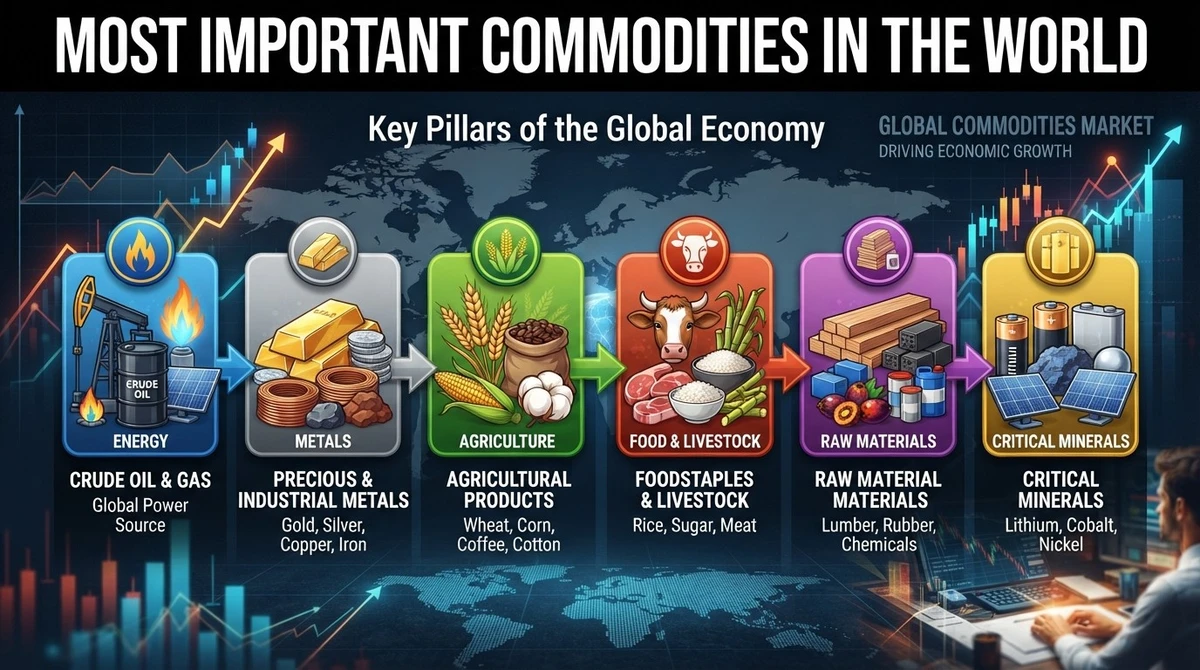
Crude oil moves people and goods and provides raw materials for petrochemicals. Natural gas supports electricity generation, heating, fertilizer production, and industry. Copper carries electricity through power networks and electronic equipment. Wheat, corn, and soybeans feed people and livestock. Gold occupies a different position, connecting physical demand with investment and central-bank reserves.
These commodities do not matter for the same reason. Some are essential to energy systems, others to food security, manufacturing, infrastructure, or financial markets.
That makes the most important commodities in the world difficult to rank using a single measure. Production volume, market value, trade flows, industrial use, strategic importance, and the consequences of a supply disruption can all tell a different story.
This article therefore does not present a strict ranking. Instead, it examines major commodities and explains what makes each one economically important, which industries depend on it, and how its role connects to the wider global economy.
The World Bank groups commodity markets into distinct categories such as energy, metals, agriculture, fertilizers, and precious metals, each with different economic drivers and market dynamics. (World Bank)
What Makes a Commodity Important?
A commodity can become important because an enormous part of the economy depends on it. Another may matter because it is difficult to replace or because its supply is concentrated in a small number of countries.
Several factors help explain that importance.
Essential economic use
Oil, natural gas, copper, iron ore, and aluminum feed directly into major industries. A disruption can raise production costs or limit output elsewhere.
Food and energy security
Wheat, corn, soybeans, and other agricultural commodities are closely tied to food supply. Energy commodities can influence transportation, electricity, heating, and industrial production.
Global trade
Many countries depend on imported commodities that they cannot produce in sufficient quantities themselves. Commodity trade therefore connects producers, manufacturers, governments, and consumers across borders.
For a broader explanation of how goods move between countries, see Economic Reader’s How Does International Trade Work?.
Limited substitutability
A commodity can become strategically important when replacing it is difficult. Building new mines, pipelines, power infrastructure, or agricultural capacity can take years.
Changing technology
Technology can also change which commodities matter most. Electrification, batteries, renewable energy, data centers, and expanding power networks are creating additional demand for several metals. The World Bank’s 2026 outlook highlights these structural demand drivers alongside traditional uses. (The World Bank)
With those factors in mind, several commodities stand out.
Crude Oil: A Foundation of the Modern Energy System
Crude oil’s importance extends far beyond gasoline.
After refining, petroleum becomes transportation fuels, heating products, petrochemical feedstocks, asphalt, lubricants, and other products used throughout the economy. The EIA notes that petroleum products serve transportation, heating, electricity generation, and chemical manufacturing. (U.S. Energy Information Administration)
Transportation gives oil particularly broad economic reach. Trucks move goods, aircraft move passengers and cargo, ships transport international trade, and heavy equipment depends heavily on petroleum-based fuels.
Oil also sits inside the supply chains of products that do not look like energy products at first glance. Petrochemical feedstocks derived from petroleum are used to make plastics, synthetic materials, solvents, and other industrial products.
That makes oil important for both moving the economy and making things the economy uses.
Its supply is also highly sensitive to geopolitical events. The World Bank’s April 2026 Commodity Markets Outlook highlighted the large effect that Middle East conflict and shipping disruptions had on energy markets, projecting a 24% increase in energy prices for 2026 under its baseline scenario. (World Bank)
Natural Gas: Fuel for Power and Industry
Natural gas occupies a different part of the energy system.
Electricity generation is one of its major uses, but the commodity also supports heating, industrial processes, chemical production, and fertilizer manufacturing.
Its connection to agriculture is easy to overlook. Natural gas is an important input into nitrogen fertilizer production, so a disruption in gas supply can eventually affect farming costs and food markets.
Natural gas is also more dependent on physical infrastructure than globally fungible commodities such as gold. Pipelines, LNG terminals, shipping capacity, and regional storage all influence how easily gas can move from one market to another.
That is one reason natural gas prices can behave very differently across regions.
Economic Reader’s How Global Supply Chains Work provides useful context for understanding how infrastructure and transportation networks determine how physical commodities move through the economy.
Gold: A Commodity With a Financial Role
Gold is unusual because its economic importance does not depend mainly on industrial consumption.
It has several distinct sources of demand:
- Jewelry
- Investment
- Central-bank reserves
- Technology and electronics
Its role in official reserves gives gold a financial significance that most industrial commodities do not have.
The World Gold Council reported 289 tonnes of net central-bank gold purchases in the second quarter of 2026. It also noted that central banks continued to view gold as an important reserve asset amid geopolitical and economic uncertainty. (World Gold Council)
Gold also has an industrial role, particularly in electronics and other technology applications. World Gold Council data showed technology demand remained a distinct part of the global gold market in 2026.
For investors, gold therefore sits at the intersection of a physical commodity market and a global financial market.
Copper: The Metal Behind Electrification
Copper has a particularly important role in an economy that is becoming more electricity-intensive.
Its conductivity makes it valuable for:
- Power cables
- Electrical equipment
- Motors
- Electronics
- Telecommunications
- Buildings
- Power grids
- Electric vehicles
The growth of electrification adds another layer to that demand.
Renewable-energy projects, transmission networks, energy storage, electric transportation, and data centers all require large amounts of electrical infrastructure. The World Bank identifies these emerging industries as important sources of demand for metals including copper and aluminum.
Copper therefore matters not simply because it is widely used, but because it sits close to the physical infrastructure needed to deliver electricity.
Its supply can also be slow to respond. Developing a new mine involves exploration, permitting, financing, construction, and years of production.
That combination of structural demand and relatively inflexible supply makes copper an important commodity to watch.
Iron Ore: The Raw Material Behind Steel
Iron ore’s importance comes largely from what it becomes.
It is the primary raw material used to produce most steel, and steel is fundamental to:
- Buildings
- Bridges
- Railways
- Vehicles
- Machinery
- Industrial equipment
- Infrastructure
This makes iron ore closely connected to construction and manufacturing.
Its market can therefore behave differently from copper. While copper is increasingly linked to electrification and electrical infrastructure, iron ore remains heavily exposed to steel production and construction activity.
The World Bank’s 2026 outlook illustrates this distinction. It expects demand for some base metals to benefit from technological expansion, while iron ore faces weaker demand associated with subdued construction activity, particularly in China. (The World Bank)
Iron ore is a useful reminder that even metals within the same broad commodity category can respond to very different economic forces.
Wheat: A Core Global Food Commodity
Wheat is important because it is deeply embedded in global food systems.
It becomes flour, bread, pasta, noodles, baked goods, and many other food products. It can also enter feed markets.
The economic significance of wheat is not limited to the farm.
A disruption can move through a chain:
Weather or crop problem → lower supply → higher wheat prices → higher processing costs → higher food prices
International trade makes the effects wider.
Import-dependent countries can be exposed to production problems in major exporting regions, while export restrictions or transportation disruptions can further tighten availability.
This is why agricultural commodities can become an economic issue far beyond agriculture itself.
Corn: Food, Feed and Fuel
Corn has an unusually broad set of end markets.
It is used for human food, animal feed, ethanol, industrial products, and food ingredients.
The livestock connection is particularly important. Large quantities of corn are used as feed, so changes in corn prices can affect the economics of producing meat, poultry, eggs, and dairy products.
Then there is ethanol.
Because corn can be converted into fuel, agricultural and energy markets can become connected. Changes in fuel demand and energy economics can influence the value of corn used for ethanol, while weather and harvest conditions determine how much supply is available.
Corn therefore links food, agriculture, livestock, and energy in one market.
Soybeans: A Link Between Crops and Livestock
Soybeans occupy a different position within agriculture.
The crop is processed into soybean meal and soybean oil, creating two major markets from the same underlying commodity.
Soybean meal is an important source of protein in animal feed. Soybean oil is used in food and other applications, including biofuel production in some markets.
That creates a wide chain of economic exposure:
Soybean production → processing → animal feed and vegetable oil → food markets
International trade adds another layer. Large exporters and importers can influence global flows, while weather, harvest conditions, shipping, currency movements, and trade policy can all affect prices.
Soybeans therefore matter not only as an agricultural crop but as a connection between crop production, livestock, food processing, and global trade.
Coffee: A Major Global Agricultural Trade
Coffee does not have the industrial reach of oil or copper, but its economic network is substantial.
Production is concentrated geographically, while consumption is spread across countries around the world.
Between those two points is an international chain involving:
- Farmers
- Processors
- Exporters
- Importers
- Roasters
- Distributors
- Retailers
- Restaurants and cafes
Weather and crop conditions in major producing regions can therefore have global consequences.
Coffee also shows that commodity importance is not always measured by whether the commodity is essential to infrastructure. Some commodities matter because they support large international agricultural and consumer industries.
Lithium: A Key Battery Material
Lithium has become increasingly important because of its role in rechargeable batteries.
Battery demand connects lithium to:
- Electric vehicles
- Consumer electronics
- Energy storage
- Electricity systems
- Other battery-powered technologies
Its importance is closely tied to electrification, but lithium also demonstrates how quickly commodity markets can change.
Technology can alter battery chemistry. New mines can increase supply. Recycling can add another source of material. Manufacturers can also change the materials they use when prices or availability shift.
Lithium’s role is therefore important, but not fixed.
That distinction matters when thinking about the commodities of the future. A commodity can become strategically important because of technological change, just as another can lose importance when technology creates a substitute.
Aluminum: Essential to Modern Manufacturing
Aluminum combines several characteristics that make it useful across the economy: relatively low weight, durability, conductivity, and recyclability.
It is widely used in:
- Transportation
- Construction
- Packaging
- Electrical equipment
- Machinery
- Energy infrastructure
Energy is particularly important to aluminum production because primary aluminum requires substantial electricity.
At the same time, demand is being supported by electrification, power transmission, energy storage, transportation, and packaging. The World Bank projects strong aluminum demand and highlights both supply constraints and these structural demand drivers in its 2026 outlook. (The World Bank)
That makes aluminum an example of a commodity influenced by both industrial demand and the cost of producing the material itself.
Coal: A Major but Changing Energy Commodity
Coal remains economically important even as energy systems change.
Its two major roles are different.
Thermal coal is mainly associated with electricity generation and industrial energy.
Metallurgical coal is used in steelmaking.
That distinction matters because coal demand is not determined by electricity consumption alone.
Its future role is being shaped by:
- Electricity demand
- Energy policy
- Environmental regulation
- Renewable-energy investment
- Steel production
- Energy security
- Industrial activity
Coal therefore represents a commodity that remains significant while its long-term role is being reshaped by changes in energy systems.
Why Commodity Importance Can Change Over Time
The commodities that matter most today may not occupy exactly the same position in the future.
Technology can create new sources of demand.
Substitution can reduce demand.
New mines and production facilities can expand supply.
Recycling can reduce pressure on primary production.
Energy policies can change fuel consumption.
Consumer preferences can reshape agricultural markets.
The metals market provides a clear example. The World Bank’s 2026 outlook points to strong demand from data centers, electrification, renewable power, and transportation, while also noting that traditional construction-related demand can be much weaker. (The World Bank)
That means the same commodity can gain importance in one part of the economy while losing importance in another.
Commodity importance is therefore dynamic rather than permanent.
How These Commodities Connect the Global Economy
The commodities above do not operate in isolation.
They form chains.
Consider oil:
Oil → Transportation → Distribution → Goods and services
Or natural gas:
Natural gas → Electricity and fertilizer → Industry and agriculture
Or metals:
Copper + Aluminum → Power infrastructure → Electrification → Electricity demand
Or iron ore:
Iron ore → Steel → Construction and manufacturing → Infrastructure
Agricultural commodities create similar connections:
Wheat/Corn/Soybeans → Food and feed → Processing → Distribution → Consumers
These links explain why a disruption in one commodity can spread into other markets.
The World Bank’s 2026 commodity analysis provides a current example of this spillover. It estimates that an oil-price increase caused by a geopolitical supply shock can feed into natural gas and fertilizer prices, with implications for food security and inflation. (World Bank)
Commodity markets are therefore better understood as an interconnected system than as a collection of unrelated products.
Commodities and the Global Supply Chain
Most consumers encounter commodities indirectly.
A finished product usually passes through several stages:
Raw material → Processing → Manufacturing → Transportation → Distribution → Consumer
Copper becomes wire and electrical equipment.
Iron ore becomes steel and construction materials.
Crude oil becomes fuel, plastics, chemicals, and other products.
Agricultural commodities become food, animal feed, oils, and biofuels.
That physical chain explains why commodity disruptions can affect businesses that never trade commodities directly.
A manufacturer may face higher material costs. A shipping company may face higher fuel costs. A food producer may pay more for agricultural inputs. A retailer may eventually pass some of those costs to consumers.
Economic Reader’s How Global Supply Chains Work explores how raw materials, processing, manufacturing, logistics, and distribution connect businesses across countries.
What Investors Should Watch in Major Commodity Markets
Investors do not need to monitor every commodity in the same way.
The useful approach is to connect each commodity with the factors that actually drive its market.
Energy
Watch:
- Global energy demand
- Production
- Inventories
- Geopolitical disruptions
- Shipping and pipeline capacity
- Refinery conditions
Industrial metals
Watch:
- Manufacturing activity
- Construction
- Infrastructure investment
- Mine supply
- Energy-transition investment
- Data-center and electricity infrastructure demand
Agricultural commodities
Watch:
- Weather
- Crop conditions
- Inventories
- Fertilizer costs
- Trade restrictions
- Major producing and importing countries
Gold
Watch:
- Interest rates
- Real yields
- The U.S. dollar
- Investment demand
- Central-bank purchases
- Geopolitical uncertainty
Gold’s recent market data illustrates why this category requires a different framework. The World Gold Council reported strong central-bank purchases in Q2 2026 and continued strategic interest in gold as a reserve asset. (World Gold Council)
For a broader forward-looking framework, Economic Reader’s Commodity Market Trends Investors Should Watch examines demand, supply, inventories, geopolitics, currencies, interest rates, and futures-market conditions.
The important point is that the same indicator does not matter equally for every commodity.
Weather can dominate wheat prices but have little direct effect on copper. Mine supply is critical for copper but not for crude oil. Interest rates and reserve demand can matter greatly for gold while playing a different role in agricultural markets.
Why There Is No Single “Most Important” Commodity
Calling one commodity the world’s most important oversimplifies how the global economy works.
Oil may be critical to transportation and petrochemicals.
Natural gas can be essential to electricity and fertilizer production.
Copper and aluminum support electrical infrastructure.
Iron ore supports steel.
Wheat, corn, and soybeans support food and livestock systems.
Gold connects physical markets with investment and official reserves.
Lithium is increasingly tied to battery technology.
Coal remains important to power generation and steelmaking.
Each occupies a different position in the economic system.
That is also why commodity prices can move differently at the same time. An energy shock does not necessarily create the same supply conditions as a copper shortage or a poor wheat harvest.
For investors, businesses, and policymakers, understanding what a commodity does, who depends on it, where it comes from, and how quickly supply can respond to changing demand is more useful than simply knowing its price.
The World’s Most Important Commodities Serve Different Economic Roles
The world’s major commodities matter because they provide something the economy cannot easily operate without.
Some move people and goods. Some generate electricity. Some build infrastructure. Some feed livestock and people. Others support batteries, electronics, investment portfolios, or official reserves.
Their roles can also overlap.
Oil affects transportation and manufacturing. Natural gas connects energy with agriculture. Copper and aluminum connect metals with electrification. Agricultural commodities connect farming with food manufacturing and trade.
That interconnectedness is what gives commodity markets their wider economic importance.
A commodity is not simply a raw material that rises or falls on a price chart. It can be an input into transportation, electricity, food, construction, manufacturing, technology, and international trade.
Understanding those connections provides a much clearer picture of why a commodity matters and why a disruption in one market can sometimes be felt far beyond the commodity itself.