Spot Market vs. Futures Market: What Is the Difference?
Spot Market vs. Futures Market
A commodity can have more than one price at the same time.
Crude oil may have a current spot price and separate futures prices for delivery in several different months. Wheat, copper, gold, natural gas, and other commodities can have the same kind of price structure.
That can seem confusing at first. If there is already a price for the commodity today, why does the market need another price for later?
The answer is that spot and futures markets serve different purposes.
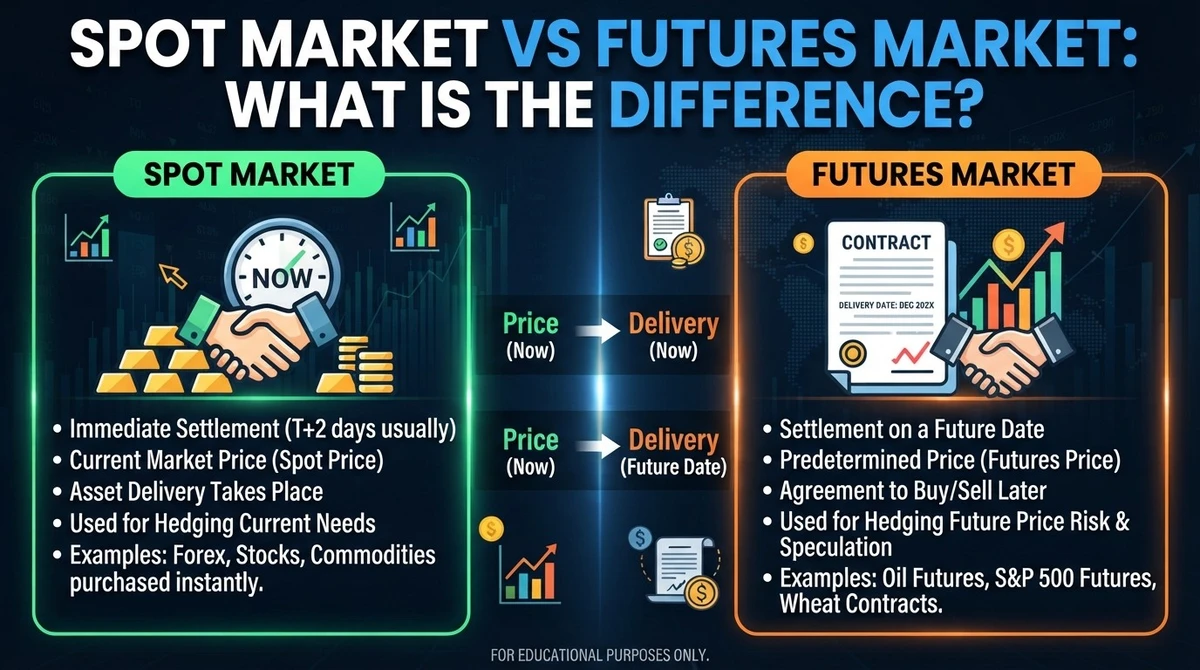
A spot market is centered on the physical commodity and current delivery. A futures market trades standardized contracts linked to future delivery or settlement. The two markets are closely connected, but their prices do not always move in exactly the same way. CFTC Futures Market Basics
That difference matters to producers, manufacturers, commodity traders, and investors because it affects pricing, hedging, storage decisions, risk management, and investment returns.
What Is a Spot Market?
A spot market is where a commodity is bought or sold for current or near-immediate delivery under the market’s normal commercial arrangements.
The CFTC defines a spot price as the price at which a physical commodity for immediate delivery is sold at a particular time and place. CFTC Futures Glossary
Imagine a food manufacturer that needs wheat for production. It can purchase physical wheat from a supplier based on the prevailing cash-market price and arrange delivery according to the transaction’s terms.
The important point is that the transaction concerns an actual physical commodity.
Spot prices can vary by location, quality, transportation costs, and local supply conditions. A barrel of oil available at one location is not necessarily economically identical to a barrel available somewhere else if moving the product is expensive or infrastructure is constrained.
That makes spot markets closely connected to the physical economy.
What Is a Futures Market?
A futures market is where standardized futures contracts are traded.
A futures contract is an agreement to buy or sell a specified commodity at a future date under standardized terms. Those terms can include the contract size, delivery month, delivery location, and acceptable quality or grade. CFTC Economic Purpose of Futures Markets
For example, a crude oil futures contract does not simply represent an informal promise to buy “some oil later.” The exchange establishes the specifications so that many participants can trade the same contract.
That standardization is one of the reasons futures markets can provide liquidity and price discovery.
It also means a futures position does not automatically mean the trader will eventually take physical delivery. Most futures contracts are offset before delivery, according to the CFTC. CFTC Futures Market Basics
The Core Difference Between Spot and Futures Markets
The simplest distinction is what is being traded and when the underlying transaction is intended to occur.
| Feature | Spot Market | Futures Market |
| Main focus | Physical commodity at current market conditions | Standardized contract for future delivery or settlement |
| Price | Spot or cash price | Futures price |
| Physical commodity | Central to the transaction | May or may not be delivered |
| Contract terms | Can vary between transactions | Standardized by the exchange |
| Main users | Producers, processors, manufacturers, merchants, consumers | Producers, consumers, hedgers, traders, and other market participants |
| Main purpose | Buying and selling physical commodities | Price discovery, hedging, and trading price exposure |
| Settlement | Physical transaction and payment arrangements | Offset, physical delivery, or cash settlement depending on the contract |
So the difference is not simply today versus tomorrow.
The deeper distinction is between a market centered on the physical commodity and a market centered on a standardized financial contract linked to that commodity.
How a Spot Commodity Transaction Works
A spot transaction begins with a physical need or a physical supply.
Suppose a coffee roaster needs 100 tons of coffee beans.
The buyer and seller may agree on:
- Quantity
- Quality
- Price
- Delivery location
- Delivery timing
- Payment terms
The coffee then moves through the physical supply chain.
The price reflects current market conditions, including available supply, demand, transportation, storage, quality, and location.
That physical connection is important. If a port becomes congested or a regional shortage develops, the local cash price can react even if the broader global commodity market is relatively stable.
Spot markets therefore provide a direct link between commodity prices and physical supply and demand.
How a Futures Contract Works
Futures markets add a standardized layer around the commodity.
Consider a farmer who expects to harvest wheat several months from now. A decline in wheat prices before harvest could reduce the revenue from the crop.
The farmer can sell wheat futures to hedge part of that price risk.
An airline faces the opposite concern. Higher fuel prices can increase operating costs, so it may use futures or other derivatives to manage some of its exposure to fuel prices.
These transactions do not necessarily mean either business wants to take delivery through the futures contract.
The purpose can instead be to make future cash flows more predictable.
The CFTC describes hedging as a central economic function of futures markets, allowing commodity producers and consumers to reduce the financial uncertainty created by changing prices. CFTC: Economic Purpose of Futures Markets
Why Spot and Futures Prices Can Be Different
Spot and futures prices are related, but they do not have to be identical.
A spot price answers a question about the commodity’s value under current physical-market conditions.
A futures price reflects the market’s price for a standardized contract associated with a future delivery or settlement period.
Between those two points, several economic factors matter:
- Storage costs
- Financing costs
- Insurance
- Transportation
- Inventory levels
- Expected supply
- Expected demand
- Seasonal conditions
- The value of having the physical commodity available immediately
These factors can change the economics of holding a commodity over time.
For a physical commodity that can be stored, owning inventory today has a cost. But holding inventory can also have a benefit when the commodity is scarce and immediately useful.
That is one reason the futures curve contains information beyond the current spot price.
Storage and Financing Help Explain the Futures Curve
Physical commodities are not free to carry.
A company storing copper may have to pay for warehousing, insurance, financing, and handling. A company storing oil or agricultural commodities faces its own carrying costs.
Those costs can influence the price of futures contracts.
CME Group explains that storage, financing, and insurance costs can contribute to contango in physically delivered commodity markets. It also notes that the benefit of holding scarce physical inventory can contribute to backwardation. CME Group: What Is Contango and Backwardation?
This is why the futures market is not simply making a guess about where the commodity will trade later.
The economics of carrying the physical commodity also matter.
Contango and Backwardation
The relationship between spot and futures prices becomes especially important when looking at the shape of the futures curve.
Contango
Contango occurs when futures prices are above the spot price or when later delivery months are priced progressively higher than nearby contracts.
For example:
- Spot crude oil: $80
- Three-month futures: $83
- Six-month futures: $86
Storage, financing, insurance, expectations, and other market conditions can contribute to this structure.
Contango matters to investors because a futures-based product may need to replace expiring contracts with more expensive contracts. That can create a negative roll effect even when the underlying spot commodity does not fall.
Backwardation
Backwardation is the opposite structure.
For example:
- Spot crude oil: $90
- Three-month futures: $87
- Six-month futures: $84
A tight physical market can contribute to this situation. When immediately available inventory is particularly valuable, the spot market can trade above later-dated futures.
CME describes this benefit of owning physical material as a form of convenience yield. CME Group: What Is Contango and Backwardation?
For a deeper look at how the futures curve affects commodity returns, see Economic Reader’s Contango vs. Backwardation Explained.
Basis: The Link Between Spot and Futures
One of the most useful concepts connecting the two markets is basis.
In commodity markets, basis generally refers to the difference between the spot or cash price and the price of a relevant futures contract. The CFTC commonly defines it as cash minus futures. CFTC Futures Glossary
Suppose:
- Spot price = $100
- Futures price = $103
Using the cash-minus-futures convention:
Basis = $100 − $103 = −$3
The basis can change as local supply, transportation, inventories, and other market conditions change.
This matters to commercial businesses because a futures hedge may protect against broad commodity-price movements without perfectly matching the price the company eventually pays or receives in the physical market.
That difference is known as basis risk.
A futures hedge can therefore reduce uncertainty without eliminating every source of price risk.
How Businesses Use Spot Markets
Businesses that physically need commodities naturally interact with spot markets.
Manufacturers
Manufacturers buy metals, energy products, chemicals, and other inputs for production.
Food processors
Food companies purchase crops, livestock-related products, oils, and other agricultural inputs.
Energy companies
Refiners, utilities, and other energy businesses buy physical fuels and feedstocks.
Commodity merchants
Trading companies can purchase, store, transport, process, and resell physical commodities.
For these businesses, the commodity is part of an actual operating process.
A copper producer, for example, may sell physical copper while also using futures to manage the price risk between production and sale.
How Businesses Use Futures Markets
Futures are particularly useful when a business wants to manage exposure to changing commodity prices.
Consider a farmer expecting to sell corn after harvest.
If corn prices fall before the crop is sold, the farmer could receive less revenue from the physical crop. A short futures position can generate gains when futures prices fall, helping offset some of the decline in the physical market.
A food manufacturer can face the reverse problem. If grain prices rise, its input costs can increase. A futures position may help offset some of that increase.
The goal is usually risk management rather than predicting the perfect price.
The CFTC notes that producers and consumers use futures to reduce the uncertainty created by commodity-price changes. CFTC: Economic Purpose of Futures Markets
How Traders and Investors Use Futures
Futures markets are also used by participants who do not need to buy or sell the physical commodity.
Some traders take positions because they expect prices to rise or fall. Others use futures as part of broader investment or risk-management strategies.
Speculators can add liquidity to the market, while commercial hedgers use futures to manage price exposure.
But futures also introduce leverage.
The CFTC warns that commodity futures trading can be volatile and complex and may not be suitable for many individual investors. Traders can lose their initial funds and, depending on the position and circumstances, may be required to provide additional money. CFTC Futures Market Basics
This is one reason futures exposure should not be treated as equivalent to simply owning the physical commodity.
Spot vs. Futures: A Simple Commodity Example
Imagine a coffee company that expects to buy coffee beans three months from now.
Today:
Spot price = $4.00 per pound
The company is concerned that prices could rise before it needs the beans.
A three-month futures contract trades at:
$4.20 per pound
The company could use futures to hedge part of its exposure.
Suppose three months later the spot price has risen to $4.50.
The company pays more for the physical coffee, but a gain on its futures position could offset part of that increase.
Now imagine the spot price instead falls to $3.80.
The company benefits from buying cheaper physical coffee, but its futures hedge may produce a loss.
That does not mean the hedge failed.
The objective was not necessarily to achieve the lowest possible purchase price. It was to reduce uncertainty around the company’s future cost.
What Happens as a Futures Contract Approaches Expiration?
The relationship between the two markets becomes particularly important as a futures contract approaches maturity.
For contracts with physical delivery, the futures price and the relevant cash price are expected to converge toward one another as expiration approaches. CME explains that without convergence, an arbitrage opportunity could exist. CME Group: What Is Contango and Backwardation?
The CFTC also explains that the delivery provision of futures contracts helps ensure convergence between futures and cash-market prices. CFTC: Economic Purpose of Futures Markets
This connection is important because the futures contract cannot remain permanently disconnected from the physical market as delivery approaches.
However, the relationship can still be affected by location, quality specifications, transportation costs, and the precise terms of the futures contract.
Physical Delivery Does Not Mean Most Traders Receive Commodities
Another common misunderstanding is that buying a futures contract means taking delivery of a truckload of oil, wheat, or another commodity.
In practice, most futures positions are closed or offset before delivery.
The CFTC states that most futures contracts are liquidated before the delivery date. Some contracts can also use cash settlement rather than physical delivery, depending on their terms.
Physical delivery still matters, however.
Even when most traders never receive the commodity, the possibility of delivery helps keep the futures contract connected to the underlying physical market.
That connection supports price discovery and convergence.
Why the Difference Matters for Commodity Investors
For investors, one of the most important lessons is that commodity price exposure is not always the same as spot-price exposure.
An investment product that uses futures can be affected by:
- Changes in futures prices
- Contango or backwardation
- The cost or benefit of rolling contracts
- Fees and expenses
- Collateral or financing returns
- The structure of the investment product
As a result, the spot price of a commodity can rise while a futures-based investment produces a smaller gain or even a loss over a particular period.
That is one reason investors should understand the structure of a commodity investment rather than assuming that it simply tracks the commodity’s current cash price.
Economic Reader’s How to Invest in Commodities covers the different ways investors can gain commodity exposure and why the investment vehicle can affect the outcome.
Spot Markets and Futures Markets Work Together
Spot and futures markets are not competing versions of the same market.
They perform different functions while remaining closely connected.
A farmer can sell physical crops in the spot market while using futures to hedge price risk.
A manufacturer can buy physical metal while monitoring futures prices.
A commodity merchant can hold inventory and use futures to manage the risk associated with changing prices.
An investor can use a futures-based product without ever taking possession of the underlying commodity.
The result is a connected market system in which physical supply and demand, inventories, storage, financing, expectations, and risk management all influence commodity prices.
Spot Market vs. Futures Market: What Should You Remember?
The easiest way to remember the difference is:
Spot markets are centered on the physical commodity under current market conditions.
Futures markets are centered on standardized contracts linked to future delivery or settlement.
Spot markets connect directly to the physical economy. Futures markets add a standardized mechanism for price discovery, hedging, and trading commodity-price exposure.
The two markets are connected through storage costs, financing, inventories, transportation, expectations, and the eventual convergence of futures and cash prices.
For anyone studying commodity markets, the important question is therefore not simply “What is the spot price?” or “What is the futures price?”
It is:
Why are the two prices different, what is causing that difference, and what does it mean for the businesses and investors using the market?