

Real Estate vs Stocks: Which Is Better in 2026?
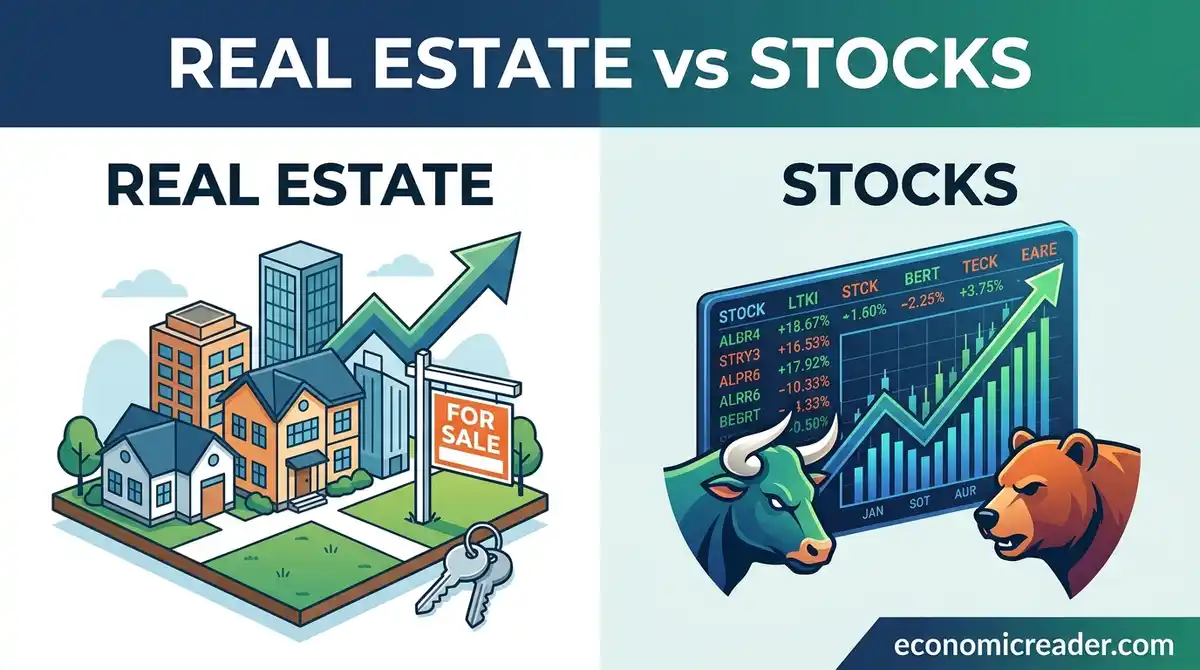
If you have money to invest in 2026, there is a good chance you have thought about two familiar options: buying real estate or putting your money into stocks.
Both can build wealth. Both can produce income. And both can lose money.
The bigger difference is in how you make money, how much work is involved, how quickly you can access your money, and how much capital you need to get started.
Buying a rental property might give you monthly rent and the chance to build equity over time. Buying stocks can give you ownership in businesses without dealing with tenants, repairs, or property taxes.
So, Real Estate vs Stocks Which Is Better 2026 is not really a question with one universal answer. The right choice depends on what you can afford, what you want your investments to do, and how comfortable you are with risk.
Let’s look at both options from the perspective of an investor making decisions in 2026.
Real Estate and Stocks Are Very Different Investments
At first glance, both investments seem similar. You put money in and hope that your investment becomes more valuable.
The experience can be completely different, though.
With real estate, you usually buy something physical. It might be a single-family home, apartment, office building, warehouse, or another type of property. If you rent it out, tenants provide income. If the property becomes more valuable, you may also benefit when you eventually sell it.
Stocks work differently. When you buy a stock, you are purchasing a small ownership interest in a company. Your investment can grow if the business becomes more valuable. Some companies also return part of their profits to shareholders through dividends.
There is another major difference: you can see and use a property, but you cannot walk into a stock.
That sounds obvious, but it affects how people think about these investments. Real estate often feels more tangible. Stocks are easier to trade and usually require much less hands-on involvement.
What Makes Real Estate Attractive in 2026?
Real estate continues to appeal to investors who want an asset they can understand on a very practical level.
You can buy a property, rent it to someone, improve it, refinance it, or eventually sell it.
That flexibility is one reason real estate has remained popular.
Rental Income Can Create a Regular Cash Flow
A rental property can generate income every month.
For example, suppose an investor owns a rental home that brings in $2,200 per month. That does not mean the investor pockets the full $2,200.
There may be expenses such as:
- Mortgage payments
- Property taxes
- Insurance
- Repairs
- Maintenance
- Property management
- Vacancy costs
After those expenses, whatever remains becomes part of the property’s cash flow.
A property that produces positive cash flow can be appealing to someone who wants an income producing investment.
You Can Use Borrowed Money
Real estate has something that makes it unusual compared with many other investments: investors can often use a mortgage to purchase a much larger asset.
Imagine you have $80,000 available.
Instead of buying an $80,000 investment outright, you might use that money toward a larger property and finance the rest with a mortgage.
That can increase your potential return on your own money, but it also increases your risk. If the property does not produce enough income or its value falls, the debt does not simply disappear.
Leverage can help an investor build wealth faster, but it can also make a bad investment much more painful.
Property Owners Have More Control
A stock investor cannot decide how Apple, Coca-Cola, or another public company operates.
A property owner has more direct control.
You can decide whether to renovate a kitchen, improve the landscaping, raise rent when legally permitted, change property management, or sell the property.
That control is attractive to people who enjoy running an investment like a small business.
Where Real Estate Gets Difficult
Real estate sounds straightforward until you actually own a property.
A tenant may move out unexpectedly. A water heater may fail. Property taxes can rise. Insurance costs can change. A roof can need repairs at exactly the wrong time.
Those problems do not necessarily make real estate a bad investment. They simply show why property ownership is not completely passive.
There is also the question of location.
A great property in a weak market may not perform as expected. A smaller property in a growing area can sometimes be a better investment.
This makes local research extremely important.
Stocks Offer a Very Different Experience
Stocks are much easier to buy than physical property.
You can open an investment account, transfer money, and purchase shares or an ETF without searching for tenants or arranging a home inspection.
That simplicity is one of the biggest reasons stocks are attractive to long-term investors.
You Can Start With a Relatively Small Amount
You do not need hundreds of thousands of dollars to begin investing in the stock market.
An investor with $100, $500, or $1,000 can get started, depending on the account and investment chosen.
This makes stocks particularly useful for people who are still building their savings.
A broad index fund can also give an investor exposure to many companies at once. Instead of trying to guess which single company will become the next big winner, an investor can own a basket of businesses.
Stocks Are Easy to Sell
Suppose you need access to your investment money.
Selling a stock is generally much faster than selling a house.
A property can sit on the market for weeks or months. Selling stocks can usually be done through a brokerage account during market trading hours.
Of course, easy access can become a problem too. When markets fall sharply, investors can sell in panic simply because they can.
Liquidity is useful, but it can also make emotional decisions easier.
Real Estate vs Stocks: A Side by Side Look
| Factor | Real Estate | Stocks |
| Starting capital | Usually higher | Can start with relatively little |
| Income | Rental income | Dividends, when available |
| Growth | Property appreciation | Share price appreciation |
| Liquidity | Relatively low | Generally high |
| Management | Often hands-on | Usually low maintenance |
| Leverage | Common | Less common for ordinary investors |
| Diversification | Requires multiple properties or funds | Easy through ETFs and index funds |
| Transaction costs | Can be significant | Usually lower |
| Physical asset | Yes | No |
| Market volatility | Usually less visible day to day | Prices can move every trading day |
| Location risk | Important | Less concentrated for diversified funds |
| Time commitment | Can be substantial | Usually much lower |
Neither side wins every category.
That is exactly why the Real Estate vs Stocks Which Is Better 2026 debate is more useful when viewed as a personal decision rather than a competition.
What About Returns?
This is where many investment comparisons become misleading.
Someone may ask, “Which one makes more money?”
There is no fixed answer.
Real estate returns can come from several sources:
- Property appreciation
- Rental income
- Mortgage principal reduction
- Potential tax advantages
Stock returns can come from:
- Share price growth
- Dividends
- Reinvestment of dividends
The actual result depends on what you buy, when you buy it, how long you hold it, the costs involved, and the broader economy.
A rental property purchased at an attractive price in a growing area may perform extremely well.
A diversified stock portfolio held for decades can also produce substantial wealth.
Neither investment comes with a guaranteed return.
The Role of Inflation
Inflation is another reason investors compare these two asset classes.
Real estate can sometimes benefit from rising prices because property values and rents may increase over time. A landlord with long-term debt may also repay that debt with dollars that are worth less than they were when the loan was taken out.
But inflation can create problems too.
Construction costs, repairs, insurance, and property taxes may all become more expensive.
Stocks have their own relationship with inflation.
Companies that have strong pricing power may be able to raise prices and protect their profits. Other businesses may struggle when their costs rise faster than their revenue.
Higher inflation can also influence interest rates, which can affect both stock valuations and real estate financing.
So inflation does not automatically make one investment the winner.
What Happens When Interest Rates Are High?
Interest rates matter a lot to real estate investors.
If mortgage rates rise, financing a property becomes more expensive. That can reduce the amount a buyer is willing or able to pay.
Higher rates can also affect property values because investors may demand better returns from real estate.
Stocks are affected by interest rates too.
When borrowing becomes more expensive, companies may face higher financing costs. Higher interest rates can also make bonds and other interest-bearing investments more attractive compared with stocks.
This is one reason the economic environment in 2026 matters when comparing the two.
Investors should avoid looking at either market in isolation.
Which One Requires More Work?
This may be the biggest practical difference.
Owning rental property can become a part-time job.
You may have to:
- Find tenants
- Collect rent
- Handle repairs
- Deal with vacancies
- Review insurance
- Pay property taxes
- Work with contractors
- Keep financial records
You can hire a property manager, but that adds another expense.
Stock investing can be dramatically simpler.
Someone who buys a diversified index fund may spend very little time managing the investment. The main challenge is often staying invested when the market becomes uncomfortable.
For a person who wants a hands-off approach, that difference can matter more than the potential return.
What If You Do Not Have Much Money?
This is where stocks usually have an obvious advantage.
Buying property requires more upfront cash. Even when financing is available, buyers may need money for a down payment, closing costs, inspections, repairs, and reserves.
Stocks can be purchased with much smaller amounts.
That does not mean someone with limited capital should ignore real estate completely.
REITs can provide another way to gain exposure to real estate without purchasing a building directly. They can be bought through investment accounts much like stocks.
For some investors, REITs offer a middle ground between the two.
What If You Want Monthly Income?
Real estate is often associated with monthly income because tenants generally pay rent on a regular schedule.
Some stocks also pay dividends, although dividend payments vary by company and are never something investors should treat as guaranteed income.
An investor looking for income might compare rental cash flow with dividends, but the comparison needs to include expenses.
A $2,000 monthly rent payment is not equivalent to $2,000 of investment income.
The landlord still has bills to pay.
Likewise, a dividend yield should not be viewed by itself. A very high yield can sometimes signal that the market expects trouble.
What If You Want Less Stress?
This depends on the person.
Some people find stock market volatility stressful. Seeing an investment fall 10% in a few weeks can be difficult even when the long-term plan has not changed.
Others find property ownership more stressful because there is always something that could go wrong.
A tenant can call at night. A major repair can wipe out several months of rental income.
There is no universally “stress-free” investment.
The better choice may simply be the one whose risks you understand and can live with.
A Practical Example
Consider two investors, Alex and Jordan.
Alex has $50,000 saved and wants to build long-term wealth. Alex does not want to deal with tenants and expects to keep investing for decades.
Jordan also has $50,000 but enjoys real estate, understands the local market, and is willing to spend time managing a property.
They could make completely different decisions with the same amount of money.
Alex might choose a diversified stock portfolio and continue adding money from each paycheck.
Jordan might use the available cash toward a rental property, assuming the numbers make sense and sufficient reserves remain after the purchase.
Neither person is necessarily making the wrong choice.
Their circumstances are different.
When Stocks May Make More Sense
Stocks may be a stronger fit if you:
- Have limited capital
- Want to invest regularly
- Prefer low-maintenance investments
- Need access to your money
- Want broad diversification
- Have a long investment horizon
- Do not want to manage physical property
For many workers, stocks can also fit naturally into retirement accounts such as a 401(k) or IRA.
That can make long-term investing easier because contributions can become part of a regular financial routine.
When Real Estate May Make More Sense
Real estate may be worth considering if you:
- Have enough cash for a property and emergency reserves
- Understand your local housing market
- Want rental income
- Are comfortable managing property
- Prefer tangible assets
- Understand mortgages and property expenses
- Have a long-term investment horizon
The important part is not simply wanting to own property.
You need to understand the numbers.
A property that looks profitable because the rent is higher than the mortgage payment may actually lose money after taxes, insurance, maintenance, vacancies, and other costs.
Could You Invest in Both?
Absolutely.
In fact, many investors do not see stocks and real estate as competing choices.
They use both.
For example, someone might hold diversified stock funds in a retirement account while owning one rental property outside of that account.
Another investor may own stocks and bonds while getting real estate exposure through REITs.
This approach can reduce dependence on a single type of asset.
It also allows each investment to serve a different purpose.
Stocks can provide liquidity and broad business exposure. Real estate can add property exposure and potential rental income.
Mistakes to Avoid in the Comparison
Chasing the Investment With the Highest Recent Return
An investment that performed extremely well recently may not repeat that performance.
Past results can be useful information, but they are not a promise about what happens next.
Ignoring the Time Commitment
A rental property may look attractive on a spreadsheet until you realize how much time it requires.
Your time has value.
Comparing Rent With Stock Returns Without Including Costs
Real estate has many costs that are easy to overlook.
Stock investing has costs too, although diversified funds can make them relatively simple to understand.
Compare the net result, not just the headline numbers.
Using Too Much Debt
Borrowing can increase returns when things go well.
It can also increase losses when things go badly.
Making the Decision Based on Emotion
Some people love real estate because they can see and touch the asset. Others dislike stocks because prices move constantly.
Neither feeling is a substitute for financial analysis.
So, Real Estate or Stocks in 2026?
There is no single investment that is best for everyone.
For someone starting with limited money and looking for an easy way to build a diversified portfolio, stocks can be the more practical choice.
For someone with more capital, a strong understanding of property markets, and an interest in rental income, real estate may be more appealing.
And for investors who want both, there is no rule saying they have to choose only one.
The better question is not simply Real Estate vs Stocks Which Is Better 2026.
It is:
Which investment fits your money, your goals, your time, and your ability to handle risk?
That question leads to a much more useful decision.
Frequently Asked Questions
1. Can real estate lose value during a market downturn?
Yes. Property values can decline when local demand weakens, unemployment rises, financing becomes more expensive, or economic conditions deteriorate. Real estate is not guaranteed to increase in value.
2. How much cash should I keep before buying an investment property?
There is no universal amount, but buyers should account for more than the down payment. Closing costs, repairs, vacancies, insurance, taxes, and unexpected expenses can all require cash after the purchase.
3. Can I get real estate exposure without becoming a landlord?
Yes. Publicly traded REITs allow investors to gain exposure to income-producing real estate without directly owning and managing a property.
4. Should I pay off my mortgage before investing in stocks?
Not necessarily. The answer depends on the mortgage rate, your other debts, emergency savings, investment goals, and risk tolerance. It is usually worth comparing the guaranteed benefit of reducing debt with the uncertain return of investing.
5. Is owning one rental property enough for diversification?
Not necessarily. One property can leave an investor heavily exposed to one location, one property type, and potentially a small number of tenants. Diversification requires looking at the investor’s entire portfolio, not just the number of properties owned.
Final Thoughts
Real estate and stocks can both play a role in a long-term wealth-building plan.
Real estate offers ownership of a physical asset, potential rental income, and the ability to use financing. Stocks offer liquidity, easy diversification, and a simple way to participate in the growth of businesses.
The better choice depends on what you are trying to accomplish.
If you value simplicity and flexibility, stocks may fit better. If you enjoy property, want rental income, and are comfortable with the work involved, real estate may deserve a place in your portfolio.
And for many investors, the answer does not have to be one or the other.
A thoughtful combination of investments can be more useful than trying to find one perfect asset.
Continue Learning…
If you’d like to explore this topic further, check out these related guides from Economic Reader:
- What Is Free Trade? – How Open Markets Shape Global Commerce.
- What Is Enterprise Value? – A Beginner’s Guide to Understanding Company Valuation.
Author Note: This article is crafted by “The Economic Reader editorial team”, dedicated to analyzing the latest market trends, financial updates, and global economic shifts to keep you informed with accurate and comprehensive insights.
Disclaimer: The information provided on this website is for educational and informational purposes only and should not be construed as professional financial, investment, or legal advice. Always consult with a certified financial advisor or professional before making any financial decisions based on this content.