What Is Free Trade? How Open Markets Shape Global Commerce
What Is Free Trade?
Think about how many products around you have crossed a border before reaching you.
A car may contain parts made in several countries. A business in the United States might buy software from a company overseas. A grocery store may sell food that could not be produced locally at the same scale or cost.
International trade makes all of this possible.
But countries do not all treat foreign goods the same way. Governments can place taxes on imports, limit quantities, or impose other rules that make cross-border business more difficult.
Free trade takes a different approach. It seeks to make international commerce easier by reducing trade barriers between participating economies.
That does not mean every product moves across every border without restrictions. In the real world, free trade operates within agreements, regulations, customs procedures, and other rules.
Understanding that distinction makes the concept much easier to understand.
Free Trade, Explained Simply
Free trade is a trade policy approach that reduces or removes certain barriers to the exchange of goods and services between countries.
The barriers can include tariffs, quotas, and other restrictions.
The basic idea is to give businesses greater access to foreign markets and allow countries to buy goods and services from international suppliers with fewer obstacles.
For consumers, that can mean more choices and potentially lower prices. For businesses, it can open access to customers, suppliers, and investment opportunities outside their home market.
The results are not always positive for every industry, though. Companies that face stronger foreign competition may have to cut costs, change their products, or find new markets.
Why Countries Trade in the First Place
Free trade makes more sense when you understand why international trade exists.
Countries have different natural resources, labor forces, technologies, infrastructure, and production capabilities. Trying to produce every possible product domestically is not necessarily the most efficient use of those resources.
Instead, countries can specialize in areas where they are relatively more efficient and trade for other products.
This idea is closely related to comparative advantage, one of the central concepts in international economics.
For example, a country with favorable conditions for agriculture may have a strong export industry in certain crops, while another country may be better positioned to produce advanced machinery.
Trade allows both sides to exchange what they produce.
What Changes When Trade Barriers Are Lower?
The effects can show up in several parts of the economy.
Businesses Can Reach More Customers
A company that sells only inside its home country is limited to that market.
When international trade becomes easier, the same company may be able to sell to customers abroad.
For an American business, that could mean exporting products to Canada, Mexico, Europe, Asia, or other markets, depending on the product and applicable trade rules.
A larger potential market can give successful companies more room to grow.
Companies Can Source From More Suppliers
Businesses do not only sell internationally. They also buy internationally.
A manufacturer may purchase raw materials, machinery, components, or other inputs from suppliers in different countries.
Having access to multiple suppliers can give businesses more choices when managing costs and production.
Competition Increases
Opening markets can also bring more foreign competitors into a domestic market.
That can be uncomfortable for businesses that have historically faced little competition.
At the same time, competition can encourage companies to improve products, control costs, invest in technology, and find more efficient ways to operate.
What Is a Tariff?
A tariff is a customs duty imposed on imported goods.
The World Trade Organization describes tariffs as customs duties on merchandise imports. (World Trade Organization)
Suppose a U.S. company imports $10,000 worth of a particular product and a 10% tariff applies.
The tariff would add $1,000 to the import duty, assuming the tariff is calculated on that value.
The economic effect can be more complicated after that. The importer might absorb the cost, pass some or all of it to customers, negotiate with suppliers, or change where it sources the product.
This is why tariffs can influence prices, business decisions, and supply chains.
What About Import Quotas?
A tariff changes the cost of importing a product.
A quota, by contrast, places a limit on the amount that can be imported under specified rules.
Quotas can therefore restrict the quantity of foreign goods entering a market.
Both tariffs and quotas can protect domestic producers from some foreign competition, but they do so in different ways.
Free Trade Does Not Mean “No Rules”
This is one of the most common misunderstandings about free trade.
A free-trade system does not mean governments stop regulating international commerce.
Countries can still have:
- Product standards
- Customs requirements
- Safety regulations
- Rules of origin
- Import procedures
- Certain tariffs or exceptions
The WTO itself notes that its trading system allows tariffs and, in limited circumstances, other forms of protection. (World Trade Organization)
So when economists or policymakers talk about free trade, they are generally talking about lower trade barriers and greater market access, not a world with zero regulation.
The Economic Case for Free Trade
Supporters of free trade generally point to several potential advantages.
More Consumer Choice
International trade allows consumers to buy products from a wider range of producers.
That can increase the variety of:
- Food
- Clothing
- Electronics
- Vehicles
- Machinery
- Services
The exact choices available depend on the country, trade rules, and the products involved.
Potentially Lower Costs
Businesses that can purchase from competitive international suppliers may be able to lower some production costs.
Those savings can sometimes reach consumers through lower prices.
However, lower trade barriers do not guarantee that every product will become cheaper. Transportation costs, exchange rates, production costs, taxes, market competition, and other factors also matter.
Larger Markets
Exporting gives businesses access to customers beyond their domestic market.
For companies that can compete internationally, that can create opportunities to increase sales and expand production.
Greater Specialization
Countries can devote more resources to industries where they have comparative advantages and trade for products that other countries produce relatively more efficiently.
That can improve the allocation of resources across economies.
More Competitive Pressure
Foreign competition can push domestic companies to improve.
A business that knows customers have alternatives has a stronger reason to improve quality, pricing, customer service, or efficiency.
Where Free Trade Can Create Problems
The benefits of trade are real, but they do not arrive without trade-offs.
Some Domestic Industries Can Lose Ground
Imagine a domestic manufacturer producing a product at a relatively high cost.
If cheaper imported alternatives enter the market, customers may switch to those imports.
The domestic company could lose sales.
Some businesses adapt successfully. Others may shrink or close.
Workers Can Be Affected Differently
Trade can create employment in export industries while reducing employment in industries exposed to import competition.
That means the effects can vary significantly by occupation, industry, region, and skill level.
A worker in an expanding export industry may benefit from stronger foreign demand, while a worker in a declining manufacturing industry may face a very different situation.
Supply Chain Dependence Can Become a Weakness
International sourcing can lower costs and increase access to specialized inputs.
But it can also create vulnerabilities.
If a critical supplier is located overseas, a disruption involving transportation, geopolitics, natural disasters, or other events can affect production.
For that reason, businesses increasingly have to think about both efficiency and resilience when designing supply chains.
Free Trade vs Protectionism
The two approaches start from different priorities.
| Free Trade | Protectionism |
| Seeks to reduce trade barriers | Uses trade barriers to protect selected domestic industries |
| Encourages international competition | Limits some foreign competition |
| Expands access to foreign markets | Places greater emphasis on domestic production |
| Can increase access to imported goods | Can make some imports more expensive |
| Supports broader international commerce | May be used for strategic or economic policy goals |
Protectionism can take several forms, including tariffs, quotas, subsidies, and other measures.
Governments may use these policies for different reasons, including protecting domestic industries, responding to trade disputes, or supporting strategic sectors.
What Is a Free Trade Agreement?
A free trade agreement (FTA) is a formal agreement between countries or trading economies that establishes rules for trade and reduces certain barriers.
The details differ from one agreement to another.
An agreement can address issues such as:
- Tariffs
- Market access
- Rules of origin
- Customs procedures
- Services
- Investment
- Digital trade
- Intellectual property
So an FTA is more than simply a promise to “trade freely.” It is a negotiated set of rules governing economic relationships between the participating parties.
A U.S. Example: USMCA
For American readers, one of the most important examples is the United States-Mexico-Canada Agreement (USMCA).
USMCA governs trade among the United States, Mexico, and Canada. It replaced NAFTA and entered into force on July 1, 2020. (United States Trade Representative)
The agreement covers areas including market access, rules of origin, customs procedures, digital trade, intellectual property, labor, and environmental provisions. (United States Trade Representative)
That illustrates an important point: modern free trade agreements cover much more than tariffs alone.
Free Trade and the WTO
The World Trade Organization (WTO) is not itself a worldwide free trade agreement.
It is an international organization that deals with the rules governing trade between nations. Its agreements provide a framework for international trade relations among its members. (World Trade Organization)
The WTO system also does not require countries to eliminate every tariff.
Instead, members make commitments regarding trade barriers and follow a broader set of rules governing international commerce. (World Trade Organization)
This is why the global trading system is better understood as a network of agreements and rules rather than one single free-trade arrangement.
Free Trade and Developing Economies
International trade can be particularly important for developing economies.
A country can use exports to build industries that serve foreign customers, generate foreign-exchange earnings, attract investment, and create employment.
Manufacturing is one possible example.
A company may establish a factory in a developing country and produce goods for both domestic and international markets.
But market access by itself does not guarantee long-term development.
Infrastructure, education, access to capital, institutions, technology, and political stability all influence how successfully a country can participate in global trade.
Free Trade vs Fair Trade
These terms are often confused.
Free trade is mainly about reducing barriers to international commerce.
Fair trade is generally associated with efforts to improve the economic and social conditions of producers and workers.
They address different questions.
Free trade asks, in broad terms:
How easily can goods and services cross borders?
Fair trade focuses more on:
Under what conditions are those goods produced and how are producers and workers treated?
The two ideas can overlap in discussions about international commerce, but they are not interchangeable.
How Free Trade Connects to Globalization
Globalization has made economies more interconnected.
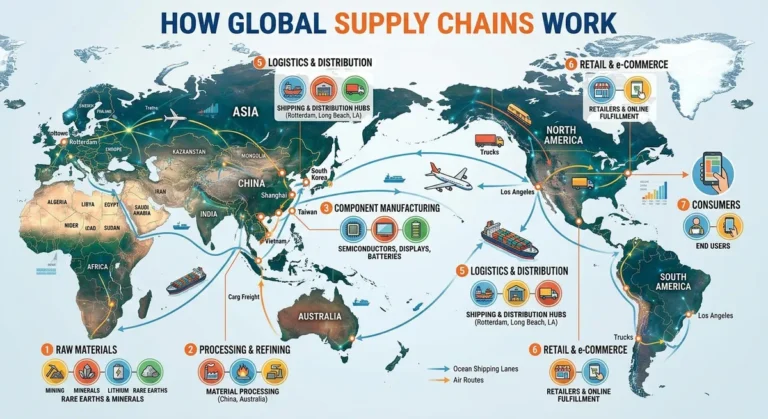
Companies can design products in one country, source components from several others, manufacture somewhere else, and sell to customers around the world.
Free trade has supported this process by reducing some of the barriers involved in international commerce.
The result is a global economy where a disruption in one country can sometimes affect businesses and consumers far beyond its borders.
That interconnectedness can make production more efficient, but it can also make supply chains more complicated to manage.
Why Trade Policy Matters to the Average Consumer
You do not have to own a multinational company to be affected by trade policy.
Trade rules can influence the prices and availability of everyday products.
A tariff on an imported component, for example, can increase costs for a manufacturer. The manufacturer may absorb that expense, change suppliers, reduce margins, or pass some of the additional cost to customers.
On the other hand, lower trade barriers can give companies access to more suppliers and increase competition.
The final effect on consumers depends on the product and the wider economic environment.
What Is the Future of Free Trade?
International trade is changing.
Companies are paying more attention to supply-chain resilience, geopolitical risks, digital commerce, and the security of critical inputs.
Services are also becoming a larger part of cross-border commerce. A company can now sell software, consulting, design, financial services, and other digital products internationally without shipping a physical item.
Artificial intelligence is likely to add another dimension to global commerce as businesses use AI for areas such as software development, logistics, customer service, research, and business operations.
The basic purpose of trade remains the same, though: countries and businesses exchange goods and services because they can gain from doing so.
Frequently Asked Questions
1. Can free trade exist if a country still has tariffs?
Yes. Free trade does not necessarily mean that every tariff disappears. Trade agreements can reduce tariffs substantially while retaining certain exceptions, restrictions, or negotiated protections. The WTO trading system itself allows tariffs under its rules. (World Trade Organization)
2. Why would a government support free trade?
A government may support free trade because it can expand market access for domestic exporters, give businesses access to international suppliers, increase competition, and provide consumers with more choices.
3. Can free trade affect inflation?
Yes, trade policy can affect prices. Changes in tariffs can alter the cost of imported goods and inputs, while greater access to international suppliers can sometimes put downward pressure on costs. The overall effect depends on the product and broader economic conditions.
4. Does free trade benefit every country equally?
No. Countries have different industries, resources, workers, and levels of competitiveness. The gains from trade can be substantial, but some industries or workers may face greater competition from imports.
5. Why do countries sign free trade agreements?
Countries can use free trade agreements to establish predictable rules, reduce selected trade barriers, improve market access, and strengthen economic relationships with trading partners.
Final Thoughts
Free trade is often presented as a simple choice between open markets and trade restrictions. In reality, international commerce is more complicated.
Countries trade because they have different resources and capabilities. Businesses trade because international markets can create new customers and suppliers. Consumers benefit from the products and services that global commerce makes available.
At the same time, stronger international competition can create real difficulties for businesses and workers in industries that lose their competitive advantage.
That is why trade policy involves trade-offs.
Free trade can make markets more open and encourage specialization, competition, and international business. Protectionist measures can sometimes be used to support domestic industries or pursue other policy objectives.
Understanding both sides gives you a much clearer picture of how the global economy actually works.
Continue Learning…
If you’d like to explore this topic further, check out these related guides from Economic Reader:
- What Is GSP+? – A Complete Guide to EU Trade Benefits.
- 10 Business Ideas – You Can Start with Low Investment in the USA.
- What Is a Traditional IRA? – Understanding How Traditional Individual Retirement Accounts Work.
Author Note: This article is crafted by “The Economic Reader editorial team”, dedicated to analyzing the latest market trends, financial updates, and global economic shifts to keep you informed with accurate and comprehensive insights.
Disclaimer: The information provided on this website is for educational and informational purposes only and should not be construed as professional financial, investment, or legal advice. Always consult with a certified financial advisor or professional before making any financial decisions based on this content.