Oil Market Weekly Update: August 24-28, 2026. What Happened This Week?
Oil Market Weekly Update: August 24-28, 2026
Oil prices finished the week lower, but the decline was not a simple sign that the global supply problem had disappeared.
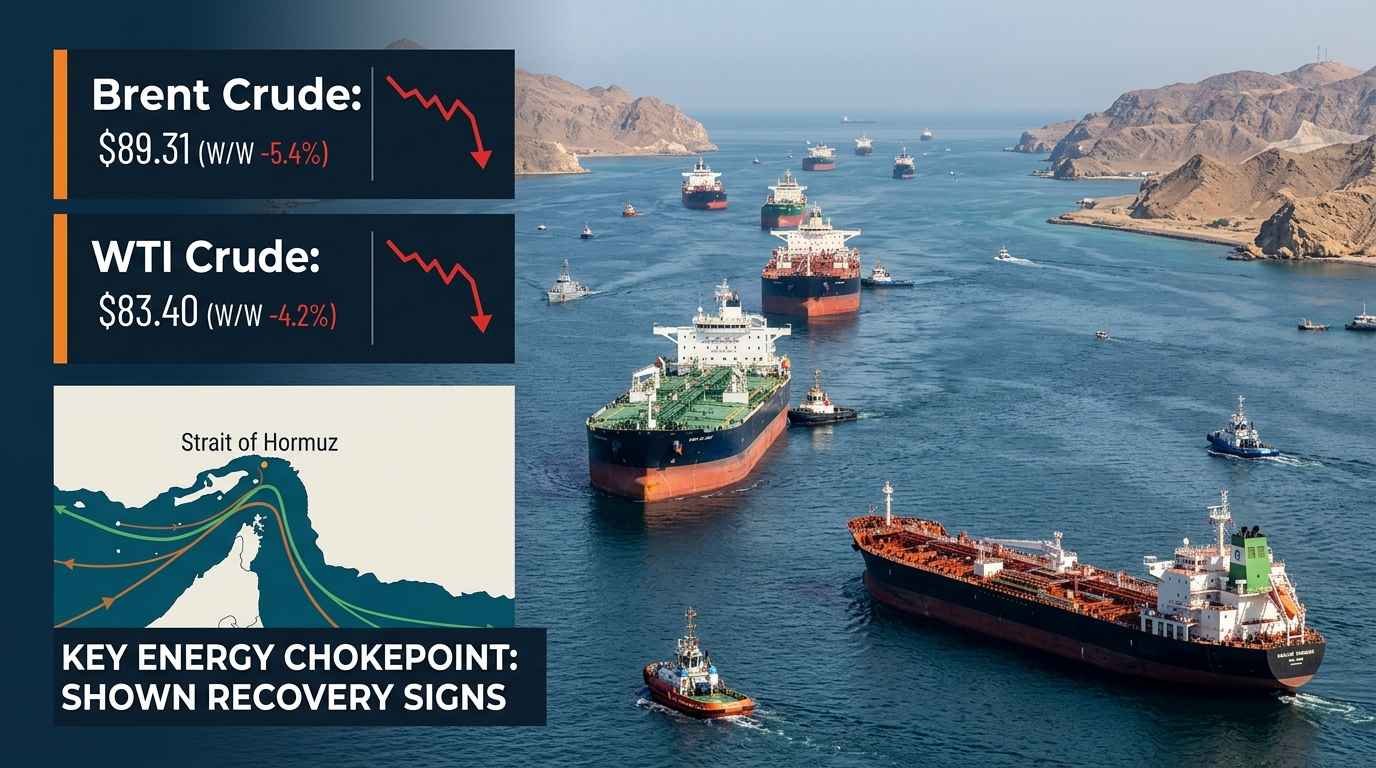
Brent crude ended Friday at $89.31 a barrel, while U.S. West Texas Intermediate (WTI) settled at $83.40. Brent fell about 5.4% for the week, while WTI declined about 4.2%.
The bigger story was what happened behind those numbers.
Markets increasingly began pricing in the possibility that more oil could reach global buyers as shipping through the Strait of Hormuz showed signs of improvement. At the same time, new U.S. sanctions on Iran, diplomatic efforts, and changing expectations about the conflict kept the market highly sensitive to geopolitical headlines.
That created an unusual situation.
Oil prices were falling even though the underlying geopolitical risk remained high.
The reason was that traders were becoming less concerned about an immediate, permanent loss of supply and more focused on whether disrupted flows could gradually recover.
The Market’s Main Question Changed
Earlier in August, the dominant question for oil investors was relatively straightforward:
How much global oil supply could be lost because of the disruption around Iran and the Strait of Hormuz?
This week, the question became more complicated:
How much oil can still reach the market despite the disruption?
That change in expectations was one of the most important developments of the week.
The Strait of Hormuz remains one of the world’s most important energy chokepoints. Reuters reported that oil flows through the waterway had shown signs of recovery, although traffic remained irregular and well below normal levels.
For oil prices, even the possibility of improving flows can matter.
Markets price future supply, not just barrels that are physically available today.
If traders believe more crude will become available in the coming weeks, the risk premium built into oil prices can begin to disappear before supply has fully normalized.
That appears to have been a major factor behind this week’s decline.
Brent and WTI Lose Ground
The week began with a sharp decline.
On Monday, Brent crude fell $2.22, or 2.35%, to $92.17, while WTI dropped $2.05, or 2.35%, to $85.01. Investors took profits after two consecutive weekly gains and largely shrugged off new U.S. sanctions against Iran.
The reaction was important.
New sanctions might normally be expected to push oil prices higher by increasing concerns about Iranian supply.
Instead, traders appeared to view the measures as part of a broader economic and diplomatic strategy rather than an immediate escalation that would remove large additional volumes of crude from the physical market.
That distinction helped weaken the bullish risk premium.
Oil therefore entered the week with a market already questioning how much of the previous rally was justified by actual supply losses.
Hormuz Becomes the Key to the Next Move
The Strait of Hormuz remained at the center of the market.
The waterway is critical because a significant share of global energy exports normally passes through it.
Any prolonged disruption can affect:
- Crude oil exports
- Refined fuel shipments
- Tanker availability
- Shipping costs
- Global energy prices
But this week, the market received signs that some shipping activity was beginning to recover.
That did not mean the strait had returned to normal.
Instead, it suggested that the physical supply shock could be less severe than the worst-case scenarios previously priced into crude.
This is why the oil market could remain geopolitically tense while crude prices moved lower.
The market was effectively removing part of the risk premium rather than declaring the supply problem over.
U.S. Inventory Data Provides a More Balanced Picture
U.S. inventory data also played an important role.
The Energy Information Administration reported that U.S. commercial crude inventories increased by only 95,000 barrels during the week ending August 21, reaching 428.9 million barrels.
That was a much smaller increase than the previous week’s large build.
The product side of the report was also notable.
Gasoline inventories fell by roughly 2.5 million barrels, while distillate inventories declined by around 2.2 million barrels.
The numbers did not point to an obvious collapse in U.S. fuel demand.
Instead, they suggested that the U.S. petroleum market remained relatively active even as crude prices were falling.
For investors, this is important because oil prices are influenced by both supply expectations and demand conditions.
A small crude inventory build does not automatically make the market bullish, but it reduces the argument that a large oversupply is building rapidly inside the United States.
The latest data can be followed through the EIA Weekly Petroleum Status Report.
Why Sanctions Did Not Send Oil Higher
One of the more interesting parts of the week was the market’s response to new U.S. sanctions on Iran.
The United States expanded economic pressure on Iran and entities doing business with the country.
Yet oil prices still declined.
That tells us something about how traders were interpreting the situation.
Sanctions can reduce oil supply, but their market impact depends on how much physical production and exports they actually remove.
If traders believe the measures will encourage negotiations or do not immediately disrupt additional barrels, the price response can be limited.
In this case, the market appeared more focused on the possibility that supply routes could gradually improve.
That reduced the impact of the sanctions on crude prices.
Thursday Shows Why Geopolitical Risk Has Not Disappeared
Oil did not move lower in a straight line.
On Thursday, Brent rebounded to around $89.70, gaining more than 2%, while WTI also recovered. The move came as expectations for an immediate diplomatic breakthrough weakened.
This was an important reminder.
The market may be reducing the supply premium, but it has not removed geopolitical risk.
Whenever negotiations appear less likely to produce a quick solution, traders can quickly add some risk premium back into crude.
That is why the oil market remains highly sensitive to headlines.
A single development involving Iran, the Strait of Hormuz or regional shipping can move prices significantly.
Friday Brings the Weekly Picture Into Focus
By Friday, crude prices were lower again.
Brent settled at $89.31, while WTI finished at $83.40. For the full week, Brent lost about 5.4%, while WTI declined approximately 4.2%.
The market was increasingly focused on signs that more oil could move through the Strait of Hormuz.
At the same time, investors were also considering the potential effect of higher U.S. interest rates on future energy demand.
That combination created pressure on crude.
The result was a week in which oil prices moved substantially lower without a corresponding disappearance of geopolitical uncertainty.
That is the key point investors should remember.
Oil Prices Are Pricing a Possible Recovery in Supply
The most important development this week was the change in the market’s supply expectations.
Oil traders appear to be increasingly confident that some disrupted supply can continue reaching the global market through a combination of:
- Improving Hormuz traffic
- Alternative export routes
- Regional production
- Diplomatic efforts
- Changes in shipping patterns
Reuters reported that Gulf oil exports had recovered significantly from their lowest levels, although flows remained below pre-conflict levels.
That is enough to change the pricing equation.
If the market once feared a dramatic and prolonged shortage, even partial recovery can reduce prices.
But the recovery does not need to be complete for the market to become less bullish.
This is why oil can fall before the physical supply situation fully returns to normal.
The U.S. Oil Market Remains Important
U.S. production will also matter as the market moves into September.
The number of active oil rigs can provide clues about how producers are responding to crude prices.
A sustained period of lower prices can eventually discourage drilling and slow future production growth.
On the other hand, elevated prices can encourage producers to maintain or increase activity.
The latest U.S. rig data showed the total oil and gas rig count remained broadly stable, while the number of active oil rigs declined during the week. That is not large enough to change the immediate supply picture, but it is worth watching as a medium-term signal.
The important point is that shale producers do not change output instantly.
Their decisions depend on expected prices, production costs, capital spending and company strategy.
Oil Still Matters for Inflation
The decline in crude prices could eventually provide some relief to consumers and businesses if it continues.
Oil affects much more than gasoline.
Lower crude prices can reduce:
- Transportation costs
- Refinery input costs
- Shipping expenses
- Manufacturing costs
- Some business operating expenses
Higher oil prices can have the opposite effect.
This is one reason energy markets are closely connected to broader inflation trends.
However, the relationship is not immediate.
A lower crude price does not automatically mean gasoline prices fall by the same amount.
Refining margins, taxes, transportation costs and local supply conditions all influence the final price consumers pay.
What the Oil Market Is Telling Investors
This week’s price action suggests that investors should be careful about describing the market as simply bullish or bearish.
There are strong arguments on both sides.
The Bullish Case
Oil could regain momentum if:
- Hormuz traffic deteriorates again
- Diplomatic efforts fail
- Energy infrastructure faces new attacks
- Iranian supply becomes more restricted
- Regional production is disrupted
Any of these developments could quickly restore the geopolitical premium.
The Bearish Case
Crude could remain under pressure if:
- Hormuz flows continue improving
- Alternative export routes expand
- Sanctions do not materially reduce physical supply
- Global economic growth slows
- Oil demand expectations weaken
The market is therefore balancing a potentially improving supply picture against the possibility of another disruption.
What September Could Look Like
September begins with the oil market in a much more uncertain position than the weekly decline might suggest.
The immediate focus will remain on the Strait of Hormuz.
If shipping activity continues to improve, traders could remove more geopolitical premium from crude prices.
If traffic deteriorates again, the market could quickly reverse.
Iran-related diplomacy will be another major factor.
A credible agreement could encourage expectations of additional supply returning to the global market.
A breakdown in negotiations could have the opposite effect.
U.S. inventory reports will also remain important.
The latest report showed crude stocks at 428.9 million barrels, while gasoline and distillate inventories declined. Future reports will help determine whether the U.S. petroleum market is becoming tighter or looser.
Global economic growth will provide another piece of the puzzle.
If economic activity remains strong, demand could provide support for crude.
If growth expectations deteriorate, demand concerns could become a larger bearish force.
The Biggest Risk for Oil Prices
The biggest upside risk is another major physical supply disruption.
Oil prices have already demonstrated how quickly geopolitical developments can change market expectations.
If the Strait of Hormuz becomes significantly less accessible again, or if additional energy infrastructure is damaged, crude could regain a large portion of its recent losses.
That risk has not disappeared.
The current price decline therefore should not be interpreted as proof that the geopolitical problem is solved.
The Biggest Downside Risk
The largest downside risk is a faster-than-expected normalization of supply.
If more tankers move through Hormuz, alternative routes continue operating and diplomatic efforts reduce tensions, global supply expectations could improve further.
That would make it harder for crude to maintain a large geopolitical premium.
A weaker global economy could add further pressure by reducing expected oil demand.
This creates two very different possible paths for September.
More supply normalization could push prices lower.
Another major disruption could send them sharply higher.
What This Week Really Changed
The August 24-28 oil market was less about the disappearance of geopolitical risk and more about a change in how investors valued that risk.
Earlier in the crisis, traders were worried about how much oil could disappear from the global market.
This week, they became increasingly focused on how much oil could continue moving despite the disruption.
That shift was enough to push Brent below $90 and WTI toward the low-$80s.
But it does not mean the physical market has returned to normal.
The Strait of Hormuz remains a major source of uncertainty.
The difference is that traders now appear to believe the world can move more oil than previously feared.
That is a meaningful change in the market narrative.
What Oil Investors Should Watch Next
The next few weeks will be driven by several indicators.
Strait of Hormuz traffic: Continued improvement would support the bearish case for crude.
Iran negotiations: A credible diplomatic breakthrough could further reduce supply concerns.
U.S. crude inventories: Weekly EIA data will show whether domestic supply is tightening or building.
Gasoline and distillate stocks: Product inventories can provide clues about fuel demand.
U.S. drilling activity: Changes in the oil rig count can provide a medium-term signal for production.
Global economic growth: Stronger growth could support demand, while weaker activity could pressure prices.
Energy infrastructure: Any new disruption could quickly change the market’s direction.
Oil Enters September With the Market Still on Edge
Oil ended August 24-28 with significant weekly losses, but the market did not become straightforward.
Brent finished at $89.31, while WTI settled at $83.40.
The decline reflected growing confidence that more oil could reach global markets, particularly as Hormuz flows showed signs of recovery.
But the geopolitical risk remains.
That is why the oil market can still change direction quickly.
The most important question for September is no longer simply whether supply is disrupted.
It is whether the improvement in physical flows can continue.
If it does, the market may continue removing its geopolitical risk premium.
If it does not, the recent decline could reverse rapidly.
Frequently Asked Questions
1. How did oil prices perform during August 24-28, 2026?
Brent crude ended the week at $89.31 a barrel, down about 5.4%, while WTI settled at $83.40, down approximately 4.2%.
2. Why did oil prices fall this week?
The main reason was a change in supply expectations. Traders increasingly believed that more oil could reach global markets as shipping through the Strait of Hormuz showed signs of recovery. That reduced part of the geopolitical risk premium built into crude prices.
3. What happened to U.S. crude inventories?
U.S. commercial crude inventories increased by 95,000 barrels to 428.9 million barrels for the week ending August 21. Gasoline and distillate inventories both declined.
4. Why is the Strait of Hormuz important to oil prices?
The Strait of Hormuz is a major global energy shipping route. Any prolonged disruption can restrict oil exports and increase concerns about global supply, which can push crude prices higher.
5. What should oil investors watch in September?
Investors should focus on Hormuz shipping activity, Iran-related negotiations, U.S. inventory data, global oil demand, U.S. drilling activity and any new disruptions to energy infrastructure.
Final Thoughts
The August 24-28 oil market showed that crude prices can fall even when geopolitical risks remain elevated.
Brent and WTI both recorded significant weekly losses because traders began placing greater weight on the possibility of improving oil flows.
That does not mean the supply problem has disappeared.
It means the market believes more oil can reach buyers than it previously expected.
That distinction is important.
If Hormuz traffic continues to recover and alternative export routes remain available, crude could face additional pressure in September.
But if negotiations fail or another major disruption occurs, the market could quickly rebuild its risk premium.
For investors, the most useful approach is therefore to watch physical oil flows rather than price alone.
The direction of crude prices in September will depend heavily on whether the recent improvement in supply conditions becomes a lasting trend.
For now, oil is no longer pricing the worst-case supply scenario. But it is still far from pricing a return to normal.
If you want to read last week’s
- Oil Market Weekly Update: please click here.
- Gold Market Weekly Update: please click here.
- Stock Market Weekly Update: please click here.
- Crypto Market Weekly Update: please click here.
Author Note: This article is crafted by “The Economic Reader editorial team”, dedicated to analyzing the latest market trends, financial updates, and global economic shifts to keep you informed with accurate and comprehensive insights.
Disclaimer: The information provided on this website is for educational and informational purposes only and should not be construed as professional financial, investment, or legal advice. Always consult with a certified financial advisor or professional before making any financial decisions based on this content.