
US Stock Market Weekly Update: What Happened in the Market from August 24-28, 2026?
US Stock Market Weekly Update: August 24-28, 2026
The U.S. stock market finished the week higher, but the headline gains only tell part of the story.
From August 24 through August 28, investors moved between two competing forces. Strong results from Nvidia reinforced optimism around artificial intelligence and corporate earnings, while renewed concerns about inflation and interest rates reminded investors that the Federal Reserve could keep monetary policy tighter for longer.
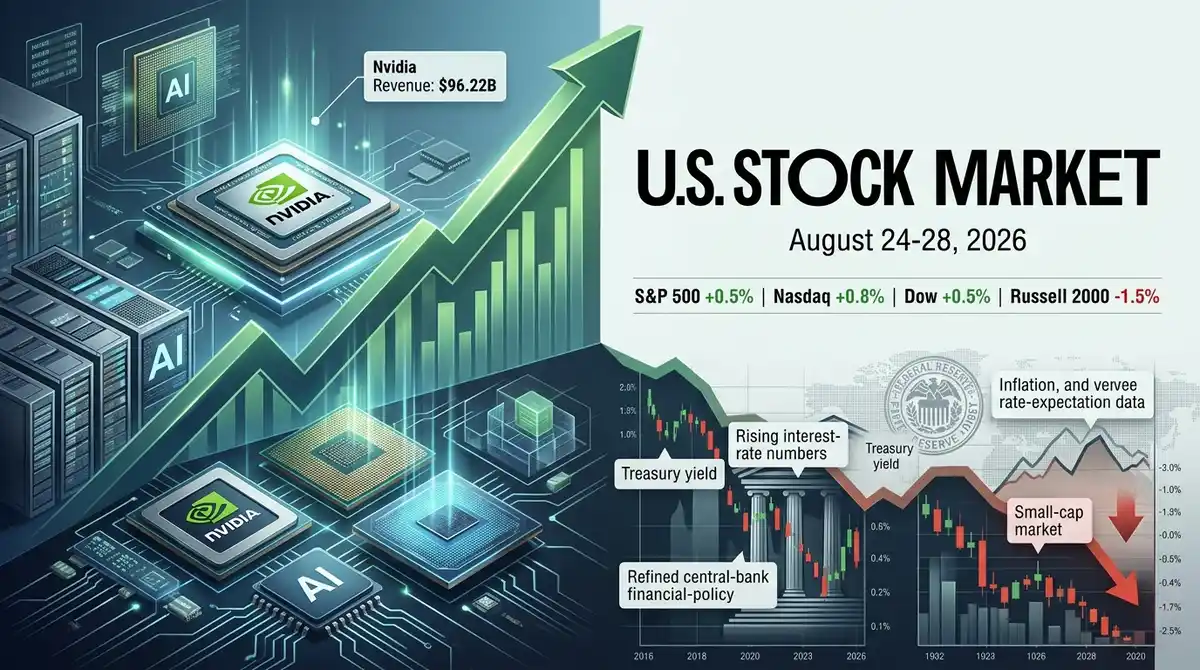
The S&P 500 gained 0.5% for the week, while the Dow Jones Industrial Average also rose 0.5%. The Nasdaq Composite gained 0.8%. The Russell 2000, however, fell 1.5%, showing that the week’s rally was concentrated in larger companies rather than spread evenly across the market. AP market report
The biggest bullish development was Nvidia’s earnings outlook. The semiconductor giant reported quarterly revenue of $96.22 billion and projected about $108 billion in revenue for its next quarter. It also forecast roughly 70% revenue growth for its next fiscal year, reinforcing expectations that AI infrastructure spending remains exceptionally strong. Reuters Nvidia report
The biggest source of pressure arrived on Friday.
Federal Reserve Chair Kevin Warsh used his Jackson Hole speech to emphasize that inflation still needs to move toward the Fed’s 2% target. His comments pushed interest rate expectations higher and contributed to a weaker finish for stocks.
So, what really happened in the U.S. stock market last week, and what should investors watch as September begins?
U.S. Stock Market Performance: August 24-28
The major U.S. indexes ended the week in positive territory, although the final trading session gave back some of the gains built earlier in the week.
| Index | August 28 Close | Weekly Change |
| S&P 500 | 7,711.76 | +0.5% |
| Dow Jones Industrial Average | 53,559.99 | +0.5% |
| Nasdaq Composite | 26,402.42 | +0.8% |
| Russell 2000 | 2,972.37 | -1.5% |
On Friday, the S&P 500 slipped 0.2% to 7,711.76, while the Nasdaq fell 0.5% to 26,402.42. The Dow declined less than 0.1%, and the Russell 2000 dropped 1.4%. AP’s August 28 market report
The weekly figures are important, but the difference between the major indexes is even more revealing.
Technology heavy large cap stocks remained relatively strong, helped by Nvidia and other companies benefiting from AI spending. Smaller companies struggled, reflecting greater sensitivity to borrowing costs and economic conditions.
For readers looking for a broader explanation of how these indexes fit together, see Economic Reader’s What Is the Stock Market?.
Stocks Started the Week With Caution
The week began with investors taking a defensive approach.
Technology stocks came under pressure on Monday as traders waited for Nvidia’s earnings and prepared for Federal Reserve Chair Kevin Warsh’s Jackson Hole speech later in the week. The S&P 500 and Nasdaq both moved lower, while investors also watched Treasury yields and geopolitical developments. Reuters market report from August 24
The market had several unanswered questions.
Would Nvidia’s results justify the high expectations surrounding AI stocks?
Would the Federal Reserve signal that interest rates could eventually move lower?
And would inflation continue to prevent the central bank from easing policy?
Those questions kept investors cautious during the early part of the week.
The mood improved as Nvidia’s earnings approached. Investors were willing to take on more technology exposure, but the market remained sensitive to movements in bond yields.
That combination set up the major turning point of the week.
Nvidia Revived the AI Trade
Nvidia became the most important corporate story of the week.
The company reported $96.22 billion in quarterly revenue, more than double the previous year, and provided a stronger than expected outlook for the following quarter. Nvidia said it expects revenue of approximately $108 billion, plus or minus 2%. Reuters Nvidia earnings coverage
The company also projected approximately 70% revenue growth for its fiscal year ending January 2028.
That forecast was significant because investors have been questioning how long the current AI spending boom can continue.
Major technology companies have committed enormous amounts of money to data centers, advanced chips and AI infrastructure. For the stock market, the critical question is whether those investments will eventually generate enough revenue and profits to justify their cost.
Nvidia’s latest results provided another reason for investors to believe the cycle still has room to run.
The company’s outlook also helped lift other technology and semiconductor stocks.
The broader message was clear: demand for AI computing remains strong, and investors are still willing to reward companies that can demonstrate tangible growth from that demand.
However, strong earnings do not eliminate valuation risk.
When expectations are already extremely high, companies need to continue delivering exceptional results to keep investors satisfied. A slowdown in AI spending or weaker than expected future guidance could therefore have an outsized effect on the technology sector.
That is something investors will continue watching in the months ahead.
Thursday Delivered a Strong Technology Rally
The market’s reaction to Nvidia became particularly clear on Thursday.
The Nasdaq Composite jumped 1.57%, the S&P 500 gained 0.72%, and the Dow rose 0.20%. Technology stocks led the advance as investors responded to Nvidia’s strong outlook and other corporate earnings. MarketWatch August 27 market coverage
The move was important because it demonstrated that investors were still willing to buy growth stocks despite concerns about interest rates.
For much of the year, the market has been trying to balance two realities.
Corporate earnings, particularly in technology, remain strong.
At the same time, interest rates and inflation continue to create pressure on valuations.
Thursday showed which side of that argument was winning for the moment.
But that did not last into Friday.
The Federal Reserve Changed the Tone
Federal Reserve Chair Kevin Warsh’s Jackson Hole speech became the week’s most important policy event.
Warsh emphasized the importance of achieving price stability and said the Federal Reserve needs confidence that inflation is moving toward its 2% objective at a sufficient pace.
His comments were interpreted by financial markets as a signal that policymakers could be willing to keep rates higher, or potentially raise them, if inflation remains too persistent.
That changed the tone of the market.
According to market pricing reported Friday, the probability of a September rate increase rose to roughly 58%, compared with 35% on Thursday. The two year Treasury yield also climbed sharply, reaching around 4.35%. AP’s August 28 market report
The significance goes beyond one Fed meeting.
Higher interest rate expectations can affect the valuation of stocks, corporate borrowing costs and investor demand for bonds.
When Treasury yields become more attractive, some investors may become less willing to pay very high prices for riskier assets.
This is particularly relevant for growth companies whose valuations depend heavily on future earnings.
For a basic explanation of inflation and its effect on the economy, see Economic Reader’s What Is Inflation?.
Why Interest Rates Matter for Stocks
The relationship between interest rates and stocks is one of the most important factors behind last week’s market movements.
When interest rates rise, borrowing becomes more expensive for businesses and consumers. Higher rates can also increase the attractiveness of bonds and other fixed income investments.
Stock valuations can come under pressure because future corporate earnings are worth less when discounted using higher interest rates.
Growth stocks can be especially sensitive to this effect.
That does not mean technology stocks automatically fall whenever rates rise.
Nvidia demonstrated the opposite last week. Its strong earnings outlook gave investors a reason to overlook some of the pressure coming from higher rate expectations.
The bigger concern is what happens if higher rates persist while corporate earnings growth begins to slow.
That combination would be more difficult for the stock market.
For now, investors appear to be separating companies with strong earnings momentum from companies that are more dependent on lower borrowing costs.
The performance of the Russell 2000 provides a useful example.
Small Cap Stocks Fell Behind
The Russell 2000 declined 1.5% during the week, even as the Nasdaq gained 0.8%.
That gap is worth watching.
Small cap companies often have greater exposure to domestic economic conditions and borrowing costs. Many smaller businesses also have less financial flexibility than the largest technology companies.
Large technology companies, by contrast, often have strong cash positions, high margins and global revenue streams.
As a result, investors may be more comfortable holding large technology companies when interest rate uncertainty increases.
The Russell 2000’s weakness suggests that last week’s optimism was not broad enough to lift every part of the market.
The market was rewarding specific areas where earnings growth remained compelling.
That is an important distinction for investors.
A rising S&P 500 does not necessarily mean that most stocks are performing equally well.
The performance gap between large technology companies and smaller businesses shows why investors should look beyond the headline index number.
The U.S. Economy Is Still Growing, But More Slowly
The stock market also received an important update on economic growth during the week.
The Bureau of Economic Analysis reported that real U.S. GDP increased at an annualized rate of 1.5% in the second quarter of 2026. That was unchanged from the advance estimate and below the 2.1% growth recorded in the first quarter. U.S. Bureau of Economic Analysis GDP release
The number does not indicate that the U.S. economy is collapsing.
Growth remains positive.
But the slowdown matters because it creates a more complicated environment for monetary policy.
If economic growth slows while inflation also falls, the Federal Reserve could have more room to ease policy.
If growth slows while inflation remains stubbornly high, the Fed faces a much more difficult decision.
That is essentially the situation investors are trying to understand now.
The economy is expanding, but not as quickly as it did in the previous quarter. At the same time, inflation remains above the central bank’s preferred level.
This combination makes upcoming economic reports particularly important.
Readers who want to understand the broader concept of economic contraction can explore Economic Reader’s What Is a Recession?.
Inflation Remains a Problem for the Fed
Inflation continues to be one of the biggest risks facing the market.
The Federal Reserve’s 2% inflation objective remains well below current price growth, meaning policymakers cannot simply assume that inflation will return to target without further restraint.
That is why Warsh’s comments mattered so much.
Investors had been hoping that slower economic growth could eventually lead to easier monetary policy. But if inflation remains elevated, the Fed may have to prioritize price stability even if that creates additional pressure on economic activity.
For the stock market, this creates a difficult balancing act.
Companies need a healthy economy to maintain revenue and earnings growth.
Investors also want lower interest rates because lower rates can support valuations.
But the Fed cannot comfortably reduce rates if inflation remains too high.
That tension is likely to remain one of the biggest market themes as September unfolds.
What the Market Is Saying About Investor Confidence
The week’s index performance suggests that investors have not abandoned stocks.
The S&P 500 and Nasdaq remained close to record levels, and Nvidia’s results produced a powerful rally in technology shares.
But the weakness in small cap stocks and Friday’s reaction to Warsh’s comments show that investors are not ignoring risks.
The market appears to be increasingly selective.
Investors are willing to pay for strong earnings growth, especially when companies can demonstrate that AI spending is producing real business results.
At the same time, they are more cautious toward companies that are heavily exposed to borrowing costs or weaker economic conditions.
That could make market breadth an important issue in the weeks ahead.
If more sectors begin participating in the rally, it could signal broader confidence.
If gains remain concentrated among a small group of technology leaders, the market could become more vulnerable to disappointment in those companies.
What Investors Should Watch in September
The next few weeks could be just as important as the events of last week.
1. The August Jobs Report
The August U.S. employment report is scheduled for September 4.
Investors will be watching payroll growth, unemployment and wage trends for clues about the health of the labor market.
A stronger labor market could reduce pressure on the Fed to cut rates.
A weaker report could increase expectations for easier policy, especially if inflation continues to moderate.
2. Federal Reserve Rate Expectations
Warsh’s speech has made the September policy outlook more uncertain.
The market is now assigning greater importance to incoming economic data.
That means even relatively small surprises in inflation or employment figures could produce larger movements in Treasury yields and stocks.
3. AI Earnings and Spending
Nvidia has raised expectations for the AI sector again.
The next question is whether other companies can demonstrate similar levels of demand.
Broadcom and other semiconductor and technology companies will be closely watched for evidence that AI investment is spreading across the industry rather than remaining concentrated in a few companies.
4. Treasury Yields
Bond yields could remain one of the most important market signals.
If yields continue moving higher, growth stocks may face renewed valuation pressure.
If yields stabilize, investors may focus more heavily on earnings and economic growth.
5. Small Cap Performance
The Russell 2000’s decline last week deserves continued attention.
A recovery in small cap stocks could suggest that investors are becoming more confident about domestic economic conditions.
Continued weakness could indicate that borrowing costs remain a significant concern.
The Bottom Line
The U.S. stock market ended August 24-28 with modest gains, but the week revealed a market that is becoming increasingly sensitive to the conflict between earnings growth and monetary policy.
The S&P 500 gained 0.5%, the Dow rose 0.5%, and the Nasdaq advanced 0.8%. Yet the Russell 2000 fell 1.5%, highlighting the uneven nature of the rally. AP’s weekly market summary
Nvidia gave investors fresh confidence in the AI growth story.
The Federal Reserve gave them a reason to remain cautious.
The economy continued to expand, but at a slower pace than in the first quarter.
And interest rate expectations moved higher as the week ended.
That leaves investors entering September with several important questions still unanswered.
Can corporate earnings continue to justify elevated stock valuations?
Will inflation move closer to the Fed’s 2% target?
And will the labor market provide enough evidence for the Federal Reserve to change its policy direction?
The answers will likely determine whether the market’s late August strength can continue.
Frequently Asked Questions
1. How did the U.S. stock market perform from August 24-28, 2026?
The S&P 500 and Dow Jones Industrial Average each gained 0.5% for the week, while the Nasdaq Composite rose 0.8%. The Russell 2000 declined 1.5%. AP’s August 28 market report
2. What was the biggest positive catalyst for stocks last week?
Nvidia’s earnings and forward guidance were the biggest positive catalyst. The company reported $96.22 billion in quarterly revenue and forecast approximately $108 billion in revenue for the following quarter, reinforcing confidence in continued AI infrastructure demand. Reuters Nvidia report
3. Why did stocks fall on Friday?
Stocks declined after Federal Reserve Chair Kevin Warsh emphasized the importance of bringing inflation back toward the Fed’s 2% target. His comments increased expectations for tighter monetary policy and pushed Treasury yields higher. Reuters August 28 market report
4. Why did the Russell 2000 underperform the Nasdaq?
The Russell 2000 is more heavily exposed to smaller domestic companies that can be sensitive to borrowing costs and economic conditions. Meanwhile, the Nasdaq benefited from strong performance among large technology and AI related companies.
5. What should investors watch as September begins?
The August jobs report, Federal Reserve rate expectations, Treasury yields, AI related earnings and the performance of small cap stocks will be among the most important factors for the market as September begins.
Final Thoughts
The past week showed that a strong stock market can still carry significant uncertainty underneath the surface.
The most interesting part of the market was not simply that the major indexes finished higher. It was the way investors responded differently to corporate earnings and monetary policy signals.
Strong AI earnings were enough to attract buyers, but expectations around interest rates remained powerful enough to reverse sentiment quickly.
That makes the next stage of the market less about chasing the strongest weekly gain and more about watching whether the underlying conditions continue to support higher valuations.
As September begins, investors will have new economic data to consider, and the market’s reaction to that information may reveal whether the late August rally has broader strength or remains dependent on a relatively narrow group of market leaders.
If you want to read last week’s
- Crypto Market Weekly Update: please click here.
- Stock Market Weekly Update: please click here.
- Gold Market Weekly Update: please click here.
- Oil Market Weekly Update: please click here.
Author Note: This article is crafted by “The Economic Reader editorial team”, dedicated to analyzing the latest market trends, financial updates, and global economic shifts to keep you informed with accurate and comprehensive insights.
Disclaimer: The information provided on this website is for educational and informational purposes only and should not be construed as professional financial, investment, or legal advice. Always consult with a certified financial advisor or professional before making any financial decisions based on this content.