
Crypto Market Monthly Update: August 2026 Bitcoin Rebounds as Institutional Demand Returns
Crypto Market Monthly Update: August 2026
August 2026 changed the mood in the cryptocurrency market.
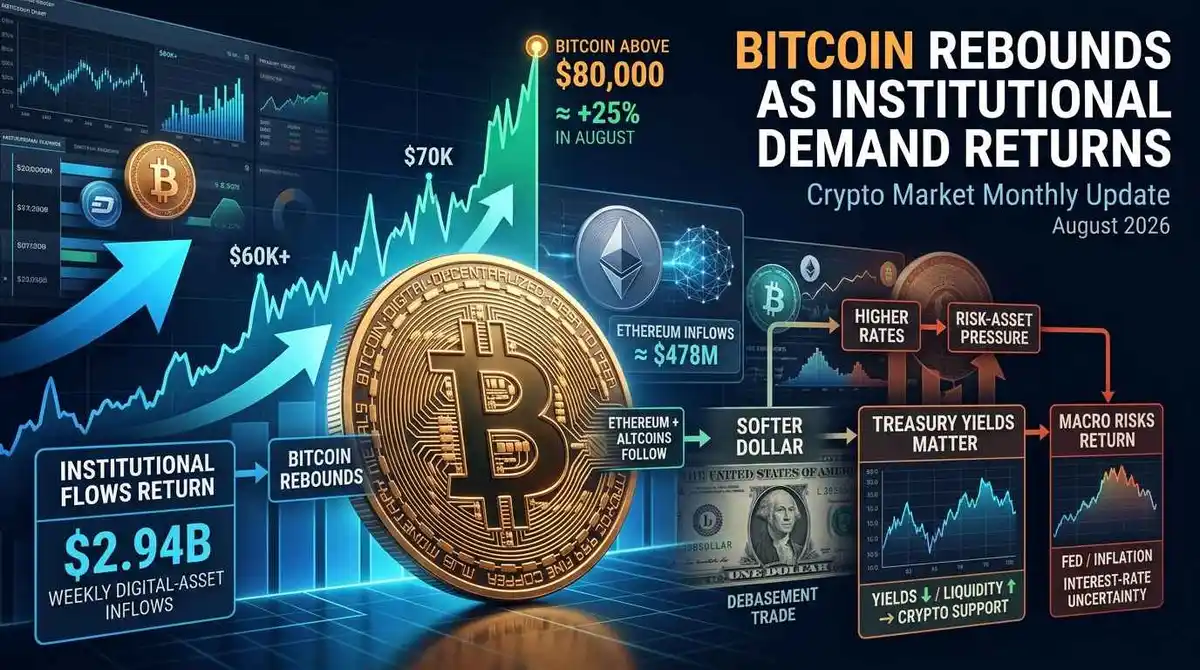
After spending much of the earlier part of the year under pressure, Bitcoin staged a powerful recovery during August, briefly moving above $80,000 as investors returned to digital assets. Ethereum and several major altcoins also strengthened, while institutional investment flows turned increasingly positive.
The recovery was not driven by a single event. A softer dollar, changing expectations around U.S. monetary policy, renewed interest in alternative assets and stronger institutional participation all contributed to the improvement.
But August was not simply a month of rising crypto prices. The final days showed that digital assets remained highly sensitive to the same forces affecting stocks, bonds and commodities particularly interest rates, Treasury yields and inflation expectations.
The result was a month that looked increasingly important for the next phase of the crypto market.
Bitcoin’s August comeback was the headline
Bitcoin began August in the $60,000s after a difficult period for digital assets. By late August, the picture had changed dramatically.
Bitcoin moved above $70,000 on August 20 and continued higher, eventually reaching above $80,000 on August 24–25.
Reuters reported on August 25 that Bitcoin had reached $81,237.94, its highest level since mid-May, and was up about 28% at that point in the month. The move put Bitcoin on course for its strongest monthly gain since November 2024. (Reuters)
Because cryptocurrency markets operate 24 hours a day, seven days a week, monthly returns can differ slightly depending on the exchange and the exact timestamp used. A more useful description for an editorial monthly review is therefore that Bitcoin gained roughly a quarter during August and briefly returned above the $80,000 level.
That was a significant change from the start of the month.
The important question, however, was what was behind the move.
The first signs of recovery appeared in capital flows
The price recovery did not happen in isolation.
Institutional flows into digital-asset investment products had already begun improving earlier in August.
CoinShares reported on August 7 that digital-asset investment products had attracted approximately $1.05 billion of inflows during the week, which would have represented a fifth consecutive positive week. That followed an eight-week period during which investors had withdrawn around $8 billion. (CoinShares)
That sequence matters.
The crypto market was beginning to see capital return before Bitcoin made its most significant move higher.
By August 20, the momentum had become much stronger. CoinShares reported that digital-asset investment products recorded approximately $2.94 billion of inflows for the week, the largest weekly inflow of 2026 at that point. (CoinShares)
This gave the August rally a more convincing foundation than a simple short-term trading bounce.
When prices rise alongside stronger investment flows, it suggests that investors are not merely chasing momentum. At least some of the move is being supported by fresh capital entering the asset class.
A weaker dollar helped change the investment backdrop
Another important part of the August story was the U.S. dollar.
Bitcoin has often responded positively when expectations for the dollar and U.S. monetary policy become less restrictive. That relationship is not mechanical, but changes in dollar liquidity, Treasury yields and interest-rate expectations can materially affect investor appetite for risk assets.
The relationship became particularly visible in August.
Reuters reported that Bitcoin’s move above $80,000 was supported by a softer dollar and growing concerns about the long-term value of fiat currencies, alongside a U.S. Treasury move to increase purchases of longer-dated government debt. (Reuters)
This contributed to what investors sometimes call the debasement trade demand for assets that investors believe may retain value if concerns about government debt, currency purchasing power or fiscal policy increase.
Bitcoin benefited from that narrative during August.
But it is important not to overstate it. Bitcoin is not a traditional safe-haven asset in the same way as high-quality government bonds or gold. Its price volatility remains substantially higher.
August simply showed that investors were once again willing to include Bitcoin in a broader macroeconomic portfolio discussion.
The Treasury market unexpectedly became part of the crypto story
One of the more unusual developments of August was the growing connection between Bitcoin’s recovery and the U.S. Treasury market.
Long-term Treasury yields had risen sharply, creating pressure on risk assets. Higher bond yields can make safer assets relatively more attractive and increase the discount rate applied to future earnings and cash flows.
That environment is generally difficult for speculative assets.
The Treasury’s decision to increase its buyback operations helped calm some concerns about longer-term yields. Reuters reported on August 20 that the move contributed to a rally in crypto assets, with Bitcoin rising above $70,000 for the first time since June. (Reuters)
This was a useful reminder that crypto is now deeply connected to global liquidity conditions.
Bitcoin may operate on a decentralized blockchain, but its market price is still influenced by central-bank policy, bond yields, currency movements and global investor risk appetite.
Ethereum finally started attracting serious attention
Bitcoin remained the dominant story, but Ethereum’s performance became increasingly important during the second half of August.
The broader crypto recovery allowed capital to move beyond Bitcoin, and Ethereum began attracting substantial institutional investment.
Coin Shares reported on August 27 that digital-asset investment products received approximately $1.65 billion of inflows during the first three trading days of that week. Bitcoin accounted for about $976 million, while Ethereum attracted approximately $478 million. XRP, Solana and Hyper liquid also recorded positive flows. (CoinShares)
That was significant for two reasons.
First, it showed that institutional demand was not limited to Bitcoin.
Second, it suggested that investors were becoming more comfortable taking risk further down the crypto market’s hierarchy as confidence improved.
Ethereum’s investment case is also different from Bitcoin’s.
Bitcoin’s appeal is increasingly connected with scarcity, monetary alternatives and digital-store-of-value arguments. Ethereum is more closely tied to blockchain infrastructure, smart contracts, decentralized applications, tokenization and stablecoin activity.
A sustained crypto recovery could therefore eventually become less dependent on Bitcoin alone.
For readers who want to understand one of the investment vehicles increasingly used to gain exposure to digital assets, Economic Reader’s What Is an ETF? provides useful background.
Altcoins started following Bitcoin
The improvement in Ethereum was part of a broader rotation.
Coin Shares’ late-August data showed positive flows into XRP, Solana and Hyper liquid alongside Bitcoin and Ethereum. (CoinShares)
This is a familiar pattern in crypto markets.
Bitcoin often leads the initial recovery. Once confidence improves, investors begin looking for higher-growth opportunities elsewhere in the market.
That can produce much larger gains in individual altcoins, but it also introduces substantially greater risk.
Not every altcoin benefits from the same fundamental factors. Some have strong network activity or institutional interest, while others can rise primarily because speculative appetite has returned.
For investors, that distinction becomes increasingly important when a broad crypto rally begins to mature.
Regulation remained part of the investment case
Policy developments in the United States also supported the broader crypto narrative during August.
On August 20, Reuters reported that President Donald Trump had called on lawmakers to pass the Clarity Act, legislation intended to establish clearer rules around whether digital assets fall under securities or commodities regulation and which U.S. regulator should oversee different parts of the market. (Reuters)
Regulatory clarity matters because institutional investors generally prefer markets where the legal framework is easier to understand.
For years, uncertainty over the treatment of cryptocurrencies in the United States has been one of the sector’s major obstacles to wider institutional participation.
That does not mean every proposed law will immediately transform the market.
But clearer rules can reduce uncertainty for exchanges, asset managers, banks, payment companies and other financial institutions considering digital-asset products.
Stablecoins were quietly becoming a bigger story
While Bitcoin’s price dominated headlines, stablecoins were developing into another important part of the crypto industry’s longer-term story.
Stablecoins are designed to maintain a relatively stable value, usually by being linked to a fiat currency such as the U.S. dollar. Their importance comes from their potential use in payments, settlement, trading and cross-border transfers.
August brought increasing evidence that traditional financial institutions were paying attention to this part of the digital-asset ecosystem.
That matters because stablecoins can provide a bridge between traditional finance and blockchain-based financial infrastructure.
The potential impact may ultimately extend beyond cryptocurrency trading.
If banks, payment networks and fintech companies increasingly use blockchain-based settlement infrastructure, the long-term growth of digital assets could depend as much on this financial infrastructure as on the price of Bitcoin itself.
The rally still had a fragile side
The biggest weakness in August’s recovery became visible toward the end of the month.
Federal Reserve Chairman Kevin Warsh’s August 28 remarks reinforced concerns that inflation remained too high and that monetary policy might need to remain restrictive.
Coin Shares noted in its August 27 market update that U.S. headline PCE inflation was running at 3.7%, while core PCE was 3.3% year over year. The firm argued that sticky inflation was limiting the scope for materially easier monetary policy. (CoinShares)
That created a difficult environment for crypto.
If interest rates remain high for longer, investors have less incentive to take additional risk. Higher Treasury yields can also make government bonds more attractive relative to volatile assets such as cryptocurrencies.
Bitcoin therefore gave back some of its late-August gains and finished the month below its brief $80,000-plus peak.
That did not erase the August recovery.
It simply demonstrated that the market still needed supportive macroeconomic conditions to sustain the move.
August was not a return to the old crypto cycle
One of the most important conclusions from August is that the cryptocurrency market is changing.
The market is increasingly influenced by institutional investment products, macroeconomic policy, Treasury yields, regulatory developments and traditional financial institutions.
At the same time, crypto retains characteristics that make it very different from conventional asset classes.
Bitcoin can move thousands of dollars in a short period. Altcoins can experience even larger swings. Market sentiment can change quickly, and liquidity can disappear during periods of stress.
Institutional participation does not remove those risks.
Instead, it means that crypto is becoming more integrated into the global financial system while remaining a high-volatility asset class.
That combination is likely to define the next phase of the market.
What August means for September
August left crypto investors with a stronger market but a more complicated outlook.
The most important question is whether the factors that supported the recovery can continue.
Institutional flows
The strongest bullish signal from August was the return of capital into digital-asset investment products.
If those inflows continue, they could provide an important foundation for further gains.
If they reverse sharply, it would suggest that August’s rally was driven more by short-term positioning than durable demand.
Federal Reserve policy
Interest-rate expectations remain critical.
A softer inflation environment could improve conditions for risk assets, while persistent inflation could keep monetary policy restrictive.
The September Federal Reserve meeting will therefore be closely watched by crypto investors as well as stock and bond investors.
Bitcoin’s ability to hold higher levels
Bitcoin’s move above $80,000 was psychologically important.
But the more meaningful test is whether it can maintain the higher trading range established during August.
Reuters’ September 3 technical analysis noted that Bitcoin had risen around 30% in recent weeks and had broken above several important moving averages, while identifying the area around its May high as a major resistance zone. (Reuters)
For a monthly review focused strictly on August, the key conclusion is simple: Bitcoin ended August in a much stronger technical and sentiment position than where it began the month, but the recovery still needed confirmation.
FAQ
1. How did Bitcoin perform in August 2026?
Bitcoin gained roughly a quarter during August, moving from the $60,000s at the beginning of the month to the upper-$70,000s by month-end and briefly trading above $80,000. Reuters reported that Bitcoin was up about 28% by August 25. Exact monthly returns can vary because cryptocurrency markets operate continuously. (Reuters)
2. What caused the crypto market to recover in August?
Several factors contributed, including stronger institutional investment flows, a softer U.S. dollar, changing expectations around monetary policy, renewed interest in alternative assets and improving sentiment toward the digital-asset sector.
3. Did Ethereum also benefit from the August recovery?
Yes. Ethereum attracted significant institutional investment flows during the second half of August. Coin Shares reported approximately $478 million of Ethereum inflows during the first three trading days of the week ending August 27. (CoinShares)
4. Why are institutional crypto flows important?
Institutional flows can provide a more sustained source of demand than short-term speculative trading. August’s strong inflows suggested that professional investors were becoming more willing to allocate capital to digital assets after the earlier weakness.
5. What should crypto investors watch after August?
The main factors are Federal Reserve policy, inflation, Treasury yields, the U.S. dollar, institutional investment flows and Bitcoin’s ability to maintain the higher levels reached during August. Regulatory developments and broader risk appetite will also remain important.
Final Thoughts
August 2026 was a turning point for the cryptocurrency market.
Bitcoin recovered sharply and briefly moved above $80,000. Institutional flows strengthened. Ethereum and selected altcoins began attracting more capital, while regulatory and stablecoin developments highlighted how much the digital-asset industry is becoming part of mainstream finance.
But August also showed that crypto has not escaped the influence of the traditional financial system.
Interest rates still matter. Treasury yields still matter. The U.S. dollar still matters. Inflation still matters.
That is perhaps the most important lesson from the month.
The next stage of the crypto market is unlikely to be determined by Bitcoin’s price alone. It will depend on whether institutional demand continues, whether macroeconomic conditions become more supportive and whether the broader digital-asset ecosystem can convert growing adoption into sustainable economic activity.
August gave the market renewed momentum.
September will show whether that momentum can become a lasting trend.
If you want to read July Month’s
- Oil Market Monthly Update: please click here.
- Gold Market Monthly Update: please click here.
- Stock Market Monthly Update: please click here.
- Crypto Market Monthly Update: please click here.
Author Note: This article is crafted by “The Economic Reader editorial team”, dedicated to analyzing the latest market trends, financial updates, and global economic shifts to keep you informed with accurate and comprehensive insights.
Disclaimer: The information provided on this website is for educational and informational purposes only and should not be construed as professional financial, investment, or legal advice. Always consult with a certified financial advisor or professional before making any financial decisions based on this content.