
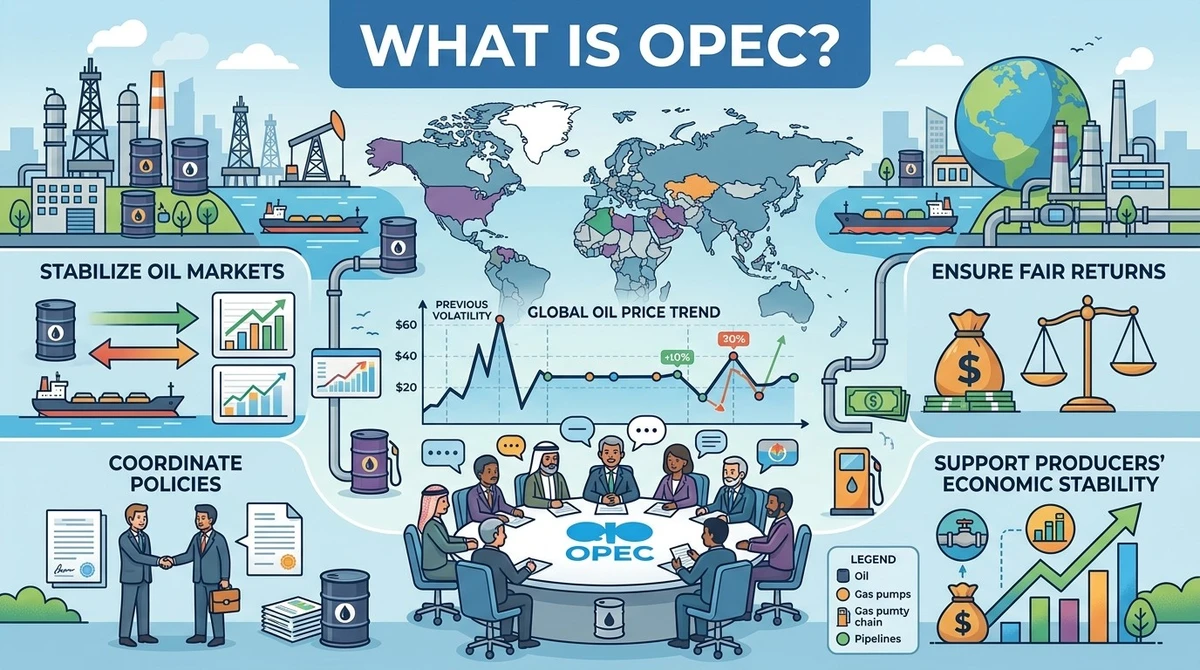
What Is OPEC? Understanding the Organization That Influences Oil Markets
When oil prices move sharply, one name appears again and again in financial news: OPEC.
The Organization of the Petroleum Exporting Countries is often described as a group that “controls” oil prices. That description is too simple. OPEC does not directly set the price consumers pay for gasoline, diesel, jet fuel, or crude oil. Instead, its members can influence the global balance between oil supply and demand by coordinating production decisions.
That influence matters because oil is still deeply connected to transportation, manufacturing, shipping, agriculture, electricity generation, and household energy costs. A change in crude oil prices can therefore spread through the wider economy.
Understanding OPEC requires looking beyond production quotas. Its influence depends on how much oil its members produce, how much spare capacity they have, what non-OPEC producers are doing, how strong global demand is, and how traders expect the market to develop.
What Is OPEC?
OPEC stands for the Organization of the Petroleum Exporting Countries. It is an intergovernmental organization created to coordinate and unify petroleum policies among its member countries.
OPEC was founded in Baghdad in September 1960 by Iran, Iraq, Kuwait, Saudi Arabia, and Venezuela. The founding countries were seeking greater control over their petroleum policies and a stronger collective position in an international oil industry that was then dominated by large international oil companies. (OPEC)
The organization’s stated objectives include supporting stability in the international oil market while considering the interests of both producing and consuming countries. (OPEC)
OPEC is headquartered in Vienna, Austria, where its Secretariat conducts research, publishes market data and analysis, and supports meetings between member governments.
The important point is that OPEC is not a single oil company and does not operate one centralized oil field. Each member country controls its own domestic petroleum industry.
Who Belongs to OPEC?
OPEC’s membership has changed considerably since 1960. Countries have joined, left, suspended membership, and returned at different points in the organization’s history.
One important recent change occurred in 2026. The United Arab Emirates announced that it would leave OPEC effective May 1, 2026. Before its departure, the UAE was one of the group’s largest producers and had significant production capacity. (U.S. Energy Information Administration)
This matters because OPEC’s influence depends partly on the amount of oil its members can actually produce. Membership numbers alone do not tell you how much market influence the organization has.
Saudi Arabia remains particularly important because of its large production capacity and role in the global oil market. EIA estimated that Saudi Arabia had about 11.6 million barrels per day of effective production capacity in 2025. (U.S. Energy Information Administration)
How Does OPEC Influence Oil Prices?
The basic mechanism is supply.
Imagine global oil demand is relatively strong while available supply is growing slowly. If OPEC members reduce production, less crude enters the market. If demand does not fall by a similar amount, the market becomes tighter.
A tighter market can put upward pressure on crude oil prices.
The opposite can also happen. If OPEC members increase production while demand remains weak or grows slowly, additional supply can place downward pressure on prices.
The relationship is not mechanical, however.
The U.S. Energy Information Administration notes that crude oil prices are determined by global supply and demand, with economic growth, petroleum consumption, non-OPEC production, OPEC production decisions, and expectations all playing important roles. (U.S. Energy Information Administration)
That is why an OPEC production announcement should not automatically be interpreted as “oil prices will rise.”
The size of the production change matters, but so does the condition of the wider market.
What Are OPEC Production Quotas?
One of OPEC’s most important tools is the use of production targets.
A production target establishes how much crude a participating country is expected to produce over a particular period.
If several major producers agree to reduce their output, the combined reduction can materially affect global supply.
But a quota is not the same as a physical shutdown switch.
Individual governments and national oil companies ultimately control production in their countries. Actual output can differ from agreed targets because of technical problems, investment limitations, domestic priorities, geopolitical conditions, or decisions by individual producers.
EIA specifically notes that compliance with OPEC production targets can vary, which can reduce the effectiveness of coordinated supply management. (U.S. Energy Information Administration)
This is one reason oil-market analysts pay attention to actual production, not just official announcements.
OPEC vs OPEC+: What Is the Difference?
This distinction is essential.
OPEC consists of the organization’s member countries.
OPEC+ is the broader cooperation framework involving OPEC members and selected non-OPEC oil-producing countries.
The modern OPEC+ framework grew out of the 2016 Declaration of Cooperation. Major non-OPEC producers, including Russia, joined OPEC members in coordinating production adjustments. (OPEC)
The broader group matters because some major oil producers are outside OPEC.
Russia is the clearest example. It is not an OPEC member, but it has participated in the OPEC+ framework and has been an important part of coordinated production decisions.
That makes OPEC+ much larger and more influential than OPEC alone.
In 2025, OPEC including the UAE accounted for an estimated 35% of global crude oil production. EIA estimated that the broader OPEC+ group accounted for about 46% of global crude production that year. After the UAE’s departure, the shares are lower. (U.S. Energy Information Administration)
Why Spare Capacity Matters
Production today is only part of the story.
Oil markets also care about how much additional production can become available if supply is disrupted.
This is known as spare capacity.
Suppose global demand is 100 million barrels per day and producers are currently supplying that amount. If a major producer has the ability to quickly increase output, the market has an additional buffer.
But if producers are already operating close to their sustainable limits, a sudden supply disruption can create much greater pressure on prices.
EIA describes spare capacity as production that can be brought online relatively quickly and sustained for an extended period. It acts as a potential buffer against supply disruptions. (U.S. Energy Information Administration)
This is one reason Saudi Arabia’s production capacity matters beyond the barrels it actually produces.
A country with significant unused capacity can potentially respond to changing market conditions in a way that a producer already operating at full capacity cannot.
OPEC Does Not Control All Global Oil Supply
This is where the simple “OPEC controls oil” narrative breaks down.
Large quantities of crude are produced outside OPEC.
The United States, Russia, Canada, Brazil, Norway, and other non-OPEC producers can materially affect global supply.
EIA estimates that countries outside OPEC accounted for about 65% of global crude oil production in 2024. (U.S. Energy Information Administration)
That means OPEC cannot make supply decisions in isolation.
For example, if OPEC reduces production but U.S. shale producers, Brazil, Canada, or other producers increase output, part of the reduction can be offset.
This creates a constant strategic problem for OPEC: reducing supply may support prices, but higher prices can also encourage competing producers to invest in additional production.
Why U.S. Shale Changed the Oil Market
The growth of U.S. shale production is one of the major changes in the modern oil market.
Hydraulic fracturing and horizontal drilling allowed U.S. producers to unlock large volumes of oil from shale formations.
The result was a significant increase in non-OPEC supply.
The broader OPEC+ cooperation framework emerged in 2016 partly in response to a period of severe oil-market imbalance associated with rapidly increasing U.S. shale production and falling oil prices. (U.S. Energy Information Administration)
This illustrates an important economic principle: when one major producer group changes supply, other producers can respond.
OPEC’s influence therefore exists within a competitive global market rather than in a market where one organization controls all available oil.
Oil Prices Depend on More Than OPEC
Even a major OPEC production decision is only one part of the oil-price equation.
Global demand is crucial.
When economic activity accelerates, transportation, manufacturing, construction, and other energy-intensive activities can increase their use of petroleum products.
When economies slow, fuel and industrial demand can weaken.
EIA identifies global economic growth as one of the major factors affecting petroleum demand and crude oil prices. (U.S. Energy Information Administration)
Inventories matter too. If companies and governments hold large oil stocks, the market may be better positioned to absorb a temporary supply disruption.
Geopolitical events can have an even faster effect.
Wars, sanctions, pipeline disruptions, refinery outages, shipping problems, or damage to critical infrastructure can change the market’s expectations almost immediately.
That is why oil prices can rise even when OPEC has not changed its production target.
Why OPEC Decisions Matter to the Global Economy
Oil is an input into many parts of the economy.
When crude prices rise, the effects can spread through gasoline, diesel, jet fuel, shipping, logistics, chemicals, plastics, and other products.
For businesses, higher energy costs can reduce profit margins unless those costs can be passed to customers.
For households, higher gasoline and heating costs can leave less money available for other spending.
For governments, oil-price movements can affect fuel subsidies, tax revenues, trade balances, and inflation.
The impact is not identical everywhere.
Oil-exporting economies can benefit from higher petroleum revenues, while oil-importing economies can face higher import bills.
This is why OPEC decisions matter far beyond the energy industry.
OPEC and Inflation
Oil can influence inflation because energy is an important input into both household consumption and business activity.
A rise in crude oil prices can push gasoline and other energy prices higher. Transportation companies may then face higher operating costs, while manufacturers and retailers can face higher logistics expenses.
Some of those costs can eventually reach consumers.
The reverse can happen when oil prices fall.
However, oil is not the only driver of inflation. Food prices, housing costs, wages, services, exchange rates, supply-chain conditions, and monetary policy can all matter.
So an OPEC production cut can create inflationary pressure without being the sole cause of a broader inflation episode.
What OPEC Is Doing in 2026
OPEC+ continues to use production adjustments as a tool for managing market conditions.
In June 2026, OPEC and non-OPEC participating countries reaffirmed their production framework through the end of 2026 and maintained the Joint Ministerial Monitoring Committee’s role in reviewing market conditions and production conformity. (OPEC)
In September 2026, seven OPEC+ countries Saudi Arabia, Russia, Iraq, Kuwait, Kazakhstan, Algeria, and Oman decided to maintain their September required production levels for October. They also reaffirmed their commitment to production conformity and continued market monitoring. (OPEC)
These decisions show how OPEC+ operates in practice.
The group does not simply announce one permanent production level. It continually reassesses market conditions and adjusts or maintains production plans as circumstances change.
That flexibility is particularly important in a market affected by geopolitical disruptions, changing demand, and uncertainty about future supply.
Why OPEC Still Matters as Energy Changes
The global energy system is changing.
Renewable energy, electric vehicles, energy efficiency, batteries, and other technologies can reduce oil demand in some sectors over time.
But the transition does not eliminate oil’s economic importance immediately.
Oil remains heavily used in transportation, petrochemicals, aviation, shipping, and numerous industrial applications.
OPEC’s own 2026 World Oil Outlook projects global oil demand reaching 124 million barrels per day by 2050, although this is OPEC’s outlook rather than a consensus forecast for the industry. (OPEC)
The more useful question is therefore not simply whether oil will remain important.
It is how quickly demand changes, where that demand comes from, how much investment is made in new production, and how producers respond as the energy system evolves.
Those changes will influence OPEC’s relevance over the coming decades.
How to Read an OPEC Announcement
For investors, businesses, and anyone following the economy, an OPEC announcement becomes more useful when several questions are considered together:
How large is the production change?
A small adjustment may have limited physical impact, while a large change can materially alter market balances.
Are producers actually complying?
Targets matter less if actual production does not follow them.
How much spare capacity exists?
Large spare capacity can provide a buffer. Limited capacity can make the market more sensitive to disruptions.
What are non-OPEC producers doing?
Higher production from the United States, Brazil, Canada, or other producers can offset part of an OPEC reduction.
What is happening to global demand?
A supply cut can have a different effect in a rapidly growing economy than in a weak global economy.
What do traders expect next?
Oil prices respond not only to today’s supply and demand but also to expectations about future production, consumption, inventories, and geopolitical risks. (U.S. Energy Information Administration)
This is why the headline “OPEC cuts production” does not tell the whole story.
OPEC’s Role Is About Influence, Not Absolute Control
OPEC remains one of the most important institutions in the global oil market because its members control substantial production capacity and can coordinate supply decisions.
But describing OPEC as an organization that simply sets the world’s oil price misses how the market actually works.
Oil prices emerge from a much larger system involving OPEC and OPEC+, non-OPEC producers, consumers, inventories, spare capacity, financial markets, geopolitical events, and expectations about future supply and demand.
That is also why OPEC’s influence can change over time.
The growth of U.S. shale reduced the organization’s relative control over global supply. Changes in global oil demand, energy technology, and investment can alter the balance again.
For anyone trying to understand gasoline prices, inflation, transportation costs, energy companies, or the global economy, OPEC is therefore best understood not as a group that controls oil prices, but as a major player capable of changing the supply conditions under which the global oil market operates.
Click here to see Oil Market Weekly Update: September 14-18, 2026.