Commodity ETFs vs Stock ETFs: How They Differ and Which May Suit Investors

Commodity ETFs vs Stock ETFs
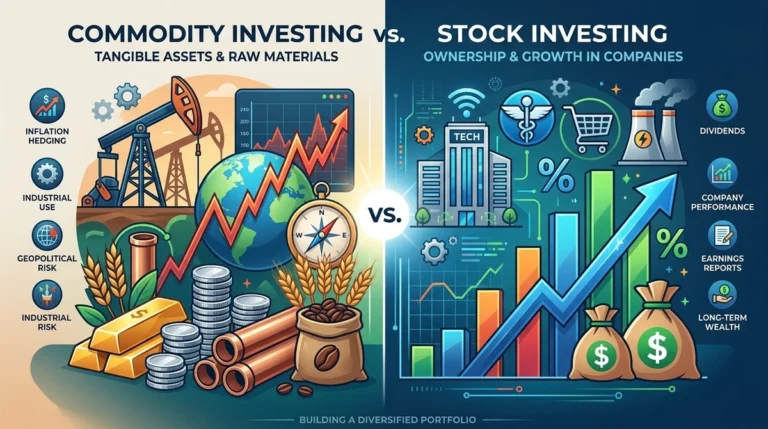
Commodity ETFs and stock ETFs may look similar in a brokerage account. Both can trade on an exchange, both can provide diversified exposure through a single security, and both can be used as part of a broader investment portfolio.
But the assets behind them are fundamentally different.
A stock ETF generally owns shares of companies. Its performance is therefore connected to corporate earnings, revenue growth, dividends, valuations, interest rates, and the broader business cycle.
A commodity exchange-traded product, by contrast, may provide exposure to physical commodities or to futures and other contracts linked to commodity prices. The U.S. Securities and Exchange Commission notes that exchange-traded products include traditional ETFs, exchange-traded commodity trusts, and exchange-traded notes, and these products do not all have the same structure or investor protections. (Investor)
That distinction affects how returns are generated, what risks investors take, how inflation affects the investment, and what can happen over a long holding period.
So, the useful comparison is not simply which category has delivered the higher return. It is what economic exposure each one provides and what role that exposure is intended to play in a portfolio.
The Asset Behind the ETF Changes the Investment
The first question is simple: What does the fund actually own or track?
A stock ETF generally holds a portfolio of company shares. Those businesses produce goods or services, generate revenue, incur expenses, invest in new capacity, borrow money, and may return cash to shareholders through dividends or share repurchases.
A commodity product has a different relationship with the underlying asset.
A physically backed precious-metals product may hold the commodity itself. A futures-based commodity product may instead hold futures contracts that provide exposure to future commodity prices. Some exchange-traded commodity products use other derivatives.
The SEC distinguishes traditional ETFs from exchange-traded commodity trusts and other ETPs. Some commodity trusts are not registered as investment companies under the Investment Company Act of 1940 even if they are commonly described as ETFs. (Investor)
That makes the first practical lesson important:
Do not judge a product only by the word “ETF” in its name. Check what it actually owns and how it obtains its exposure.
Stock ETFs Are Connected to Businesses
A stock ETF ultimately gives investors exposure to companies.
That means its performance can be influenced by:
- Revenue growth
- Earnings
- Profit margins
- Business investment
- Competitive conditions
- Interest rates
- Consumer demand
- Corporate debt
- Investor valuations
- Dividends
A broad-market stock ETF may spread exposure across hundreds or thousands of companies, while a sector or thematic ETF may be much more concentrated.
Stock ETFs can therefore be very different from one another.
A broad-market fund may provide exposure to the overall U.S. equity market. A dividend ETF may emphasize companies with particular dividend characteristics. A growth ETF may concentrate on companies expected to grow earnings or revenue rapidly. A sector ETF may focus on areas such as energy, technology, healthcare, or financials.
The SEC notes that ETFs can follow indexes or use active management, and investors should examine each fund rather than assume all ETFs have the same level of diversification or risk. (Investor)
The common feature is that the underlying assets are businesses or securities linked to businesses.
Commodity Products Follow a Different Economic Cycle
Commodity prices are driven more directly by physical supply and demand and by expectations about those conditions.
Oil prices can react to production changes, inventories, transportation disruptions, geopolitical events, and global demand.
Natural gas can be particularly sensitive to weather, storage levels, production, and electricity demand.
Agricultural commodities can be affected by planting conditions, weather, crop yields, and global food demand.
Metals can respond to industrial activity, construction, monetary conditions, currency movements, and investor demand.
The CFTC notes that commodity ETPs can use futures, options, swaps, or other commodity interests, and that the risks depend partly on the underlying commodity and the instruments used to obtain exposure. (Commodity Futures Trading Commission)
This creates a different investment relationship.
A stock ETF is primarily connected to business performance.
A commodity product is primarily connected to commodity prices and the market structure used to obtain that exposure.
How Each Type Generates Returns
This is one of the most important differences.
For a stock ETF, total return can broadly come from:
Share price appreciation + dividends
For a commodity product, returns generally depend much more directly on the change in the value of the underlying commodity exposure, although the exact result depends on the product’s structure.
A physically backed gold product, for example, may closely track the price of gold before expenses and other factors.
A futures-based oil product can behave differently because the fund owns contracts rather than barrels of oil.
That distinction becomes particularly important when investors hold the product for an extended period.
Why Commodity Futures Can Create Different Returns
Futures contracts have expiration dates.
A commodity fund that wants to maintain ongoing futures exposure generally has to close expiring contracts and replace them with contracts that expire later. This process is known as rolling the futures position.
The relationship between different futures maturities can affect the return.
Suppose the spot price of oil is $80 per barrel.
Imagine the futures market looks like this:
| Contract | Price |
| Current/spot price | $80 |
| Near-term futures | $82 |
| Later futures | $86 |
The later contracts are more expensive than the near-term contracts. This market structure is known as contango.
If a fund repeatedly sells the cheaper expiring contract and buys the more expensive later contract, the roll can create a drag on returns even if the underlying commodity price does not fall.
The opposite structure is known as backwardation, where later-dated contracts are cheaper than nearer contracts. In that situation, rolling contracts can potentially contribute positively to returns.
The CFTC specifically warns that rolling futures positions can create gains or losses depending on the relative prices of expiring and later contracts. (Commodity Futures Trading Commission)
This is why a futures-based commodity product does not necessarily deliver the same return as simply looking at the commodity’s spot-price chart.
A Rising Commodity Does Not Guarantee the Same ETF Return
Imagine oil rises 15%.
It would be tempting to assume an oil futures ETF should also rise exactly 15%.
But several factors can produce a different result:
- Futures-curve conditions
- Roll yield
- Fund expenses
- Trading costs
- Collateral income
- Benchmark methodology
- Tracking differences
The CFTC notes that commodity ETP shares may not track the underlying commodity perfectly over time, partly because futures contracts expire and must be rolled. (Commodity Futures Trading Commission)
This does not make futures-based commodity products inherently inappropriate.
It simply means investors need to understand what the fund is designed to track.
Income Is a Major Difference
Stocks can represent ownership in companies that generate cash.
Those companies may distribute part of that cash to shareholders through dividends.
Commodity prices do not work the same way.
A barrel of oil does not pay a dividend. Gold does not generate corporate earnings. A bushel of wheat does not distribute cash to its owner.
Some commodity products can generate income from collateral or other parts of their structure, but direct commodity exposure should not automatically be treated like dividend-producing equity exposure.
This creates an important distinction:
Stock ETFs can provide exposure to businesses that generate earnings and potentially distribute income.
Commodity products primarily provide exposure to changes in the value of the underlying commodity or related contracts.
For investors building long-term portfolios, that difference can materially affect how each asset fits into the overall strategy.
Commodity Exposure Can Add a Different Source of Risk
One reason investors consider commodities is diversification.
A portfolio made almost entirely of stocks is heavily exposed to corporate earnings, equity valuations, economic growth, and financial-market conditions.
Commodity exposure introduces different drivers.
Oil can respond to supply disruptions.
Gold can respond to monetary conditions and safe-haven demand.
Copper can respond to industrial activity.
Agricultural commodities can respond to weather.
That does not mean commodities automatically move in the opposite direction from stocks.
Different exposure does not mean opposite performance.
Correlation can change over time.
During an inflation shock, stocks and commodities could both rise because companies may benefit from stronger nominal revenues while commodity prices increase.
During a recession, stocks and economically sensitive commodities such as industrial metals can both decline as demand weakens.
During a severe financial shock, investors may also sell multiple asset classes at the same time to raise cash.
The potential diversification benefit therefore comes from having different economic drivers, not from assuming commodities will always rise when stocks fall.
Inflation Creates Another Important Difference
Commodities have a direct connection to the prices of many goods and production inputs.
Oil affects transportation and energy costs.
Natural gas affects heating and electricity markets.
Industrial metals are used in construction and manufacturing.
Agricultural commodities feed into food production.
As a result, commodity prices can become an important part of inflation dynamics.
But this does not mean every commodity ETF is a reliable inflation hedge in every environment.
The relationship depends on the commodity, the source of inflation, monetary policy, supply conditions, and the investment vehicle itself.
Gold is a particularly different case. Investors may use gold because of its perceived store-of-value characteristics or as part of a defensive allocation, but gold prices can also respond to real interest rates, the U.S. dollar, monetary expectations, and investor positioning.
The right question is therefore not simply, “Does this ETF hedge inflation?”
It is:
Which economic conditions could make this particular commodity exposure valuable or vulnerable?
Stock ETFs Have a Different Relationship With Economic Growth
Economic growth can support corporate revenue and profits.
When consumers spend more, businesses may sell more products and services. Companies may expand production, hire workers, invest in equipment, and generate higher earnings.
That creates a direct link between economic growth and many stock investments.
Commodities can also benefit from economic expansion, but the relationship is more complicated.
Stronger global manufacturing can increase demand for copper and other industrial metals.
Higher travel and transportation activity can increase demand for oil.
But commodity prices also depend on supply.
If producers increase output faster than demand grows, prices can weaken even while the broader economy continues expanding.
This is why investors should not treat “economic growth” as a universal bullish signal for either category.
A Commodity Company Is Not the Same as a Commodity
One of the easiest mistakes is confusing commodity exposure with exposure to companies that produce commodities.
Consider two investments:
A physical gold product
and
an ETF holding gold-mining companies
They are not equivalent.
The first is primarily exposed to the price of gold.
The second owns businesses.
A gold-mining company is affected by gold prices, but also by:
- Energy costs
- Labor costs
- Equipment expenses
- Production levels
- Debt
- Mine quality
- Operational problems
- Management decisions
- Political and regulatory conditions
The same principle applies to oil.
An oil-producer ETF can benefit when crude prices rise, but it is still a portfolio of businesses rather than a direct oil-price investment.
This distinction is particularly useful when comparing commodity ETFs with stock ETFs.
Sometimes the investor does not actually want commodity exposure. They want companies whose earnings are influenced by commodities.
Those are different investment decisions.
Holding Period Can Change the Comparison
The investment horizon is another important consideration.
A broad stock ETF can theoretically be held for decades because the underlying companies continue operating, producing goods and services, and generating earnings.
A futures-based commodity product has a different structure because its contracts expire.
The fund must continually manage those contracts to maintain exposure.
That means long-term investors need to understand the futures curve and roll effects rather than simply comparing today’s commodity price with its price several years ago.
The CFTC specifically notes that futures contracts are time-limited and that commodity pools using futures must manage those positions as contracts approach expiration. (Commodity Futures Trading Commission)
This does not mean commodity products are only for short-term investors.
It means the holding period should be considered together with the product’s structure.
Fees Are Not the Whole Cost
Expense ratios are important for both stock and commodity funds, but they do not tell the entire story.
For a conventional stock ETF, investors may mainly focus on:
- Expense ratio
- Trading spread
- Brokerage costs
- Tracking difference
For a futures-based commodity product, investors may also need to consider:
- Futures-roll effects
- Brokerage and trading costs
- Management expenses
- Collateral returns
- Tracking difference
The CFTC advises investors to review management fees, advisory fees, brokerage costs, commissions, and other expenses when evaluating commodity pools and related products. (Commodity Futures Trading Commission)
Therefore, two products with apparently similar expense ratios can still produce different net returns.
Taxes Can Also Depend on the Structure
U.S. investors should also avoid assuming that every commodity product receives the same tax treatment as an ordinary stock ETF.
The tax treatment can depend on the product’s legal structure and the assets or contracts it holds.
For example, the IRS states that regulated futures contracts can fall under Section 1256 rules, including mark-to-market treatment and specific capital-gain rules. But that does not mean every commodity ETF or ETP automatically receives Section 1256 treatment. (IRS)
Investors should therefore check the fund’s tax documents and consult a qualified tax professional when the tax treatment is important to the investment decision.
The key point is simple:
Do not assume the tax treatment from the label “commodity ETF.”
A Practical Comparison
The differences can be summarized like this:
| Factor | Stock ETFs | Commodity ETFs/ETPs |
| Main exposure | Businesses and securities | Commodities or commodity-linked contracts |
| Main return drivers | Earnings, valuations, dividends | Commodity prices, supply, demand, futures structure |
| Income potential | Dividends may be available | Usually, no direct income from the commodity itself |
| Business growth exposure | Yes | Usually no, unless the product owns commodity-producing companies |
| Inflation sensitivity | Often indirect | Can be more directly connected to commodity prices |
| Diversification | Can range from broad to highly concentrated | Can range from one commodity to broad commodity exposure |
| Futures-roll risk | Usually not a core feature | Possible with futures-based products |
| Concentration risk | Depends on the ETF | Can be high with single-commodity products |
| Long-term return mechanics | Corporate earnings and valuations | Commodity price and product structure |
| Key research question | What businesses does it own? | What commodity exposure does it actually provide? |
The table does not make one category superior to the other. It shows why the two categories can perform different jobs.
Which May Suit Different Investment Goals?
The answer depends on what the investor is trying to accomplish.
If the goal is long-term business growth
A diversified stock ETF may provide exposure to companies that can grow revenue, earnings, and potentially dividends over time.
If the goal is direct commodity exposure
A commodity product may be more relevant when the investment thesis specifically concerns the price of gold, oil, natural gas, agricultural commodities, or another resource.
If the goal is exposure to commodity-producing businesses
A stock ETF focused on energy, mining, or other commodity-related companies may be more appropriate than a direct commodity product because the investor is seeking business exposure rather than only commodity-price exposure.
If the goal is diversification
Either category can play a role, but the reason for adding it should be clear.
A commodity allocation should not be justified simply by assuming commodities always move opposite stocks.
If the goal is inflation sensitivity
Commodity exposure may be relevant because commodities are important inputs into the prices of goods and services. But the investor should identify which commodity and which product structure actually fits the inflation scenario being considered.
A Better Way to Choose Between Them
Instead of asking, “Which ETF is better?”, start with the economic exposure you want.
1. What should generate the return?
Do you want corporate earnings and dividends, or changes in commodity prices?
2. What does the fund actually own?
Look beyond the fund name. Check whether it holds stocks, physical commodities, futures, swaps, or another structure.
3. How does the product track its target?
A futures-based product can behave differently from the commodity’s spot price because of contract rolls and the futures curve.
4. What role does it play in the portfolio?
Is the objective growth, diversification, commodity exposure, income, or exposure to a particular economic theme?
5. How concentrated is the exposure?
A single-commodity product can depend heavily on one market. A broad stock ETF may spread risk across many companies, while a sector ETF can still be highly concentrated.
6. What are the total costs?
Look beyond the expense ratio and consider trading costs, tracking differences, and, where relevant, futures-roll effects.
7. What happens if the investment thesis is wrong?
If oil prices fall, corporate earnings disappoint, inflation declines, or interest rates remain high, how could the investment respond?
This last question is often more useful than focusing only on the potential upside.
The Real Difference Is the Economic Exposure
Commodity ETFs and stock ETFs both provide exchange-traded access to markets, but they connect investors to very different parts of the economy.
A stock ETF generally connects investors to businesses, earnings, dividends, and corporate growth.
A commodity ETF or ETP can connect investors more directly to physical resources, commodity prices, futures contracts, and supply-and-demand conditions.
That difference affects the entire investment experience.
Stocks can provide long-term participation in business growth but remain exposed to corporate earnings and equity valuations.
Commodities can provide exposure to different economic forces, but their returns can depend heavily on supply conditions, commodity cycles, futures curves, product structure, and sometimes roll costs.
Neither category automatically belongs in every portfolio.
The more useful decision is to identify the exposure the portfolio needs, understand how the product delivers that exposure, and then consider whether the risks match the investor’s objective and time horizon.
That approach is more informative than comparing commodity and stock ETFs simply by their recent returns.
The key question is not “Which one is better?”
It is “What economic exposure am I actually buying, and what job do I want it to perform in my portfolio?”