How Inflation Could Shape the U.S. Economy in 2026: Growth, Markets, Consumers and the Fed
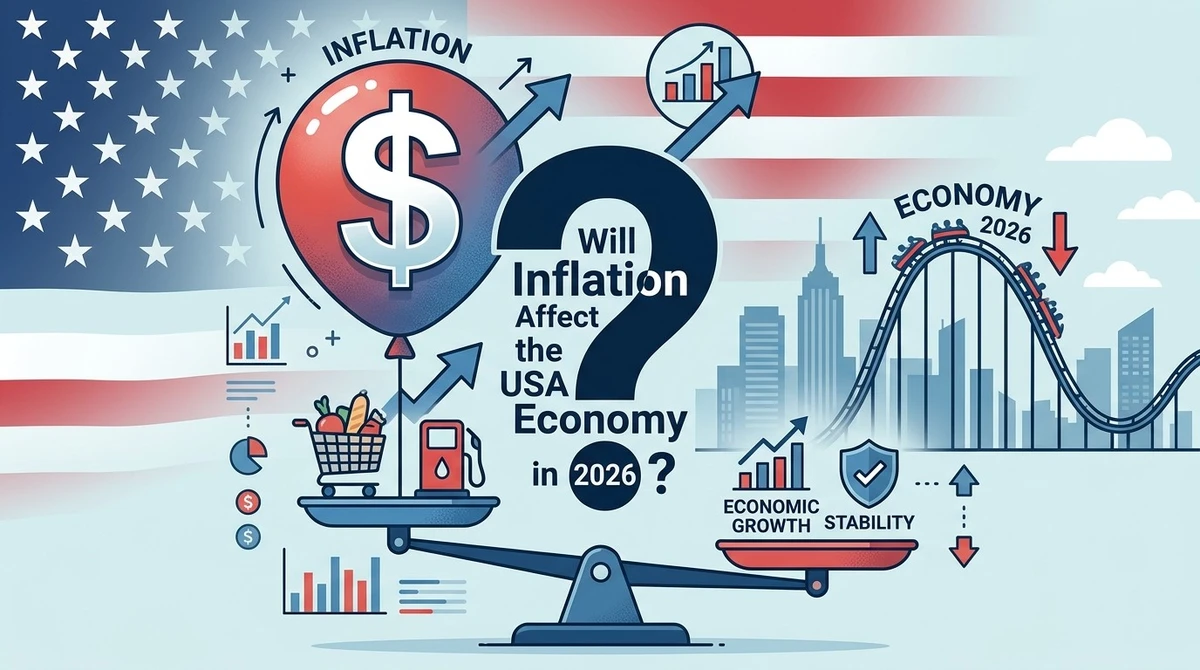
How Inflation Could Shape the U.S. Economy in 2026
Inflation is no longer running at the extreme levels seen during the U.S. inflation surge of 2021 and 2022. But in 2026, it is still high enough to influence nearly every major part of the economy.
That makes inflation one of the most important variables to watch through the rest of the year.
The latest data show why. The Consumer Price Index (CPI) rose 3.4% over the 12 months through August 2026, while core CPI, which excludes food and energy, increased 2.4%. The Federal Reserve’s preferred inflation gauge, the Personal Consumption Expenditures (PCE) price index, was up 3.7% year over year in July, with core PCE inflation at 3.3%. (Bureau of Labor Statistics)
At the same time, the U.S. economy is still expanding. The Federal Reserve’s September projections put 2026 real GDP growth at a median 2.3%, with unemployment at 4.1% and PCE inflation at 3.7%. The median projected federal funds rate for the end of 2026 was 4.1%. (Federal Reserve)
That combination is what makes the inflation story important.
The U.S. economy is not simply dealing with falling prices or an economy-wide collapse in demand. Instead, policymakers are trying to bring inflation down while keeping economic growth and employment reasonably stable.
For households, that affects purchasing power. For businesses, it affects costs and pricing decisions. For investors, it influences interest rates, bond yields and valuations. And for the Federal Reserve, it determines how much pressure should remain on monetary policy.
The question for the rest of 2026 is therefore bigger than whether inflation rises or falls in the next monthly report.
The more important question is whether inflation can move closer to the Fed’s 2% goal without forcing a significant slowdown in the U.S. economy.
Why Inflation Still Matters in 2026
The inflation problem of 2026 is different from the shock the U.S. economy experienced several years ago.
During 2021 and 2022, inflation accelerated rapidly as supply-chain disruptions, strong demand, energy costs, labor-market pressures and other factors pushed prices sharply higher.
Inflation subsequently slowed.
But slower inflation does not mean prices returned to their earlier levels.
If a household’s grocery bill rises sharply during one period and then increases at a slower rate later, the rate of inflation has fallen even though the household is still paying more than before.
That distinction remains important in 2026.
The current inflation rate measures how quickly prices are increasing now. It does not reverse the cumulative increase in the overall price level that occurred during previous years.
The August CPI report illustrates the current environment. Overall CPI rose 3.4% over the year, while food prices increased 2.7% and shelter increased 3.0%. Energy prices were a particularly important short-term factor, with the energy index up 2.1% in August and 16.3% over the previous 12 months. Gasoline prices rose 3.9% in August alone. (Bureau of Labor Statistics)
So the challenge in 2026 is not the same as the inflation emergency of 2022.
It is the persistence of price pressure at a time when policymakers would prefer inflation to be much closer to 2%.
That creates a more complicated economic trade-off.
The Inflation Growth Trade Off
Inflation matters for growth because controlling it can require tighter financial conditions.
When interest rates are high, households generally face higher costs for mortgages, credit cards, auto loans and other forms of borrowing. Businesses also face higher financing costs, which can influence decisions about investment, expansion and hiring.
That is the basic transmission mechanism from inflation to economic growth.
But the relationship is not one-way.
Strong economic growth can support household incomes and spending. Strong demand can also make it easier for businesses to raise prices when supply is unable to keep pace.
This is why inflation and growth can become difficult to separate.
If demand remains strong enough to support economic expansion, inflation may take longer to return to target. If monetary policy becomes more restrictive to deal with that inflation, growth may eventually slow.
The ideal outcome would be different: inflation would continue falling while consumer demand, employment and investment remain healthy.
That is easier to describe than to achieve.
The Federal Reserve’s September projections capture the tension. Officials’ median projection calls for 2.3% real GDP growth in 2026 alongside 3.7% PCE inflation. The same projections put unemployment at 4.1%. (Federal Reserve)
In other words, the Fed is not projecting an economy that needs a major contraction to bring inflation down. It is projecting continued growth while inflation remains above target.
Whether that balance holds will depend on what happens to prices, demand and financial conditions during the final months of the year.
What Inflation Means for American Households
Consumers experience inflation more directly than almost any other part of the economy.
A national inflation figure may appear manageable on paper, but households feel price changes through rent, groceries, gasoline, insurance, utilities, travel and other everyday expenses.
The impact is also uneven.
A household spending most of its income on essential expenses has less room to adjust when prices rise. Another household with more discretionary income may be able to reduce travel, dining out or other non-essential purchases without changing its basic standard of living.
That difference can shape consumer behavior.
When prices rise faster than expected, households may delay large purchases, switch to cheaper alternatives, search more aggressively for discounts or reduce discretionary spending.
Those changes can eventually affect businesses.
A retailer may see customers move toward lower-priced products. A restaurant may face weaker demand for higher-priced meals. A consumer-goods company may discover that customers are becoming more sensitive to price increases.
Inflation therefore does more than reduce purchasing power.
It can change what consumers buy.
Spending May Hold Up Even When Inflation Remains Elevated
The latest income and spending data show why the consumer story is not simply negative.
In July, personal income increased 0.4%, disposable personal income increased 0.5% and personal consumption expenditures rose 0.2%. Real PCE, however, was essentially flat on a monthly basis. The personal saving rate was 3.0%. (Bureau of Economic Analysis)
That distinction between nominal and real spending is important.
Nominal consumer spending can rise because households are paying higher prices. Real spending attempts to capture the underlying volume of goods and services purchased after accounting for price changes.
If nominal spending remains strong while real spending is much weaker, part of the apparent strength is simply the effect of higher prices.
That is one reason the consumer should be watched through both spending data and inflation-adjusted measures.
The question is not only whether Americans are spending more dollars.
It is whether those dollars are buying more goods and services.
Food and Housing Keep Inflation Close to Consumers
Food and housing deserve particular attention because they are difficult for households to avoid.
Food prices increased 2.7% over the year through August, while food-at-home prices rose 2.2%. Food-away-from-home prices increased 3.4%. (Bureau of Labor Statistics)
These rates are far below the worst inflation readings of the earlier inflation surge, but food remains highly visible in household budgets.
Housing is even more important because shelter represents a large share of consumer spending and carries substantial weight in the CPI.
Shelter prices increased 3.0% over the year through August. (Bureau of Labor Statistics)
Housing inflation also tends to move more slowly than some other categories.
That creates a challenge for monetary policy. The Federal Reserve can influence borrowing conditions and demand, but it cannot directly set rents or increase the supply of housing.
As a result, some components of inflation can remain elevated even when monetary policy is already restrictive.
The Labor Market Adds Another Layer
The labor market is one of the most important links between inflation and economic growth.
When employment is strong, households have income to spend. That supports economic activity.
But labor costs are also an important input for businesses. If wages and other employment costs rise rapidly while productivity does not keep pace, companies may attempt to protect margins by raising prices.
That does not mean wage growth automatically causes inflation.
Productivity, profit margins, demand and other costs all matter.
The current labor-market data point to continued resilience rather than a broad employment collapse. Nonfarm payroll employment increased by 162,000 in August, while the unemployment rate remained at 4.1%. (Bureau of Labor Statistics)
For the inflation outlook, that creates an important question: can employment remain relatively stable while price pressures gradually ease?
If the answer is yes, the Fed may be able to bring inflation down without causing a severe downturn.
If inflation remains persistent while labor demand stays strong, monetary policy could remain restrictive for longer.
Why the Fed’s 2026 Decision Is So Difficult
The Federal Reserve has two major responsibilities: maximum employment and price stability.
Inflation makes those objectives harder to balance when economic conditions are still relatively resilient.
At its September 2026 meeting, the Fed’s projections showed a median 2026 federal funds rate of 4.1%, alongside 3.7% PCE inflation and 2.3% real GDP growth. (Federal Reserve)
Those projections should not be treated as a guaranteed path for interest rates.
They are participants’ projections based on information available at the time of the meeting and their individual assessments of appropriate monetary policy.
That distinction matters because inflation can change quickly if energy prices, supply conditions or demand shift.
The September projections also show considerable uncertainty around inflation. The range of 2026 PCE inflation projections was 2.9% to 3.8%, illustrating how differently policymakers assess the possible path. (Federal Reserve)
The Fed therefore has to react to incoming data rather than simply follow a predetermined sequence of rate moves.
Interest Rates Are the Main Link Between Inflation and the Economy
The federal funds rate does not directly determine the price of gasoline, groceries or rent.
Its influence works through financial conditions.
Higher policy rates can make borrowing more expensive. That can reduce demand for interest-sensitive purchases and make some business investments less attractive.
Lower rates can have the opposite effect.
This is why monetary policy takes time to affect the broader economy.
A rate decision made today can influence housing, investment and consumer credit over the following months rather than immediately.
That lag makes the Fed’s job particularly difficult when inflation is changing.
If policymakers wait too long to respond, inflation may remain elevated.
If they tighten too aggressively, they risk weakening demand more than necessary.
The challenge is finding the point where inflation pressure falls without creating an unnecessary economic slowdown.
What Persistent Inflation Could Mean for Businesses
Businesses face inflation differently from households.
A company can respond to higher costs by raising prices, reducing margins, cutting expenses, changing suppliers, investing in productivity or delaying expansion.
Its ability to do so depends heavily on its industry.
A company with strong pricing power may be able to pass higher costs to customers.
A company operating in a highly competitive market may have much less room to raise prices.
That difference can become increasingly important when inflation remains elevated for an extended period.
Persistent cost increases can squeeze margins if selling prices cannot keep pace.
Higher interest rates add another pressure point.
A business considering a major expansion may decide that the expected return is no longer attractive once financing costs are included.
If many businesses make similar decisions, the effect can spread through the economy.
Lower investment can eventually affect construction, equipment demand, productivity and future growth.
Inflation Can Change Investment Decisions Before It Changes GDP
This is one of the less obvious ways inflation can shape the economy.
Consider a company deciding whether to build a new facility.
The company must estimate future demand, construction costs, labor expenses, financing costs and expected returns.
When inflation is unpredictable, those calculations become harder.
Even if inflation is not extremely high, uncertainty can make businesses more cautious.
That does not mean every company will stop investing.
Large technology, energy and infrastructure projects may continue because their expected long-term returns remain attractive.
But the hurdle rate for investment can rise when financing becomes more expensive and future costs are less certain.
This is one reason inflation can influence economic growth well beyond the monthly CPI report.
What Inflation Means for Stocks
Inflation affects stocks mainly through earnings expectations, costs and interest rates.
Higher prices can increase revenue for companies that can pass those increases to customers.
But higher input costs can reduce margins.
At the same time, higher interest rates can affect how investors value future corporate earnings.
This is particularly relevant for companies whose expected cash flows are far into the future.
That does not mean inflation automatically produces a weaker stock market.
Different industries have different exposures.
Energy companies may benefit from higher commodity prices. Companies with strong pricing power may protect margins more effectively than businesses operating in highly competitive markets.
Other companies may be squeezed between rising costs and customers unwilling to accept higher prices.
The important issue is therefore not simply the headline inflation rate.
It is how inflation interacts with revenue growth, margins, financing costs and valuation.
Bonds Face a Different Inflation Problem
Inflation can be particularly important for the bond market because fixed-income investors receive predetermined payments.
If inflation rises unexpectedly, the purchasing power of those payments falls.
Higher inflation expectations can also push Treasury yields higher as investors demand more compensation for holding longer-term debt.
When yields rise, prices of existing bonds generally fall.
That makes inflation data especially important for longer-duration bonds.
The relationship also extends beyond government debt.
Corporate borrowing costs are influenced by Treasury yields and credit conditions. If benchmark yields remain elevated, companies may face higher costs when issuing new debt or refinancing existing obligations.
So persistent inflation can affect the cost of capital across the economy, not just the price of consumer goods.
The Dollar Adds Another Dimension
Inflation can influence the U.S. dollar, but the relationship is not straightforward.
Currency values depend on relative interest rates, economic growth, capital flows, monetary policy and global risk sentiment as well as inflation.
If persistent U.S. inflation leads the Federal Reserve to maintain relatively high interest rates, that can support demand for dollar-denominated assets.
But persistent inflation can also raise questions about the future purchasing power of the currency.
The dollar’s direction therefore depends on how U.S. inflation compares with inflation and monetary policy elsewhere, rather than on the U.S. inflation rate alone.
For the economy, the exchange rate matters because a stronger or weaker dollar can influence import prices, exports, corporate earnings and financial conditions.
Energy Prices Could Change the Inflation Picture Quickly
Energy is one of the clearest short-term risks to the inflation outlook.
August data showed why. Gasoline prices rose 3.9% during the month, while the broader energy index increased 2.1%. Over the year, the energy index was up 16.3%. (Bureau of Labor Statistics)
Energy prices affect households directly at the gas pump and indirectly through transportation and production costs.
Higher fuel prices can increase the cost of moving goods, operating vehicles and providing services.
Some of those costs may eventually be passed to consumers.
But the duration of the energy increase matters.
A short-lived energy shock can raise headline inflation temporarily without fundamentally changing underlying price trends.
A prolonged increase is more difficult because businesses and consumers have more time to adjust prices and expectations.
That is one reason energy markets will remain important for the inflation outlook through the rest of 2026.
The Bigger Risk May Be Inflation That Stops Falling
The most difficult scenario for policymakers is not necessarily a sudden inflation spike.
It could be inflation that simply refuses to move lower.
The Federal Reserve’s September projections put 2026 PCE inflation at 3.7%, compared with its 2% longer-run objective. The median projection falls to 2.3% in 2027 and 2.1% in 2028, suggesting policymakers expect the current inflation pressure to ease over time. (Federal Reserve)
But if inflation stays higher for longer, the path to those later projections could become more difficult.
The Fed could keep rates higher for longer.
Treasury yields could remain elevated.
Businesses could continue facing higher financing costs.
Consumers could continue adjusting their spending patterns.
Markets could become increasingly sensitive to each inflation and employment release.
The economic effect would not necessarily be a recession.
The bigger issue would be a prolonged period in which restrictive financial conditions remain necessary to prevent inflation from becoming entrenched.
Three Possible Inflation Paths for the Rest of 2026
The remainder of 2026 can be viewed through three broad scenarios.
1. Inflation Gradually Cools
In this scenario, inflation continues moving lower while consumer spending and employment remain reasonably stable.
That would give the Federal Reserve more flexibility to reduce monetary-policy restraint over time.
Lower rates could eventually support housing, business investment and other interest-sensitive areas of the economy.
The key condition would be that inflation falls without a sharp deterioration in demand.
2. Inflation Remains Persistent
Here, price growth remains above the Fed’s target for longer than expected.
Energy prices, housing, services or other categories could keep inflation elevated.
The result would likely be a longer period of restrictive monetary policy.
Businesses and households would have to operate with higher financing costs, while financial markets would remain sensitive to inflation data.
3. Inflation Falls Because Growth Weakens
A third possibility is that inflation falls mainly because consumer and business demand slows.
That would produce a lower inflation rate, but not necessarily a better economic environment.
If spending weakens substantially, businesses may reduce hiring and investment.
The Fed would then face a different problem: inflation would be improving, but employment and growth could become bigger concerns.
That is why the direction of inflation alone does not tell the full economic story.
The reason inflation is moving matters just as much.
What to Watch Through the End of 2026
Several indicators will help determine which path the economy is taking.
PCE Inflation
PCE is the inflation measure most closely associated with the Fed’s 2% objective.
The July data showed headline PCE inflation at 3.7% and core PCE at 3.3%. The next release will provide a clearer indication of whether inflation is moving toward or away from the Fed’s projected path. (Bureau of Economic Analysis)
CPI
CPI remains one of the most closely watched monthly inflation reports because of its detailed breakdown across goods and services.
The August report showed headline inflation at 3.4% and core inflation at 2.4%. (Bureau of Labor Statistics)
Employment and Wages
A stable labor market can support consumer spending.
A rapidly weakening labor market would point to a different economic environment.
The August report showed payrolls rising by 162,000 and unemployment remaining at 4.1%. (Bureau of Labor Statistics)
Real Consumer Spending
The key question is whether households continue increasing the quantity of goods and services they consume, rather than simply spending more because prices are higher.
July’s real PCE was essentially flat, making future readings particularly useful for assessing consumer momentum. (Bureau of Economic Analysis)
Treasury Yields
Long-term Treasury yields provide a market-based signal of expectations for inflation, growth, monetary policy and government borrowing.
A sustained rise in yields could tighten financial conditions even if the Fed does not make an immediate change to its policy rate.
Energy Prices
Oil and gasoline prices can alter the inflation picture quickly.
A sustained energy shock would have broader implications than a short-lived monthly move.
What Inflation Could Mean for 2027
The effects of 2026 inflation will not necessarily disappear when the calendar changes.
If inflation falls steadily, the economy could enter 2027 with lower price pressures and potentially more room for monetary easing.
If inflation remains persistent, businesses and households may enter 2027 with higher financing costs and continued uncertainty around interest rates.
The Fed’s September projections already point toward lower inflation in 2027, with median PCE inflation projected at 2.3% and the federal funds rate at 4.1%. For 2028, the median PCE inflation projection falls to 2.1%, while the projected federal funds rate falls to 3.9%. (Federal Reserve)
Those are projections, not promises.
The actual path will depend on the data and on developments that cannot be known with certainty today.
That makes the final months of 2026 important not only for the current year’s economic performance but also for the starting conditions of 2027.
The Inflation Question That Matters Most
Inflation is often discussed as a single number.
The U.S. economy is more complicated than that.
A 3% or 4% inflation rate does not affect every household, business or financial asset in the same way. The consequences depend on where price increases are occurring, whether incomes are keeping pace, how businesses respond, and how monetary policy reacts.
That is why the next stage of the U.S. economy will depend on more than whether the CPI number moves up or down in a particular month.
The key issue is whether inflation can continue to cool without a major decline in consumer demand, employment or business investment.
As of September 2026, the U.S. economy remains in a position where growth is continuing, unemployment is relatively low and inflation is still above the Federal Reserve’s target. The Fed’s own projections reflect that tension: 2.3% projected real GDP growth for 2026 alongside 3.7% PCE inflation. (Federal Reserve)
That leaves several variables to watch closely.
Consumers need enough income to keep spending. Businesses need enough demand to maintain investment. Inflation needs to move lower. And the Federal Reserve needs to balance price stability with the risk of weakening the economy too much.
If those pieces move in the same direction, the U.S. economy could move toward a more stable inflation environment.
If they move in opposite directions, the policy trade-offs become much harder.
For the rest of 2026, inflation will therefore remain less a story about the cost of individual products and more a measure of how well the entire U.S. economy is balancing prices, demand, employment, investment and interest rates.
That balance will shape not only the final quarter of 2026, but also the economic conditions entering 2027.