What Is the Commodity Market? Understanding Global Commodity Markets
What Is the Commodity Market?
When oil prices rise, transportation and production costs can change. When wheat prices jump, food producers face higher input costs. When copper becomes more expensive, the economics of construction, manufacturing, and energy infrastructure can shift.
These connections lead back to the commodity market.
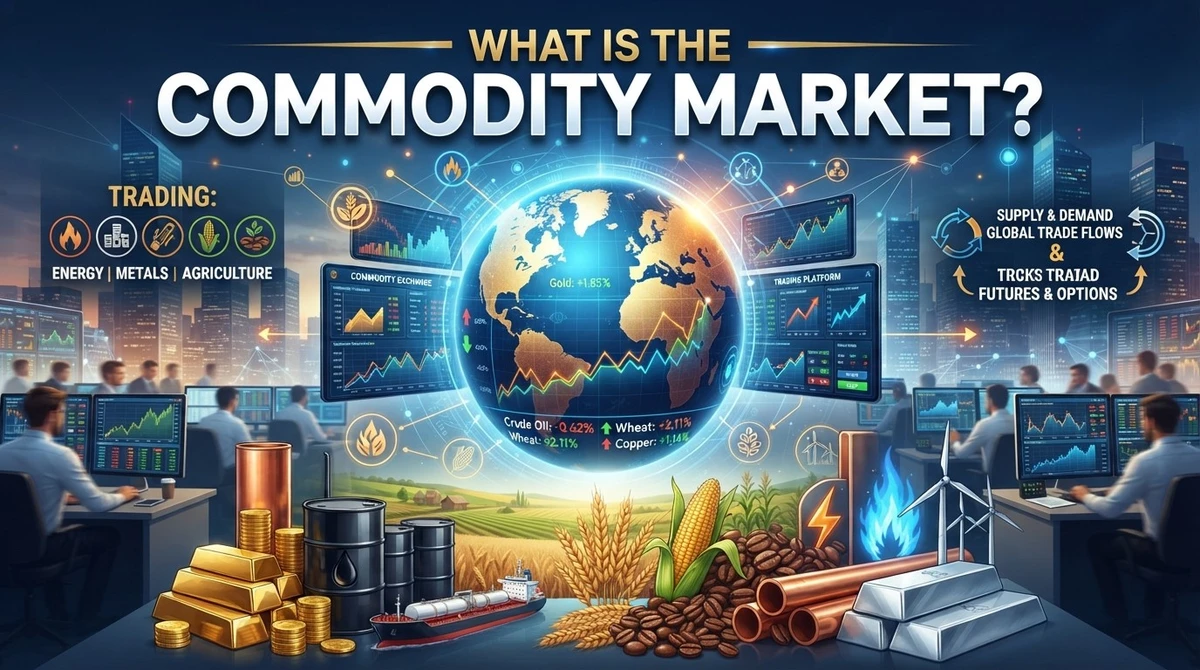
A commodity market is the broader system through which raw materials and primary goods are produced, bought, sold, priced, transported, and hedged. It includes physical markets for products such as crude oil, natural gas, wheat, coffee, copper, and gold, as well as financial markets where participants trade futures and other contracts linked to those commodities.
Commodity markets are therefore much more than places where traders speculate on prices. They connect farmers with food companies, miners with manufacturers, energy producers with refiners, and producers with buyers around the world.
The World Bank’s commodity markets research tracks major energy, agricultural, metal, and other commodity markets and examines how their movements affect the wider global economy.
Understanding those differences makes it easier to see why commodity prices can affect inflation, international trade, business costs, and economic growth.
Commodities Are the Raw Materials of the Economy
A commodity is generally a basic good or raw material that can be traded because units of the same grade are largely interchangeable.
Crude oil is one example. A particular grade of crude can be priced according to standardized characteristics rather than being sold like a branded consumer product.
The same principle applies to many agricultural products and metals.
Major commodity groups include:
- Energy: crude oil, natural gas, coal, gasoline
- Agriculture: wheat, corn, soybeans, coffee, cocoa, cotton, sugar
- Industrial metals: copper, aluminum, nickel, and other metals
- Precious metals: gold, silver, and platinum
- Livestock: cattle and other agricultural products
- Other raw materials: products such as lumber and certain industrial inputs
These categories may all be called commodities, but their economics can be very different.
A wheat harvest depends heavily on weather and growing conditions. Oil supply depends on production capacity, inventories, transportation, and geopolitics. Copper demand is closely connected to industrial activity, construction, manufacturing, and infrastructure investment.
That is why there is no single explanation for movements in “commodity prices.”
The Physical Market Comes First
The simplest way to understand commodity markets is to start with the physical market.
This is where the actual commodity is produced, transported, bought, and sold.
A farmer sells wheat to a buyer. An oil producer sells crude to a refiner. A mining company sells copper to a manufacturer. A food company purchases agricultural commodities for processing.
These transactions are part of the real economy.
The physical market also involves storage, transportation, quality standards, financing, insurance, and delivery arrangements. Those factors can affect the price a buyer actually pays.
A barrel of crude available immediately in one location may not have the same economic value as crude available several months later somewhere else.
This is why commodity prices are not simply abstract numbers on a trading screen. They are connected to the cost and availability of physical resources.
The Financial Market Adds Another Layer
Alongside physical trading is a large financial market built around commodities.
This includes:
- Futures contracts
- Options
- Exchange-traded commodity products
- Other financial instruments linked to commodity prices
A futures contract is an agreement to buy or sell a specified quantity of a commodity at a predetermined price for a future date. Investor.gov’s commodities guide explains how standardized commodity futures and options are traded through organized markets.
Importantly, not everyone using these markets is trying to profit from price movements.
Farmers, mining companies, food manufacturers, airlines, energy companies, and other businesses may use futures to manage the uncertainty created by changing commodity prices.
That makes the financial side of the commodity market closely connected to the physical economy.
Supply and Demand Matter, but Timing Matters Too
Commodity prices are ultimately influenced by supply and demand, but commodities have an important characteristic: supply often cannot adjust quickly.
If demand for copper suddenly increases, mining companies cannot immediately create new mines.
If wheat prices rise before planting season, farmers cannot instantly produce an additional harvest.
If oil demand increases sharply, producers may need substantial investment and time before additional production becomes available.
This limited short-term flexibility can amplify price movements.
The same principle works in reverse. If demand weakens while production remains high, inventories can build. Sellers may then lower prices to attract buyers.
This helps explain why commodity markets can react strongly to relatively small changes in expected supply or demand.
The key is not simply today’s physical supply and demand. Market participants are constantly considering what supply and demand might look like in the future.
Weather, Geopolitics, and Technology Can Move the Market
Commodity markets are particularly sensitive to events that affect physical production or transportation.
Weather can influence agricultural commodities.
A drought can reduce crop yields. A favorable growing season can increase supply.
Geopolitical events can affect energy markets by disrupting production, pipelines, shipping routes, or export infrastructure.
Technology can change demand in the opposite direction. New technologies can increase demand for some materials while reducing the need for others.
The World Bank’s commodity research shows how commodity markets can be reshaped by geopolitical shocks, climate-related changes, and technological developments. Its 2026 research also highlights the different effects such shocks can have across energy, food, fertilizer, and metals markets. (World Bank)
This means a commodity can become economically more important even without becoming scarcer.
Its importance may change because the global economy has found a new use for it.
Spot Markets and Immediate Prices
The spot market refers to transactions involving immediate or near-immediate delivery of a commodity.
The spot price therefore represents the current market value under particular conditions, including location, quality, and delivery arrangements.
That last point matters.
There is not necessarily one universal price for every physical unit of a commodity.
Transportation costs, storage availability, quality differences, taxes, and regional shortages can create price differences between locations.
For example, the price of crude oil at one delivery point can differ from another because moving physical oil between those locations costs money and requires infrastructure.
The spot market therefore reflects the economics of obtaining the commodity now.
Futures Markets Help Businesses Manage Price Risk
One of the most important functions of commodity futures is hedging.
Imagine a wheat farmer expecting to harvest a crop several months from now.
The farmer faces the risk that wheat prices could fall before the crop is sold.
A futures position can be used to manage part of that risk.
A food manufacturer faces the opposite problem. It may need wheat later and worry that prices will rise.
The company can use futures to help manage its exposure to that potential increase.
The objective is not necessarily to predict the market correctly.
It is to make future revenue or costs more predictable.
The CFTC’s explanation of the economic purpose of futures markets describes how producers and consumers can use futures to hedge against changing commodity prices and gain greater certainty over expected revenues and costs.
This is one of the reasons commodity futures exist as an economic tool rather than simply a vehicle for speculation.
Price Discovery Is Another Core Function
Commodity markets also perform an important economic function known as price discovery.
Price discovery is the process through which buyers and sellers collectively establish market prices.
Participants continuously respond to information about:
- Production
- Consumption
- Inventories
- Weather
- Transportation
- Interest rates
- Geopolitical developments
- Expected future demand
Their decisions are reflected in market prices.
A farmer can therefore observe market prices when planning production. A manufacturer can use commodity prices when estimating future costs. A government can monitor commodity markets when assessing inflation or external economic risks.
The price is not simply telling traders what a commodity is worth.
It is also communicating information about how market participants view its availability and future demand.
The CFTC notes that standardized futures markets contribute to the relationship between futures prices and cash-market prices, which is an important part of the price-discovery process. (CFTC)
Contango and Backwardation Show Why Time Matters
Commodity markets have another feature that distinguishes them from ordinary retail markets: the relationship between current prices and future prices.
Two commonly used terms are contango and backwardation.
Contango generally describes a market in which futures prices are above the current spot price.
Backwardation generally describes a market in which futures prices are below the spot price.
These conditions can reflect expectations about future supply and demand, but they can also be influenced by storage costs, financing costs, inventories, and the economic value of holding the physical commodity.
Storage is especially important.
Oil needs tanks. Wheat needs silos. Metals require warehouses and transportation.
Those costs influence the economics of holding a commodity over time.
As a result, a futures price should not simply be interpreted as a guaranteed prediction of where the commodity will trade in the future.
Commodity Markets Can Feed into Inflation
Commodity markets have a direct connection to inflation because many commodities are inputs into the production and transportation of goods and services.
Energy is the clearest example.
When oil prices rise, transportation and production costs can increase. Businesses may absorb some of those costs, reduce margins, change suppliers, or pass part of the increase to customers.
Food commodities work through a similar chain.
Higher agricultural prices can raise the cost of food production, but the relationship between a commodity price and the final retail price is not one-to-one. Processing, labor, packaging, transportation, distribution, and other costs also matter.
This is why commodity shocks can contribute to inflation without completely determining it.
Economic Reader’s guide to What Is Inflation? explains the broader relationship between changing prices and purchasing power.
The World Bank closely monitors commodity markets because movements in energy, food, metals, and other raw materials can have significant macroeconomic consequences. Its 2026 Commodity Markets Outlook provides a current example of how a major energy shock can spread through other commodity markets and affect inflation and growth. (World Bank)
Commodity Markets Are Closely Connected to Global Trade
Commodities are among the foundations of international trade.
Countries do not have equal access to natural resources.
Some economies are major oil exporters. Others import most of their energy.
Some countries produce large agricultural surpluses. Others depend heavily on imported food.
Some economies have substantial mineral resources, while manufacturers elsewhere depend on those materials.
This creates a global network in which commodities move across borders from producers to processors and consumers.
Economic Reader’s How Does International Trade Work? explains how imports, exports, transportation, customs, and global supply chains connect economies.
Commodity markets are an important physical layer underneath that broader trading system.
Commodity Prices Can Change a Country’s Economic Position
Commodity price movements can have very different effects depending on whether a country is a major exporter or importer.
For a commodity-exporting economy, higher prices can increase:
- Export revenues
- Foreign-exchange earnings
- Government revenue
- Investment
- Domestic income
But dependence on commodities can also create vulnerability.
If a country relies heavily on a narrow range of commodity exports, a major price decline can reduce export earnings and put pressure on government finances and economic growth.
Commodity-importing economies face the opposite problem.
Higher oil, food, or fertilizer prices can increase import bills and put pressure on inflation, household purchasing power, and trade balances.
The IMF’s Primary Commodity Prices database tracks global commodity prices and country-specific commodity terms-of-trade indices covering 182 economies. These measures help show how changes in world commodity prices can create gains or losses for countries depending on their trade exposure.
Commodity Markets Are Not the Same as Commodity Investing
This distinction is important for readers.
The commodity market is the entire economic system involving physical commodities, producers, consumers, traders, exchanges, logistics, and financial contracts.
Commodity investing is the act of obtaining financial exposure to commodity prices.
An investor might gain that exposure through an exchange-traded product rather than buying barrels of oil or storing physical metals.
Economic Reader’s Best Commodity ETFs in the USA looks at one way investors can obtain commodity exposure through ETFs.
The two subjects are connected, but they answer different questions.
Understanding the commodity market explains how the underlying economic system works.
Commodity investing explains how an investor can participate financially in that market.
Speculators Are Part of the Market Too
Not every participant in a commodity market needs the physical commodity.
Financial traders, investment firms, and other participants may use futures and options to take positions based on expected price movements.
This creates a distinction between hedging and speculation.
A food producer using futures to reduce exposure to rising wheat prices is hedging.
A trader taking a futures position because they expect wheat prices to rise is speculating.
Both types of participants can be present in the same market.
Speculation can provide liquidity, while hedging allows businesses to manage commercial risks.
But futures trading can also involve substantial financial risk. Investor.gov notes that commodity futures are complex instruments, while the CFTC warns that futures trading can involve significant losses and should not be treated as a simple high-return opportunity. (Investor.gov)
That is why the existence of a commodity market should not be confused with an invitation for every investor to trade futures.
The Commodity Market Reaches Everyday Life
Most people never trade a commodity futures contract, yet commodity markets can still affect their daily lives.
Oil influences transportation costs.
Natural gas can affect energy costs.
Copper is used in electrical and industrial systems.
Agricultural commodities become food products.
Gold is used in jewelry, technology, and financial markets.
Fertilizer affects the economics of farming.
Lumber affects construction.
A commodity-price change can therefore move through several stages:
Raw material → Producer → Manufacturer → Distributor → Retailer → Consumer
The further a commodity moves through the supply chain, the more other costs become part of the final price.
This explains why a change in the price of a raw material does not necessarily produce an equal change in the retail price of a finished product.
Technology Is Changing Which Commodities Matter
Commodity markets evolve as the global economy changes.
The rise of electric vehicles, renewable energy, batteries, data centers, and expanded electricity infrastructure has increased attention on certain industrial metals and energy inputs.
At the same time, improvements in technology can reduce the amount of a material required for a particular product or make substitution easier.
The result is a constantly changing relationship between technology and resource demand.
The World Bank’s commodity research examines how technological change, climate-related developments, and shifts in global production can reshape commodity markets over time. (World Bank)
This means the most economically important commodities today may not occupy exactly the same position in the global economy a decade from now.
Why the Commodity Market Matters
Commodity markets sit at the intersection of the physical and financial economies.
They connect:
- Natural resources with production
- Producers with consumers
- Businesses with price-risk management
- Commodity prices with inflation
- Resource exporters with global trade
- Financial markets with physical goods
That is what makes them economically important.
The biggest mistake is to think of commodities as one uniform asset class.
Oil has different economics from wheat. Copper behaves differently from gold. Agricultural commodities depend heavily on weather and harvest cycles, while metals are influenced by mining investment, industrial demand, technology, and infrastructure spending.
Even within one commodity, prices can change because of different forces at different times.
The better question is therefore not simply “Are commodity prices rising?”
It is:
What is changing underneath the price?
Is production falling? Are inventories shrinking? Is demand accelerating? Has transportation been disrupted? Has technology changed consumption? Are businesses hedging future costs? Has a geopolitical event changed the availability of a major export?
Those questions reveal what a commodity market is actually communicating.
Ultimately, the commodity market is one of the mechanisms that connects the world’s natural resources with its factories, farms, businesses, financial markets, and consumers. Understanding that connection makes it easier to understand everything from energy and food prices to inflation, international trade, business costs, and global economic cycles.