What Is a Ponzi Scheme? How Investment Fraud Works and How to Recognize the Warning Signs
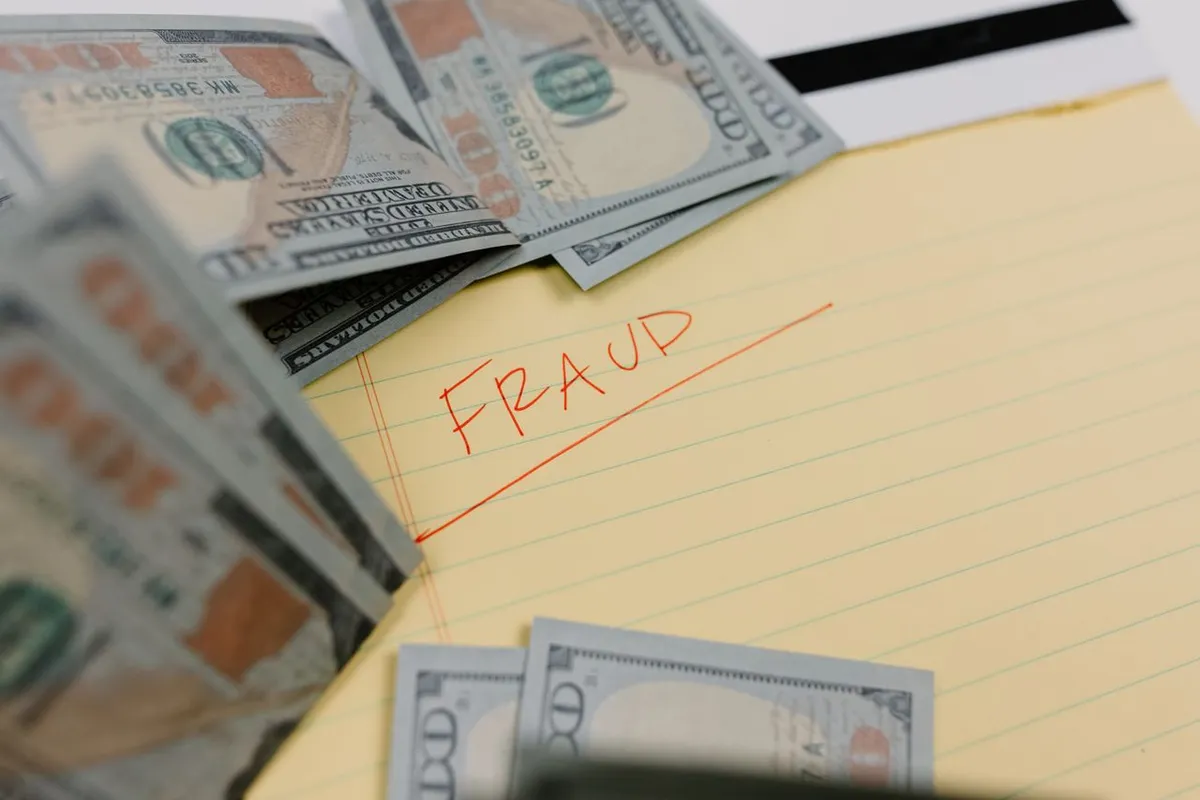
A Ponzi scheme is an investment fraud that uses money from newer investors to pay earlier investors, rather than generating enough legitimate returns from an underlying business or investment activity.
The scheme can look convincing for a surprisingly long time. Early investors may receive payments exactly as promised. Account statements may show profits. The operator may present a professional image and provide detailed explanations about how the investment supposedly generates returns.
But the central problem is simple: the money coming in from new investors is being used to satisfy financial promises made to existing investors.
That makes a Ponzi scheme dependent on continuous new money. Once new investments slow down or too many participants try to withdraw their funds, the structure can become impossible to sustain.
Understanding that mechanism matters because Ponzi schemes do not always look like obvious scams. They can be presented as investment funds, private businesses, trading programs, real estate opportunities, cryptocurrency ventures, or other supposedly profitable investments.
What Is a Ponzi Scheme?
A Ponzi scheme is a fraudulent investment arrangement in which returns paid to earlier participants are funded primarily by money received from later participants.
The name comes from Charles Ponzi, who became notorious in the United States in the early 20th century after promoting an investment scheme based on an alleged opportunity involving international postal reply coupons.
The underlying problem, however, is much broader than that historical case.
A legitimate investment has an identifiable source of potential returns. A company can generate profits, a bond can pay interest, a property can produce rental income, or an asset can increase in value.
A Ponzi scheme creates the appearance of those returns without having enough genuine investment profits behind them.
The operator therefore needs a growing pool of incoming money to keep the system functioning.
How a Ponzi Scheme Works
Consider a simple example.
An operator promises investors a 10% monthly return.
Investor A contributes $10,000.
Instead of generating a legitimate $1,000 investment profit, the operator attracts Investor B, who contributes another $10,000.
The operator can use part of B’s money to give A the promised $1,000 payment.
A now has something that looks like proof that the investment works.
The operator may then tell A that the account is performing well. A might reinvest the supposed profit, add more money, or recommend the opportunity to someone else.
As more investors join, the operator has more incoming money available to maintain the appearance of profitability.
The crucial point is that the payment to A did not come from a successful underlying investment. It came from money supplied by another participant.
That is what makes the structure fraudulent.
Why Ponzi Schemes Can Look Successful
One of the most deceptive features of a Ponzi scheme is that early investors may actually receive money.
Someone who invests $5,000 and later receives $1,000 in supposed profits has a real payment in their hands.
That experience creates credibility.
The investor may tell friends and relatives:
“I invested, and they actually paid me.”
Other participants may see account balances showing substantial gains. The operator may also provide statements, dashboards, newsletters, transaction histories, or other materials designed to make the investment appear legitimate.
Those things do not establish where the returns came from.
The appearance of profitability can exist precisely because new investor money is temporarily sufficient to support withdrawals and promised payments.
The SEC has identified this basic pattern in Ponzi schemes, noting that money from new investors can be used to pay purported returns to existing investors. (SEC)
Trust Can Help the Scheme Grow
Ponzi schemes are not built entirely around financial calculations. They also depend heavily on trust.
An operator may establish credibility through professional credentials, impressive offices, financial terminology, business relationships, or claims about previous investment success.
Personal relationships can be even more powerful.
If an investment comes from a close friend, family member, colleague, or respected community member, a potential investor may be less likely to investigate it independently.
Sometimes the person making the recommendation genuinely believes the opportunity is legitimate. They may have received payments themselves and therefore have no obvious reason to suspect fraud.
That can allow a scheme to spread through existing networks of trust.
The SEC has also warned that fraudsters can exploit affinity relationships, including shared communities and organizations, to make investment offers appear more credible. (SEC)
Why High and Consistent Returns Are a Warning Sign
Investment returns naturally fluctuate.
Businesses have strong and weak periods. Markets rise and fall. Interest rates change. Commodity prices move. Economic conditions shift.
That makes unusually high and unusually consistent returns an important warning sign.
The issue is not simply that a particular return is high. A legitimate investment can sometimes produce an exceptional return.
The better question is whether the claimed return is credible, explainable, and supported by verifiable economic activity.
For example, an investment promising a substantial monthly return regardless of market conditions deserves much more scrutiny than an investment whose performance naturally changes with the assets it owns.
The SEC specifically identifies high returns with little or no risk and overly consistent returns as common warning signs of potential investment fraud. (SEC)
Warning Signs of a Possible Ponzi Scheme
No single warning sign proves that an investment is a Ponzi scheme. But several red flags appearing together should lead investors to slow down and investigate.
1. Guaranteed High Returns
Promises of large profits with little or no risk should raise immediate questions.
Higher potential returns generally come with higher risk. A supposedly guaranteed high return needs a particularly convincing explanation of how the payment is generated and what supports the guarantee.
2. Returns That Never Seem to Change
Markets do not normally deliver identical results month after month.
An investment that appears to produce almost exactly the same strong return regardless of whether markets are rising, falling, or highly volatile deserves closer examination.
3. Vague Investment Strategies
An operator may use complicated financial language without clearly explaining where investor money goes.
Terms such as “proprietary trading,” “advanced algorithms,” “private opportunities,” or “institutional strategies” do not demonstrate that an investment is legitimate.
Investors should be able to understand, at a reasonable level, what actually generates the claimed return.
4. Difficulty Withdrawing Money
Withdrawal problems can be particularly important.
An investor may suddenly be told that additional taxes, processing fees, account upgrades, or other payments are required before money can be released.
Delays may also be blamed on temporary technical or administrative problems.
Some legitimate investments have withdrawal restrictions. The warning sign is unexplained, repeatedly changing, or increasingly difficult access to money that investors were previously told they could withdraw.
The SEC lists difficulty receiving payments as one of the warning signs investors should take seriously. (SEC)
5. Pressure to Invest Quickly
Fraudulent opportunities may create urgency.
Potential investors might be told that only a few places remain, that the opportunity will disappear soon, or that they should keep the offer confidential.
Pressure reduces the time available for independent research.
A legitimate opportunity should not require someone to skip basic due diligence simply because the promoter wants money immediately.
6. Problems With Documentation or Verification
Investors should be able to verify important claims independently.
Questions worth asking include:
- Who operates the investment?
- Where is the company registered?
- What exactly is the money invested in?
- Who holds the assets?
- How are returns generated?
- Are financial statements independently audited?
- Can the claimed assets be independently verified?
- Is the investment professional or firm appropriately registered or licensed where required?
If basic information cannot be confirmed outside the promoter’s own materials, caution is warranted.
The SEC advises investors to be skeptical of investments that lack adequate documentation or involve unregistered investments or unlicensed sellers. (SEC)
Why Investors May Keep Putting Money In
It may seem obvious that investors would leave after receiving a warning sign. Real situations are more complicated.
An investor who has already received profitable-looking payments may actually become more confident.
Suppose someone invests $20,000 and their account later shows $30,000. They may decide to withdraw only the supposed $10,000 profit while leaving the original investment in place.
The operator benefits because the money remains inside the scheme.
Social proof can reinforce the effect.
If several people in the same network appear to be making money, a potential investor may interpret that as evidence that the opportunity is legitimate.
Early successful withdrawals therefore do more than move money. They can help create the reputation that attracts the next group of investors.
Why a Ponzi Scheme Eventually Collapses
The mathematical problem becomes clearer as the scheme grows.
Imagine a small Ponzi scheme begins with 10 investors contributing $10,000 each.
That gives the operator $100,000 in incoming capital.
If the operator promises a 10% return, another $10,000 is needed simply to satisfy the promised return to those investors, assuming there is no legitimate investment profit.
Now imagine the number of investors doubles.
The amount of money required to maintain the same promises also grows.
The operator therefore needs a continuing stream of new capital. The larger the scheme becomes, the larger the pool of new money must be to keep the appearance of success alive.
Eventually, growth slows.
Fewer new investors arrive. Existing investors request larger withdrawals. Some participants become suspicious and try to take their money out at the same time.
The operator can no longer bring in enough new funds to cover the obligations.
At that point, the structure begins to break down.
This is why a Ponzi scheme is fundamentally different from a normal investment that simply performs badly. A legitimate investment can lose money because the underlying asset or business loses value. A Ponzi scheme has a structural funding problem because its apparent returns depend on incoming participant money.
Ponzi Scheme vs. Legitimate Investment
The key difference is the source of the return.
A legitimate investment has an underlying economic source of value.
For example:
- A bond can generate interest from the issuer.
- A profitable company can generate earnings.
- Rental property can generate rental income.
- A business can generate revenue and profits.
- An asset can increase in value because buyers are willing to pay more for it.
The returns are not guaranteed, and investors can still lose money.
A Ponzi scheme instead creates the appearance of investment returns without a sufficient underlying source of legitimate investment profits.
Economic Reader’s What Is Investment? provides a broader explanation of how legitimate investments can generate returns and why investment risk matters.
That distinction is important because losing money on a legitimate investment does not make it a Ponzi scheme.
Investment risk and investment fraud are different problems.
Ponzi Schemes and Pyramid Schemes Are Not the Same
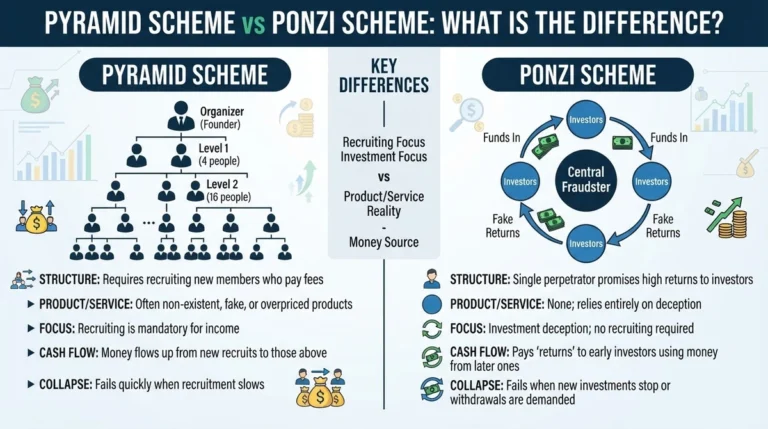
Ponzi schemes and pyramid schemes are often discussed together, but their structures differ.
In a Ponzi scheme, the operator generally controls the investment arrangement and uses money from newer participants to make payments to earlier participants.
A pyramid scheme is primarily built around recruitment. Participants are rewarded for bringing new people into the structure, with money flowing upward through the network.
The FTC explains that pyramid schemes focus on recruitment rather than genuine sales to ultimate customers. (Federal Trade Commission)
Recruitment can sometimes appear in a Ponzi scheme as well, but it is not what defines the structure.
The important question is therefore not simply whether new people are being recruited. It is how the money flows and what supposedly generates the promised return.
What Investors Can Check Before Sending Money
Due diligence cannot guarantee that an investment is safe, but it can make fraudulent claims harder to hide.
Before investing, consider checking the following.
Understand the business.
Ask what the company actually does and how it supposedly produces returns.
Verify the people involved.
Do not rely only on biographies, testimonials, or credentials supplied by the promoter. Look for independently verifiable information.
Check registration and regulatory status.
Where relevant, check whether the investment professional, firm, or offering is registered with the appropriate regulator.
Understand where the money is held.
Ask which financial institution or custodian holds investor assets and whether that information can be independently confirmed.
Read the withdrawal terms.
Understand when and how money can be withdrawn before investing.
Question guarantees.
If someone promises a high return with little or no risk, ask what assets, contracts, or business activity support that promise.
Do independent research.
A professional website, impressive presentation, social-media testimonials, or a recommendation from a friend should not replace independent verification.
The SEC provides investor resources for checking investment professionals, reviewing fraud alerts, and reporting potential investment problems. (SEC)
What to Do If Something Looks Wrong
If an investment starts showing several warning signs, avoid sending additional money until the situation has been independently investigated.
Keep records of communications, account statements, transaction receipts, contracts, promotional materials, and other relevant documents.
If money has already been sent, contacting the relevant bank or payment provider and appropriate regulators or law-enforcement authorities may be important, depending on the circumstances and jurisdiction.
Investors should also be careful about recovery scams.
Someone may approach a previous fraud victim claiming they can recover the lost money for an upfront payment. That can become a second fraud targeting someone who has already suffered a loss.
Investment Risk Is Not the Same as Investment Fraud
This distinction deserves emphasis.
A legitimate investment can perform badly.
A stock can fall 40%. A business can fail. A property can lose value. A bond issuer can default.
Those outcomes can be financially painful without being fraudulent.
Investment fraud involves deception about the nature of the opportunity, the use of money, the source of returns, or other material facts.
This is why investors should not judge an investment only by whether they made or lost money.
The more useful question is whether the investment operates the way it claims to operate.
Economic Reader’s What Is Risk Management in Investing? explores the difference between taking investment risk and managing that risk as part of a broader investment strategy.
Why Understanding the Structure Matters
The most useful way to recognize a Ponzi scheme is not to memorize the name of one famous fraud.
It is to understand the economic structure.
Ask a simple question:
Where does the money for the promised return actually come from?
If the answer is a clearly identifiable business, asset, loan, interest payment, rental stream, or other legitimate economic activity, there is something concrete to investigate.
If the explanation ultimately depends on money arriving from newer investors, the structure becomes fundamentally different.
That is why unusually high returns, remarkably consistent profits, vague strategies, pressure to invest, and withdrawal problems matter most when they appear together. Each one can have an innocent explanation in isolation. Together, they can indicate that an investment’s apparent success depends more on new money than on genuine economic performance.
A legitimate investment can lose money. Markets can behave unpredictably. Businesses can fail.
A Ponzi scheme is different because the problem is built into the way the promised returns are financed.
Understanding that distinction can help investors look beyond impressive returns and ask the more important question: what economic activity is actually generating the money?