Top 10 Commodity Exchanges in the World: The Global Markets Behind Oil, Gold, Metals and Agriculture
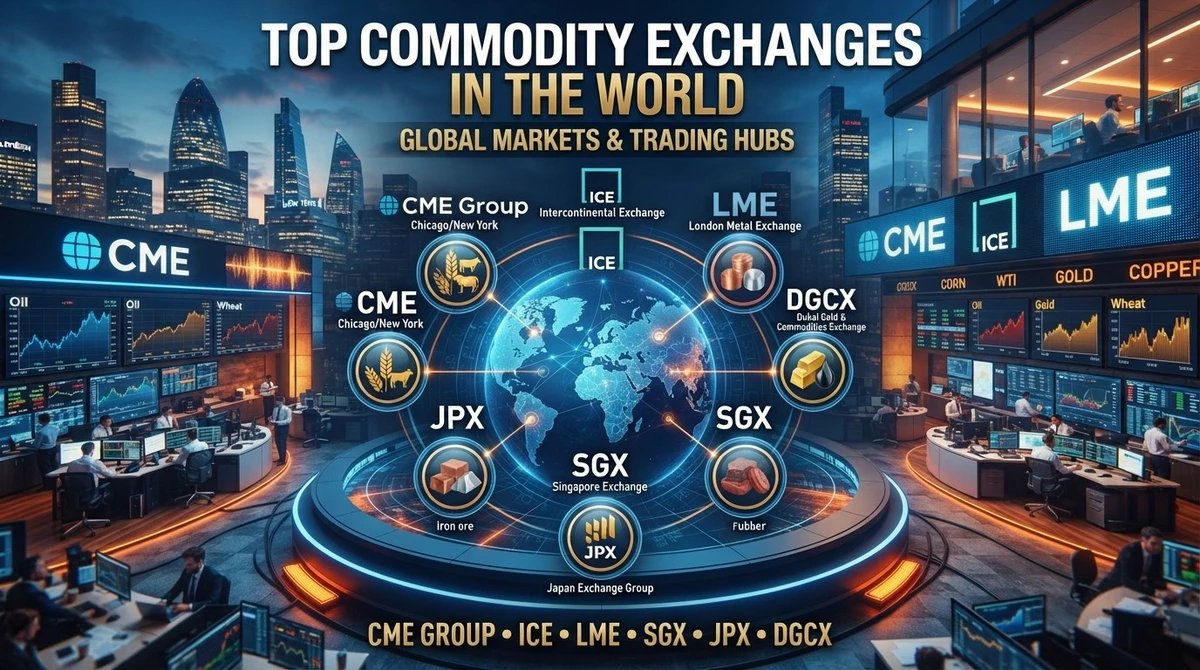
Top 10 Commodity Exchanges in the World
When people talk about oil, gold, copper, wheat, coffee, or other commodities, the physical product is only part of the story.
A barrel of crude oil has a physical market. So does a shipment of wheat, a load of copper, or a quantity of gold. But prices for these commodities are also shaped through organized markets where producers, manufacturers, traders, investors, and other participants buy and sell standardized futures and options contracts.
These exchanges provide a meeting point between the physical economy and financial markets.
The world’s major commodity exchanges do not all specialize in the same products. Some are closely associated with energy. Others are central to industrial metals, agricultural products, precious metals, or specific regional markets.
There is also no single official ranking of the world’s “top” commodity exchanges. Exchanges differ in contract volume, product breadth, liquidity, benchmark influence, physical-delivery systems, and geographic reach.
The list below therefore uses a broader methodology based on global market significance, benchmark influence, product breadth, liquidity, regional importance, and connections to physical commodity markets rather than claiming that one exchange is objectively larger than every other exchange across all measures.
1. CME Group: A Global Center for Commodity Futures
CME Group operates several major derivatives exchanges, including CME, CBOT, NYMEX, and COMEX.
Its commodity markets cover energy, agriculture, metals, and related products. NYMEX is particularly associated with energy markets, while CBOT has deep roots in agricultural futures. COMEX is a major venue for precious and industrial metals.
Major contracts across the CME Group ecosystem include:
- WTI crude oil
- Natural gas
- Gold
- Silver
- Copper
- Corn
- Soybeans
- Wheat
- Livestock
- Dairy
CME Group describes its commodity platform as covering benchmark energy, agricultural, and metals markets, with futures and options used for price discovery and risk management. (CME Group)
That breadth gives CME a distinctive position in global commodity derivatives.
A producer can use a futures contract to manage the risk of falling prices, while a manufacturer or other buyer can use the same market to manage exposure to rising input costs.
The exchange also provides a common clearing infrastructure across many of its markets, which helps commercial and financial participants manage positions across different commodity sectors.
2. ICE: Energy Benchmarks and Global Soft Commodities
Intercontinental Exchange, or ICE, has a particularly strong position in energy and soft commodities.
Its futures markets include crude oil, natural gas, power, coal, emissions, and agricultural commodities. Its soft-commodity markets include products such as cocoa, coffee, and sugar.
The exchange’s most recognizable commodity benchmark is Brent crude oil.
Brent is widely used as a reference for internationally traded crude oil, making its futures market particularly relevant to producers, refiners, trading companies, airlines, and other businesses exposed to energy prices.
ICE also operates important agricultural markets.
That combination gives the exchange exposure to two very different parts of the physical economy: energy and agricultural supply chains.
The distinction between these commodities is also useful when considering the differences between hard and soft commodities. Their production cycles, storage characteristics, and supply responses can be very different, which affects how commercial participants manage price risk.
3. London Metal Exchange: The Global Reference Point for Industrial Metals
The London Metal Exchange, or LME, has a much narrower commodity focus than CME or ICE, but its influence within industrial metals is substantial.
The LME describes itself as a global center for industrial-metals pricing, hedging, and trading. It provides markets for metals including copper, aluminum, zinc, nickel, lead, and tin. (Lme)
The exchange’s importance comes from the connection between financial contracts and physical metal markets.
The LME operates a worldwide network of approved warehouses, while its prices are widely used as reference points for physical metal transactions. The exchange says its physical-delivery system helps connect producers and consumers with financial-market participants. (Lme)
For a manufacturer that depends on copper or aluminum, the price is not simply a financial-market statistic. It affects production costs, inventory values, procurement decisions, and ultimately the price of finished goods.
The LME therefore demonstrates how a specialized exchange can have an economic reach far beyond its own trading venue.
4. Shanghai Futures Exchange and INE: China’s Commodity Market Infrastructure
China is one of the world’s largest consumers and processors of energy, metals, and industrial raw materials.
That makes its futures markets important to global commodity pricing.
The Shanghai Futures Exchange, or SHFE, provides markets for a wide range of metals and industrial commodities, while the Shanghai International Energy Exchange, or INE, provides internationally oriented energy contracts.
Shanghai’s importance is closely connected to China’s industrial economy.
When Chinese manufacturers, refiners, construction companies, and other industrial users change their demand for raw materials, producers around the world can feel the effect.
Shanghai’s exchanges provide a regional price-discovery mechanism for that enormous economic system.
This is also an example of why commodity prices cannot always be understood through production alone. A major consuming economy can have just as much influence on commodity markets as a major producer.
5. Dalian Commodity Exchange: China’s Agricultural and Industrial Link
The Dalian Commodity Exchange, or DCE, is another major Chinese futures market.
Its product mix has included agricultural commodities such as soybeans, soybean meal, soybean oil, corn, and palm oil, alongside industrial products including iron ore, coking coal, coke, and chemical materials.
This combination reflects China’s economic structure.
China is a major agricultural commodity consumer, but it is also the world’s largest steel-producing economy and one of the largest consumers of industrial raw materials.
Iron ore is a useful example.
The commodity is mined in countries such as Australia and Brazil but is heavily consumed by China’s steel industry. A futures market connected to Chinese demand therefore has implications well beyond China’s borders.
Dalian illustrates how an exchange can gain international relevance through the scale of the economy using its contracts, even when the physical commodities themselves originate elsewhere.
6. Zhengzhou Commodity Exchange: Agricultural Price Discovery in China
The Zhengzhou Commodity Exchange, or CZCE, is closely associated with China’s agricultural commodity markets.
Its products have included wheat, cotton, sugar, rapeseed, rapeseed oil, and rapeseed meal, alongside selected industrial and chemical commodities.
Agricultural futures have a distinctive economic function because production conditions can change rapidly.
Weather affects crops.
Planting decisions affect future supply.
Harvest conditions influence inventories.
Trade policy can alter export flows.
Changes in domestic consumption can shift the balance between supply and demand.
Futures markets cannot eliminate those uncertainties, but they give commercial participants a mechanism for managing some of the price risk.
That makes Zhengzhou relevant not only to traders but also to farmers, processors, merchants, and other participants in China’s agricultural economy.
7. B3: Brazil’s Connection Between Agriculture and Commodity Finance
Brazil is one of the world’s major agricultural producers and exporters, giving its domestic derivatives market an important role in commodity risk management.
B3 operates futures markets for commodities including live cattle, corn, Arabica coffee, Robusta coffee, soybeans, ethanol, and gold.
Agriculture is particularly important here.
Brazilian producers and exporters can face significant price exposure between production and final sale. A coffee grower, cattle producer, or soybean producer may not know the price that will be available when the physical product reaches the market.
Futures contracts provide a way to manage part of that uncertainty.
B3 also demonstrates how regional commodity exchanges can connect with international benchmarks.
Brazilian commodity markets do not operate separately from global prices. Currency movements, international demand, shipping costs, inventories, and overseas futures markets all influence domestic pricing.
8. Multi Commodity Exchange of India: India’s Commodity Derivatives Hub
The Multi Commodity Exchange of India, or MCX, is India’s largest commodity derivatives exchange.
Its markets cover bullion, industrial metals, energy, agriculture, and commodity indices.
Gold and silver are particularly relevant to India’s commodity economy, while crude oil, natural gas, copper, aluminum, zinc, and other industrial commodities connect the exchange to India’s broader energy and manufacturing sectors.
MCX says it provides a platform for price discovery and risk management and operates under India’s Securities and Exchange Board of India. It also describes itself as India’s largest commodity-derivatives exchange. (MCXWEB)
MCX therefore matters not simply because India consumes large quantities of commodities, but because it provides a domestic market through which businesses and financial participants can manage exposure to those prices.
9. Tokyo Commodity Exchange: Japan’s Established Commodity Market
The Tokyo Commodity Exchange, or TOCOM, operates within the Japan Exchange Group ecosystem.
Its commodity markets have historically included precious metals, energy, rubber, and agricultural products.
Japan’s role in commodities differs from that of major producing countries.
The country is heavily dependent on imported energy and raw materials, while its manufacturing economy has extensive exposure to global commodity costs.
That makes price risk important for refiners, manufacturers, trading companies, and other commercial participants.
Japan Exchange Group also incorporates commodity markets into the Nikkei-JPX Commodity Index, which includes exposure to areas such as precious metals, oil, rubber, and agricultural commodities.
TOCOM therefore represents an important link between Asian consumption, international commodity prices, and financial risk management.
10. Euronext: Europe’s Agricultural Price Center
Euronext has a particularly important position in European agricultural commodities.
Its milling wheat futures and options are used as a reference for European physical milling wheat and are relevant to cooperatives, merchants, trading houses, processors, importers, and exporters.
The contract’s physical-delivery structure connects the financial market with actual agricultural supply chains.
That connection matters because European grain prices depend on more than local harvest conditions.
Weather, Black Sea exports, global wheat supply, energy costs, fertilizer prices, currency movements, and international trade flows can all influence European agricultural markets.
Euronext provides a standardized mechanism through which market participants can manage some of that uncertainty.
Its role shows why a specialized agricultural exchange can have significant economic influence even without offering the enormous range of products available at larger multi-asset derivatives groups.
Why Commodity Exchanges Matter to the Physical Economy
A commodity exchange is not simply a place where traders speculate on prices.
Its deeper economic functions include price discovery, risk transfer, liquidity, and standardized trading.
Consider a wheat producer.
The farmer does not know the market price that will be available when the crop is harvested months later. A flour mill faces the opposite problem: it needs wheat in the future but cannot know exactly what it will cost.
A futures market allows both sides to manage part of that uncertainty.
The producer can use futures to reduce exposure to falling prices.
The buyer can use futures to reduce exposure to rising prices.
Neither side eliminates the underlying economic risk. Instead, the exchange provides a mechanism for transferring that risk among market participants.
The same basic principle applies to oil producers, airlines, copper manufacturers, gold refiners, coffee companies, and other businesses.
One Commodity Can Have Several Important Prices
There is rarely one universal commodity price.
Crude oil is a clear example.
WTI, Brent, and other crude benchmarks represent different grades, locations, delivery systems, and market structures.
That does not mean one price is correct and another is wrong.
It reflects the physical reality of commodity markets.
Location matters.
Quality matters.
Transportation costs matter.
Storage matters.
Taxes and regulations matter.
Supply and demand can also vary between regions.
The result is a network of related prices rather than one global number.
That is why several commodity exchanges can remain important at the same time.
Why Physical Delivery Still Matters
Many people think of futures markets as purely financial.
In reality, physical delivery remains part of the design of several major commodity contracts.
The LME’s warehouse system is one example. Its approved warehouses connect exchange contracts with actual inventories of metals. (Lme)
Physical delivery does not mean that every futures trader wants to receive barrels of oil, tonnes of copper, or truckloads of wheat.
Instead, the possibility of delivery helps maintain a relationship between the financial contract and the underlying commodity.
That connection strengthens the usefulness of futures prices as commercial reference points.
It also helps explain why the physical commodity market remains important even when much of the visible trading activity occurs through financial contracts.
Why Commodity Exchanges Are Concentrated in Certain Regions
The geography of commodity exchanges is not random.
Major markets tend to develop where several conditions come together:
- Large commodity producers
- Major consuming industries
- Financial centers
- Transportation infrastructure
- Storage facilities
- Regulatory frameworks
- Established trading communities
- Physical delivery networks
Chicago became deeply connected to agricultural futures because of the scale of U.S. farming and grain distribution.
London developed a major role in industrial metals.
New York became important for energy and precious metals.
Shanghai’s exchanges reflect China’s enormous industrial economy.
Brazil’s B3 is closely connected to agricultural production.
India’s MCX reflects the country’s large commodity-consuming economy.
An exchange is therefore part of a wider physical and financial ecosystem.
How Commodity Exchanges Affect Businesses and Consumers
The influence of these markets extends far beyond professional traders.
Commodity prices affect business costs throughout supply chains.
Higher crude oil prices can raise transportation and manufacturing expenses.
Higher natural gas prices can affect electricity generation and fertilizer production.
Higher copper prices can increase costs for electrical equipment, construction, and industrial machinery.
Higher wheat prices can influence food manufacturers and eventually consumer prices.
This is one reason economists and policymakers monitor commodity futures markets.
Exchange prices provide information about market expectations, perceived supply risks, demand conditions, and future price exposure.
Commodity exchanges therefore function partly as information systems for the physical economy.
Regional Markets Are Connected
The major exchanges should not be viewed as isolated marketplaces.
They interact through trade, arbitrage, inventories, transportation costs, currencies, and expectations.
A copper trader may watch both London and Shanghai.
An oil market participant may compare Brent and WTI.
A soybean trader may follow both U.S. and Brazilian markets.
A European grain company may monitor Euronext alongside U.S., Black Sea, and other international prices.
If a sufficiently large price difference develops between two connected markets, traders may have an incentive to move the physical commodity or use financial contracts to capture the difference.
That process helps connect regional markets.
It also means a supply disruption in one part of the world can influence prices far beyond the original location.
For a broader explanation of how goods move across borders and how international trade connects economies, see How Does International Trade Work?.
The Global Commodity Market Is Bigger Than Any One Exchange
The world’s commodity exchanges are best understood as parts of a larger system.
CME Group brings together major energy, agricultural, and metals markets.
ICE provides major energy and soft-commodity benchmarks.
The LME plays a central role in industrial metals.
Shanghai, Dalian, and Zhengzhou reflect the scale of China’s industrial and agricultural economy.
B3 connects Brazil’s agricultural production with global commodity finance.
MCX provides India’s major domestic commodity derivatives infrastructure.
TOCOM serves an important Asian consuming economy, while Euronext provides a major European agricultural reference market.
Their roles are different, but the economic function is closely related: they provide organized markets where prices can be discovered and commodity-price risk can be transferred.
That function connects financial markets to mines, farms, refineries, factories, warehouses, shipping routes, and consumers.
Understanding Commodity Exchanges Through Their Economic Role
The most useful way to compare the world’s major commodity exchanges is not simply to ask which one has the highest trading volume.
A better question is what economic function each market performs.
Some exchanges are broad and cover energy, metals, and agriculture. Others are highly specialized and derive their influence from one particular commodity group.
Some are internationally oriented benchmarks. Others are especially important because they serve a large regional producing or consuming economy.
What connects them is their role in converting uncertainty in the physical commodity economy into standardized prices and tradable risk.
A commodity may begin its journey in a mine, farm, or oil field, but its economic value is influenced along the way by producers, consumers, logistics companies, financial institutions, traders, and exchanges.
Understanding those exchanges adds another layer to understanding commodities themselves.
It shows not only what commodities are, but also where prices are discovered, how businesses manage commodity risk, and how regional markets become part of a global pricing network.