
Top 10 Commodity Producing Countries in the World: Leaders in Oil, Metals, Agriculture and More
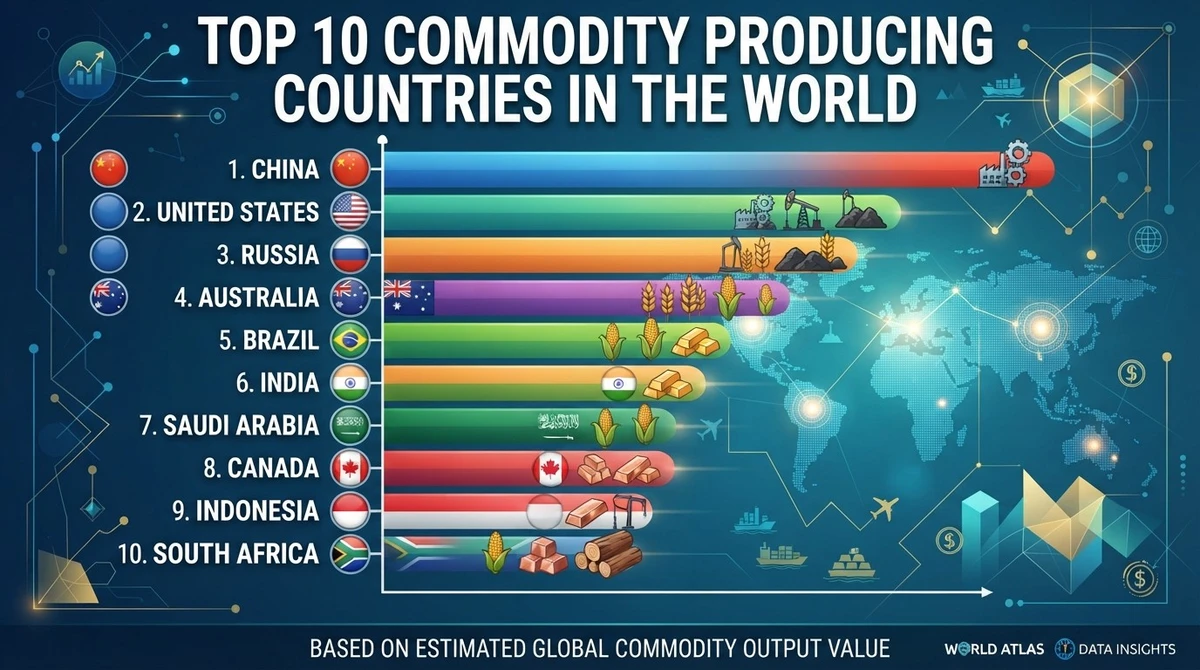
Top 10 Commodity Producing Countries in the World
Commodities are the physical goods that keep the global economy moving.
Oil powers transportation and industry. Natural gas supplies electricity and heating. Metals are essential for construction, machinery, electronics, vehicles, and infrastructure. Agricultural commodities provide food, animal feed, biofuel inputs, and raw materials for a wide range of industries.
Yet the countries producing these resources are not evenly distributed around the world.
A relatively small group of economies accounts for a large share of global production in energy, minerals, metals, and agriculture. Some countries are highly specialized, such as Saudi Arabia in oil or Chile in copper. Others have much broader commodity bases spanning energy, mining, and agriculture.
That geographic concentration matters. A disruption at a major mine, a change in oil production, a poor harvest, or a new export restriction can affect manufacturers, traders, consumers, and governments far beyond the producing country.
This article examines 10 of the world’s major commodity-producing countries, what they produce, and why their resource base matters to the global economy.
What Makes a Country a Major Commodity Producer?
There is no single number that can accurately rank every commodity-producing country.
Crude oil is measured in barrels per day. Natural gas is commonly measured in cubic meters. Wheat, corn, and soybeans are measured in tonnes. Gold, copper, lithium, and other minerals are also measured by weight, but their economic values can be dramatically different.
Simply adding these quantities together would therefore produce a misleading ranking.
Instead, the countries in this article are compared based on the breadth and scale of their production across major commodity categories, including energy, metals, minerals, and agriculture. Their importance to international supply chains is also considered.
This means the list is an editorial comparison of commodity-production strength, not a calculation that converts every commodity into one universal production number.
For minerals, the U.S. Geological Survey’s Mineral Commodity Summaries 2026 is the earliest comprehensive source of 2025 global mineral production data and covers more than 90 individual minerals and materials. (U.S. Geological Survey)
For agriculture, the latest FAOSTAT production dataset available through the end of 2025 covers crop and livestock production through 2024. It includes 278 products across major agricultural categories. (FAOHome)
For a broader explanation of the goods themselves, see Economic Reader’s What Are Commodities?
1. China – Scale Across Minerals, Agriculture and Industry
China’s commodity strength is unusual because it is not built around one resource.
The country has major production across coal, metals, industrial minerals, agricultural products, and other raw materials. Its mineral sector is particularly significant.
A 2026 USGS study examining China’s mineral production found that China produced 74 of 77 mineral commodities in its dataset and ranked first globally for 39 of those commodities based on 2023 production data. (U.S. Geological Survey)
China is particularly important in minerals used throughout modern manufacturing.
Its production position includes materials such as graphite, rare earths, tungsten, magnesium, gallium, and other industrial inputs. In the USGS study, China accounted for exceptionally large shares of global production for several of these minerals. (U.S. Geological Survey)
Agriculture adds another major dimension. China is a large producer of crops and livestock products, serving both a huge domestic market and international supply chains.
What makes China’s position especially important, however, is the connection between raw materials and manufacturing.
The country is not simply a source of minerals. Its industrial economy also provides extensive processing and manufacturing capacity, allowing commodities to move further along the supply chain inside the country.
That combination gives China a role that extends from resource production to industrial production.
2. United States – Energy, Agriculture and Minerals
The United States has one of the world’s broadest commodity-production bases.
Energy is a major part of that position. The U.S. was the world’s largest crude-oil producer in 2025, with production including lease condensate averaging a record 13.6 million barrels per day. EIA reported that U.S. production was about 40% higher than that of the next two largest producers, Russia and Saudi Arabia. (U.S. Energy Information Administration)
The United States is also a major natural-gas producer. EIA identifies it as the world’s largest natural-gas producer based on the latest available 2024 data, with 2025 global natural-gas production data still pending in that dataset. (U.S. Energy Information Administration)
Agriculture gives the country another major source of commodity output.
The U.S. produces large quantities of corn, soybeans, wheat, livestock, and other agricultural commodities. Its highly developed farming, storage, transportation, and export infrastructure allows those products to reach markets around the world.
Minerals add another layer. USGS estimated the value of U.S. nonfuel mineral production at approximately $112 billion in 2025. (U.S. Geological Survey)
The combination of energy, agriculture, and minerals makes the United States less dependent on any single commodity category than many specialized resource economies.
3. Russia – A Major Energy and Mineral Supplier
Russia’s commodity importance is closely tied to its enormous natural-resource base.
Oil and natural gas are central to the country’s production profile, while coal and a wide range of metals and minerals add further depth.
EIA estimates that Russian crude-oil production averaged about 9.9 million barrels per day in 2024 and remained broadly unchanged in 2025. Production was affected by OPEC+ restrictions and other factors. (U.S. Energy Information Administration)
Russia is also an important producer of metals and minerals, including nickel, aluminum, copper, gold, palladium, platinum-group metals, and coal.
That diversity matters because Russia’s influence is not limited to energy markets.
Its mineral production also connects it to industrial supply chains that depend on metals for manufacturing, transportation, construction, and technology.
This makes Russia an example of a commodity producer whose global importance comes from the combination of energy resources and mineral wealth.
4. Australia – Mining Powerhouse With Global Reach
Australia’s commodity economy is strongly centered on mining.
Iron ore is one of its most important exports, linking Australian mines directly to the global steel industry. The country is also a major producer of coal, gold, bauxite, alumina, lithium, copper, and other minerals.
That combination has made Australia particularly important to Asian commodity supply chains.
Its large mineral resource base has also positioned it as an important supplier of materials associated with the energy transition. Lithium, for example, is an important input for rechargeable batteries, while copper is widely used in electrical infrastructure.
Australia’s strength is therefore broader than simply being a major iron-ore exporter.
Its mining sector supplies a collection of materials that feed steelmaking, energy infrastructure, manufacturing, and technology.
The country’s commodity position also shows why mineral production should not be viewed only through the lens of today’s prices. Long-term resource availability and the ability to develop mines can influence supply chains for decades.
5. Brazil – Agriculture Meets Mining and Energy
Brazil is one of the world’s most diversified commodity-producing economies.
Agriculture is at the center of that story.
The country is a major producer of soybeans, sugar, coffee, corn, cattle, and other agricultural commodities. Its large land base and export-oriented agricultural system give it a major role in global food and feed markets.
Mining adds another important pillar.
Brazil is a major iron-ore producer, supplying a metal that is fundamental to steel production. Its mining industry also includes other important minerals.
Energy provides a third source of commodity strength.
Brazil has become a significant oil producer, particularly through offshore production.
The combination is important because these commodity categories are driven by very different market forces. Agricultural output can respond to weather and planting decisions, iron ore depends heavily on steel demand, and oil production is influenced by global energy markets.
Brazil therefore does not depend on a single commodity cycle.
Its resource base connects the country simultaneously to food, industrial materials, and energy markets.
6. Canada – Energy, Minerals and Agricultural Resources
Canada combines large natural-resource reserves with a diversified production base.
Oil is one of its most important commodities, particularly because of its large oil-sands industry. Canada is also a significant natural-gas producer.
Mining provides another major source of output.
The country produces gold, copper, nickel, potash, uranium, iron ore, and other minerals. Several of these materials are increasingly important to discussions about critical-mineral supply chains.
Agriculture completes the picture.
Canada is a major producer and exporter of wheat, canola, pulses, livestock, and other agricultural commodities.
The result is a commodity economy that spans energy, mining, and agriculture.
Canada’s geographic relationship with the United States also matters. The two economies are deeply connected through energy infrastructure, agricultural trade, transportation networks, and manufacturing supply chains.
That means Canadian commodity production has effects far beyond the value of the raw materials themselves.
7. Saudi Arabia – Oil Concentration With Global Significance
Saudi Arabia has a much more concentrated commodity profile than countries such as China or the United States.
Its importance comes primarily from oil.
EIA reported that Saudi Arabia’s crude-oil production including lease condensate increased from about 9.2 million barrels per day in 2024 to 9.6 million barrels per day in 2025. (U.S. Energy Information Administration)
Saudi Arabia also has significant natural-gas resources and a large petrochemical industry.
But oil remains the central reason the country occupies such an important position in global commodity markets.
Its role illustrates an important principle: commodity influence does not require a country to produce dozens of different resources.
A country that produces a strategically important commodity at very large scale can have an outsized effect on global markets.
Saudi Arabia’s role within OPEC also adds another dimension because changes in its production can become part of broader decisions affecting global oil supply.
8. India – Agriculture, Coal and Industrial Resources
India has a broad commodity base supported by both its enormous domestic market and its large agricultural and mining sectors.
Agriculture is particularly important.
India produces major quantities of rice, wheat, sugarcane, cotton, milk, spices, and other agricultural products. Its huge population means that much of this production is consumed domestically, making India both a major producer and a major commodity consumer.
Coal is another major component of the country’s resource system.
India’s coal industry supplies a large share of the fuel used in domestic power generation and industry.
The country also produces iron ore, bauxite, manganese, zinc, and other minerals.
This combination creates a different commodity model from that of heavily export-dependent resource economies.
India’s commodity sector is closely connected to domestic economic growth, infrastructure development, electricity demand, food consumption, and industrialization.
As the economy expands, demand for energy and raw materials can rise alongside production.
9. Indonesia – Coal, Nickel and a Growing Processing Role
Indonesia has become increasingly important in global commodity markets, particularly through coal and nickel.
Coal remains a major part of the country’s production and export economy.
Nickel, however, has changed the strategic importance of Indonesia’s mineral sector.
Indonesia possesses large nickel resources and has invested heavily in domestic processing. Nickel is important to stainless-steel production and can also play a role in battery supply chains.
This makes Indonesia a useful example of the difference between producing a commodity and processing it.
Rather than relying only on exports of raw ore, Indonesia has sought to develop more domestic processing capacity and attract downstream industrial investment.
The country also produces palm oil, natural gas, copper, tin, and other commodities.
Its proximity to major Asian manufacturing economies further increases the importance of its commodity supply chains.
10. Chile – Copper Specialization With Strategic Importance
Chile demonstrates that a country does not need to dominate many commodity categories to become globally important.
Copper is the foundation of its commodity economy.
Chile has long been the world’s leading copper-mining country. Copper is essential to electrical systems, construction, machinery, electronics, transportation, and energy infrastructure.
Chile also has major lithium resources and production, adding another strategically important mineral to its commodity profile.
The concentration creates both an advantage and a vulnerability.
Strong global demand for copper can generate substantial export earnings and investment. But when copper prices fall or production is disrupted, the effects can spread through the Chilean economy.
The country’s experience highlights the economic importance of specialization in commodity markets.
A single resource can create a major international role while also exposing an economy to fluctuations in that resource’s price and demand.
Why Commodity Production Is Concentrated in Certain Countries
The geographic distribution of commodity production begins with nature.
Oil and gas deposits form under particular geological conditions. Metal deposits depend on geological processes that can concentrate minerals in specific regions. Agricultural production depends on land, water, climate, and growing conditions.
But natural resources alone do not determine production.
Investment, infrastructure, technology, transportation, labor, energy availability, government policy, and access to export markets all influence whether a resource can be developed at scale.
That is why countries can have similar geological potential but very different levels of actual production.
It also explains why commodity leadership can change over time.
New technologies can make previously difficult resources economical to extract. New infrastructure can open remote regions. Environmental rules can change production costs. Higher prices can encourage investment, while lower prices can delay new projects.
Commodity leadership is therefore not completely fixed.
Production Is Not the Same as Processing
One of the most important distinctions in global commodity markets is the difference between extracting or producing a raw material and processing it into a usable industrial input.
A country may mine a mineral but send it elsewhere for refining. Another country may import raw materials and dominate the processing stage.
China is an important example.
A 2026 USGS study found that China’s role in minerals extends beyond extraction and includes a large network of processing facilities. The study identified more than 1,500 processing facilities in its China dataset and found that China ranked first globally for 39 of the 74 mineral commodities it produced in the study’s 2023 dataset. (U.S. Geological Survey)
That distinction matters because modern supply chains often depend on several stages.
A mineral may be mined in one country, transported to another for concentration or refining, processed into a specialized material somewhere else, and finally incorporated into a manufactured product.
The country that controls one stage does not necessarily control the entire supply chain.
This is particularly important for critical minerals, where governments and manufacturers increasingly focus on supply-chain resilience rather than simply access to raw deposits.
Why These Countries Matter to the Global Economy
Commodity-producing countries influence much more than commodity exchanges.
Oil production affects transportation costs, fuel prices, industrial expenses, and inflation.
Metal production influences construction, machinery, automobiles, electronics, power systems, and infrastructure.
Agricultural output affects food prices, animal feed, biofuels, and household consumption.
The effects can also move through international trade.
Countries with large production surpluses often become major exporters, while countries with limited domestic resources may depend heavily on imports.
For a broader explanation of how these cross-border flows work, see Economic Reader’s How Does International Trade Work?
Commodity production also influences investment.
High prices can encourage companies to develop new mines, expand farms, drill new wells, or build additional processing capacity. Lower prices can have the opposite effect.
Over time, these investment decisions affect future supply.
That creates an important feedback loop: today’s commodity prices influence tomorrow’s production capacity.
How Commodity Producers Can Affect Global Supply Chains
Large producers do not automatically control commodity prices.
Prices depend on global supply and demand, and most major commodities have many producers and consumers.
However, when production is highly concentrated, disruptions in one country can have an unusually large effect on global supply.
Oil provides a clear example.
If production changes significantly in one of the world’s largest oil-producing countries, the effect can spread quickly through international markets because crude oil is globally traded.
The same principle applies to minerals.
If a country accounts for a very large share of global production of a specialized mineral, disruptions at mines, processing facilities, ports, or transportation networks can affect manufacturers in other countries.
Agriculture introduces another source of uncertainty.
Weather can reduce crop yields unexpectedly, while favorable growing conditions can produce unusually large harvests. Because major agricultural exporters supply international markets, these changes can influence global food and commodity prices.
The global economy is therefore connected to production decisions and physical conditions in a relatively small number of resource-rich regions.
Commodity Leadership Is About More Than What Comes Out of the Ground
The world’s major commodity-producing countries do not all have the same economic model.
China combines mineral production with enormous processing and manufacturing capacity.
The United States combines energy, agriculture, and minerals.
Russia has major energy and mineral resources.
Australia is a mining powerhouse with major importance in iron ore, coal, and other minerals.
Brazil connects agriculture, mining, and energy.
Saudi Arabia demonstrates the global importance of concentrated oil production.
India combines agriculture, coal, and minerals with an enormous domestic market.
Indonesia is increasingly important in coal, nickel, and mineral processing.
Canada combines energy, minerals, and agriculture.
Chile has built a strategically important position around copper and other minerals.
What connects these countries is not simply the amount of raw material they produce.
Their importance also depends on infrastructure, processing capacity, export networks, domestic demand, and their position within global supply chains.
That is why commodity production is closely linked to international trade, industrial development, inflation, energy security, and economic growth.
Oil fields, mines, farms, and processing facilities may be thousands of miles away from the final consumer, but their output can influence the cost of fuel, food, construction materials, electronics, vehicles, and everyday goods.
As global demand changes and new technologies increase demand for certain minerals and energy sources, the countries that produce and process these resources will remain important links in the physical foundation of the world economy.