

World Top 10 Pyramid Schemes: Major Pyramid Scams in History and Lessons for Investors
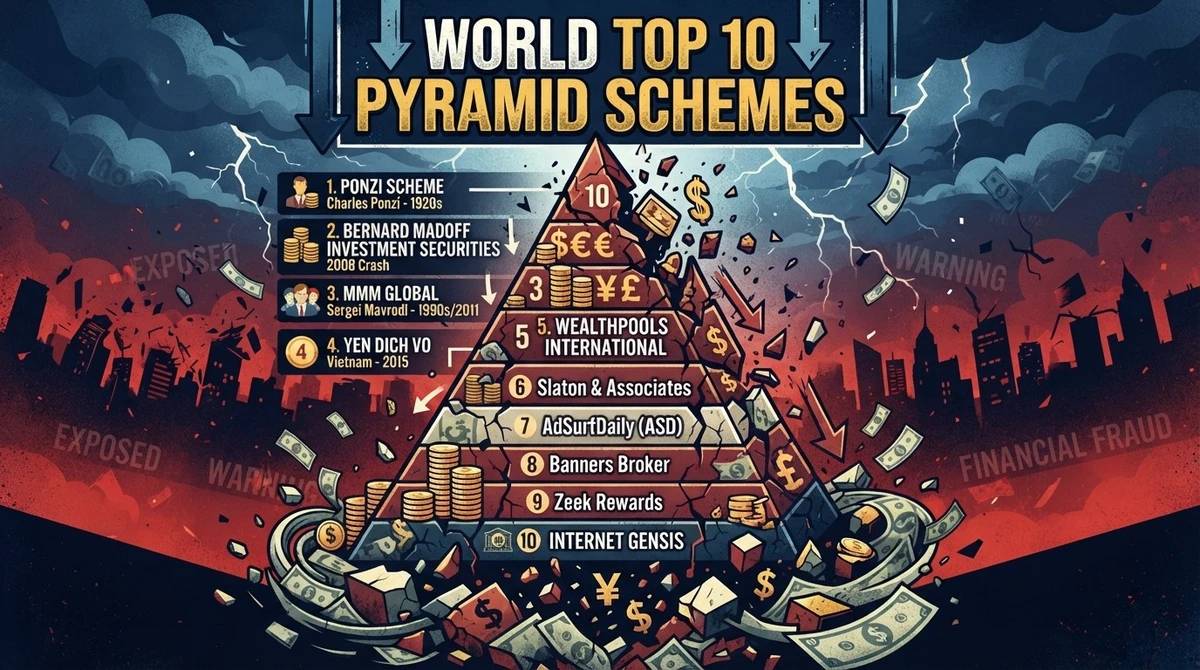
World Top 10 Pyramid Schemes
Pyramid schemes are not limited to one country, industry, or generation.
They have appeared in investment programs, direct selling, online businesses, advertising platforms, cryptocurrency projects, and financial clubs. Some depended on face-to-face recruitment. Others used websites, social media, online conferences, or blockchain technology to reach participants across borders.
The basic attraction has remained remarkably similar: participants are offered the possibility of making money by joining an opportunity and, in many cases, bringing additional people into the network.
What has changed is the technology, product, and financial story surrounding the model.
A recruitment structure that once relied on meetings and personal introductions can now spread through social media. A scheme that once sold physical products can instead promote digital memberships, investment packages, or cryptocurrency-related opportunities.
This article examines ten significant pyramid-scheme cases and episodes from around the world. It is not a precise ranking by financial losses, participant numbers, or revenue, because the available evidence differs substantially between cases. Some are notable for their scale, others for their impact on a national economy, their use of new technology, or the regulatory precedents they created.
The goal is to understand how these schemes operated, why people were attracted to them, and what their history reveals about financial risk.
1. OneCoin: When Cryptocurrency Became the Product
OneCoin is one of the most significant examples of how a traditional recruitment model was adapted to the cryptocurrency boom.
Founded in Bulgaria in 2014, OneCoin was marketed internationally through a multi-level marketing network. Participants purchased cryptocurrency packages and were encouraged to recruit additional people into the system.
The U.S. Department of Justice says victims invested more than $4 billion worldwide in OneCoin. Prosecutors said the operation involved millions of victims and marketed a fraudulent cryptocurrency through a global MLM network. (Department of Justice)
The problem was not simply that OneCoin used cryptocurrency terminology.
Its distribution model depended heavily on a global network of participants who were encouraged to sell packages and recruit others. That recruitment structure helped the operation expand far beyond its original market.
OneCoin is particularly useful as an economic case study because it demonstrates how a familiar business model can be repackaged around a new financial technology.
The language shifted toward cryptocurrency, blockchain, digital finance, and financial disruption. But the underlying attraction still relied heavily on recruitment and expectations of financial gain.
For readers trying to understand the difference between a genuine cryptocurrency network and a financial opportunity marketed with cryptocurrency terminology, Economic Reader’s What Is Bitcoin? and What Is Blockchain? provide useful background.
2. Albania’s 1996-97 Pyramid Crisis: When Fraud Became a Macroeconomic Problem
Most pyramid schemes are discussed as consumer or investor-fraud cases.
Albania’s 1996-97 crisis shows what can happen when pyramid schemes become large enough to affect an entire national economy.
During Albania’s transition from communism to a market economy, informal investment companies began offering extremely high returns. By late 1996, several schemes had taken on clear pyramid characteristics, with some promising monthly returns far above the country’s inflation rate. The IMF later estimated that the nominal liabilities of the schemes reached almost half of Albania’s GDP. (IMF eLibrary)
The scale made the collapse unusually destructive.
The IMF reported that real GDP fell by about 7% in 1997, while the collapse of the schemes contributed to a broader economic and social crisis. The country’s currency also depreciated sharply and government revenues were disrupted. (IMF eLibrary)
The crisis became a reminder that financial fraud can become a macroeconomic issue when a large share of household savings is concentrated in speculative or fraudulent structures.
Albania therefore matters for a reason that goes beyond the size of the schemes themselves.
It shows how weak financial institutions, limited regulatory capacity, unrealistic return expectations, and large-scale household participation can combine into a much broader economic crisis.
3. MMM: Mass Participation and Social Proof in Russia
Russia’s MMM became one of the most famous financial schemes of the 1990s.
Founded by Sergei Mavrodi, MMM grew rapidly during a period when Russia was undergoing a major economic and institutional transition. The operation attracted enormous public attention and was promoted as an investment opportunity.
Contemporary reporting by the Los Angeles Times estimated that MMM had reached around 10 million investors and had gathered approximately $1 billion, although the figures were described at the time as rough estimates. (Los Angeles Times)
MMM is more accurately discussed as a major Ponzi-type financial scheme than as a conventional product-based pyramid. Its inclusion here is useful because it illustrates another form of mass financial participation: people entering because other people around them appeared to be making money.
That creates a powerful social mechanism.
When thousands or millions of people participate, the size of the crowd itself can become a source of credibility. Potential investors may interpret widespread participation as evidence that an opportunity has already been validated.
In reality, popularity does not establish the sustainability of a financial model.
MMM therefore highlights an important behavioral element of large-scale financial fraud:
social proof can become part of the economic mechanism.
4. Forsage: The Pyramid Model Moves Onto Blockchain
Forsage demonstrated how a recruitment-based structure could be built around smart contracts.
The platform operated across blockchain networks and presented itself as a decentralized cryptocurrency opportunity. Participants could enter through smart-contract transactions and earn through a recruitment-based structure.
In 2022, the U.S. Securities and Exchange Commission charged 11 individuals over Forsage, alleging that it operated as a $300 million global crypto pyramid and Ponzi scheme. The SEC said the platform had attracted millions of retail investors worldwide and used smart contracts on Ethereum, Tron, and Binance blockchains. (SEC)
The case matters because blockchain can create a strong impression of transparency.
Transactions may be visible on a public ledger.
The code may be publicly accessible.
Payments can be executed automatically.
None of those features, however, proves that the underlying economic model is sustainable.
A smart contract can automate a transaction, but it cannot determine whether the activity behind that transaction creates genuine economic value.
That distinction is important well beyond Forsage.
Automation changes how a financial system operates. It does not automatically make the underlying incentives sound.
5. BitConnect: Crypto Hype and a Global Promotion Network
BitConnect became one of the most prominent examples of how cryptocurrency enthusiasm could be combined with investment promises and a large promotional network.
The platform promoted a “lending program” in which investors were told that proprietary trading technology could generate unusually high returns.
In 2021, the SEC filed an action alleging that BitConnect and its founder defrauded retail investors of approximately $2 billion through an unregistered and fraudulent offering. The SEC also alleged that BitConnect maintained a worldwide promoter network and rewarded promoters for bringing attention and investors to the program. (SEC)
That combination was important.
The investment story provided the promise of returns.
The promoter network provided distribution.
Online videos and social media then allowed promoters to reach large audiences at relatively low cost.
BitConnect demonstrates how new technology can change the speed and reach of financial promotion without necessarily changing the underlying economic problem.
The technology may be new.
The incentive structure may not be.
6. AirBit Club: Cryptocurrency, Personal Trust, and Cross-Border Recruitment
AirBit Club shows how a cryptocurrency story can be combined with traditional face-to-face recruitment.
Beginning in 2015, promoters marketed AirBit Club as a cryptocurrency-related multi-level marketing business. According to the U.S. Department of Justice, participants were promised passive returns from cryptocurrency mining and trading.
Those activities did not actually take place, prosecutors said.
Promoters traveled across the United States and to countries in Latin America, Asia, and Eastern Europe, using expos and smaller community presentations to recruit participants. The defendants later pleaded guilty or were convicted, and approximately $100 million in assets were ordered forfeited. (Department of Justice)
The case is especially revealing because it was not purely a digital operation.
The cryptocurrency narrative created the financial story, but personal meetings and community relationships helped establish trust.
That combination can be powerful.
A potential participant may be more willing to accept a complicated investment story when it comes from a friend, acquaintance, or trusted promoter rather than from an anonymous website.
AirBit Club therefore illustrates how technology and traditional social networks can reinforce each other.
7. Mirror Trading International: When Automated Trading Becomes the Pitch
Mirror Trading International (MTI) was a South African cryptocurrency investment operation that expanded internationally.
The company operated an internet-based cryptocurrency club and pooled members’ cryptocurrency for trading. It also used a multi-level marketing structure to attract participants.
MTI eventually became one of South Africa’s largest insolvency cases. In a 2024 judgment, the Western Cape High Court noted that more than R1 billion worth of Bitcoin was held by the company on liquidation and recorded that MTI’s business model had been declared an unlawful multi-level-marketing, or “pyramid/Ponzi,” scheme. (SAFLII)
The case illustrates a recurring feature of financial fraud: technical complexity can make an opportunity difficult for ordinary participants to evaluate.
An automated trading system can sound sophisticated.
A cryptocurrency trading strategy can sound highly specialized.
A global membership network can make the business appear established.
But the central economic question remains much simpler:
What activity actually generates the return?
If the answer is unclear, technical language should not substitute for evidence.
8. FutureNet and FutureAdPro: The Online Advertising Opportunity
FutureNet and FutureAdPro illustrate how pyramid-style structures moved into online advertising.
The platforms offered advertising-related packages and membership statuses. Poland’s Office of Competition and Consumer Protection (UOKiK) investigated the systems and warned consumers about their structure.
UOKiK later determined that FutureAdPro operated as a pyramid-type promotional system in which financial benefits depended primarily on introducing new members rather than on selling or consuming products. The regulator also took action against promoters who encouraged people to join the systems. (archiwum.uokik.gov.pl)
The significance of FutureNet is the way an older recruitment model was adapted to the online attention economy.
Instead of relying mainly on physical meetings, promoters could use websites, YouTube, online communities, and social media.
This changed the economics of distribution.
A promoter no longer needed to persuade someone in the same town. A video or online post could reach potential participants in another country almost instantly.
The internet did not create the recruitment model.
It simply made the model easier to distribute.
9. SkyBiz: One of the Early Internet-Era Global Schemes
SkyBiz emerged during the earlier phase of internet-based business opportunities.
The company promoted an online business package involving web-related tutorials and encouraged participants to purchase packages and recruit additional associates.
In 2001, the FTC alleged that SkyBiz was an illegal international pyramid scheme and said the operation may have obtained approximately $175 million from consumers worldwide. The agency obtained a court order freezing assets and appointing a temporary receiver. (Federal Trade Commission)
The later settlement included consumer redress and restrictions on future illegal marketing activity.
SkyBiz is historically important because it demonstrates that international online recruitment did not begin with social media or cryptocurrency.
The internet was already capable of turning a business opportunity into a cross-border operation decades ago.
The difference was scale and speed.
Modern platforms can reach potential participants almost instantly, but the underlying challenge separating genuine customer demand from recruitment-driven demand remains familiar.
10. Gold-Quest: Investment Referrals and the Flow of New Money
Gold-Quest represents another form of internationally promoted investment opportunity.
Gold-Quest International was a Panamanian corporation that solicited investors through direct contacts, its website, and referrals from existing investors.
In proceedings before Ontario securities authorities, allegations recorded from an SEC complaint stated that Gold-Quest accepted approximately $29 million from investors between 2006 and 2008 and that most of the money raised was allegedly used to make payments to existing investors and commissions to participants rather than legitimate investments. (Capital Markets Tribunal)
The case highlights the importance of examining the flow of money rather than simply the investment story.
An opportunity may be presented around gold, commodities, technology, property, or another attractive asset.
The underlying economic question is still the same:
What happens to the money after it enters the system?
A referral commission does not establish that an investment is genuine or sustainable.
The source of returns matters more than the story used to attract the initial investment.
What These Global Cases Reveal About Pyramid Schemes
The cases above span several decades, continents, industries, and technologies.
Yet several recurring patterns become visible.
The Product Changes Faster Than the Incentive
The products marketed by pyramid schemes have changed substantially.
They have included:
- investment programs
- online advertising packages
- cryptocurrency
- trading systems
- digital memberships
- business opportunities
- financial packages
The incentive structure can remain much more stable.
When participants can earn more by bringing in new participants than by generating genuine external customer demand, recruitment can become the central economic activity.
That is why looking only at the product can be misleading.
The compensation system deserves equal attention.
The Federal Trade Commission’s current guidance on multi-level marketing emphasizes that determining whether an MLM is an unlawful pyramid scheme is fact-specific. The agency considers the compensation plan, incentives, participant behavior, marketing representations, and the role of sales to ultimate users rather than applying one simple percentage test.
Technology Changes Distribution, Not Economic Reality
Older schemes depended heavily on personal meetings.
Later operations used telephone calls, printed material, and large sales events.
The internet expanded the potential audience.
Social media turned participants into their own marketing channels.
Cryptocurrency added another layer of financial complexity and global reach.
Smart contracts introduced automated transactions.
Yet none of those technologies removes the underlying economic constraint.
A recruitment-driven model still needs new participants.
A financial investment still needs a genuine source of returns.
A business opportunity still needs customers who buy because they want the product or service—not simply because they hope to recruit someone else.
Technology can accelerate growth.
It cannot manufacture sustainable demand.
Financial Complexity Can Create a False Sense of Legitimacy
Sophisticated terminology can make an opportunity appear more credible.
Trading bots.
Blockchain.
Smart contracts.
Digital assets.
Automated arbitrage.
Mining.
These terms can describe real technologies or financial activities.
But their presence in a business presentation does not establish that the promised activity actually exists or that it can generate the returns being advertised.
The more complicated the explanation becomes, the more important it is to return to basic questions:
Who pays?
What is being sold?
What generates the return?
Why does the participant receive compensation?
Those questions often reveal more than a lengthy presentation about technology.
Why International Pyramid Schemes Are Difficult to Stop
Cross-border operations create another layer of difficulty.
A company may be incorporated in one country, have promoters in several others, maintain digital infrastructure elsewhere, and move money through multiple financial systems.
SkyBiz, for example, prompted action by U.S. authorities while the FTC described the operation as reaching consumers internationally. (Federal Trade Commission)
OneCoin similarly operated through a global MLM network and attracted victims around the world. (Department of Justice)
AirBit Club used promoters who traveled across multiple regions to recruit participants. (Department of Justice)
This creates an enforcement problem.
The regulator investigating the scheme may not control the company, promoters, bank accounts, cryptocurrency wallets, or assets.
By the time authorities intervene, money may already have moved across several jurisdictions.
For investors, this creates another practical question:
Who regulates the company, and where would an investor have to seek legal protection if something goes wrong?
A company’s international appearance can be attractive.
It can also make recovery and enforcement considerably more complicated.
The Investor Lesson Is Not Simply “Avoid MLMs”
It would be too broad to conclude that every multi-level marketing company is a pyramid scheme.
The FTC’s guidance makes clear that the analysis depends on how the compensation system operates, what participants are encouraged to do, how products are sold, and who ultimately buys them. (archiwum.uokik.gov.pl)
Investors and prospective participants should therefore examine the economics of the opportunity rather than relying only on its branding.
Useful questions include:
- Where does the revenue come from?
- Who are the actual customers?
- How much money comes from participants joining or purchasing qualifying packages?
- Is recruiting essential to earning meaningful compensation?
- Can the business operate without continually adding participants?
- Are income claims supported by reliable evidence?
- What happens to the money after it is deposited?
- What regulator, if any, oversees the business?
- What legal entity actually holds the participant’s money?
For investment-related opportunities, understanding the relationship between potential returns and risk is also important. Economic Reader’s What Is Investment? and What Is Risk Management in Investing? provide useful background for evaluating those questions.
From Mailbox Flyers to Smart Contracts
The history of pyramid schemes can be viewed partly as a history of distribution technology.
Older operations depended on personal meetings and local networks.
Later schemes used telephone calls, printed material, and large conferences.
The internet expanded the potential audience.
Social media made every participant a potential promoter.
Cryptocurrency introduced new financial narratives and global payment systems.
Smart contracts made some transactions programmable.
But the underlying economic questions have remained remarkably stable.
Does the business generate value outside the participant network?
Are customers buying because they want the product or service?
Is investment income being generated by a genuine economic activity?
Or does the system depend on continually bringing in more people?
That distinction is more important than the technology surrounding the opportunity.
A polished website, cryptocurrency terminology, sophisticated software, international offices, or a large online community can make a financial opportunity look impressive. None of those features establishes that the underlying model is sustainable.
The most useful lesson from the world’s major pyramid schemes is therefore one of economic substance.
Before committing money, investors should look past the presentation and trace the flow of money.
Who provides it? Where does it go? What activity generates the promised return? And can the model continue without a constant supply of new participants?
Those questions have remained relevant from the earliest large-scale pyramid schemes to today’s blockchain-based financial opportunities.