How Are Commodity ETFs Taxed? A Guide for U.S. Investors
How Are Commodity ETFs Taxed?
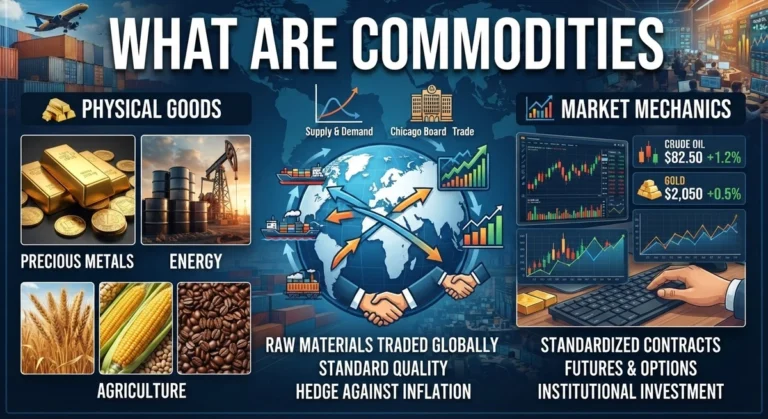
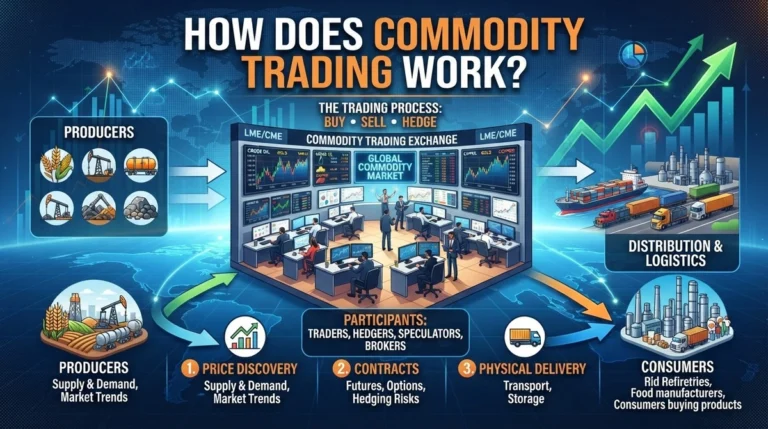
Commodity ETFs can give U.S. investors access to gold, silver, oil, natural gas, and broader commodity markets without requiring them to buy and store the underlying assets themselves.
But there is an important difference between commodity ETFs and many traditional stock ETFs: the tax treatment can depend heavily on how the commodity product is structured.
A fund that holds physical gold does not necessarily create the same tax considerations as a fund that uses commodity futures. Partnership structures can create different reporting requirements, while certain futures contracts are subject to special federal tax rules.
That makes taxation part of the investment decision rather than an issue to consider only after receiving a tax form.
This guide explains the main U.S. federal tax considerations surrounding commodity ETFs, including physically backed products, futures-based funds, Section 1256 contracts, K-1 reporting, capital gains, distributions, and the Net Investment Income Tax (NIIT).
Individual tax situations can vary, so investors should review the current documents for the specific fund and consult a qualified tax professional when appropriate.
Why Commodity ETF Taxes Can Be Different
The word “ETF” does not tell you how a commodity product is taxed.
Traditional stock ETFs generally invest in securities such as shares of publicly traded companies. Commodity exchange-traded products can use a wider range of structures and assets, including physical metals, futures contracts, trusts, partnerships, or subsidiaries.
The SEC also notes that exchange-traded commodity products are not necessarily the same type of registered investment company as traditional stock and bond ETFs. (Investor.gov)
That distinction matters because the tax rules can follow the underlying investment structure.
For an investor, the first useful question is therefore:
What does this fund actually own or use to obtain commodity exposure?
Commodity Products Can Use Very Different Structures
Commodity exposure can be created in several ways.
Physically Backed Precious-Metal Products
Some products hold physical gold or silver in custody.
The investor does not own the metal directly, but the product is designed to provide exposure to the value of the underlying bullion.
This structure creates a tax issue that is less common with ordinary stock ETFs: certain precious metals are treated as collectibles under U.S. tax rules.
Futures-Based Commodity Funds
Other commodity products obtain exposure through futures contracts.
Futures can provide exposure to markets such as crude oil, natural gas, agricultural commodities, and precious metals without the fund taking physical delivery of those commodities.
Certain regulated futures contracts fall under Section 1256, which brings special rules for recognizing and characterizing gains and losses. (IRS)
Partnership and Pass-Through Structures
Some commodity investment products may use partnerships or other pass-through arrangements.
That can change the way investors receive tax information. Instead of receiving only the forms commonly associated with ordinary securities investments, an investor may receive a Schedule K-1 reporting their share of certain income, gains, losses, or other tax items.
The exact reporting depends on the specific product.
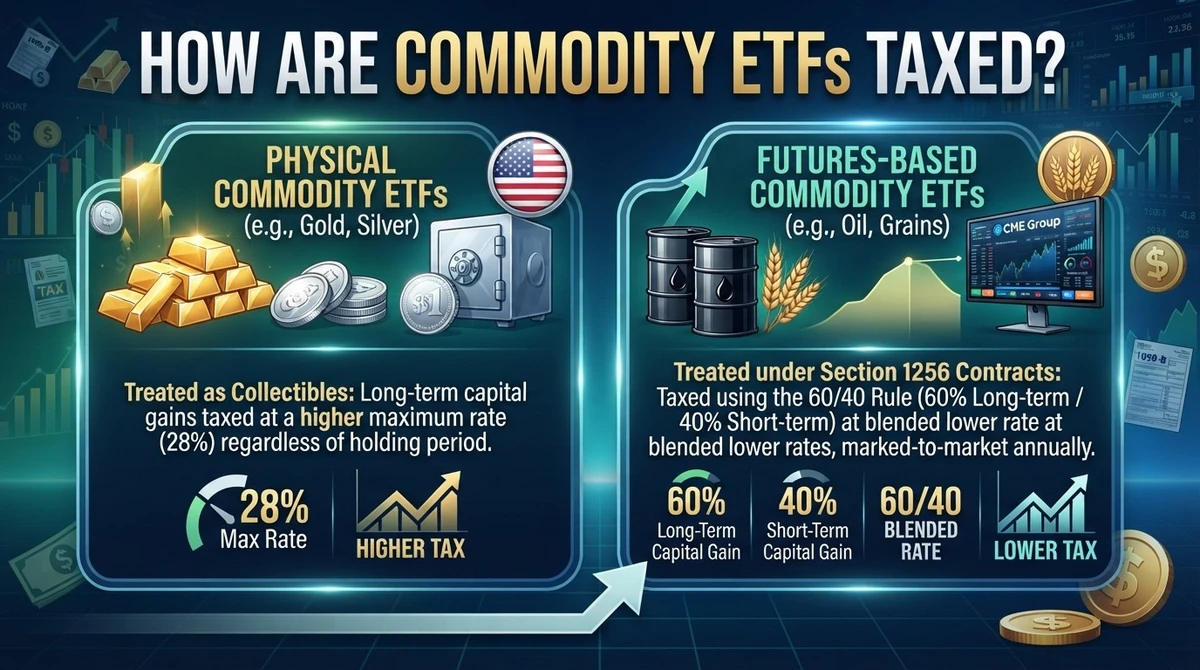
Physically Backed Gold and Silver Products Can Raise Collectibles Issues
Gold and silver deserve special attention because the IRS classifies certain metals, including gold, silver, and platinum bullion, as collectibles. (IRS)
Under the federal capital-gains rules, long-term gains from collectibles can be subject to a maximum 28% rate.
That does not mean every gold or silver exchange-traded product automatically receives the same tax treatment as directly owning bullion.
The legal structure of the product matters.
For example, a physically backed precious-metal trust can have tax treatment that differs from an investment company holding securities or a fund using futures contracts.
Investors should therefore read the fund’s prospectus and tax disclosures rather than assuming that every product tracking gold or silver works the same way.
Futures-Based Commodity Funds and the 60/40 Rule
Futures introduce another important tax consideration.
Under Section 1256, qualifying contracts are generally marked to market at the end of the tax year. The IRS explains that gains and losses on Section 1256 contracts are generally treated as 60% long-term and 40% short-term, regardless of how long the position was actually held. (IRS)
For example, if a qualifying Section 1256 position produces a $10,000 gain, the general 60/40 framework would treat:
- $6,000 as long-term capital gain
- $4,000 as short-term capital gain
The actual tax calculation can be more complicated at the fund and investor level, but the 60/40 rule is an important reason commodity futures taxation cannot simply be treated like the taxation of ordinary stock holdings.
SEC fund disclosures also describe how Section 1256 contracts can be subject to mark-to-market treatment and the 60/40 classification. (SEC)
What Does Mark-to-Market Mean?
Mark-to-market treatment can sound more complicated than it is.
In broad terms, qualifying Section 1256 contracts held at the end of the tax year are generally treated as though they were sold at their fair market value on the last business day of the year.
That means an unrealized gain or loss can be recognized for tax purposes even though the position has not been physically closed in the ordinary sense.
For a futures-based commodity fund, this can affect the timing and character of the fund’s taxable results.
Investors therefore should not assume that tax recognition always occurs only when the fund sells its ETF shares.
The fund’s own tax structure and reporting determine how the underlying activity reaches shareholders.
Why K-1 Forms Can Matter
Tax reporting is another area where commodity products can differ from ordinary ETFs.
A Schedule K-1 is commonly associated with partnerships and reports an investor’s share of certain partnership tax items.
Depending on the structure, a commodity investment can therefore involve more detailed tax reporting than an investor might expect from a conventional stock ETF.
The IRS partnership tax forms include separate reporting for different types of capital gains and other tax categories. (IRS)
However, not every commodity ETF issues a K-1.
Some products are structured to provide different forms of shareholder tax reporting. The only reliable way to know what to expect is to check the specific fund’s current documents and historical tax information.
Before buying, investors can check:
- The prospectus
- The fund’s tax information
- Recent shareholder reports
- Previous tax forms, where available
- Whether the fund historically issued a K-1
The reporting format can be an important practical consideration, particularly for investors who prefer simpler tax preparation.
What Happens When You Sell a Commodity ETF?
Selling ETF shares can create a capital gain or loss.
At the basic level, the gain or loss is generally based on the difference between the investor’s adjusted tax basis and the amount realized from the sale.
For example, suppose an investor buys commodity ETF shares for $10,000 and later sells them for $13,000.
The basic economic gain is $3,000 before considering applicable adjustments, expenses, and taxes.
But the tax treatment of that gain can depend on the type of commodity product involved.
A physically backed precious-metal product may raise collectibles considerations. A futures-based fund may have a different tax profile because of the underlying futures activity.
The investor’s own holding period and tax situation can also affect the final result.
That is why the purchase price and sale price alone do not tell the whole tax story.
Short-Term and Long-Term Treatment Is Not Always Straightforward
For ordinary capital assets, the holding period generally matters.
Assets held for more than one year can qualify for long-term capital-gain treatment, while assets held for one year or less generally produce short-term gains.
Commodity products can involve additional rules.
Section 1256 contracts are a clear example. Qualifying contracts are generally divided 60% long-term and 40% short-term under the special rules, regardless of the actual holding period. (IRS)
So an investor should not look only at how long they personally held the ETF shares.
The fund’s underlying positions and structure can also influence the tax result.
Commodity ETF Distributions Can Also Create Taxable Income
Commodity funds may make distributions during the year.
Depending on the structure, those distributions can reflect different types of income or gains.
For an investor, the important question is not simply:
“Did the ETF pay me cash?”
It is:
“How is that payment classified for tax purposes?”
The answer should appear in the fund’s year-end tax reporting.
Investors should keep their tax documents and avoid assuming that every distribution from a commodity product is equivalent to a qualified dividend from a traditional stock ETF.
This distinction can become particularly important when comparing different commodity products with similar market exposure.
The 3.8% Net Investment Income Tax Can Add Another Layer
Some higher-income investors may also need to consider the 3.8% Net Investment Income Tax (NIIT).
The IRS says the NIIT generally applies to the lesser of net investment income or the amount by which modified adjusted gross income exceeds the applicable threshold.
For individuals, the thresholds are:
- $200,000 for single or head-of-household filers
- $250,000 for married couples filing jointly
- $125,000 for married individuals filing separately
The tax rate is 3.8%. (IRS)
Net investment income can include items such as interest, dividends, and capital gains.
This means the tax cost of a commodity ETF can depend not only on the fund’s structure, but also on the investor’s broader income and filing situation.
NIIT is separate from the regular federal income-tax calculation, so investors who may be subject to it should consider the two separately.
Taxable Brokerage Accounts and Retirement Accounts
The account holding the investment also changes the tax discussion.
In a taxable brokerage account, investors generally need to account for taxable gains, losses, and distributions during the year.
Traditional and Roth IRAs operate under different tax rules, so the tax consequences cannot simply be copied from a taxable brokerage account.
This creates two separate questions:
What is the tax treatment of the commodity product?
and
What is the tax treatment of the account holding it?
Both matter.
An investor should therefore avoid assuming that a commodity ETF’s taxable-account treatment automatically describes what happens inside an IRA or another tax-advantaged account.
Commodity ETFs vs. Commodity Producer Stocks
Commodity exposure does not always require owning a commodity product.
An investor could instead buy shares of companies that produce commodities.
Consider gold.
A physically backed gold product is primarily designed to provide exposure to the price of gold. A gold-mining company, by contrast, is a business.
Its share price can be affected by:
- Gold prices
- Production costs
- Energy prices
- Debt
- Mine output
- Labor costs
- Management decisions
- Political and operational risks
The tax treatment also starts from a different place because the investor owns shares of a company rather than a commodity trust or a futures-based product.
This is one reason two investments can provide exposure to the same broad economic theme while having different risk and tax characteristics.
What Should Investors Check Before Buying?
Tax research does not have to become a complicated process.
Before buying a commodity ETF or exchange-traded commodity product, investors can work through a short checklist.
1. Identify the underlying exposure
Does the product hold:
- Physical metal?
- Commodity futures?
- Commodity-related securities?
- A broad commodity index?
- A combination of assets?
2. Check the legal structure
Look at the prospectus and fund documents to determine how the product is organized.
The SEC recommends that investors review a fund’s available information, including its prospectus and shareholder report, before investing. (Investor.gov)
3. Find the tax reporting information
Check whether the product historically provides:
- Form 1099
- Schedule K-1
- Other tax reporting documents
4. Look for special tax rules
For futures-based products, look for references to:
- Section 1256
- Mark-to-market treatment
- 60/40 treatment
For precious-metal products, check whether collectibles treatment is discussed.
5. Review distributions
Look at the fund’s historical distributions and year-end tax information.
6. Consider your account type
Determine whether the investment will be held in:
- A taxable brokerage account
- A traditional IRA
- A Roth IRA
- Another tax-advantaged account
7. Consider your personal tax situation
Factors such as income, filing status, capital gains, losses, and NIIT exposure can affect the result.
8. Use current documents
Tax rules and fund structures can change.
A current prospectus and current tax information are more useful than relying on an old article, an online forum, or the tax treatment of another fund.
A Simple Commodity ETF Tax Comparison
| Investment Structure | Main Exposure | Key Tax Consideration |
| Physically backed gold or silver product | Physical precious metal | Collectibles rules may apply depending on the structure |
| Futures-based commodity fund | Commodity futures | Qualifying Section 1256 contracts generally receive 60/40 treatment and mark-to-market treatment |
| Partnership-based commodity product | Commodity-related assets or derivatives | May involve Schedule K-1 reporting |
| Commodity producer stock ETF | Shares of commodity companies | Generally, starts with the tax treatment of securities rather than direct commodity exposure |
| Broad commodity fund | Multiple commodities | Treatment depends on the fund’s underlying investments and structure |
This table is a framework, not a universal tax classification. The actual fund documents determine the applicable treatment.
Why Tax Treatment Belongs in ETF Comparison
Investors often compare commodity products using:
- Expense ratios
- Liquidity
- Tracking performance
- Commodity exposure
- Futures structure
- Assets under management
Taxes deserve a place alongside those factors.
Imagine two products that provide broadly similar exposure to a commodity market. One may have relatively straightforward tax reporting, while another may involve a more complicated structure or different treatment of gains.
That difference may not appear in the headline expense ratio.
It does not automatically make one structure better than another. A more complicated tax structure may accompany a particular type of commodity exposure that an investor specifically wants.
The practical lesson is simpler: compare the after-tax characteristics of the investment, not just its headline fee or pre-tax performance.
Taxes Are Part of the Total Cost
The cost of a commodity ETF goes beyond its expense ratio.
Depending on the product, investors may need to consider:
- Fund expenses
- Bid-ask spreads
- Trading costs
- Futures-related costs
- Tracking differences
- Taxable distributions
- Capital gains
- Tax reporting requirements
The SEC also advises investors to consider a fund’s fees, expenses, investment objective, and underlying assets when evaluating ETFs. (Investor.gov)
Taxes can therefore affect the return an investor ultimately keeps.
This is particularly relevant when two commodity products provide similar exposure through different structures.
Frequently Asked Questions
Are commodity ETFs taxed differently from stock ETFs?
They can be. Commodity products may use physical commodities, futures, trusts, partnerships, or other structures that create tax considerations not found in many traditional stock ETFs.
Are gold ETFs taxed as collectibles?
Certain physically backed gold products can be subject to collectibles rules because gold bullion is included among collectibles under federal tax rules. The exact treatment depends on the structure of the product.
What is the 60/40 rule for commodity ETFs?
For qualifying Section 1256 contracts, gains and losses are generally treated as 60% long-term and 40% short-term, regardless of the actual holding period. Those contracts are also generally marked to market at year-end.
Do all commodity ETFs issue K-1 forms?
No. K-1 reporting depends on the structure of the specific product. Investors should check the fund’s tax documents rather than assuming every commodity ETF follows the same reporting method.
Can commodity ETF gains be subject to the 3.8% NIIT?
Potentially. Certain investment income, including capital gains, can fall within the Net Investment Income Tax rules when the taxpayer’s modified adjusted gross income exceeds the applicable threshold.
Are commodity ETFs tax-efficient?
There is no single answer. Tax efficiency depends on the fund’s structure, underlying investments, distributions, investor circumstances, and account type.
Should taxes affect how I choose a commodity ETF?
Yes. Taxes can influence the return an investor ultimately keeps. They should be considered alongside the fund’s objective, structure, costs, liquidity, risks, and expected exposure.
The Tax Treatment Starts With the Structure
Commodity ETFs can make commodity investing much more accessible, but their tax treatment is not necessarily as simple as their exchange-traded format suggests.
A physically backed precious-metal product can raise collectibles considerations. A futures-based product can involve Section 1256 rules, including mark-to-market and 60/40 treatment for qualifying contracts. A partnership structure can create K-1 reporting. Higher-income investors may also need to consider the 3.8% Net Investment Income Tax. (IRS)
For that reason, investors should look beyond the ticker symbol and expense ratio.
Before buying a commodity ETF, understand what creates the commodity exposure, how the product is structured, what tax documents shareholders receive, and how the investment fits into the account where it will be held.
For a broader look at commodity funds and the different structures investors can encounter, see Economic Reader’s Best Commodity ETFs in the USA.
The key takeaway is straightforward: when it comes to commodity ETFs, the tax treatment starts with the structure behind the investment.