Why Are Commodity Prices Rising?
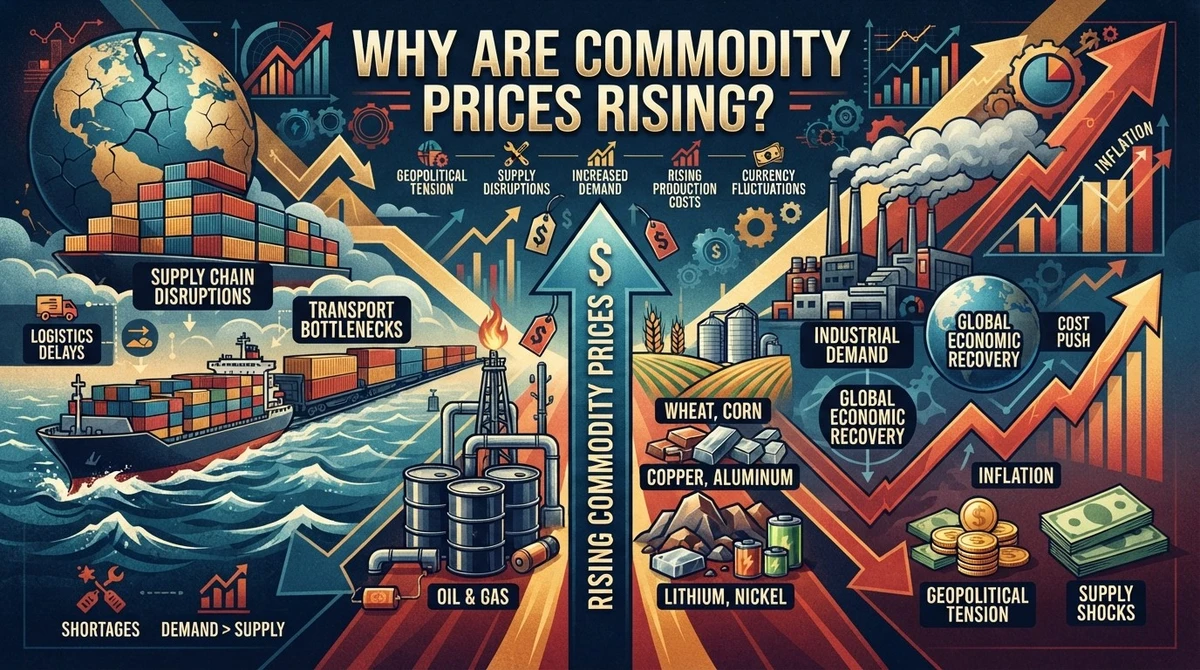
Why Are Commodity Prices Rising?
Commodity prices can rise for many reasons, and stronger demand is only one of them.
Oil can become more expensive after a supply disruption. Food prices can increase when poor weather threatens harvests. Metals can rise when industrial demand stays firm while mining supply struggles to expand. Gold can move higher when investors seek protection during periods of geopolitical or financial uncertainty.
These markets are different, but they share one basic feature: prices respond when the balance between available supply and demand changes.
That balance can shift quickly. A production problem, shipping disruption, weather event, or geopolitical conflict can tighten a market before producers have time to respond.
Recent data shows how varied these movements can be. The World Bank reported that its energy price index rose 8.8% in August 2026, led by a 10.1% increase in natural gas and a 5.7% increase in crude oil. Metal prices rose 4.0%, precious metals increased 8.8%, and food prices rose 1.4%. (World Bank)
So, why are commodity prices rising?
The answer depends on the commodity, but several forces repeatedly shape global commodity markets.
Supply Shortages Can Push Prices Higher
The most direct reason for a commodity price increase is a reduction in available supply.
Suppose a market normally needs 100 units of a commodity each month and producers supply roughly the same amount. If production suddenly falls to 90 units while demand remains near 100, buyers have to compete for a smaller supply.
Prices can rise until the market finds a new balance.
Supply can be disrupted by:
- Production outages
- Natural disasters
- War and geopolitical conflict
- Mine closures
- Equipment failures
- Export restrictions
- Shipping problems
- Weather-related production losses
The size of the disruption is not the only issue. A relatively small supply loss can have a much larger price effect when inventories are already low or producers have little spare capacity.
Energy markets provide a current example. The EIA reported that Brent crude averaged about $91 per barrel in August 2026, up $7 from July, as Middle Eastern oil exports remained constrained. (U.S. Energy Information Administration)
Demand Growth Can Tighten Commodity Markets
Supply is only half of the equation.
Commodity prices can also rise when demand grows faster than producers can respond.
Economic expansion can increase demand for:
- Oil and natural gas
- Electricity
- Industrial metals
- Construction materials
- Agricultural products
- Transportation fuels
Stronger manufacturing can increase demand for copper and aluminum. Construction activity can support demand for steel-related commodities, while higher transportation activity can increase fuel consumption.
Technology investment can create additional demand as well. Data centers, electric vehicles, power networks, and renewable-energy infrastructure all require significant quantities of certain metals.
The World Bank reported in 2026 that metals prices were being supported by resilient demand alongside supply pressures. (World Bank)
Demand does not need to surge dramatically. When supply is already tight, even moderate demand growth can push prices higher.
Low Inventories Give Supply Shocks More Power
Inventories provide a buffer between supply and demand.
When stocks are plentiful, buyers can rely on existing inventories while producers deal with a temporary disruption. When inventories are low, there is much less room for error.
That creates an important relationship:
Low inventories + supply disruption = greater potential for price increases
This is why inventory data matters so much in commodity markets.
Oil provides a useful example. In its September 2026 outlook, the EIA said global oil inventories had been falling because of continued production and trade disruptions and expected inventories to decline further during the second half of the year. (U.S. Energy Information Administration)
A market with comfortable inventories can absorb a temporary shock. A market with limited stocks can react much more sharply.
Geopolitical Risk Can Move Commodity Markets Quickly
Commodity markets are particularly sensitive to geopolitical events because production and transportation are concentrated in specific regions.
A conflict can affect:
- Production facilities
- Export terminals
- Pipelines
- Ports
- Shipping routes
- Insurance costs
- Trade relationships
- Government export policies
The impact can extend far beyond the country where the disruption occurs.
The 2026 energy shock is a clear example. The World Bank linked the year’s sharp energy-price increase to a major geopolitical supply shock, while the EIA reported that constrained Middle Eastern exports were pushing global oil prices higher. (World Bank)
The key issue is not simply the conflict itself. Commodity markets react to the amount of supply that may become unavailable and how difficult it will be to replace.
Higher Energy Costs Can Raise Other Commodity Prices
Commodity markets are closely connected.
Higher oil and natural gas prices can increase the cost of producing, processing, and transporting other commodities.
Mining companies use large amounts of energy. Farmers depend on fuel and fertilizer. Manufacturers require electricity and transportation. Ships, trucks, and aircraft also depend heavily on energy.
This creates a chain:
Higher energy costs → higher production and transportation costs → pressure on margins → potentially higher commodity prices
Fertilizer is an especially important example because energy costs influence the economics of fertilizer production, while fertilizer itself affects agricultural production.
The connection between commodities and global supply chains is also important here. Economic Reader’s guide to How Global Supply Chains Work explains how disruptions at one stage can affect costs and availability elsewhere in the supply chain.
Weather Can Move Agricultural Commodity Prices
Agricultural commodities have another major price driver: weather.
Crops depend on rainfall, temperature, soil moisture, and seasonal growing conditions. Droughts can reduce yields, while excessive rainfall or extreme heat can damage crops.
Because agriculture follows biological cycles, producers cannot instantly replace lost output.
If a major crop fails today, farmers cannot simply produce a replacement harvest tomorrow.
Recent FAO data shows how weather and supply concerns can influence food markets. The FAO Food Price Index averaged 133.3 points in August 2026, up 1.9% from July and 2.5% from a year earlier. FAO said adverse weather, geopolitical conditions, and Black Sea trade logistics were among the factors behind higher food-price quotations. (FAOHome)
The effect can differ significantly between crops, which is why agricultural commodities should not be treated as one single market.
Trade Restrictions Can Tighten Global Supply
Commodity markets depend heavily on international trade.
Countries import oil, natural gas, metals, grains, fertilizer, and other raw materials because domestic production may not be enough to meet demand.
Export restrictions can therefore reduce global availability even when total world production has not changed much.
If a major exporting country limits shipments, buyers may have to compete for supplies from other producers. Those alternative supplies may be more expensive or require longer transportation routes.
Trade restrictions can also redirect commodities between regions, changing local prices and increasing transportation costs.
Economic Reader’s guide to How Does International Trade Work? provides useful context for understanding why commodity markets are so dependent on international trade flows.
Shipping Problems Can Add More Price Pressure
Producing a commodity is only the first step.
It still has to reach the buyer.
The chain often looks like:
Production → Transportation → Storage → Processing → Final user
A disruption at any stage can affect prices.
Port closures, shipping delays, higher freight costs, damaged infrastructure, or problems at important trade routes can reduce the amount of commodity reaching a particular market.
This also explains why the same commodity can trade at different prices in different locations.
Transportation costs, local inventories, regional demand, and available supply all influence the price buyers actually face.
Producers Cannot Always Respond Quickly
Higher prices normally encourage producers to increase supply.
But commodity production often has long adjustment periods.
A mining company cannot open a new copper mine immediately after copper prices rise. Exploration, permitting, financing, construction, and infrastructure can take years.
Oil production can also require substantial capital and planning. Agriculture has a different constraint: farmers operate according to planting and harvesting cycles.
That creates an important difference between short-term and long-term supply.
Short-term supply can be relatively inflexible even when long-term supply is more responsive.
Higher prices may eventually attract new investment, increase production, encourage recycling, or accelerate substitution. But those responses often take time.
The U.S. Dollar Can Influence Commodity Prices
Most major internationally traded commodities are priced in U.S. dollars.
Currency movements can therefore affect the effective cost of commodities for buyers outside the United States.
A weaker dollar can make dollar-denominated commodities relatively cheaper for foreign buyers, potentially supporting demand. A stronger dollar can have the opposite effect.
The relationship is not automatic, though.
Commodity prices are also influenced by inventories, supply disruptions, economic growth, interest rates, and geopolitical developments. The dollar is one part of the broader pricing picture, not a standalone explanation.
Strong Demand and Tight Supply Can Work Together
Some of the strongest commodity price increases occur when demand is firm at the same time that supply is constrained.
Consider copper.
If demand rises because of investment in electricity networks, data centers, electric vehicles, and manufacturing while mine production struggles to expand, the market faces pressure from both directions.
Higher demand + limited supply = a tighter market
Prices may then rise enough to encourage additional production, recycling, substitution, or lower consumption.
The World Bank’s 2026 commodity data reflects this kind of pressure in metals markets, where resilient demand and supply constraints have supported prices. (World Bank)
Investor Demand Can Affect Some Commodities
Not every commodity is bought only for physical consumption.
Investors can gain exposure through futures, exchange-traded products, physical metals, and other financial instruments. That can affect demand and price expectations, particularly in markets such as gold.
Gold is different from many industrial commodities because it has both physical and financial demand.
Jewelry and technology are important sources of demand, while investors and central banks also hold gold as a financial asset and reserve.
That means gold can respond to geopolitical uncertainty, financial-market conditions, interest rates, and investor positioning even when industrial demand is relatively stable.
The World Bank’s April 2026 outlook projected precious-metal prices to rise 42% during 2026, reflecting strong demand amid geopolitical uncertainty. (World Bank)
Commodity Prices Can Rise Before a Physical Shortage Appears
Commodity markets are forward-looking.
Prices do not necessarily wait for a confirmed shortage.
Traders and businesses make decisions based on expectations about:
- Future production
- Future demand
- Inventories
- Weather
- Geopolitical developments
- Shipping conditions
- Government policies
- Interest rates
- Currency movements
If the market expects supply to become tighter in the future, prices can rise before the physical shortage becomes obvious.
That is one reason commodity prices can sometimes move before official production data confirms a major change.
Expectations matter because businesses need to make purchasing and hedging decisions before commodities are actually needed.
Why Different Commodities Can Move in Opposite Directions
It is easy to talk about “commodity prices” as though commodities were one market.
They are not.
Oil, gold, copper, wheat, natural gas, coffee, and lithium have different producers, consumers, supply chains, production cycles, storage characteristics, and geographic concentrations.
As a result, one commodity can rise while another falls.
The World Bank’s 2026 outlook illustrates this clearly. It projected overall commodity prices to rise 16% in 2026, but expected very different movements across categories, including energy at +24%, fertilizer at +31%, metals and minerals at +17%, precious metals at +42%, and agriculture at -6%. (World Bank)
A rising broad commodity index therefore does not mean every commodity is becoming more expensive.
Futures Markets Add Another Layer
Commodity prices are also influenced by futures markets.
The price of a commodity for immediate delivery does not always equal the price of a futures contract for delivery at a later date.
When futures prices are above the spot price, the market is generally described as contango. When futures prices are below the spot price, it is generally described as backwardation.
These conditions can reflect expectations about future supply and demand, inventories, storage costs, financing, and other market conditions.
This distinction is especially important for investors because the return from a futures-based commodity investment can differ from the change in the commodity’s spot price.
For a deeper explanation of commodity investment exposure, see Economic Reader’s Best Commodity ETFs guide.
Why Commodity Prices Can Fall Again
A price increase does not necessarily become a lasting trend.
Markets can reverse when the underlying conditions change.
Prices may fall when:
- Production increases
- New supply reaches the market
- Inventories rebuild
- Demand weakens
- Economic growth slows
- Shipping disruptions end
- Geopolitical risks decline
- Consumers switch to substitutes
- High prices reduce consumption
There is also a feedback mechanism at work.
High prices can encourage more production and investment while giving consumers a reason to reduce usage or find alternatives.
Over time, those responses can loosen the market and put downward pressure on prices.
What Should Investors Watch When Commodity Prices Rise?
A rising commodity price is only the starting point. Investors trying to understand the move should look at the conditions behind it.
Supply: Is production falling, rising, or staying stable?
Demand: Is consumption increasing, or is the move mainly supply-driven?
Inventories: Are stocks being depleted or rebuilt?
Geopolitics: Could production or transportation be disrupted?
Weather: Is the commodity exposed to drought, heat, storms, or other weather risks?
Trade flows: Are restrictions or shipping problems changing where the commodity can move?
Currency: Is the U.S. dollar affecting international purchasing power?
Futures curve: Are futures prices showing contango or backwardation?
Producer response: Can suppliers increase output quickly, or will new capacity take years?
Substitution: Can consumers switch to another material, fuel, or product?
These questions help separate a temporary price spike from a more persistent change in market conditions.
Commodity Price Increases Usually Have More Than One Cause
There is no single explanation for rising commodity prices.
A commodity can become more expensive because supply has fallen, demand has increased, inventories are low, weather has damaged production, trade has been disrupted, or investors have increased financial demand.
Often, several forces are working at the same time.
The 2026 market shows why that matters. Energy prices have been heavily influenced by geopolitical supply disruptions, food markets have faced weather and trade-related pressures, and metals have been supported by a combination of demand and supply constraints. (World Bank)
The most useful question is therefore not simply “Why did the commodity price go up?”
It is:
What changed in supply, demand, inventories, trade, or expectations that made buyers and sellers value the commodity differently?
That question provides a much clearer way to understand commodity markets and why the next price move may not have the same cause as the last one.