How Do Rare Earth Materials Affect the Economy? Understanding Their Economic Impact
How Do Rare Earth Materials Affect the Economy?
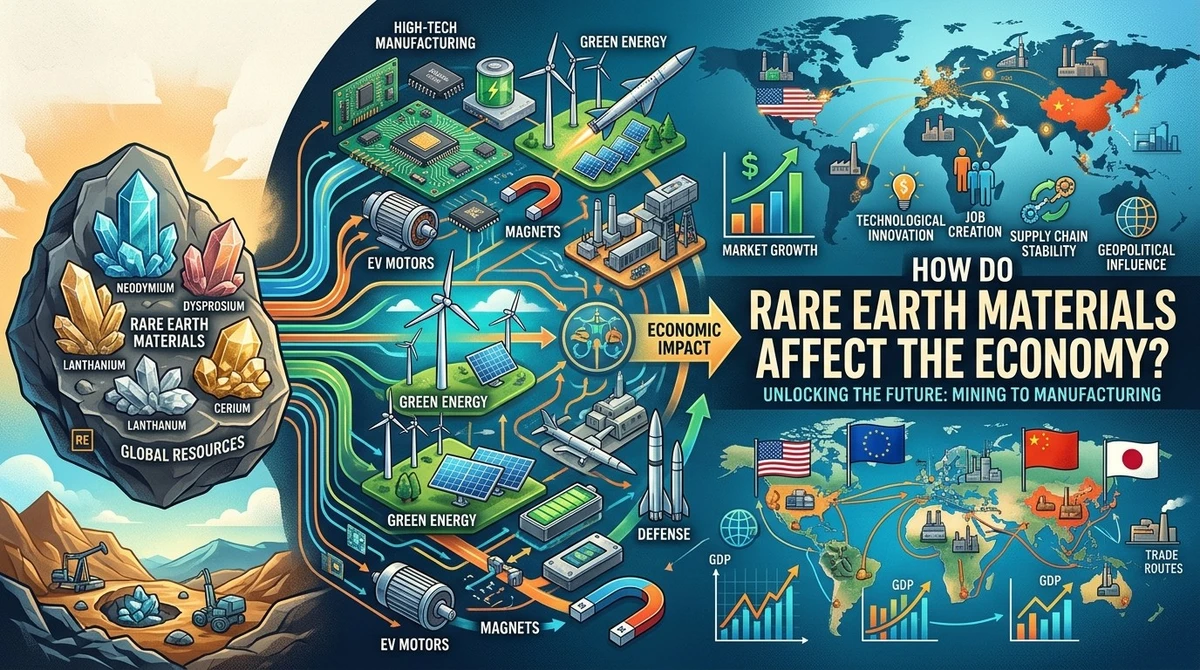
Rare earth materials occupy an unusual position in the global economy. Their direct market value is relatively small, yet industries worth trillions of dollars can depend on them.
The reason is not simply that rare earths are difficult to mine. Their economic importance comes from where they sit in modern production chains. Certain rare earth materials are essential to permanent magnets, electric vehicles, wind turbines, advanced electronics, industrial machinery, aerospace systems and other high-value technologies.
The International Energy Agency (IEA) estimates that the annual market for magnet rare earths is less than $10 billion. Yet if certain export controls were fully implemented, around $6.5 trillion of annual downstream production outside China could be at risk. The IEA estimates that diversifying magnet rare earth supply chains would require about $60 billion of investment over the next decade. (IEA)
That contrast captures the central economic issue: a small input market can become a major economic vulnerability when supply is concentrated and substitutes are limited.
The Economic Chain Starts with Supply
The economic effect of rare earths begins well before a finished product reaches consumers.
A simplified transmission chain looks like this:
Rare earth supply → components → manufacturing → investment and output → trade and prices → wider economic activity
A disruption at the first stage can therefore spread through several layers of the economy.
For example, a manufacturer may depend on a particular permanent magnet. If the magnet becomes unavailable, the company may have to pay more, find another supplier, redesign its product or reduce production. The original disruption may have involved a relatively small amount of material, but the consequences can extend to factories, workers, suppliers and customers.
This is why the economic significance of rare earths cannot be measured by the value of the minerals alone.
For background on the materials themselves, see Economic Reader’s What Are Rare Earth Materials?.
How Supply Disruptions Reach Businesses
The first visible effect of a rare earth shortage is usually a business problem rather than a macroeconomic one.
A company facing a supply disruption might:
- Pay more for critical inputs
- Search for alternative suppliers
- Increase inventories
- Redesign products
- Delay production
- Postpone investment
- Pass some costs to customers
If the affected material is used across an entire industry, the disruption can become much larger.
The IEA’s analysis of China’s 2025 rare earth export controls provides a recent example. Some manufacturers outside China experienced difficulties obtaining permanent magnets, and some automakers reduced production or temporarily suspended operations. (IEA)
The economic lesson is important: a supply shock does not need to affect every rare earth element to create a wider industrial problem. A bottleneck involving one important material or processing stage can be enough.
Why a Small Mineral Market Can Affect a Much Larger Economy
Rare earths illustrate a broader principle of modern manufacturing: the value of an input is not necessarily equal to the value of the output that depends on it.
A permanent magnet might represent only a small portion of the cost of an electric vehicle or industrial machine. But if a manufacturer cannot obtain enough magnets, the issue is no longer the price of the magnet itself.
The company may not be able to complete the product.
That can result in:
- Factory downtime
- Lower capacity utilization
- Delayed deliveries
- Lost sales
- Idle equipment and workers
- Higher sourcing costs
- Delayed investment
The same principle applies to other advanced manufacturing sectors.
This is why the IEA estimates that a full disruption of certain rare earth supply chains could put around $6.5 trillion of annual downstream production outside China at risk, despite the much smaller size of the underlying rare earth market. (IEA)
The scale difference is what makes rare earth supply risk economically significant.
Rare Earth Prices Do Not Translate Directly Into Consumer Prices
A sharp increase in rare earth prices does not automatically produce an equally large increase in the price of finished goods.
Rare earths are usually only one part of a product’s total cost. Labor, energy, machinery, transportation, software, research, financing and distribution can all account for much larger shares.
That means a tripling in the price of a rare earth material may produce a much smaller increase in the final price of a product.
The IEA’s analysis of rare earth price increases demonstrates this difference between mineral-price inflation and finished-product inflation. (IEA)
Businesses may initially absorb some of the increase through lower margins. Others may negotiate with suppliers, redesign products or shift sourcing.
Over time, however, persistent shortages can increase costs across the supply chain.
So the economic effect is better understood as cost pressure rather than a simple one-for-one pass-through to consumers.
Electric Vehicles and Clean Energy Increase the Stakes
Rare earth supply has become particularly relevant to the global energy transition.
Permanent magnets are used in some electric vehicle motors and wind turbine generators. Demand for these technologies can therefore increase demand for magnet-related rare earths.
The IEA’s 2026 outlook shows continued growth in demand for magnet rare earths, while supply diversification remains behind the pace needed to meet projected demand. Existing and announced projects outside the dominant supplier are expected to cover only around half of projected mining requirements, about one-quarter of refining needs and less than one-fifth of magnet demand outside China by 2035. (IEA)
That gap creates an economic trade-off.
Companies and governments can maintain highly concentrated supply chains that may be cheaper during normal conditions, or spend more to create alternative sources that are less vulnerable to disruption.
The second option costs more today in exchange for potentially lower disruption costs later.
Technology and Advanced Manufacturing Add Another Layer
Rare earth demand is not limited to electric vehicles and renewable energy.
Advanced electronics, robotics, aerospace, defense, industrial automation and AI-related infrastructure also rely on technologies that can use rare earth-enabled components.
The connection with AI is particularly interesting because the economic importance is often indirect. AI systems themselves are not simply a collection of rare earth materials. But the infrastructure required to build and operate advanced computing systems depends on complex networks of servers, power equipment, cooling systems, industrial machinery and electronic components.
The IEA identifies rare earths as strategically important across advanced industry, semiconductors, artificial intelligence, aerospace and defense as well as energy and transport. (IEA)
As these industries expand, reliable access to specialized materials becomes part of the economics of technological investment.
Trade Dependence Can Become a Cost
Rare earth supply concentration also affects international trade.
A country may have mineral resources of its own but still depend on foreign processing or magnet manufacturing. That creates a gap between resource ownership and industrial supply security.
When trade restrictions or geopolitical tensions emerge, businesses may respond by:
- Diversifying suppliers
- Building strategic inventories
- Signing long-term contracts
- Investing in domestic processing
- Moving some manufacturing
- Developing alternative materials
These changes can make production more expensive.
For a company, paying more for a second supplier may appear inefficient when supply is functioning normally. But if the alternative prevents a factory shutdown during a disruption, the additional cost can function as a form of insurance.
This is part of the broader shift toward more resilient global supply chains.
Can Rare Earth Shortages Cause Inflation?
Rare earth shortages can contribute to inflation, but their effect is usually more targeted than an oil or natural gas shock.
A simplified process would be:
Supply shortage → higher input costs → more expensive components → higher production costs → higher prices for some goods
The size of the effect depends on several factors.
If rare earths represent only a small share of a product’s cost, even a major increase in mineral prices may have a limited effect on the final price.
If the shortage also causes factories to operate below capacity, however, the economic damage can become much larger.
That is why rare earth disruptions can matter even when they do not generate a large increase in headline inflation.
The bigger concern may be industrial disruption rather than broad consumer-price inflation.
Why Companies May Pay More for Supply Security
One of the most important economic consequences of rare earth concentration may be higher investment in supply-chain resilience.
A manufacturer that once optimized primarily for the lowest possible input cost may now consider the cost of disruption as well.
That can lead to investment in:
- Multiple suppliers
- Larger inventories
- Recycling
- Alternative materials
- Product redesign
- Domestic or regional production
- Long-term purchasing agreements
These decisions can raise operating or capital costs.
But companies do not necessarily view those costs as wasted money. They may treat them as protection against a much larger potential loss.
The IEA estimates that diversifying magnet rare earth supply chains would require roughly $60 billion of investment over the next decade. Compared with the potential $6.5 trillion annual exposure from a severe disruption, the investment represents a relatively small economic insurance cost. (IEA)
What Does This Mean for Investment and Economic Growth?
Rare earth supply can influence economic growth through investment, productivity and industrial capacity.
New mines and processing plants create direct investment and employment. More importantly, reliable access to materials can support the expansion of downstream industries.
The reverse is also possible.
If companies cannot secure critical inputs, they may delay new factories, reduce capacity utilization or reconsider where they manufacture products.
That creates a link between mineral security and capital investment.
The effect on productivity can also matter. Advanced machines, electric motors, robotics and other technologies can increase output per worker. If supply constraints make those technologies more expensive or difficult to obtain, adoption may slow.
Rare earth supply therefore does not determine economic growth by itself. Instead, it can influence whether important industries can expand and invest efficiently.
Why Governments Care About Rare Earth Supply
Rare earths have increasingly become an economic-security issue because governments have to consider risks that individual companies may not be able to manage alone.
The basic policy dilemma is straightforward.
A country can rely heavily on the lowest-cost global supplier and benefit from efficient production during normal conditions. But if that supply is interrupted, rebuilding alternative capacity can take years.
That is why governments are supporting domestic mining, refining, recycling, strategic partnerships and alternative supply chains.
The goal is not necessarily complete self-sufficiency.
For many economies, a more practical objective is diversification: ensuring that one supplier, one processing location or one trade route cannot determine whether an entire industry can operate.
The IEA’s 2026 analysis describes this as a broader economic-security challenge, noting that highly concentrated critical-mineral supply chains have already demonstrated their vulnerability to export restrictions. (IEA)
The Economic Trade-Off: Efficiency vs. Resilience
Rare earths reveal a difficult trade-off in modern globalization.
For years, companies have had strong incentives to build supply chains around efficiency. If one supplier can provide a material at the lowest cost, buying from that supplier can make economic sense.
But extreme concentration creates another cost: the cost of disruption.
A diversified supply chain may require more expensive suppliers, additional inventories and redundant production capacity. Those costs can reduce efficiency during normal periods.
Yet the same redundancy can protect production when conditions deteriorate.
The economic question is therefore not simply:
“Which supplier is cheapest?”
It is increasingly:
“What is the cost of depending too heavily on one supplier?”
That change in thinking could influence corporate investment decisions well beyond the rare earth industry.
The Long-Term Economic Impact of Rare Earth Materials
Rare earth materials show how a relatively small commodity market can sit underneath much larger parts of the global economy.
Their economic importance comes from the combination of several factors:
Concentrated supply + specialized applications + limited substitutes + large downstream industries
When those factors come together, even a relatively small disruption can create disproportionate economic effects.
The response will likely involve more mining, refining, magnet manufacturing, recycling, substitution and supplier diversification. But each of those responses requires capital, time and technical expertise.
The IEA estimates that around $60 billion of investment could be needed over the next decade to diversify magnet rare earth supply chains, compared with the potential exposure of trillions of dollars of annual downstream production in a severe disruption scenario. (IEA)
That comparison explains why rare earths have moved beyond the traditional boundaries of the mining industry.
For businesses, they are a supply-chain risk.
For manufacturers, they can affect production and investment.
For governments, they are increasingly connected to industrial and economic security.
And for the wider economy, they demonstrate a basic principle of modern production: the economic importance of a material is not determined only by its market value. It can also depend on how many critical industries would struggle without it.