

What Is EBITDA? A Beginner’s Guide to Understanding Company Profitability
When investors look at a company, revenue alone does not tell the whole story. Two businesses can generate similar sales but have very different operating results.
That is why investors and analysts use several financial metrics to understand how a business is performing.
One of those metrics is EBITDA.
EBITDA is widely used in company analysis, business valuation, lending, and mergers and acquisitions. It focuses on earnings before interest, income taxes, depreciation, and amortization, giving analysts another way to examine operating performance.
But EBITDA can also be misunderstood.
It is not the same as net income. It is not the same as cash flow. And a higher EBITDA does not automatically mean a company is financially stronger.
Understanding what EBITDA measures, what it leaves out, and how it fits into a broader financial analysis can help investors make better sense of company financial statements.
What Is EBITDA?
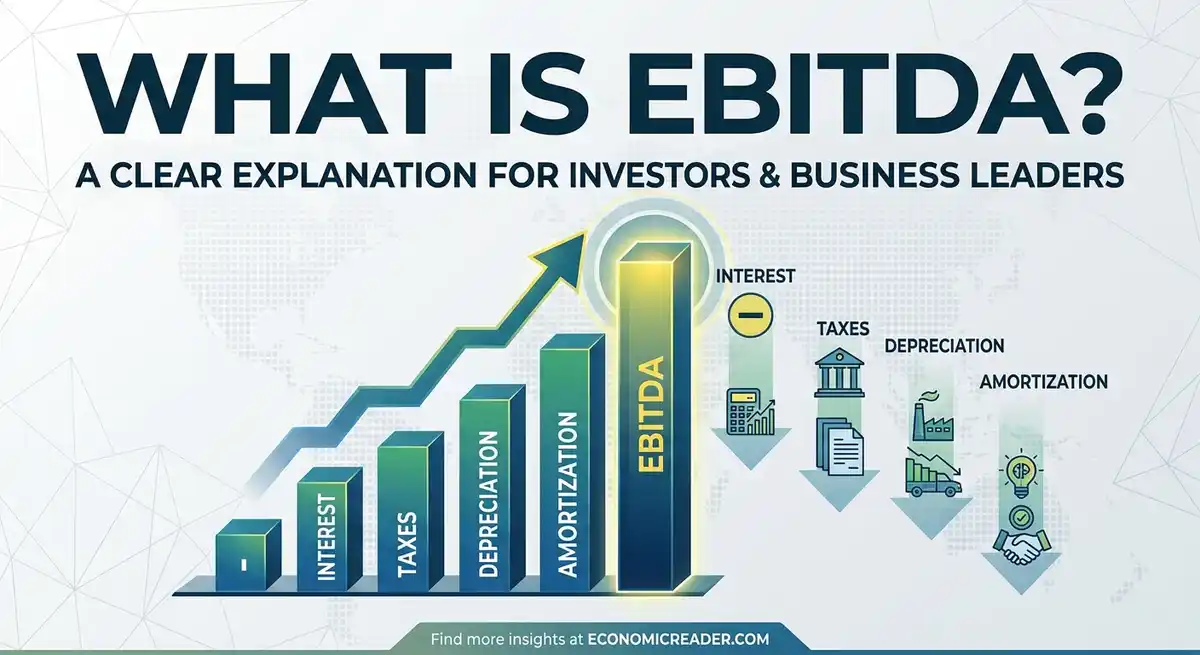
EBITDA stands for Earnings Before Interest, Taxes, Depreciation, and Amortization.
It is a financial measure used to evaluate a company’s earnings before these four expenses are taken into account.
The SEC recognizes EBITDA as a non-GAAP financial measure. Companies may use it as a supplemental measure alongside their GAAP financial results. (SEC)
In simple terms, EBITDA is designed to give investors a view of operating performance before considering:
- Interest expenses
- Income taxes
- Depreciation
- Amortization
This can be useful when comparing businesses with different debt structures, tax situations, or asset bases.
However, EBITDA should be viewed as one part of financial analysis rather than a complete measure of profitability.
What Does EBITDA Stand For?
Each letter in EBITDA represents a specific financial item.
Earnings
Earnings generally refer to net income when EBITDA is calculated from the bottom of the income statement.
Interest
Interest represents the cost associated with borrowing money.
Two companies can have similar operations but very different interest expenses because they use different amounts of debt.
Taxes
Taxes are amounts owed to governments based on applicable tax rules.
Tax rates can differ between companies because of their locations, business structures, and other circumstances.
Depreciation
Depreciation is the accounting allocation of the cost of a tangible asset over its useful life.
Examples include:
- Buildings
- Machinery
- Vehicles
- Equipment
Depreciation is a real economic cost associated with using assets, even though the expense recorded in a particular period does not represent a current-period cash payment.
Amortization
Amortization generally refers to the allocation of the cost of certain intangible assets over time.
Examples can include:
- Patents
- Software
- Certain acquired intangible assets
- Other intellectual property
How Is EBITDA Calculated?
A common formula is:
EBITDA = Net Income + Interest + Taxes + Depreciation + Amortization
It can also be calculated from operating income:
EBITDA = Operating Income + Depreciation + Amortization
The second approach is useful because operating income already excludes interest and income taxes.
The exact presentation can vary depending on the company’s financial statements and how the metric is derived.
A Simple EBITDA Example
Suppose a company reports:
- Net income: $1,500,000
- Interest expense: $300,000
- Income taxes: $400,000
- Depreciation: $500,000
- Amortization: $200,000
Using the formula:
EBITDA = $1,500,000 + $300,000 + $400,000 + $500,000 + $200,000
EBITDA = $2,900,000
The company therefore has EBITDA of $2.9 million under this calculation.
This number does not mean the company has $2.9 million of cash available to spend. EBITDA excludes several important costs and is not a cash flow measure. CFA Institute specifically notes that EBITDA is not strictly a cash flow number because it does not account for items such as working capital changes and noncash revenue. (CFA Institute)
Why Do Investors Use EBITDA?
EBITDA can provide useful information when it is used correctly.
1. To Examine Operating Performance
EBITDA can help investors focus on the earnings generated before interest, taxes, depreciation, and amortization.
This can provide a different perspective from net income.
For example, a company may report lower net income because it has significant interest expenses. EBITDA allows an investor to examine the business before those financing costs.
2. To Compare Companies
Companies can have different:
- Debt levels
- Tax environments
- Asset structures
- Depreciation policies
Because EBITDA excludes some of these factors, analysts may use it as one measure when comparing businesses.
However, comparisons should still be made carefully. EBITDA definitions and adjustments can vary, particularly when companies report Adjusted EBITDA.
3. To Analyze Business Valuation
EBITDA is commonly used in valuation analysis.
One widely used valuation multiple is:
EV / EBITDA
This compares enterprise value with EBITDA.
Because EBITDA is measured before interest, it is applicable to the providers of both debt and equity capital, which is one reason EV/EBITDA is commonly used in valuation analysis. (CFA Institute)
4. To Evaluate Acquisition Targets
Companies and investors may consider EBITDA when evaluating potential acquisitions.
A buyer may examine EBITDA alongside:
- Revenue
- Debt
- Cash flow
- Capital expenditures
- Growth
- Working capital requirements
This gives a more complete picture of the business.
What Is EBITDA Margin?
EBITDA margin shows EBITDA as a percentage of revenue.
The formula is:
EBITDA Margin = EBITDA ÷ Revenue × 100
For example, suppose a company has:
Revenue: $10 million
EBITDA: $2 million
EBITDA margin:
$2 million ÷ $10 million × 100 = 20%
The company therefore has an EBITDA margin of 20%.
EBITDA margin can help investors evaluate operating profitability relative to revenue and compare a company’s performance over time.
However, a meaningful comparison usually requires looking at companies within the same industry or with similar business models.
EBITDA vs Revenue
Revenue and EBITDA answer different questions.
| Metric | What It Shows |
| Revenue | Sales generated by the business |
| EBITDA | Earnings before interest, taxes, depreciation, and amortization |
A company can have rapidly growing revenue without generating strong EBITDA.
That is why investors often look at both measures rather than relying on sales alone.
EBITDA vs Net Income
EBITDA and net income are not interchangeable.
| EBITDA | Net Income |
| Excludes interest | Includes interest |
| Excludes income taxes | Includes income taxes |
| Excludes depreciation | Includes depreciation |
| Excludes amortization | Includes amortization |
| Used to examine operating performance | Represents profit after applicable expenses |
Net income remains an important GAAP measure, while EBITDA can provide additional information when used as a supplemental metric.
EBITDA vs Cash Flow
This is one of the most important distinctions beginners should understand.
EBITDA is not cash flow.
A company can report strong EBITDA while having weak free cash flow.
Why?
Because a business may need to spend substantial amounts on:
- Equipment
- Buildings
- Technology
- Working capital
- Debt payments
- Taxes
EBITDA does not capture all of these cash requirements.
For that reason, investors should examine cash flow statements and free cash flow when assessing a company’s financial health.
What Is Adjusted EBITDA?
Investors may also come across the term Adjusted EBITDA.
Adjusted EBITDA starts with EBITDA and then makes additional adjustments determined by the company.
These adjustments may include certain:
- Restructuring costs
- Stock based compensation
- Acquisition related expenses
- One time charges
- Other items management considers unusual or non recurring
The exact adjustments differ between companies.
That means investors should not automatically assume that Adjusted EBITDA from one company is directly comparable with Adjusted EBITDA from another.
SEC guidance distinguishes EBITDA from differently calculated measures such as Adjusted EBITDA. (SEC)
When a company reports an adjusted measure, investors should read the reconciliation to the closest GAAP measure and understand what has been excluded.
EBITDA and Business Valuation
EBITDA is particularly common in valuation analysis.
Suppose a business has:
Enterprise value: $50 million
EBITDA: $5 million
The EV/EBITDA multiple would be:
$50 million ÷ $5 million = 10×
This means the company’s enterprise value is equal to 10 times its EBITDA.
Investors can compare this multiple with:
- Historical company valuations
- Similar companies
- Industry valuation ranges
However, valuation multiples should never be viewed in isolation.
A company with a lower multiple is not automatically a better investment.
Growth prospects, debt, capital requirements, margins, competitive advantages, and future cash generation all matter.
How Investors Should Analyze EBITDA
A useful EBITDA analysis goes beyond asking whether the number is high or low.
Look at the Trend
Is EBITDA:
- Increasing?
- Stable?
- Declining?
A consistent improvement may indicate stronger operating performance, while a declining EBITDA trend may require further investigation.
Examine the EBITDA Margin
If revenue is growing but EBITDA margin is falling, the company may be facing rising operating costs.
If both revenue and EBITDA are increasing while margins remain stable or improve, the business may be scaling more efficiently.
Check Debt
High EBITDA does not eliminate the risks associated with high debt.
A company may generate substantial EBITDA but still face significant interest and repayment obligations.
Check Cash Flow
Cash flow provides information that EBITDA cannot.
Investors should compare EBITDA with operating cash flow and free cash flow to understand how much money the business is actually generating.
Understand Capital Expenditures
Capital intensive companies may need to spend large amounts on equipment, property, technology, or infrastructure.
EBITDA does not subtract these investments.
That can make EBITDA look stronger than the amount of cash ultimately available to the business.
EBITDA Across Different Industries
The usefulness of EBITDA can vary by industry.
Technology
Technology companies may use EBITDA to evaluate operating performance, particularly when comparing businesses with different capital structures.
However, investors should also pay close attention to research and development costs, stock based compensation, and cash flow.
Manufacturing
Manufacturing companies often require significant investments in machinery and equipment.
EBITDA can provide useful information about operating performance, but depreciation and capital expenditures remain important considerations.
Retail
Retail companies can use EBITDA to assess operating performance across stores or business segments.
Investors may also examine sales growth, margins, inventory, and cash flow.
Telecommunications
Telecommunications businesses often have substantial infrastructure investments.
EBITDA can therefore be useful for comparing operating performance, but investors should not ignore capital expenditures and debt.
The Limitations of EBITDA
EBITDA is useful, but it has clear limitations.
1. EBITDA Is Not a GAAP Profit Measure
EBITDA is a non GAAP financial measure rather than a standard GAAP measure. (SEC)
It should therefore be considered alongside GAAP financial information rather than treated as a replacement for it.
2. It Excludes Real Costs
Interest, taxes, depreciation, and amortization are excluded from EBITDA, but those costs still matter to a business.
Ignoring them completely can create an incomplete picture.
3. It Does Not Measure Cash Available
EBITDA does not account for all cash requirements.
A company can have strong EBITDA and still have limited free cash flow. (CFA Institute)
4. Adjusted EBITDA Can Become Difficult to Compare
Companies can make different adjustments when presenting Adjusted EBITDA.
Investors should understand the reconciliation instead of accepting the headline number without examining its components.
5. It Can Be Misleading for Capital Intensive Businesses
Businesses that require heavy investment in physical assets may have significant depreciation and capital expenditure.
Removing depreciation from the operating measure can make comparisons look better than they actually are if capital requirements are ignored.
A Practical Example
Imagine two companies, Company A and Company B.
Both report:
Revenue: $20 million
Company A:
- EBITDA: $5 million
- Debt: $8 million
- Capital expenditures: $1 million
Company B:
- EBITDA: $5 million
- Debt: $25 million
- Capital expenditures: $4 million
At first glance, both companies appear equally strong because they have the same revenue and EBITDA.
But the broader picture is very different.
Company B has substantially more debt and higher capital requirements.
This example shows why EBITDA should not be used by itself.
A good investor asks what is happening behind the EBITDA number.
EBITDA and 2026 Business Analysis
EBITDA remains widely used in company reporting and valuation in 2026.
Current corporate disclosures continue to present EBITDA and Adjusted EBITDA as supplemental measures for evaluating operating performance.
At the same time, investors are paying close attention to whether companies can turn reported operating earnings into sustainable cash generation.
This is particularly relevant in capital intensive areas such as artificial intelligence infrastructure, cloud computing, and data centers, where large investments can have a major effect on cash flow and debt.
For example, recent reporting on Oracle’s 2026 financial position has highlighted the importance of looking beyond EBITDA at debt, leases, and capital spending when evaluating an AI infrastructure strategy. (Reuters)
The broader lesson is simple: EBITDA can be useful, but it should be part of a much larger financial picture.
Common EBITDA Mistakes Beginners Make
Mistake 1: Assuming EBITDA Means Cash
It does not.
EBITDA is a financial performance measure, not a direct measure of cash generated.
Mistake 2: Assuming Higher EBITDA Always Means Better
A company with higher EBITDA may also have:
- Higher debt
- Larger capital requirements
- Weak free cash flow
- Slower future growth
Mistake 3: Ignoring Net Income
Net income provides important information that EBITDA excludes.
Both measures can help investors understand different parts of a company’s financial performance.
Mistake 4: Ignoring Industry Differences
EBITDA margins vary significantly across industries.
Comparing a software company directly with a manufacturing company may not provide a meaningful conclusion.
Mistake 5: Looking Only at One Year
A single year’s EBITDA can be misleading.
Investors should examine several years of financial results when possible.
Frequently Asked Questions (FAQ)
1. Why do companies report EBITDA?
Companies may report EBITDA to provide investors and other stakeholders with an additional view of operating performance. Because it is a non GAAP measure, it is normally presented alongside GAAP financial information.
2. Can a company have positive EBITDA and still lose money?
Yes. A company can have positive EBITDA while reporting a net loss because interest, taxes, depreciation, amortization, and other expenses can reduce earnings below zero.
3. Why is EV/EBITDA commonly used in valuation?
EV/EBITDA compares enterprise value with a pre interest earnings measure, making it useful when comparing companies with different capital structures. (CFA Institute)
4. What should I check besides EBITDA?
Look at revenue growth, operating income, net income, debt, operating cash flow, free cash flow, and capital expenditures. No single metric can fully describe a company’s financial condition.
5. Is EBITDA useful for beginners?
Yes, as long as beginners understand what it does and does not measure. It is best used as one part of a broader company analysis rather than as a standalone indicator.
Final Thoughts
EBITDA can be a useful starting point when you want to understand how a company’s operations are performing before interest, taxes, depreciation, and amortization.
It can help investors compare businesses, study operating margins, and analyze valuation multiples such as EV/EBITDA.
But EBITDA has an important limitation: it leaves out several costs that can materially affect a company’s financial position.
That is why a stronger analysis looks beyond one number.
When evaluating a company, consider EBITDA alongside revenue, net income, debt, operating cash flow, free cash flow, and capital expenditures.
The goal is not simply to find a company with a high EBITDA.
The goal is to understand how that EBITDA is being generated and whether the business can turn its operating performance into sustainable value over time.
Continue Learning…
If you’d like to explore this topic further, check out these related guides from Economic Reader:
- Real Estate vs Stocks – Which Is Better in 2026?
- What Is Free Trade? – How Open Markets Shape Global Commerce.
- 10 Common Mistakes – New Entrepreneurs Make and How to Avoid Them.
Author Note: This article is crafted by “The Economic Reader editorial team”, dedicated to analyzing the latest market trends, financial updates, and global economic shifts to keep you informed with accurate and comprehensive insights.
Disclaimer: The information provided on this website is for educational and informational purposes only and should not be construed as professional financial, investment, or legal advice. Always consult with a certified financial advisor or professional before making any financial decisions based on this content.