
Oil Market Weekly Update: August 31-September 4, 2026 U.S.-Iran Tensions Push Crude Higher
Oil Market Weekly Update: August 31-September 4, 2026
The oil market entered September with a familiar problem, but this time the reaction was much stronger: geopolitical risk returned to the center of the market.
Crude prices jumped as the United States and Iran resumed military exchanges, raising fresh concerns about oil supplies moving through the Middle East and, in particular, the Strait of Hormuz.
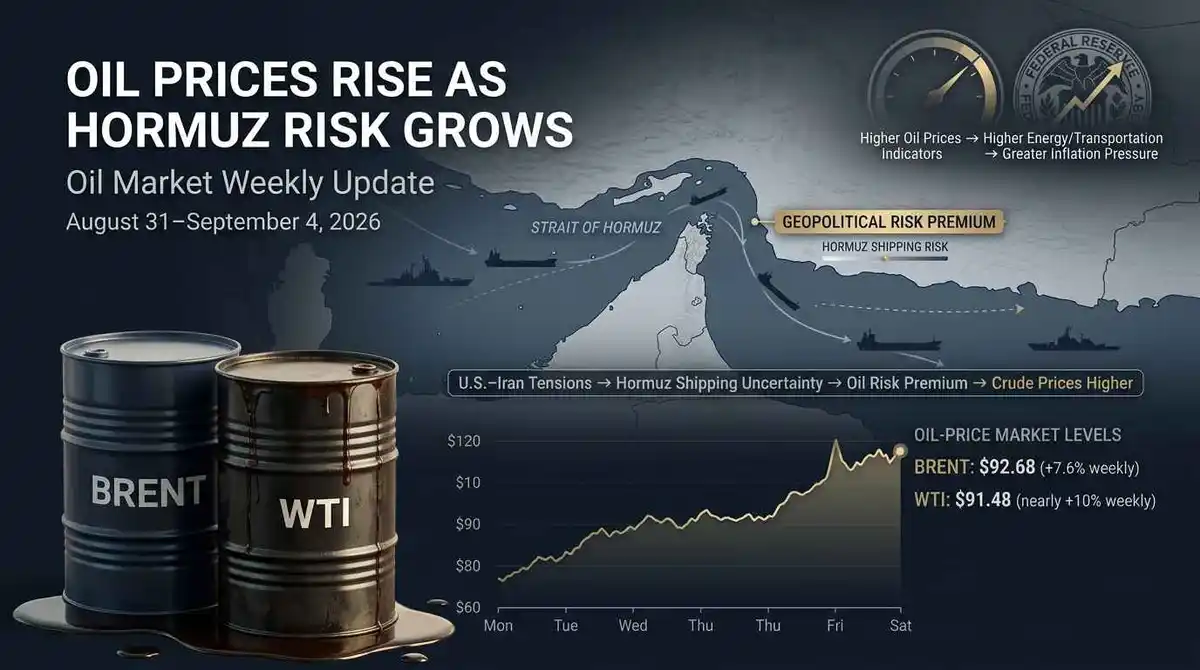
By Friday’s close, Brent crude had risen to $92.68 per barrel, gaining about 7.6% for the week, while U.S. West Texas Intermediate (WTI) settled at $91.48, up nearly 10%. Reuters described the weekly increase as the strongest for oil since mid-July. (Reuters)
The rally was not driven by a sudden collapse in global oil production. Instead, investors were pricing a higher risk premium into crude because the conflict increased uncertainty around future supplies and shipping routes.
That distinction matters.
A Geopolitical Shock Sets the Tone
Oil prices were already carrying a geopolitical premium when the week began.
On Monday, August 31, renewed fighting between the United States and Iran pushed Brent above $90 for the first time in several sessions.
Brent settled at $90.49, up 2.71%, while WTI climbed to $85.76, a gain of 2.83%. Reuters reported that both contracts reached their highest levels since August 25 during the session. (Reuters)
The market reaction was understandable.
The Strait of Hormuz is one of the world’s most important oil transit routes. Any prolonged disruption can affect crude exports from major Middle Eastern producers and increase shipping costs and delivery uncertainty.
That does not mean that every military escalation automatically removes millions of barrels from the global market.
Oil traders often move prices higher before a physical shortage appears because they are pricing the possibility that one could develop.
That is what happened at the beginning of this week.
Tuesday: Oil Jumps More Than $4
Tuesday delivered the week’s most dramatic early move.
Brent and WTI both rose by more than $4 a barrel as traders assessed the latest U.S.–Iran military developments and the possibility of further disruption to Middle Eastern oil supplies. Brent settled at a five-week high. (Reuters)
The market was also confronted with a particularly concerning development around the Strait of Hormuz.
Reuters reported that two supertankers carrying Saudi oil were struck by unknown projectiles within minutes of each other on September 1. (Reuters)
For oil markets, incidents involving tankers can have an outsized impact because they raise questions about whether shipping companies will continue using the route normally.
If vessels become reluctant to travel through the area, the consequences can extend beyond the barrels immediately affected.
Insurance costs can rise.
Shipping times can increase.
Available tanker capacity can tighten.
And buyers can become more concerned about securing future supplies.
All of those factors can add to the price of crude.
The Strait of Hormuz Becomes the Market’s Main Focus
The Strait of Hormuz remained at the heart of the oil story throughout the week.
However, the situation was more complicated than simply saying that the waterway had stopped carrying oil.
Reuters reported on September 2 that U.S. Energy Secretary Chris Wright said around 17 million barrels of oil transited the Strait on Monday, suggesting that flows were still occurring despite the conflict. (Reuters)
At the same time, Reuters reported later in the week that only four vessels passed through the waterway on Thursday, compared with a 10-day average of about 15 vessels. (Reuters)
This difference illustrates why the oil market was so volatile.
Physical flows had not simply disappeared, but shipping activity remained highly uncertain.
For traders, that creates a difficult calculation:
How much oil can still move today, and how much will be able to move if the conflict gets worse?
The answer can change quickly depending on military developments.
Wednesday and Thursday: The Rally Continues, but the Market Becomes More Selective
Oil did not simply move straight upward throughout the week.
Wednesday brought another rise, with renewed U.S.–Iran attacks keeping supply concerns elevated. Brent settled about 1% higher after a volatile session. (Reuters)
By Thursday, the market was balancing several competing forces.
The geopolitical risk premium remained firmly in place, but traders were also considering the possibility of diplomatic progress between Russia and Ukraine and the potential effect of broader global economic conditions.
Reuters reported that Brent and WTI were mixed on Thursday as investors weighed Middle East escalation against the possibility of progress elsewhere in geopolitical negotiations. (Reuters)
That combination is important because oil markets rarely trade on one factor alone.
Even when geopolitical risk is high, investors still have to consider:
- Global economic growth
- Fuel demand
- U.S. inventories
- OPEC+ supply
- Refinery activity
- Shipping conditions
- Interest rates
- The strength of the U.S. dollar
This is why crude can rise sharply on one headline and then give back part of the move when traders reassess the actual supply implications.
Friday: Oil Finishes a Powerful Week
Friday brought some profit-taking, but it did little to change the overall weekly picture.
Brent and WTI both moved lower during parts of the session as traders locked in gains and assessed the latest developments.
By the close, however, crude remained substantially higher than where it had started the week.
Brent finished at $92.68, while WTI ended at $91.48. Brent gained approximately 7.6% during the week and WTI nearly 10%. (Reuters)
The move represented the strongest weekly performance for both benchmarks since mid-July.
For the oil market, the message was clear: traders were willing to pay significantly more for crude to compensate for the increased uncertainty surrounding Middle Eastern supply routes.
Why the Oil Rally Matters Beyond Energy Markets
Oil prices do not stay inside the energy sector.
When crude becomes more expensive, the impact can spread through transportation, manufacturing, agriculture and consumer prices.
Fuel is a direct cost for airlines, trucking companies, shipping operators and many other businesses.
Energy is also an input into the production and transportation of countless goods.
That means a sustained oil rally can create broader inflation pressure.
This is particularly important right now because the Federal Reserve and other central banks are already monitoring inflation closely.
If energy prices remain elevated, central banks may have to consider whether higher fuel costs could keep overall inflation above target for longer.
Economic Reader explains this relationship in more detail in How Inflation Affects Your Money.
Oil and the Federal Reserve: An Unexpected Connection
The oil market’s relationship with interest rates can seem indirect, but it can become important during a geopolitical shock.
A simplified chain looks like this:
Higher oil prices → higher energy costs → stronger inflation pressure → fewer expectations for rapid rate cuts or greater chance of tighter policy → potential pressure on economic growth
This creates a difficult environment for investors.
Oil producers may benefit from higher crude prices, while energy-intensive businesses and consumers can face higher costs.
At the same time, higher inflation can complicate central-bank decisions.
The Federal Reserve’s monetary policy therefore matters to the oil market even though the Fed does not control crude prices directly.
Economic Reader’s What Is the Federal Reserve? explains how the U.S. central bank influences interest rates, financial conditions and the wider economy.
The Bigger Question: Is This a Supply Shock or a Risk Premium?
This is perhaps the most important question for investors after this week’s rally.
Oil prices can rise for two very different reasons.
The first is an actual physical supply shortage.
If millions of barrels genuinely disappear from the market for an extended period, higher prices may persist until producers or inventories compensate.
The second is a risk premium.
In that situation, traders push prices higher because they fear that a supply disruption could occur.
This week’s rally appears to contain a substantial geopolitical risk component.
Reuters reported that analysts were raising short-term price forecasts because of the continued uncertainty around the Strait of Hormuz. Citi raised its third-quarter Brent forecast to $86 per barrel from $80, while ANZ raised its short-term Brent forecast to $95 and warned of further upside if the conflict intensifies. (Reuters)
That does not guarantee that oil will remain above $90.
If tensions ease and shipping activity normalizes, some of the risk premium could disappear quickly.
On the other hand, a major disruption to exports or tanker traffic could produce another sharp price increase.
What Could Push Oil Even Higher?
The bullish case for oil depends largely on whether the geopolitical situation deteriorates further.
Several developments could keep upward pressure on prices.
1. More Disruption Around Hormuz
The biggest risk remains the Strait of Hormuz.
If tanker traffic falls substantially for an extended period, the market could begin pricing a more serious physical supply problem.
2. Damage to Oil Infrastructure
Attacks affecting production facilities, export terminals, pipelines or storage infrastructure could have a more direct effect on global supply.
3. Wider Regional Escalation
If the conflict expands beyond the current areas of confrontation, the number of oil-producing countries and shipping routes at risk could increase.
4. Higher Shipping and Insurance Costs
Even if crude production continues, more expensive or restricted shipping can raise the delivered cost of oil.
These risks explain why crude prices can remain elevated even when actual production losses are relatively limited.
What Could Bring Oil Prices Back Down?
The bearish case is equally important.
If the United States and Iran move toward a sustained de-escalation, the geopolitical risk premium could unwind.
Improving tanker traffic through the Strait of Hormuz would also reduce concerns about physical supply.
At the same time, weaker global economic growth could reduce demand for fuel and industrial energy.
This creates a particularly uncertain outlook.
Oil prices do not need a major supply increase to fall sharply. Sometimes they only need the market to become less worried about future supply.
The Economic Impact Could Become More Important
The biggest concern for policymakers is no longer just the price of crude itself.
It is the possibility that elevated oil prices could remain high long enough to influence inflation.
Reuters reported that the oil rally, together with rising U.S. diesel prices, was already increasing concerns about inflation and government borrowing costs. U.S. diesel prices reached a record average of about $5.85 per gallon, according to the September 4 report. (Reuters)
That creates a difficult environment.
Consumers face higher transportation and energy costs.
Businesses face higher operating expenses.
Central banks face a more complicated inflation outlook.
And investors must reassess the earnings outlook for different sectors of the economy.
Economic Reader’s What Is Inflation? provides more background on how changes in energy and other prices can influence the broader price level.
Oil Market Outlook
The short-term outlook is likely to remain dominated by geopolitics.
The market has already shown how quickly crude can move when traders believe that Middle Eastern supply routes are becoming less secure.
The key question now is whether this week’s increase becomes the beginning of a longer oil rally or simply a temporary geopolitical spike.
A sustained move higher would probably require either prolonged disruption to shipping or a meaningful reduction in physical oil supplies.
If tensions ease and the flow of tankers improves, some of this week’s risk premium could disappear.
For investors, the most important indicators to watch are therefore not just Brent and WTI prices.
They include:
- Strait of Hormuz shipping activity
- Middle Eastern oil exports
- Tanker attacks or disruptions
- U.S. crude and fuel inventories
- OPEC+ supply decisions
- Global economic growth expectations
- Inflation data
- Central-bank policy expectations
The interaction between these factors will determine whether oil remains near current elevated levels or begins to retreat.
Frequently Asked Questions
1. Why did oil prices rise this week?
Oil prices rose mainly because renewed U.S.–Iran military conflict increased concerns about Middle Eastern supply and shipping disruptions, particularly around the Strait of Hormuz. Brent gained about 7.6% for the week, while WTI rose nearly 10%. (Reuters)
2. What is the Strait of Hormuz and why is it important for oil?
The Strait of Hormuz is a strategically important maritime route connecting the Persian Gulf with the Gulf of Oman and the Arabian Sea. Disruption to tanker traffic through the waterway can create significant uncertainty for global oil supplies and shipping costs.
3. Did oil production actually collapse this week?
Not necessarily. The market’s reaction was driven heavily by the risk of future supply disruption. Oil continued to move through the Strait, although tanker traffic became highly uncertain and was substantially lower than recent averages at points during the week. (Reuters)
4. Can higher oil prices increase inflation?
Yes. Higher oil prices can increase fuel, transportation and production costs. If elevated energy prices persist, they can contribute to broader inflation pressure and complicate central-bank decisions.
5. What should oil investors watch next?
The main focus will be developments involving the United States and Iran, tanker traffic through the Strait of Hormuz, actual Middle Eastern export volumes, U.S. inventory data and signals about global oil demand. Any meaningful improvement or deterioration in the geopolitical situation could produce large price movements.
Final Thoughts
The August 31–September 4 week was a reminder that geopolitical risk can quickly reshape the oil market.
Brent and WTI began the week already carrying a supply-risk premium. Renewed U.S.–Iran military exchanges then pushed crude sharply higher as traders became increasingly concerned about the security of Middle Eastern shipping routes.
The result was a powerful weekly rally, with Brent ending at $92.68 and WTI at $91.48. (Reuters)
But the next stage of the oil story is less certain.
If the conflict continues to threaten tanker traffic and regional exports, prices could remain elevated or move higher.
If tensions ease and shipping conditions improve, some of the geopolitical premium could disappear just as quickly.
For the global economy, the stakes are significant. A prolonged oil rally would not only affect energy companies and fuel prices. It could also influence inflation, business costs, consumer spending and central-bank policy.
For now, the oil market is watching one thing above all else:
Whether this week’s geopolitical risk premium becomes a lasting supply problem – or fades as tensions ease.
If you want to read last week’s
- Oil Market Weekly Update: please click here.
- Gold Market Weekly Update: please click here.
- Stock Market Weekly Update: please click here.
- Crypto Market Weekly Update: please click here.
Author Note: This article is crafted by “The Economic Reader editorial team”, dedicated to analyzing the latest market trends, financial updates, and global economic shifts to keep you informed with accurate and comprehensive insights.
Disclaimer: The information provided on this website is for educational and informational purposes only and should not be construed as professional financial, investment, or legal advice. Always consult with a certified financial advisor or professional before making any financial decisions based on this content.