
US Stock Market Weekly Update: August 31-September 4, 2026 Strong Jobs Data Rekindles Fed Rate Hike Fears
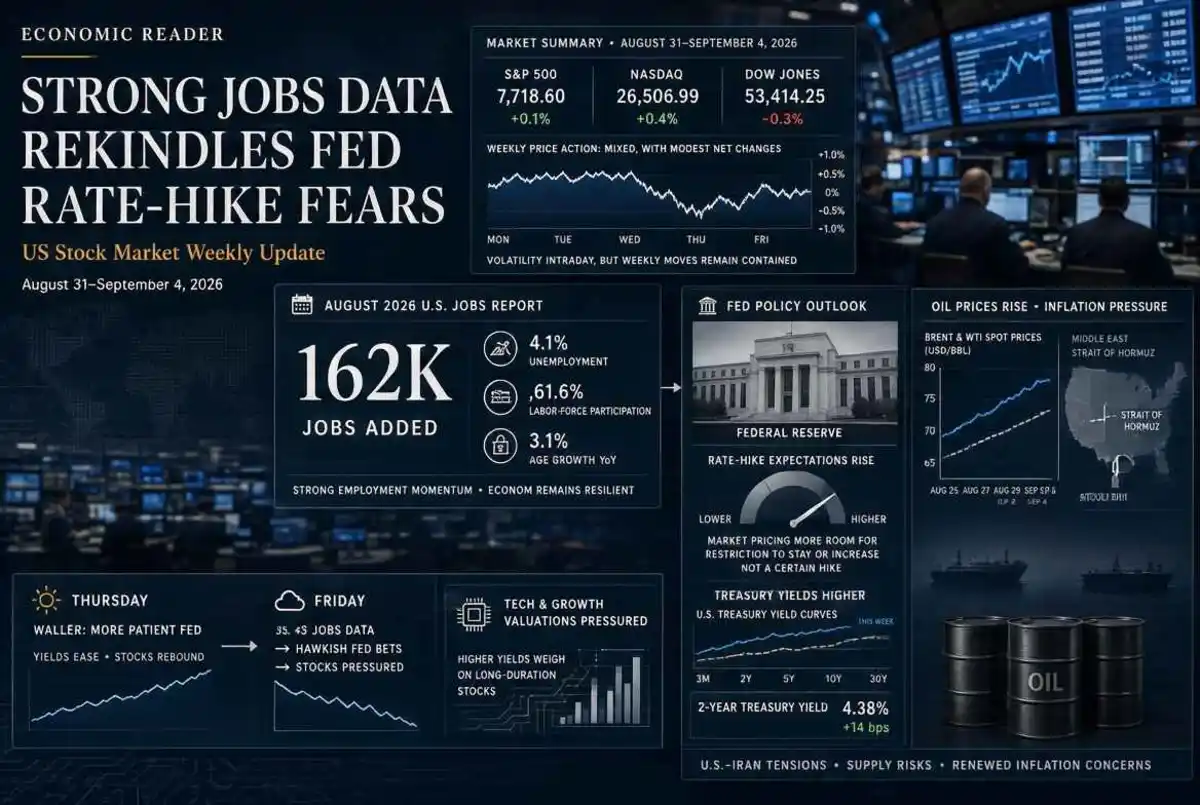
US Stock Market Weekly Update: August 31-September 4, 2026
The U.S. stock market finished the first week of September with a mixed performance as investors moved between optimism over economic resilience and renewed concern about interest rates.
The S&P 500 and Nasdaq Composite managed small weekly gains, while the Dow Jones Industrial Average slipped. But the modest index moves disguise a more complicated week underneath. Rising oil prices, renewed U.S.–Iran tensions, Treasury yields and changing Federal Reserve expectations repeatedly shifted investor sentiment.
The biggest market test came on Friday, when a much stronger-than-expected U.S. employment report pushed Treasury yields higher and increased expectations that the Federal Reserve could raise interest rates at its September meeting. (Reuters)
That left investors facing a familiar but difficult combination: an economy that still appears capable of generating jobs, but an inflation and interest-rate environment that could keep monetary policy restrictive for longer.
How the Major U.S. Indexes Performed
According to AP’s market data, the major indexes finished the week with relatively modest moves:
| Index | September 4 Close | Weekly Performance |
| S&P 500 | 7,718.60 | +0.1% |
| Nasdaq Composite | 26,506.99 | +0.4% |
| Dow Jones Industrial Average | 53,414.25 | -0.3% |
| Russell 2000 | 2,975.65 | +0.1% |
The S&P 500 and Nasdaq therefore managed to remain positive for the week despite Friday’s selloff, while the Dow ended slightly lower. (AP News)
The relatively small weekly changes also show why looking only at the final numbers can be misleading. The market experienced several sharp daily swings as investors reassessed interest-rate expectations.
A Difficult Start to September
The week began with investors carrying concerns from the final days of August into September.
On Monday, U.S. stocks weakened as rising crude oil prices revived inflation concerns. The combination of geopolitical tensions and higher energy costs raised the possibility that inflation could prove more persistent, making it harder for the Federal Reserve to loosen monetary policy. (Reuters)
The pressure continued on Tuesday. Treasury yields moved higher while crude prices jumped, creating a difficult backdrop for equities. Higher bond yields can make stocks less attractive relative to fixed-income assets and can also increase financing costs for businesses.
Technology and growth stocks can be particularly sensitive to changes in interest-rate expectations because a significant portion of their valuations depends on future earnings.
Wednesday Brought a Partial Rebound
After several sessions of weakness, stocks recovered on Wednesday.
Reuters reported that Wall Street advanced as investors looked for opportunities in stocks that had declined during the previous sessions. The rebound demonstrated that investors had not completely abandoned risk assets despite concerns about rates and oil. (Reuters)
However, the recovery remained fragile.
The market was still balancing three competing forces:
- strong enough economic activity to support corporate earnings;
- higher energy prices creating renewed inflation pressure;
- uncertainty over whether the Fed would keep rates unchanged or tighten policy further.
That tension became even clearer on Thursday.
Waller’s Comments Give Stocks a Lift
Thursday produced the week’s strongest rebound.
Federal Reserve Governor Christopher Waller indicated that policymakers could remain patient on further rate increases. His comments helped reduce some of the market’s immediate concern about an imminent rate hike, pushing Treasury yields lower and allowing stocks to rally. (Reuters)
The Dow gained more than 600 points during the session, while technology stocks also benefited from the easing in rate expectations.
This was an important reminder of how closely the equity market was tracking monetary policy expectations. Investors were not simply reacting to corporate earnings or economic growth. They were also constantly reassessing the path of interest rates.
For readers following how monetary policy affects financial markets, Economic Reader’s explanation of what the Federal Reserve does provides useful background.
Friday Changed the Picture Again
The mood shifted sharply after the release of the August employment report.
U.S. employers added 162,000 jobs in August, considerably above economists’ expectations. The unemployment rate remained at 4.1%, while the labor-force participation rate increased to 61.6%. Average hourly earnings were up 3.1% from a year earlier. (Reuters)
The strength of the report initially looked positive for the economy. But for investors, the implications for monetary policy were more complicated.
A stronger labor market gives the Federal Reserve more room to maintain or increase interest rates if policymakers believe inflation remains too high. Markets therefore increased their expectations for a September rate hike after the report.
Reuters reported that the probability of a 25-basis-point rate increase at the September meeting rose significantly following the employment data. (Reuters)
Treasury yields moved higher, with the two-year yield – which is particularly sensitive to expectations for Fed policy – rising to its highest level since January 2025. (Reuters)
Stocks consequently ended Friday lower:
- S&P 500: -0.38%
- Nasdaq Composite: -0.29%
- Dow Jones: -0.51%
Semiconductor stocks were among the stronger areas of the market, while several individual companies experienced significant declines. (Reuters)
The Bigger Story Was Interest Rates
The week’s most important market relationship was not simply stocks versus earnings. It was stocks versus interest-rate expectations.
The sequence was straightforward:
Stronger economic data → higher rate expectations → higher Treasury yields → pressure on equity valuations.
But the opposite also occurred during the week:
More patient Fed expectations → lower yields → renewed demand for stocks.
This explains why Thursday’s rally and Friday’s decline could happen within just two trading sessions.
For investors, the key issue is no longer simply whether the U.S. economy is growing. The question is whether growth is strong enough to keep inflation pressures alive.
That distinction matters because a strong economy is normally good news for corporate profits. But if strong growth forces the Fed to maintain tighter monetary policy, higher interest rates can eventually offset some of that benefit.
Economic Reader’s article on how inflation affects your money provides more context on the broader relationship between inflation, interest rates and financial conditions.
Oil Prices Added Another Layer of Risk
The stock market also had to contend with a sharp move in crude oil prices during the week.
Renewed U.S.–Iran tensions pushed oil higher and raised concerns about possible disruptions to energy supplies through the Middle East. Reuters reported that Brent crude posted a substantial weekly gain, while WTI also climbed sharply. (Reuters)
For equity investors, higher oil prices create a difficult trade-off.
Energy companies can benefit from higher crude prices, but expensive oil can increase transportation and production costs across the economy. If those costs feed into consumer prices, inflation could become more persistent.
That would potentially make the Federal Reserve less willing to ease monetary policy.
The result is an unusual situation in which geopolitical developments in the oil market can directly influence expectations for U.S. interest rates and, in turn, equity valuations.
Technology Stocks Remain a Key Market Driver
Technology continued to play an important role in determining the direction of the broader market.
The Nasdaq finished the week slightly stronger than the S&P 500, despite Friday’s decline. Investors remain focused on artificial intelligence spending, semiconductor demand and the earnings outlook for large technology companies.
At the same time, elevated valuations make the sector particularly sensitive to changes in bond yields.
When Treasury yields rise, the present value of future corporate earnings becomes less attractive. This does not automatically mean technology stocks will fall, but it can make investors more selective.
The week’s performance therefore suggests that enthusiasm around AI and technology remains strong, but monetary policy continues to act as an important counterweight.
What Investors Are Watching Next
The September 15–16 Federal Reserve meeting is now the central event on the monetary-policy calendar. (Reuters)
But investors will receive important information before policymakers meet.
The next major focus will be U.S. inflation data, particularly the Producer Price Index and Consumer Price Index. These reports could determine whether the strong August jobs report translates into a higher probability of a rate increase or whether inflation data gives policymakers a reason to remain patient.
That makes the coming week potentially more important than the modest weekly index movements suggest.
Investors will also continue monitoring:
- Treasury yields
- crude oil prices
- U.S.–Iran developments
- inflation expectations
- technology and semiconductor stocks
- corporate earnings guidance
- Federal Reserve comments
The combination of strong employment and elevated energy prices means the market is likely to remain highly sensitive to incoming economic data.
What This Week Means for Investors
The biggest lesson from this week’s trading is that a strong economy does not always produce a straightforward bullish response from the stock market.
The August jobs report was clearly positive from an economic perspective. But investors immediately considered what it could mean for monetary policy.
That is why the market’s reaction was negative even though the underlying employment figures were stronger than expected.
For long-term investors, this environment reinforces the importance of looking beyond individual trading sessions. A one-day move following an economic report does not necessarily change the longer-term earnings outlook for companies.
At the same time, interest rates, inflation and energy prices can influence valuations for months rather than days.
The broader picture therefore remains one of economic resilience versus monetary-policy risk.
FAQ
1. How did the U.S. stock market perform during August 31–September 4, 2026?
The S&P 500 and Nasdaq ended the week slightly higher, while the Dow finished lower. The S&P 500 gained about 0.1%, the Nasdaq rose about 0.4%, and the Dow declined about 0.3%. (AP News)
2. Why did stocks fall on Friday?
Stocks declined after the August employment report showed 162,000 new jobs, significantly above expectations. The stronger labor market increased expectations that the Federal Reserve could raise interest rates, pushing Treasury yields higher. (Reuters)
3. Why are higher Treasury yields important for stocks?
Higher Treasury yields can make bonds relatively more attractive and increase the discount rate used to value future corporate earnings. This can place pressure on equity valuations, particularly growth and technology stocks.
4. What role did oil prices play in the stock market this week?
Higher crude prices increased concerns about inflation and the possibility of prolonged monetary tightening. Renewed U.S.–Iran tensions contributed to the rise in oil prices. (Reuters)
5. What should investors watch next?
The next major focus is U.S. inflation data ahead of the Federal Reserve’s September 15–16 meeting. Investors will also be watching Treasury yields, oil prices, geopolitical developments and further comments from Fed officials.
Final Thoughts
The first week of September showed just how quickly the U.S. stock market can change direction when interest-rate expectations move.
Stocks began the week under pressure from higher oil prices and rising yields, recovered after more patient comments from Fed Governor Christopher Waller, and then turned lower again after a stronger-than-expected jobs report.
The weekly index changes were modest, but the underlying message was much more significant.
Investors are now weighing an economy that continues to show resilience against the possibility that inflation and energy costs could keep monetary policy restrictive.
That tension is likely to remain one of the defining forces for U.S. equities as the market moves toward the Federal Reserve’s September meeting.
If you want to read last week’s
- Oil Market Weekly Update: please click here.
- Gold Market Weekly Update: please click here.
- Stock Market Weekly Update: please click here.
- Crypto Market Weekly Update: please click here.
Author Note: This article is crafted by “The Economic Reader editorial team”, dedicated to analyzing the latest market trends, financial updates, and global economic shifts to keep you informed with accurate and comprehensive insights.
Disclaimer: The information provided on this website is for educational and informational purposes only and should not be construed as professional financial, investment, or legal advice. Always consult with a certified financial advisor or professional before making any financial decisions based on this content.