
How Global Supply Chains Work: The Networks Behind the Products We Buy
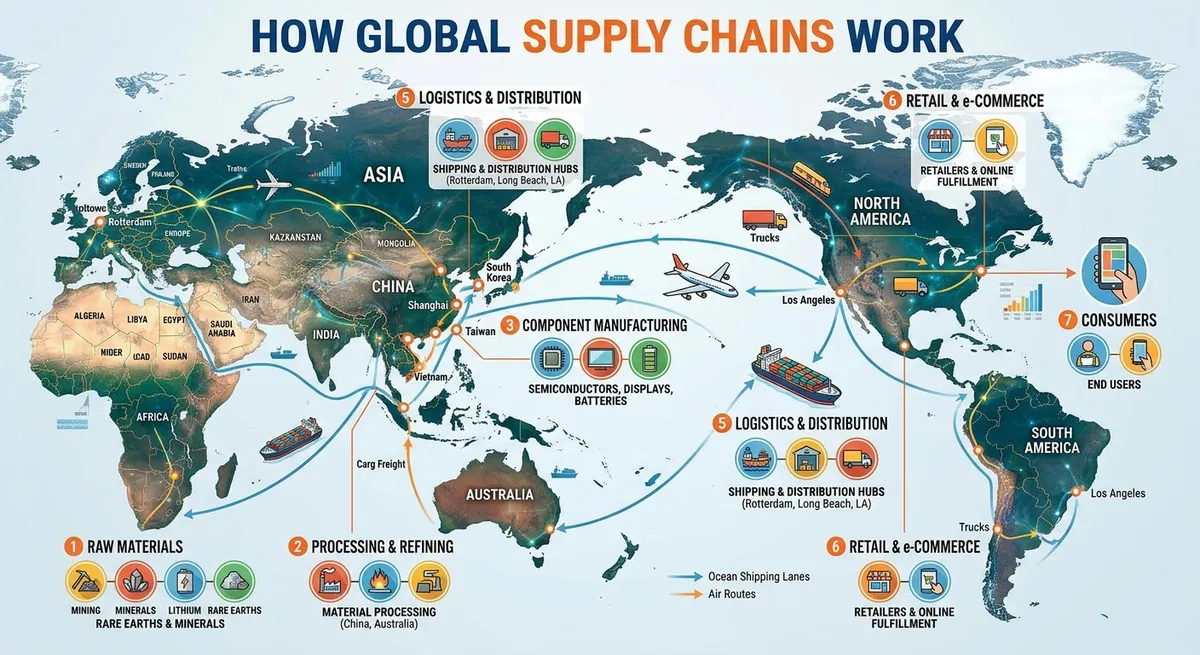
How Global Supply Chains Work
The product you buy from a store may have traveled through a surprisingly complex economic network before reaching you.
A smartphone can involve minerals from one country, processed materials from another, semiconductor production somewhere else, assembly in a different location, and transportation through several logistics’ hubs. A car can depend on thousands of components supplied by companies operating across multiple countries.
This is why a global supply chain is better understood as a network rather than a straight line.
It connects suppliers, manufacturers, logistics providers, warehouses, financial institutions, technology systems, retailers, and customers across borders. Each participant depends on information and deliveries from other parts of the network.
That structure creates major economic advantages. Companies can specialize, production can be located where it is most efficient, and consumers can gain access to a wider range of products at competitive prices.
But the same interconnectedness creates vulnerability.
A disruption at a relatively small supplier can eventually affect a major manufacturer. A port problem can delay factory production. A currency movement can increase the cost of imported inputs. A trade restriction can force companies to redesign sourcing networks.
Understanding how global supply chains work therefore means understanding how production, information, money, and risk move through the same network.
A Global Supply Chain Is a Network of Dependencies
The simplest supply-chain diagram might show:
Supplier → Manufacturer → Distributor → Retailer → Consumer
Real-world networks are much more complicated.
A manufacturer may have hundreds of direct suppliers. Those suppliers may depend on thousands of companies further upstream.
A car manufacturer, for example, may purchase a component from a Tier-1 supplier. That supplier may purchase electronics from a Tier-2 supplier, which depends on a semiconductor producer and specialized chemical manufacturers.
The network can therefore look more like:
Final manufacturer → Tier-1 suppliers → Tier-2 suppliers → Tier-3 suppliers → Raw-material producers
This creates layers of dependency that are not always visible to the final company.
A business may know exactly who its direct suppliers are while having much less information about suppliers several levels deeper.
That hidden structure is one reason supply-chain risk can be difficult to identify before a disruption occurs.
Production Can Be Split Across Many Countries
Global supply chains became possible partly because production itself can be divided into stages.
A company does not need to manufacture an entire product in one location.
Instead, different countries can specialize in different activities based on labor, technology, infrastructure, natural resources, supplier networks, market access, and other economic advantages.
A simplified electronics network might look like:
Raw materials → Processed materials → Components → Semiconductors → Assembly → Distribution → Retail
Each stage can create additional value.
The WTO describes this pattern through global value chains (GVCs), where companies divide activities such as design, component production, assembly, and marketing across economies. The organization notes that many products are effectively “made in the world” rather than made entirely within one country. (World Trade Organization)
This distinction matters because international trade is not simply about exporting finished products. Countries can specialize in particular stages of production and trade intermediate goods and services with one another.
Supply Chains vs. Global Value Chains
The terms supply chain and global value chain are closely related but emphasize different things.
A supply-chain perspective focuses heavily on how inputs, products, information, and logistics move through a network.
A global-value-chain perspective asks a broader economic question:
Where is value being created, and which countries and companies capture it?
Consider a hypothetical electronic device.
One country might provide raw materials. Another could process them. A third could manufacture advanced components. Another could assemble the final product. Research, software, branding, marketing, and distribution could happen elsewhere.
The final selling price therefore reflects value added at multiple stages.
This matters for developing economies. Participating in a global supply chain is useful, but moving from low-value activities toward processing, components, engineering, design, or other higher-value functions can generate greater economic benefits.
The World Bank emphasizes that logistics and participation in global value chains can help countries specialize in particular production stages rather than having to produce entire goods domestically. (World Bank Blogs)
Information Moves Through the Network Too
Physical goods are only one part of a global supply chain.
Information moves alongside them.
Companies need to know:
- How much customers are buying
- How much inventory is available
- When suppliers can deliver
- Whether factories are operating normally
- Where shipments are located
- Whether production needs to increase or decrease
- Whether a component is becoming scarce
Suppose consumers suddenly demand more of a product.
The retailer may increase its orders. The distributor responds by ordering more from the manufacturer. The manufacturer then increases orders for components.
The original change in consumer demand can therefore become a much larger change in upstream orders.
This is known as the bullwhip effect.
Forecasting errors, delayed information, large batch orders, and attempts to protect against shortages can amplify changes as they move backward through the network.
The result can be either excessive inventory or unexpected shortages.
That is why supply-chain management is partly an information-management problem.
Inventory Is a Financial Decision, Not Just a Storage Decision
Inventory protects companies against uncertainty, but holding inventory is expensive.
Businesses must finance products before selling them and may also incur storage, insurance, handling, and obsolescence costs.
Keeping inventory extremely low can therefore improve efficiency under normal conditions.
But if a supplier suddenly stops delivering, low inventory can become a serious weakness.
This creates a basic trade-off:
Lower inventory → lower carrying costs but greater exposure to shortages
Higher inventory → greater protection but more capital tied up
The appropriate balance depends on the product, supplier reliability, delivery time, demand volatility, and cost of disruption.
For a critical component that takes months to replace, carrying additional inventory may make economic sense even when storage costs are high.
Logistics Connects the Network
Production does not create economic value if goods cannot reach the next stage.
Global supply chains therefore depend on transportation systems including ships, ports, trucks, railways, aircraft, warehouses, and distribution centers.
A supply-chain disruption does not have to begin inside a factory.
A port closure can delay components.
A shortage of shipping capacity can increase freight costs.
A damaged railway can prevent goods from reaching a manufacturing center.
A customs delay can leave products waiting at a border.
The World Bank emphasizes that efficient logistics including transportation, warehousing, and trade-related services can reduce costs, improve competitiveness, expand trade, and help economies participate in global value chains. (World Bank Blogs)
This makes logistics infrastructure an economic asset, not merely a transportation service.
How One Small Disruption Can Spread
The network structure becomes most important when something goes wrong.
Imagine a specialized Tier-3 supplier suddenly loses production capacity.
The immediate problem may appear small.
But the chain reaction could look like this:
Tier-3 disruption → component shortage → Tier-2 production delay → Tier-1 supplier receives fewer inputs → final manufacturer reduces production → shipments are delayed → retailers receive less inventory → consumers face limited availability or higher prices
The original disruption does not need to be large to create a large downstream effect.
The impact depends on how replaceable the supplier is, how much inventory exists, how quickly alternative suppliers can respond, and how concentrated the network is.
This is why dependency matters more than distance.
A company can be thousands of miles away from a disruption and still be economically exposed to it.
Global Supply Chains Also Depend on Money
The physical network has a financial network running alongside it.
Companies purchase inputs, pay suppliers, finance inventory, insure shipments, borrow working capital, and receive payments from customers.
International transactions can also involve multiple currencies.
Suppose a company imports a component priced in U.S. dollars. If its domestic currency weakens against the dollar, the local-currency cost of that component rises even if the supplier does not change its price.
That can affect profit margins or eventually influence the price paid by customers.
Economic Reader’s How Currency Exchange Rates Work explains how exchange-rate movements affect importers, exporters, and businesses operating across borders.
This shows why global supply chains cannot be separated completely from financial markets.
Trade Rules Are Part of the Network
Goods crossing borders must also operate within legal and regulatory systems.
Businesses may have to deal with:
- Tariffs
- Customs procedures
- Import documentation
- Product standards
- Rules of origin
- Export controls
- Sanctions
- Licensing requirements
These rules can influence where companies source materials and where they locate production.
For example, if a tariff makes imported components more expensive, a company may search for a domestic supplier or shift sourcing to another country.
Economic Reader’s How Does International Trade Work? provides the broader explanation of how goods, services, payments, and trade rules connect economies.
The important point is that trade policy can change the structure of a supply network even when no factory has physically moved yet.
Efficiency and Resilience Are Different Goals
For many years, companies had strong incentives to optimize supply chains around efficiency.
They sought:
- Lower costs
- Fewer unnecessary inventories
- Specialized suppliers
- Large production volumes
- Global sourcing
- Fast delivery
These strategies can work extremely well when conditions are stable.
But a highly optimized network may have little spare capacity.
A company that relies on one low-cost supplier may have an efficient supply chain under normal conditions but face severe losses if that supplier suddenly fails.
This creates one of the central strategic questions in modern supply-chain management:
How much efficiency should a company sacrifice to gain resilience?
Resilience can involve multiple suppliers, alternative production sites, strategic inventory, different transportation routes, and better visibility into lower-tier suppliers.
Each provides insurance against disruption but insurance has a cost.
The goal is therefore not to eliminate risk. It is to decide which risks are expensive enough to justify paying to reduce them.
Global Supply Chains Are Being Rewired
The structure of global production is not disappearing, but it is changing.
The World Bank reported in April 2026 that global value chains had shown resilience despite policy turbulence, adapting partly through trade diversion and the creation of new trade relationships. (World Bank)
The WTO similarly reports that global value chains are being reshaped by technological change, the green transition, and geopolitical conditions, with businesses and governments placing greater emphasis on resilience. (World Trade Organization)
This does not necessarily mean companies are abandoning global production.
Instead, businesses may diversify suppliers, add regional production capacity, create alternative sourcing routes, or reduce dependence on a single country for strategically important inputs.
The result may be a more diversified network rather than a completely domestic one.
That distinction is important.
Reshoring means bringing production back home.
Diversification means reducing dependence on one source.
Regionalization means organizing more production around regional markets.
Companies can pursue the latter two without abandoning global supply chains.
Geopolitics Can Change the Economics of Production
Supply chains operate inside a changing geopolitical environment.
Tariffs, sanctions, export controls, strategic competition, conflicts, and policy uncertainty can all influence sourcing decisions.
A supplier may remain technically efficient but become less attractive if the political relationship between countries deteriorates.
The 2026 World Bank research describes global trade as being reshaped by geopolitical conflicts, trade tensions, supply-chain disruptions, and policy uncertainty.
This can encourage businesses to build redundancy into their networks.
But replacing established suppliers is not easy.
A new factory may require new equipment, trained workers, quality testing, regulatory approval, and years of supplier relationships.
That is why supply chains usually evolve gradually rather than being rebuilt overnight.
Why Developing Countries Care About Supply Chains
Global production networks can create an important development pathway.
A country may begin by exporting raw materials.
It can then move toward:
Raw materials → Processing → Components → Manufacturing → Higher-value services and design
Moving upward does not happen automatically.
It requires infrastructure, reliable electricity, skilled workers, access to finance, trade connectivity, technology, and institutions that allow businesses to invest and expand.
Logistics is especially important because countries cannot participate effectively in international production if moving goods across borders is slow or unpredictable. The World Bank identifies efficient logistics as an important factor in connecting economies to global value chains and supporting growth and jobs. (World Bank Blogs)
The economic objective is therefore not simply to attract a factory.
It is to develop capabilities that allow domestic companies and workers to capture more value as production networks evolve.
Technology Is Improving Supply Chain Visibility
Digital technology is changing how companies manage these networks.
Businesses increasingly use data analytics, cloud systems, sensors, automated warehouses, digital tracking, and artificial intelligence to improve forecasting and monitor operations.
The objective is not simply automation.
It is visibility.
If a company can detect that a supplier is falling behind before production stops, it may have time to find another supplier, redirect inventory, change shipping arrangements, or adjust customer orders.
But technology cannot eliminate physical constraints.
A digital system can identify a congested port.
It cannot make the port process ships instantly.
Technology improves the information layer of the supply chain; physical infrastructure still determines what can actually move.
What Global Supply Chains Mean for Consumers
Consumers often experience global supply chains indirectly.
When networks work efficiently, products can become cheaper, more varied, and more widely available.
When networks are disrupted, consumers may notice:
- Higher prices
- Longer delivery times
- Product shortages
- Fewer choices
- Changes in product specifications
But a supply shock does not automatically produce permanent inflation.
Businesses may absorb costs, use existing inventory, switch suppliers, redesign products, or accept lower profit margins.
The final impact depends on how large the disruption is and how easily the network can adapt.
That is why resilience matters economically.
A flexible supply chain can absorb a shock without passing the full cost to consumers.
The Future Is More Likely to Be Reconfigured Than De Globalized
The debate around supply chains is sometimes presented as a choice between globalization and complete self-sufficiency.
That is too simple.
Companies still have strong incentives to use international specialization.
At the same time, geopolitical risk and recent disruptions have shown the cost of excessive concentration.
The likely response is a more complicated model:
Global sourcing + regional capacity + diversified suppliers + strategic inventory + better information
rather than:
One global supplier + minimum inventory + lowest possible cost
The World Bank’s 2026 research describes global trade as changing rather than simply becoming weaker, while WTO research shows that global value chains remain deeply embedded in the world economy even as they are being rewired.
Globalization, therefore, is not necessarily ending. Its production networks are being redesigned.
Economic Reader’s What Is Globalization? explores the wider economic integration behind these cross-border connections.
The Bigger Economic Picture
Global supply chains are ultimately systems for coordinating production across distance.
They allow businesses to combine resources, specialized skills, technology, capital, logistics, and information from different parts of the world.
That structure can increase efficiency and productivity.
But it also creates interdependence.
A disruption in one location can travel through the network because companies are connected through suppliers, transportation routes, financial relationships, and information flows.
This creates the central trade-off of modern supply-chain strategy.
Efficiency reduces the cost of normal operations.
Resilience reduces the cost of abnormal events.
Neither can be maximized without considering the other.
The cheapest supplier is not necessarily the best supplier. The shortest route is not necessarily the safest route. The lowest inventory level is not necessarily the most efficient decision once the cost of a stockout is considered.
The strongest global supply networks are therefore not simply those that minimize cost.
They are the ones that balance cost, speed, specialization, visibility, and resilience well enough to remain competitive when conditions change.
That is what makes global supply chains so important to the modern economy: they are not merely the networks that move products. They are the networks through which economic shocks, opportunities, costs, and value move around the world.