
What Is ASEAN? Understanding Southeast Asia’s Economic and Strategic Importance
What Is ASEAN?
Southeast Asia has become one of the most important regions in the global economy.
The region connects major trade routes between the Indian and Pacific Oceans, hosts large manufacturing and services industries, attracts substantial foreign investment, and plays an increasingly important role in global supply chains.
At the center of this regional integration is the Association of Southeast Asian Nations, better known as ASEAN.
ASEAN is not a single country and it is not simply a free-trade agreement. It is a regional organization through which Southeast Asian countries cooperate on economic, political, security, and social issues.
Its economic importance has grown significantly. In 2024, the ASEAN economy expanded by 4.8%, while trade in goods reached about $3.8 trillion, trade in services reached $1.3 trillion, and foreign direct investment (FDI) inflows reached $226 billion. (ASEAN Main Portal)
Understanding ASEAN therefore means looking beyond its name. Its importance comes from the way its member economies are becoming increasingly connected to each other and to the wider global economy.
What Is ASEAN?
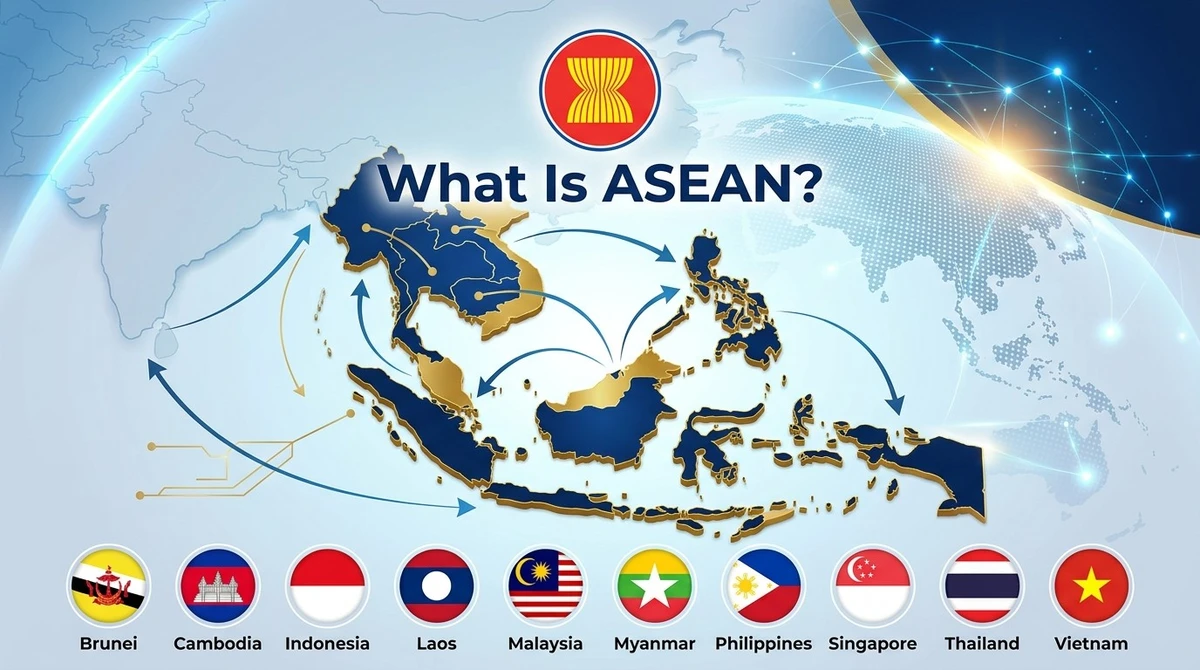
ASEAN was established on August 8, 1967, by Indonesia, Malaysia, the Philippines, Singapore, and Thailand.
Brunei joined in 1984, Vietnam in 1995, Laos and Myanmar in 1997, and Cambodia in 1999.
Timor-Leste became ASEAN’s 11th member state in October 2025. (ASEAN Main Portal)
The organization provides a framework for regional cooperation rather than creating a single government or unified economy.
Member states remain independent countries with their own currencies, governments, economic policies, and legal systems.
What ASEAN does is create mechanisms for cooperation and integration across areas such as:
- Trade
- Investment
- Economic policy
- Infrastructure
- Digital development
- Energy
- Tourism
- Connectivity
- Regional security
This makes ASEAN different from a country such as the United States or a monetary union such as the euro area.
ASEAN Is More Than a Trade Bloc
One of the easiest ways to misunderstand ASEAN is to think of it only as a trade organization.
Trade is important, but the economic community is broader.
The ASEAN Economic Community (AEC) seeks to make the region more integrated by supporting the movement of goods, services, investment, capital, and skilled labor.
ASEAN has also developed trade agreements and economic frameworks designed to reduce barriers between member states and connect the region with major external markets.
For readers unfamiliar with how cross-border commerce works, Economic Reader’s guide to how international trade works provides a useful foundation.
The goal is not to eliminate every difference between member economies. Instead, ASEAN is trying to make it easier for businesses to operate across borders while strengthening the region’s collective economic position.
The Economic Weight of Southeast Asia
ASEAN’s economic scale is one of the main reasons global companies pay attention to the region.
In 2024, ASEAN’s economy grew 4.8%. Its goods trade increased 8.9% to approximately $3.8 trillion, while services trade rose 12.2% to about $1.3 trillion. FDI inflows reached $226 billion, an 8.5% increase from the previous year. (ASEAN Main Portal)
These figures show that ASEAN is not simply a collection of emerging markets. Together, its economies form a major center of global production, trade, investment, and consumption.
The region also has a large and diverse consumer base, ranging from highly developed economies such as Singapore to rapidly growing economies such as Vietnam and Indonesia.
That diversity creates both opportunities and challenges.
Different levels of income, infrastructure, productivity, regulation, and industrial development mean companies can find different roles for different countries within the same regional supply chain.
How ASEAN Supports Regional Trade
ASEAN’s economic integration has developed over several decades.
The ASEAN Free Trade Area was established in 1992, followed by additional agreements designed to facilitate trade and investment.
Today, the ASEAN Economic Community continues to focus on reducing barriers, improving connectivity, strengthening regional production networks, and making cross-border business more predictable.
This matters because modern trade is rarely a simple transaction between two countries.
A product may use raw materials from one country, components from another, assembly in a third, and distribution through several other markets.
That is why regional economic integration can be valuable even when individual ASEAN countries remain separate economies.
It allows businesses to build production networks that use the different strengths of countries across the region.
For a broader explanation of how these networks operate, Economic Reader’s guide to How Global Supply Chains Work explores the connections between suppliers, manufacturers, logistics companies, and consumers.
Why Global Companies Pay Attention to ASEAN
ASEAN has become an important destination for companies looking to expand manufacturing, services, and regional operations.
Several factors contribute to this.
First, the region offers access to a large consumer market.
Second, ASEAN contains established manufacturing centers with experience in electronics, automobiles, machinery, consumer goods, and other industries.
Third, companies can use the region as part of broader Asian supply chains.
Fourth, ASEAN’s trade agreements connect its economies with major markets outside the region.
FDI data illustrates this interest. ASEAN reported $226 billion in FDI inflows in 2024, with the region remaining an important destination for new investment projects. (ASEAN Main Portal)
The result is a region where manufacturing, investment, logistics, technology, and consumer markets increasingly overlap.
ASEAN and Global Supply Chains
Supply-chain diversification has become more important as companies respond to geopolitical tensions, trade-policy uncertainty, transportation disruptions, and changing production costs.
ASEAN is positioned to benefit from some of these shifts because companies can build or expand production networks across multiple countries in the region.
Electronics, semiconductors, automobiles, machinery, renewable-energy components, and consumer products are among the industries connected to Southeast Asian production networks.
This does not mean ASEAN will replace other major manufacturing centers.
Instead, companies can use ASEAN as one part of a broader diversification strategy.
That distinction matters. Global supply chains are increasingly being designed for resilience as well as efficiency.
Economic Reader’s article on What Is Free Trade? explains how trade agreements and reduced barriers can influence the movement of goods and services between economies.
ASEAN’s Strategic Location
ASEAN’s importance is not based on economics alone.
Geography gives the region strategic significance.
Southeast Asia sits between the Indian and Pacific Oceans and near some of the world’s most important maritime trade routes.
Large volumes of goods, energy, and raw materials move through waters surrounding the region.
This makes Southeast Asia important for global shipping, energy security, manufacturing, and international commerce.
Countries outside the region therefore have strong economic and strategic interests in maintaining stable trade relationships with ASEAN.
ASEAN Centrality in the Indo Pacific
ASEAN also plays a central role in the broader Indo-Pacific regional architecture.
Rather than aligning itself exclusively with one major power, ASEAN has developed several regional forums that bring together Southeast Asian countries and larger economies.
These include ASEAN+3, the East Asia Summit, and the Regional Comprehensive Economic Partnership (RCEP).
ASEAN’s Outlook on the Indo-Pacific also emphasizes cooperation, connectivity, economic development, and an open regional framework.
This approach gives ASEAN a role that extends beyond its own member states.
The organization can provide a platform where countries with different interests continue to engage on economic and strategic issues.
ASEAN and the Wider Asian Economy
ASEAN is increasingly connected to the wider Asian economic system.
China, Japan, South Korea, India, Australia, New Zealand, the United States, and the European Union all have significant economic relationships with countries in Southeast Asia.
RCEP is particularly important because it links ASEAN with several major Asia-Pacific economies through a common regional trade framework.
For businesses, this means ASEAN can function not only as a destination market but also as a production and distribution platform connecting multiple economies.
This is one reason the region’s importance extends beyond its own population and GDP.
The Challenges Behind ASEAN’s Growth
ASEAN’s economic opportunities do not eliminate its challenges.
The member economies have very different levels of development.
Infrastructure quality, productivity, income levels, financial systems, regulatory environments, and digital capabilities vary significantly across the region.
These differences can make deeper economic integration difficult.
ASEAN also faces external risks.
Global trade tensions can affect export-dependent industries. Geopolitical conflicts can disrupt shipping and investment decisions. Energy and food-price shocks can increase business costs. Climate-related disruptions can affect agriculture, infrastructure, and supply chains.
The global trading system itself is also changing.
Economic Reader’s recent analysis of the challenges facing the WTO explains how geopolitical tensions, technology, industrial policy, and changing global supply chains are putting pressure on traditional trade rules.
ASEAN therefore has to manage two objectives at the same time: deepen regional integration while remaining flexible enough to respond to a changing global economy.
What ASEAN Could Look Like in the Future
ASEAN’s next stage of economic integration is guided by the AEC Strategic Plan 2026-2030, which forms part of ASEAN 2045: Our Shared Future.
The plan contains six strategic goals, 44 objectives, and 192 strategic measures. It focuses on areas including economic integration, digital transformation, innovation, sustainability, supply-chain resilience, investment, energy, infrastructure, and productivity. (ASEAN Main Portal)
ASEAN’s longer-term ambition is to become the world’s fourth-largest economy by 2045 while developing a more integrated, future-ready regional economy. (ASEAN Main Portal)
That is an ambition rather than a guaranteed outcome.
Achieving it will depend on how effectively ASEAN countries address development gaps, improve productivity, strengthen infrastructure, adopt new technologies, and maintain an environment that supports investment and trade.
Why ASEAN Matters to the Global Economy
ASEAN matters because Southeast Asia has become more than a collection of individual emerging economies.
It is developing into an interconnected economic region with major manufacturing networks, growing consumer markets, substantial trade flows, strong investment activity, and a strategically important geographic position.
Its role is also changing.
Companies are looking at ASEAN not only for lower-cost production, but also for market access, supply-chain diversification, digital growth, and long-term investment opportunities.
At the same time, ASEAN’s strategic position gives it importance in the wider Indo-Pacific economy.
The region’s future will depend on how well its members can turn economic integration into higher productivity, stronger resilience, and broader participation in global trade.
For the global economy, that makes ASEAN a region worth watching not simply because of how large it is today, but because of how its economic and strategic role is evolving.