How Does Commodity Trading Work?
How Does Commodity Trading Work?
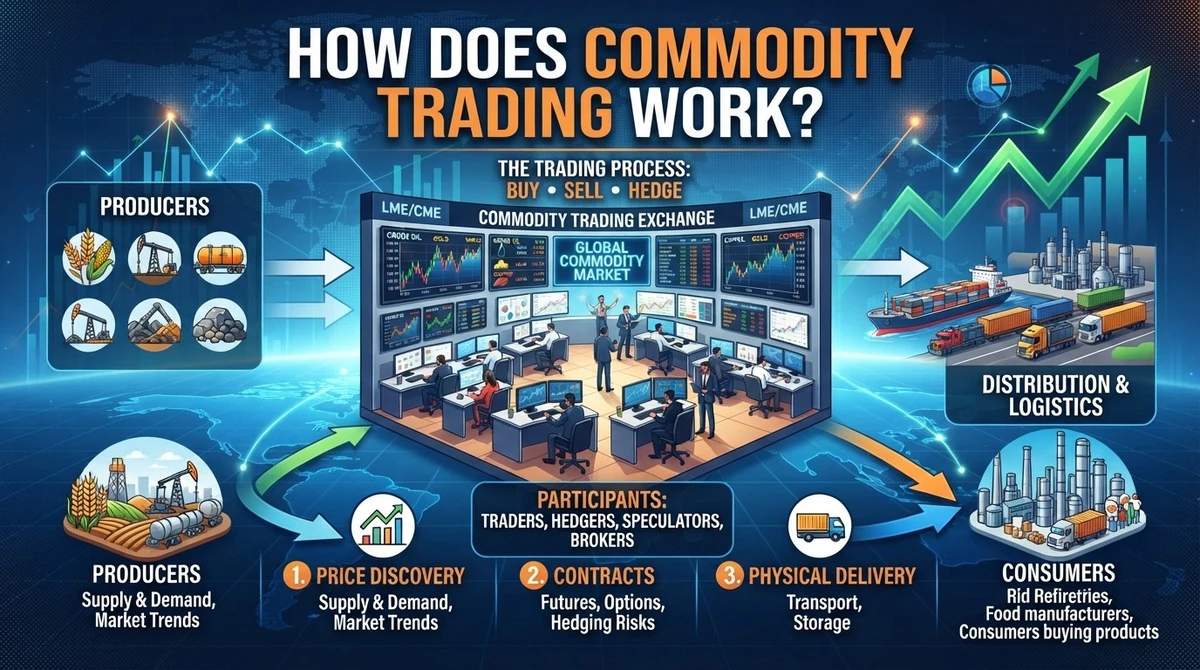
Commodity trading connects financial markets with the physical goods used throughout the global economy.
Oil, natural gas, gold, copper, wheat, corn, and coffee are all commodities that can be traded through different markets and financial instruments. But commodity trading does not necessarily mean buying and storing barrels of oil, tons of copper, or truckloads of wheat.
In financial markets, much of the activity takes place through futures contracts.
A futures contract allows a buyer and seller to agree on the terms of a transaction for a specified commodity and future date. The contract has a defined quantity, delivery month, and other standardized conditions. Most futures positions are closed before the delivery process begins. (CFTC)
That creates a trading process that is different from buying a stock.
A commodity trader needs to understand not only whether the price might rise or fall, but also which contract is being traded, how much that contract represents, how margin works, when it expires, and how the position will eventually be closed or settled.
For a broader introduction to commodities and their role in the economy, see What Are Commodities?.
What Is Commodity Trading?
Commodity trading involves buying and selling commodities or financial contracts linked to commodities.
There are two connected markets.
The physical commodity market involves the actual goods. An oil refiner may need crude oil, a food processor may need wheat, and a manufacturer may need copper.
The financial commodity market allows businesses and traders to manage or take exposure to changes in commodity prices without necessarily taking possession of the physical product.
Futures are especially important because they can be used by both commercial businesses managing price risk and traders seeking to profit from price movements. Exchanges standardize important contract terms such as quantity, delivery month, delivery location, and acceptable grades or qualities.
This standardization makes it possible for many participants to trade the same contract rather than negotiating every detail of every transaction.
Where Does Commodity Trading Take Place?
Commodity trading takes place through organized exchanges and over-the-counter markets.
Exchange-Traded Markets
Organized futures exchanges provide standardized contracts and centralized trading and clearing.
Major commodity markets include energy, metals, and agricultural futures traded through exchanges such as those operated by CME Group.
The clearing system is an important part of this structure. For exchange-traded futures, the clearing house stands between buyers and sellers, helping manage the obligations created by the contracts.
For a broader look at the exchanges where commodity price discovery takes place, see Top 10 Commodity Exchanges in the World.
Over-the-Counter Markets
Not every commodity transaction takes place on an exchange.
Businesses can also negotiate customized contracts directly with counterparties in over-the-counter markets. These agreements can be designed around particular quantities, delivery schedules, prices, or other commercial requirements.
That flexibility can be useful for companies with specific physical needs, although OTC transactions have different liquidity, counterparty, and transparency characteristics from standardized exchange-traded futures.
What Actually Happens When a Commodity Trade Is Placed?
A futures trade can be understood as a sequence of decisions and obligations.
1. Choose the Commodity
The trader first chooses a market such as crude oil, natural gas, gold, copper, wheat, or corn.
The choice matters because each commodity has its own supply chain and price drivers.
2. Choose the Contract
The trader then selects a specific futures contract.
This means looking beyond the commodity name. The trader needs to know:
- Contract size
- Delivery month
- Delivery location, where applicable
- Quality or grade
- Minimum price movement
- Settlement method
- Last trading date
Two contracts linked to the same commodity can have different prices because they represent different delivery periods.
3. Decide on the Position
A trader expecting the futures price to rise may establish a long position by buying a contract.
A trader expecting the price to fall may establish a short position by selling a contract.
This ability to take either side of the market is one of the major differences between futures trading and simply buying physical commodities.
4. Post Margin
The trader does not normally pay the full value represented by the contract upfront.
Instead, the trader posts margin.
Futures margin is a performance bond or collateral supporting the position. It is not a down payment toward owning the underlying commodity.
5. The Position Is Marked to Market
As the futures price changes, the value of the position changes.
Futures positions are marked to market using settlement prices, with gains and losses reflected through the trader’s margin account. CME Group explains that daily settlement prices are used to determine profits and losses on futures positions. (CME Group)
If the market moves against the trader far enough, additional funds may be required to maintain the position.
6. Close or Settle the Position
The trader can normally close the position before expiration by taking an offsetting position.
A trader who is long one contract can sell an equivalent contract to offset it. A trader who is short can buy an equivalent contract to close the position.
If the position remains open as expiration approaches, the contract follows its specific settlement or delivery rules.
That is the basic life cycle of a commodity futures trade.
Futures Contracts Are the Core Trading Instrument
Futures are central to commodity trading because their standardized terms make the market easier to trade.
Consider a crude oil futures contract.
The exchange determines the quantity of oil represented by the contract, the delivery month, the delivery terms, and other specifications. The market then determines the price.
This structure serves both commercial and financial participants.
A producer may use futures to reduce the financial impact of a potential decline in the price of its commodity.
A manufacturer that needs a commodity may use futures to reduce uncertainty about future purchase costs.
Other traders may take positions because they expect prices to move.
The CFTC identifies both hedgers and speculators as important participants in futures markets. Hedgers use futures to manage price risk, while speculators attempt to profit from price changes. (CFTC)
So commodity futures are not simply a betting market. They are also connected to the way producers and consumers manage real-world price risk.
A Simple Crude Oil Trade Example
Consider a hypothetical crude oil futures contract representing 1,000 barrels.
Suppose a trader buys one contract at $75 per barrel.
The contract represents:
1,000 × $75 = $75,000
The trader does not necessarily deposit $75,000 to open the position. The applicable margin requirement is much smaller than the contract’s full notional value.
Now assume the futures price rises from $75 to $77.
The price has increased by:
$2 per barrel
Across 1,000 barrels:
1,000 × $2 = $2,000
If the trader closes the position at $77, the position has a $2,000 gain before transaction costs and other adjustments.
If the price instead falls from $75 to $73, the position has a $2,000 loss.
The example shows why contract size matters.
A $2 move in the quoted price may look small, but the effect becomes much larger when multiplied by the number of units represented by the contract.
It also illustrates why leverage can make futures positions much more sensitive to relatively small price movements.
What Is Margin in Commodity Trading?
Margin is one of the most important concepts in futures markets.
It is often misunderstood as a down payment. It is not.
Futures margin is collateral used to support the trader’s obligations. CFTC defines initial margin as the amount required when a futures position is opened and maintenance margin as the minimum amount that must generally remain in the account. (CFTC)
Consider what happens after a trade is opened.
If the market moves in the trader’s favor, gains are credited to the account.
If the market moves against the trader, losses reduce the account balance.
If the balance falls below the applicable maintenance requirement, additional funds may be required.
This is part of the reason futures can create significant leverage. The amount deposited can be much smaller than the total value represented by the contract.
Leverage can magnify gains, but it can also magnify losses. The CFTC warns that futures trading is complex and risky and that traders can lose their initial funds and, in some circumstances, be required to provide additional money. (CFTC)
How Commodity Traders Make or Lose Money
The basic calculation depends on the direction of the position and the movement in the futures price.
Long Position
A long position generally gains value when the futures price rises.
For example:
Buy at $75
Sell at $78
Price change = +$3
If the contract represents 1,000 barrels, the gross price difference would be:
1,000 × $3 = $3,000
Short Position
A short position generally benefits when the futures price falls.
For example:
Sell at $75
Buy back at $72
Price change = +$3 for the short position
Again, with a 1,000-barrel contract, the gross price difference would be:
1,000 × $3 = $3,000
Actual trading results can differ after commissions, fees, bid-ask spreads, financing considerations, and other costs.
More importantly, price direction is only part of the calculation.
Contract size and leverage determine how strongly a price move affects the account.
What Happens When a Futures Contract Approaches Expiration?
Unlike a stock, a futures contract has a defined life.
Every futures contract has an expiration date and specific settlement procedures. As that date approaches, a trader has to decide what happens to the position.
There are three basic possibilities.
Close the Position
The trader can take an offsetting position before expiration.
This is common for participants who are trading price movements rather than seeking delivery of the physical commodity.
Roll the Position
A trader who wants to maintain exposure can close the current contract and open a position in a later delivery month.
This is called rolling the position.
The trader is therefore no longer holding exactly the same contract. They are moving their exposure from one delivery period to another.
Hold Through Settlement
Some traders hold contracts into the settlement process.
Depending on the specific contract, settlement may involve physical delivery or cash settlement. CME Group notes that physical delivery is important for certain commodity contracts, but only a small percentage of commodity futures contracts are actually physically delivered. (CME Group)
The exact rules depend on the individual contract, which is why understanding the contract specifications before trading matters.
Contango and Backwardation Affect the Cost of Staying in the Market
Commodity futures prices can differ across delivery months.
When later-dated contracts trade above earlier ones, the market is generally described as being in contango.
When later-dated contracts trade below earlier ones, it is generally described as backwardation.
This becomes important when a trader or fund rolls from one contract to another.
Suppose a trader wants to maintain crude oil exposure but does not want to hold the expiring contract through settlement. The trader may sell the current contract and buy a later one.
If the later contract is more expensive, replacing the position can create a negative roll effect.
If the later contract is cheaper, the economics of the roll can be different.
The futures curve therefore affects the cost of maintaining commodity exposure over time.
This is particularly important for commodity ETFs and other exchange-traded products that use futures contracts rather than simply holding the physical commodity. CFTC notes that futures-based commodity products may not track changes in a commodity’s spot price exactly because the futures contracts have to be replaced as they approach expiration. (CFTC)
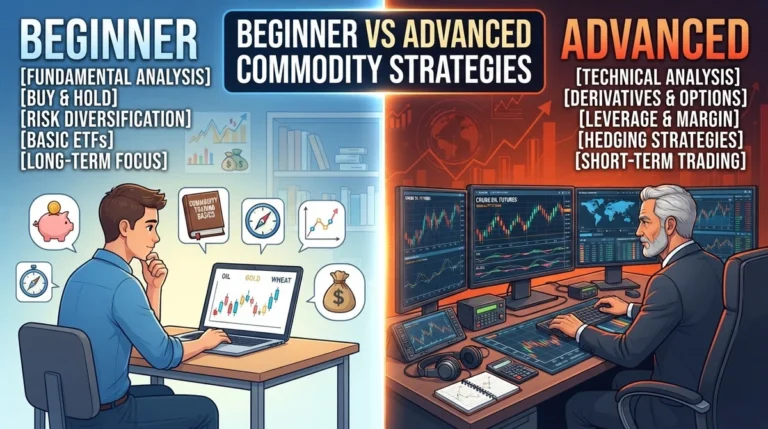
Economic Reader examines this issue in more detail in Beginner vs. Advanced Commodity Strategies.
Commodity Trading Is Not Limited to Futures
Futures are central to commodity trading, but commodity exposure can also come through other instruments.
Commodity Options
Commodity options give the buyer the right, but not the obligation, to buy or sell a futures contract at a specified price under defined terms.
Options add additional variables such as the strike price, expiration, premium, and volatility.
Commodity ETFs and ETPs
Exchange-traded products can provide commodity exposure through physical holdings, futures contracts, or other structures.
They can be accessed through a securities account and may be simpler operationally than trading futures directly. But their performance can differ from the spot price of the underlying commodity, particularly when futures contracts must be rolled.
See Best Commodity ETFs in the USA for a deeper look at this type of exposure.
Producer Stocks
Another route is buying shares of companies that produce commodities.
An oil producer, for example, can benefit from higher oil prices, but its stock is also affected by production costs, debt, management decisions, capital spending, and other company-specific factors.
That means a commodity producer’s stock is not the same thing as direct commodity exposure.
What Moves a Commodity Position?
Commodity prices can respond to many forces, but the relevant drivers depend on the market.
Oil and natural gas can react to production, inventories, weather, transportation constraints, LNG demand, and geopolitical disruptions.
Agricultural commodities can respond sharply to weather, crop conditions, harvest expectations, inventories, and export demand.
Metals can be influenced by industrial activity, mine production, inventories, interest rates, currency movements, and expectations for economic growth.
For a trader, the important point is not simply knowing these factors individually. It is understanding how they can change the price of the specific futures contract being traded.
A supply disruption, for example, may affect one delivery month more strongly than another if traders expect the disruption to be temporary.
That is one reason commodity trading requires attention to both the physical market and the futures curve.
The Risks Commodity Traders Need to Understand
Commodity futures can involve substantial risk, particularly because of leverage.
Leverage Risk
A relatively small amount of margin can control a contract with a much larger notional value.
That can magnify both gains and losses.
Volatility Risk
Commodity prices can move rapidly when markets react to weather, inventory data, supply disruptions, geopolitical developments, or changing expectations.
Margin Risk
A losing position reduces the account balance. If the balance falls below the applicable maintenance requirement, additional funds may be required.
Liquidity Risk
Some contracts or market conditions can have less liquidity than others. That can make it more difficult or expensive to enter or exit a position.
Expiration Risk
A futures contract has a defined lifespan. Ignoring the contract’s expiration and settlement rules can create obligations the trader did not intend to take on.
Roll Risk
Maintaining exposure across multiple contract months means dealing with changes in the futures curve. The cost of replacing one contract with another can affect overall results.
Delivery Risk
Some commodity futures involve physical delivery provisions. A trader should understand those terms before holding a position near the relevant delivery period.
The CFTC specifically warns that commodity futures and options are complex and risky and emphasizes the importance of understanding the obligations of a contract before trading it. (CFTC)
How Commodity Trading Differs From Stock Trading
Commodity futures and stocks can both be traded electronically, but the underlying structures are very different.
| Feature | Commodity Futures | Stocks |
| What is traded? | A standardized contract linked to a commodity | An ownership interest in a company |
| Expiration | Futures contracts have defined dates | Common stocks generally do not expire |
| Margin | Performance margin is required | Depends on the account and whether borrowing is used |
| Leverage | Often significant | Depends on the account and strategy |
| Physical settlement | Possible for certain contracts | No physical commodity delivery |
| Futures curve | Important | Not applicable |
| Contract size | Standardized | Shares are the basic unit |
| Main price drivers | Commodity supply, demand, inventories, weather, and macro factors | Company earnings, valuation, business conditions, and market factors |
The biggest practical difference is that a futures position is a contract with a defined lifespan, while a stock represents ownership in a company and generally has no expiration date.
That difference changes how a trader has to manage the position.
Commodity Trading Starts With the Contract, Not Just the Price
Commodity trading can look simple from a distance.
A trader buys when expecting a price increase and sells when expecting a decline. But the actual process involves much more than predicting direction.
The trader needs to know what the contract represents, how large the position is, how much margin is required, how daily gains and losses are settled, when the contract expires, and what happens if the position is held toward settlement.
The futures curve can also affect the economics of maintaining exposure, particularly when a position is rolled from one delivery month to another.
This is what separates commodity trading from simply watching the price of oil, gold, wheat, or copper on a screen.
The financial contract sits between the trader and the physical commodity market. Its specifications determine what is being traded, while the underlying market determines many of the forces that move its price.
Once that connection is clear, commodity trading becomes easier to understand: choose the contract, establish the position, manage the margin, monitor the price and futures curve, and know exactly how the position will be closed or settled.
That process is the foundation of how commodity trading works.