
What Is a Trade Deficit? A Complete Beginner’s Guide to Understanding Trade Imbalances
Introduction
Countries around the world buy and sell goods and services with each other every day.
A country may:
- Export products to foreign markets
- Import products from other countries
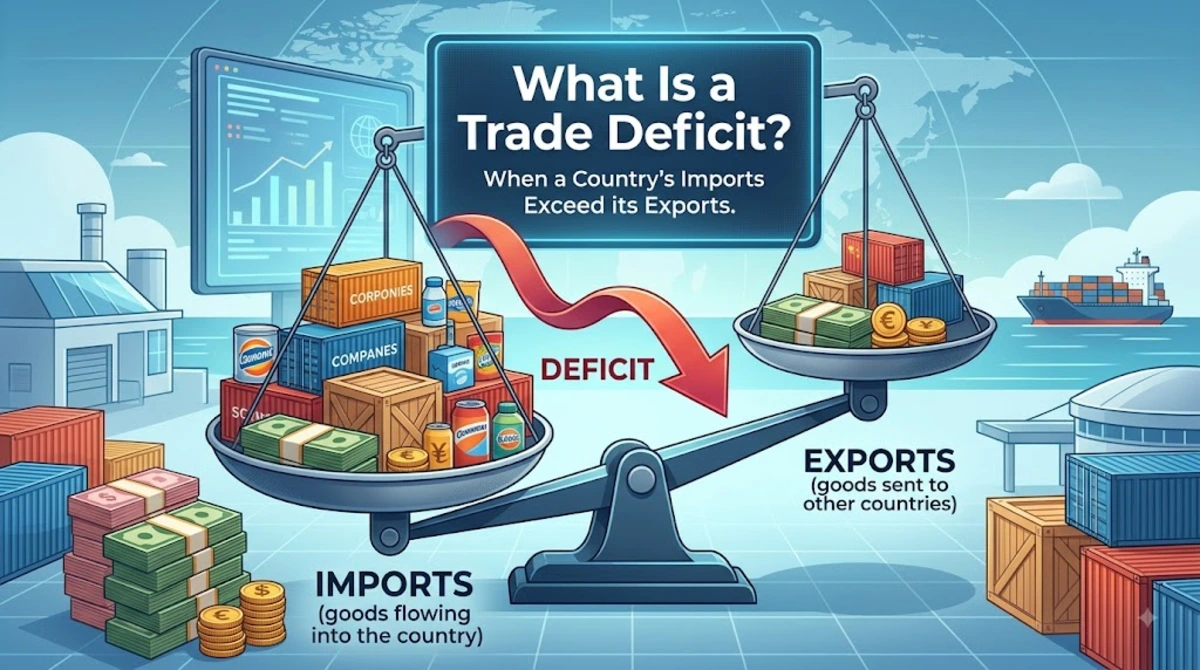
When a country imports more goods and services than it exports, it creates a trade deficit.
Trade deficits are an important part of the global economy because they affect:
- Currency values
- Businesses
- Employment
- Economic policies
- International relationships
Many people think a trade deficit is always bad, but the reality is more complex. The impact depends on why the deficit exists and how the economy is performing.
The simple explanation is:
A trade deficit occurs when a country buys more goods and services from other countries than it sells to them.
What Is a Trade Deficit?
A trade deficit happens when:
Imports > Exports
This means the value of products and services a country purchases from foreign countries is greater than the value of products and services it sells internationally.
Example:
Suppose:
- A country imports $500 billion worth of goods.
- It exports $350 billion worth of goods.
The difference is:
$500 billion − $350 billion = $150 billion trade deficit
The country has a trade deficit of $150 billion.
What Is International Trade?
International trade is the exchange of goods and services between countries.
It includes:
Products and services purchased from foreign countries.
Examples:
- Oil
- Electronics
- Machinery
- Food products
Products and services sold to foreign countries.
Examples:
- Technology
- Vehicles
- Agricultural products
- Software services
Understanding Trade Balance
The trade balance measures the difference between a country’s exports and imports.
There are two main outcomes:
A trade surplus occurs when:
Exports > Imports
The country sells more internationally than it buys.
Example:
Exports = $600 billion
Imports = $450 billion
Trade surplus = $150 billion
Trade Deficit
A trade deficit occurs when:
Imports > Exports
The country buys more from international markets than it sells.
Example:
Imports = $700 billion
Exports = $500 billion
Trade deficit = $200 billion
How Is a Trade Deficit Calculated?
The formula is:
Trade Balance = Exports − Imports
If the result is negative, the country has a trade deficit.
Example:
Exports = $800 billion
Imports = $1 trillion
Trade Balance:
$800 billion − $1 trillion = -$200 billion
The country has a $200 billion trade deficit.
Why Do Trade Deficits Happen?
Trade deficits occur for several reasons.
1. High Consumer Demand
One common reason is strong consumer demand.
When people have higher incomes, they may buy more products, including foreign goods.
Example:
Consumers may purchase:
- Imported cars
- Foreign electronics
- International brands
Higher imports can increase the trade deficit.
2. Strong Currency Value
A strong currency makes foreign products cheaper.
Example:
When the US dollar is strong:
- Imported goods become less expensive for American consumers.
- Businesses may buy more foreign products.
This can increase imports.
3. Low Domestic Production
Some countries import products because they cannot produce enough locally.
Reasons include:
- Limited resources
- Higher production costs
- Lack of manufacturing capacity
4. Global Supply Chains
Modern businesses operate through global supply chains.
Companies may import:
- Raw materials
- Components
- Machinery
These imports help businesses produce goods efficiently.
5. Economic Growth
A growing economy often imports more.
During strong economic periods:
- Businesses invest more.
- Consumers spend more.
- Demand for foreign products increases.
A rising trade deficit does not always mean economic weakness.
Why Do Countries Import More Than They Export?
Countries may have trade deficits because:
They Need Resources
Example:
A country without oil reserves may import energy.
They Want Lower-Cost Products
Foreign suppliers may produce certain goods more efficiently.
They Focus on Specialized Industries
Countries often specialize in industries where they have advantages and import other products.
Is a Trade Deficit Bad?
A trade deficit is not automatically good or bad.
The impact depends on economic conditions.
A country may have a trade deficit while still having:
- Strong economic growth
- High investment
- Low unemployment
However, large and persistent deficits can create challenges.
Potential Benefits of Trade Deficits
1. More Consumer Choices
Imports provide access to:
- More products
- International brands
- Advanced technology
2. Lower Prices
Foreign competition can reduce prices.
Consumers may benefit from cheaper goods.
3. Access to Foreign Resources
Imports allow countries to obtain:
- Energy
- Raw materials
- Technology
4. Economic Efficiency
Countries can focus on industries where they are most productive.
Trade allows specialization.
Potential Problems of Trade Deficits
Although deficits are not always harmful, they can create risks.
1. Pressure on Domestic Industries
Local companies may struggle to compete with foreign producers.
Example:
A domestic manufacturing company may lose customers to cheaper imported products.
2. Job Loss in Certain Industries
Some industries may reduce employment because of increased foreign competition.
However, other industries may create jobs through trade and investment.
3. Foreign Debt Concerns
A country with a large trade deficit may need foreign investment to finance the difference.
Over time, excessive dependence can create financial risks.
4. Economic Dependence
Heavy reliance on imported goods may create supply risks.
Examples:
- Energy dependence
- Supply chain disruptions
Trade Deficit vs Trade Surplus
| Trade Deficit | Trade Surplus |
| Imports exceed exports | Exports exceed imports |
| Money flows out through purchases. | More foreign income enters. |
| May increase foreign dependence | May strengthen export industries |
| Common in many large economies | Common in export-focused economies |
How Trade Deficits Affect GDP
Trade affects GDP through net exports.
The GDP formula includes:
GDP = Consumer Spending + Investment + Government Spending + Net Exports
Where:
Net Exports = Exports − Imports
When imports exceed exports:
- Net exports become negative.
- GDP growth may be reduced.
However, imports can also support GDP by providing:
- Business equipment
- Production materials
- Technology
How Trade Deficits Affect Currency Value
Trade deficits can influence currencies.
A large deficit may increase demand for foreign currencies because a country needs to pay for imports.
However, currency values depend on many factors:
- Interest rates
- Inflation
- Investor confidence
- Economic growth
How Trade Deficits Affect Businesses
Businesses experience both advantages and challenges.
Benefits:
- Access to cheaper materials
- More supplier options
- Lower production costs
Challenges:
- Increased foreign competition
- Currency risks
- Supply chain uncertainty
How Trade Deficits Affect Consumers
Consumers may benefit from:
- Lower prices
- More product choices
- Access to foreign goods
However, some domestic industries may face pressure from competition.
Real-World Example: United States Trade Deficit
The United States has experienced trade deficits for many years.
Reasons include:
- Strong consumer demand
- High imports of manufactured goods
- Global supply chains
- The role of the US dollar as a global currency
The US economy can support large trade deficits because of:
- Large financial markets
- Strong investor confidence
- High demand for US assets
How Governments Try to Reduce Trade Deficits
Countries may use several strategies.
1. Increase Exports
Governments may support:
- Export industries
- International business expansion
- Trade agreements
2. Improve Domestic Production
Countries may invest in:
- Manufacturing
- Technology
- Infrastructure
3. Trade Policies
Governments may use:
- Tariffs
- Import restrictions
- Trade agreements
4. Currency Policies
Currency value can affect trade competitiveness.
A weaker currency may make exports cheaper internationally.
Trade Deficit vs Budget Deficit
These terms are often confused.
| Trade Deficit | Budget Deficit |
| Related to international trade | Related to government finances |
| Imports exceed exports | Government spending exceeds revenue. |
| Involves foreign trade | Involves government budget |
They are different economic concepts.
Future of Global Trade Balance
Global trade continues changing because of:
Technology
Digital services are becoming a larger part of international trade.
AI may improve:
- Supply chain efficiency
- Production decisions
- Global logistics
Supply Chain Changes
Companies are focusing on:
- More reliable suppliers
- Regional production
- Reduced dependence on one country
Frequently Asked Questions (FAQ)
1. What is a trade deficit in simple words?
A trade deficit happens when a country imports more goods and services than it exports.
2. Is a trade deficit always bad?
No. A trade deficit can have both benefits and challenges depending on the economy.
3. What causes a trade deficit?
Common causes include high consumer demand, strong currency value, low domestic production, and global supply chains.
4. What is the difference between a trade deficit and trade surplus?
A trade deficit means imports are higher than exports, while a trade surplus means exports are higher than imports.
5. How does a trade deficit affect consumers?
Trade deficits can provide consumers with cheaper products and more choices but may create challenges for some domestic industries.
Final Thoughts
A trade deficit is an important concept in understanding the global economy.
It occurs when a country imports more than it exports, but its effects are not always negative.
Trade deficits can provide:
- Lower-cost products
- Access to resources
- Greater consumer choices
However, large and persistent deficits can create challenges for certain industries and increase economic dependence.
Understanding trade deficits helps investors, entrepreneurs, and consumers better understand international trade and economic trends.
If you want to learn what ESG investing is, read our full guide; click here
Author Note: This article is crafted by “The Economic Reader editorial team”, dedicated to analyzing the latest market trends, financial updates, and global economic shifts to keep you informed with accurate and comprehensive insights.
Disclaimer: The information provided on this website is for educational and informational purposes only and should not be construed as professional financial, investment, or legal advice. Always consult with a certified financial advisor or professional before making any financial decisions based on this content.