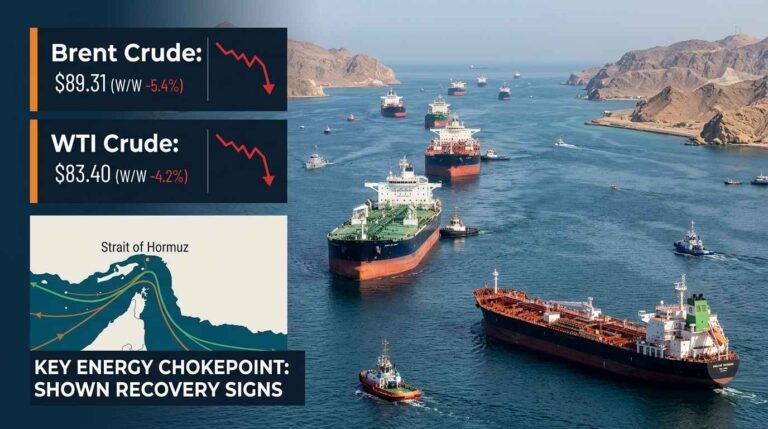

Oil Market Weekly Update: Powerful Bullish Rally Lifts Brent Above $94 (August 17–21, 2026)
Introduction
The Oil Market Weekly Update for August 17–21, 2026 was dominated by renewed geopolitical pressure surrounding Iran, continued disruption to oil flows through the Strait of Hormuz, and growing concerns about the availability of Middle Eastern crude.
Both major benchmarks posted a second consecutive weekly gain.
On Friday, Brent crude settled at $94.39 per barrel, while U.S. West Texas Intermediate (WTI) settled at $87.06. Brent gained 6.39% for the week, while WTI rose 5.66%. Both benchmarks had reached their highest levels since July 24 during Thursday’s rally.
The rally accelerated late in the week after U.S. President Donald Trump threatened additional economic sanctions against countries supporting Iran. Investors interpreted the threat as another potential risk to already-constrained oil supply.
At the same time, the U.S. Energy Information Administration (EIA) reported that U.S. commercial crude inventories increased by 4.4 million barrels during the week ending August 14. That inventory build was a bearish factor, but it was outweighed by geopolitical supply concerns.
Overall, the week ended with a bullish but highly volatile oil market.
Oil Market Snapshot (August 17–21, 2026)
| Market Indicator | Weekly Data |
| Brent August 21 Close | $94.39/barrel |
| WTI August 21 Close | $87.06/barrel |
| Brent Weekly Change | +6.39% |
| WTI Weekly Change | +5.66% |
| Brent Thursday Close | $93.78 |
| WTI Thursday Close | $87.83 |
| Brent Weekly Trend | Strongly Higher |
| WTI Weekly Trend | Strongly Higher |
| Overall Market Sentiment | Bullish / High Volatility |
| Main Driver | Middle East supply disruption & Iran tensions |
Reuters reported that Brent and WTI both reached their highest levels since July 24 during Thursday’s rally before easing slightly on Friday.
What Happened to Oil This Week?
Monday, August 17: Oil Starts the Week Under Pressure
Oil entered the week with geopolitical risk already elevated.
The market was attempting to balance two opposing forces.
On one side, continued disruptions to Middle Eastern oil flows supported prices.
On the other, concerns about demand and U.S. inventory levels limited the upside.
The previous week’s EIA data had shown WTI at $83.99 per barrel on August 14, compared with $79.77 a week earlier.
That meant the market was already entering August 17 with a substantial upward move behind it.
Tuesday, August 18: Supply Risks Remain the Focus
Tuesday trading remained heavily influenced by the ongoing U.S.-Iran conflict.
Investors were particularly focused on the Strait of Hormuz.
The waterway is one of the world’s most important energy chokepoints, and disruption there can have an immediate impact on global oil prices.
At the same time, traders were watching U.S. petroleum inventory data ahead of Wednesday’s EIA release.
The market was therefore caught between:
Geopolitical supply risk
and
Potential evidence of weaker U.S. inventory demand.
Wednesday, August 19: Inventory Build Creates a Headwind
The EIA’s weekly petroleum report provided an important piece of market data.
For the week ending August 14:
- U.S. commercial crude inventories increased 4.4 million barrels
- Total crude inventories reached 428.8 million barrels
- Gasoline inventories increased 0.7 million barrels
- Distillate inventories decreased 1.5 million barrels
- Total commercial petroleum inventories increased 8.8 million barrels
The EIA said crude inventories were matching the five-year average for this time of year.
This was an important bearish signal for crude.
A large crude inventory build can indicate that supply is exceeding immediate demand.
However, oil prices remained supported because the market was more concerned about the potential loss or restriction of Middle Eastern supply.
U.S. Refinery Activity Remained Strong
The EIA data also showed that U.S. refinery activity remained elevated.
For the week ending August 14:
- Crude refinery inputs averaged 17.4 million barrels per day
- Refinery utilization reached 97.2%
- Gasoline production averaged 9.7 million barrels per day
- Distillate production averaged 5.2 million barrels per day
The strong refinery utilization rate indicates that U.S. refiners were processing substantial volumes of crude.
That is important because strong refinery activity can support crude demand.
However, the increase in crude inventories showed that high refinery throughput did not prevent stocks from building during the reporting week.
Thursday, August 20: The Major Oil Rally
Thursday became the key day of the Oil Market Weekly Update.
Brent crude jumped $2.16, or 2.4%, to $93.78 per barrel.
WTI rose $2.00, or 2.3%, to $87.83.
Both benchmarks reached their highest levels since July 24.
The catalyst was renewed U.S. pressure on Iran.
President Trump threatened economic consequences against countries supporting Iran, increasing concerns that the conflict could further disrupt oil supply.
The market interpreted the threat as an increase in the geopolitical risk premium.
Why Did Oil Rise So Sharply?
There were several interconnected reasons.
1. Iran Supply Risks
Iranian crude exports were already heavily constrained by U.S. restrictions and the ongoing conflict.
Reuters reported that offers of Iranian crude to Chinese buyers had declined and prices had risen as the U.S. blockade restricted shipments.
If additional sanctions further restrict Iranian exports, global supply could become tighter.
2. Strait of Hormuz Disruption
The Strait of Hormuz remained one of the biggest risks for the oil market.
Reuters reported that only seven commodity ships crossed the Strait on Thursday, approximately half the previous day’s number.
Before the conflict, the waterway handled approximately one-fifth of global oil and LNG supplies.
That makes any prolonged disruption extremely important for global energy markets.
3. Middle Eastern Production Disruptions
Oil prices were also supported by continued curtailment of supply from major producers including:
- Saudi Arabia
- Iraq
- United Arab Emirates
- Kuwait
Reuters reported that supply from major Middle Eastern producers remained curtailed.
This created a significant risk premium in crude prices.
Friday, August 21: Oil Consolidates at High Levels
Friday brought a small pullback in the market, but oil remained firmly higher for the week.
Brent settled at:
$94.39/barrel
WTI settled at:
$87.06/barrel
Brent gained 6.39% during the week, while WTI gained 5.66%.
The Friday increase came after Trump threatened additional economic sanctions against Iran’s trading partners.
The market was therefore ending the week with geopolitical risk still elevated.
Brent Crude Analysis
Brent is the most important international crude benchmark.
The August 17–21 rally pushed Brent toward the psychologically important $95 area.
The Friday close of $94.39 left the benchmark just below that level.
Key resistance: $95
A sustained move above $95 could strengthen the bullish momentum.
Next resistance: $100
The $100 level is an important psychological threshold.
A move toward $100 would likely require either a further deterioration in Middle Eastern supply or a significant escalation in geopolitical tensions.
WTI Crude Analysis
WTI finished the week at $87.06.
The benchmark gained 5.66% during the week.
WTI also reached its highest level since July 24 on Thursday.
Key resistance: $90
The $90 level is the next major psychological target.
A sustained break above $90 could increase momentum toward $95.
Key support: $85
The $85 area could become an important short-term support zone after this week’s rally.
A fall below $85 would suggest that some of the geopolitical premium is being removed.
U.S. Inventory Data: The Bearish Factor
One of the most interesting aspects of this week’s market was that oil prices rose strongly despite an increase in U.S. crude inventories.
The EIA reported:
+4.4 million barrels
of commercial crude inventory growth for the week ending August 14.
This would normally be a negative signal for crude prices.
But oil markets were focused more heavily on potential future supply disruptions.
This shows an important principle:
Oil prices reflect expected future supply and demand, not just today’s inventory numbers.
If traders believe future supply could become significantly tighter, prices can rise even when current inventories are increasing.
U.S. Fuel Inventories
The inventory picture was mixed.
Gasoline
Gasoline inventories increased 0.7 million barrels.
However, they remained 5% below the five-year average for this time of year.
Distillates
Distillate inventories fell 1.5 million barrels and remained approximately 13% below the five-year average.
This suggests that refined-product inventories remained relatively tight even though crude inventories increased.
U.S. Consumer Fuel Prices
Higher crude prices were already filtering through to U.S. consumers.
The EIA reported that the national average regular gasoline price reached:
$4.049 per gallon on August 17
That was up from $4.006 a week earlier and approximately $0.924 above the year-earlier price.
The national average diesel price reached:
$5.454 per gallon
That was up $0.197 from the previous week and $1.741 above the year-earlier level.
Higher oil prices therefore have direct consequences for households and businesses.
Impact on Consumers
Rising crude prices can eventually translate into higher:
- Gasoline prices
- Diesel prices
- Transportation costs
- Airline operating costs
- Shipping costs
- Manufacturing costs
- Delivery expenses
If elevated oil prices persist, they can also create additional inflationary pressure.
This is especially important because energy costs affect many parts of the economy indirectly.
Impact on Businesses
Businesses that depend heavily on transportation can face higher operating costs when crude prices rise.
Examples include:
- Trucking companies
- Airlines
- Logistics companies
- Shipping firms
- Construction companies
- Manufacturers
- Agricultural businesses
Companies may respond by passing some of these costs to customers.
That can contribute to broader inflation.
Impact on Investors
Oil-producing companies can potentially benefit from higher crude prices because stronger commodity prices can improve revenue and cash flow.
However, higher oil prices can be negative for industries that consume large amounts of energy.
The market therefore creates both winners and losers.
Potential beneficiaries
- Oil producers
- Energy-service companies
- Refiners in certain circumstances
- Some commodity-focused funds
Potential pressure points
- Airlines
- Transportation companies
- Consumer businesses
- Energy-intensive manufacturers
Geopolitical Risk Remains the Main Story
The most important theme of this Oil Market Weekly Update was geopolitical risk.
The ongoing conflict has disrupted energy flows through the region.
Reuters reported that the earlier peace deal between the U.S. and Iran expired during the week without either side making efforts to restart talks.
That reduced the market’s expectation of an immediate diplomatic resolution.
As a result, traders maintained a significant geopolitical risk premium in crude prices.
But Alternative Supply Is Limiting the Rally
There is an important counterargument.
Not all lost Middle Eastern barrels are permanently disappearing from the global market.
Reuters noted that alternative sources are helping compensate for some disruptions, including:
- Pipelines
- Shuttle routes
- U.S. shale production
- Venezuelan supply
- UAE exports
This is one reason why oil has not moved dramatically above $100 despite the severe geopolitical disruption.
The market is essentially asking:
How much supply can alternative producers and transportation routes replace?
Oil Market Outlook
The Oil Market Weekly Update points to a bullish near-term setup, but the outlook remains highly dependent on geopolitical developments.
Bullish Scenario
Oil could move higher if:
- U.S. sanctions against Iran intensify
- Strait of Hormuz traffic remains severely restricted
- Middle Eastern production remains curtailed
- Iranian exports fall further
- Diplomatic negotiations fail
- Alternative supplies cannot fully compensate
Under this scenario:
Brent → $95 → potentially $100
and
WTI → $90 → potentially $95
become important upside areas.
Neutral Scenario
Oil could stabilize if:
- Alternative supplies increase
- Hormuz shipping gradually improves
- Iran tensions remain contained
- U.S. inventories continue building
- Demand growth remains moderate
Under this scenario, Brent could consolidate around the low-to-mid $90s while WTI trades around the mid-to-high $80s.
Bearish Scenario
Oil could decline if:
- U.S.-Iran diplomatic talks restart
- Strait of Hormuz traffic improves substantially
- Middle Eastern production resumes
- Iranian exports recover
- U.S. crude inventories continue rising
- Global demand weakens
In that case, the geopolitical premium could quickly disappear.
Key Oil Price Levels to Watch
Brent Crude
Resistance: $95
Major psychological resistance: $100
Potential support: $90
WTI Crude
Resistance: $90
Major resistance: $95
Potential support: $85
These are analytical reference levels, not guaranteed price targets.
Frequently Asked Questions (FAQ)
1. What happened to oil prices during August 17–21, 2026?
Oil prices posted a second consecutive weekly gain. Brent crude settled at $94.39 per barrel, gaining 6.39% for the week, while WTI settled at $87.06, gaining 5.66%.
2. Why did oil prices rise this week?
The main drivers were continued Middle Eastern supply disruptions, uncertainty surrounding the Strait of Hormuz, increased U.S. pressure on Iran, and concerns that additional sanctions could further restrict oil flows.
3. Did U.S. crude inventories increase?
Yes. The EIA reported that U.S. commercial crude inventories increased by approximately 4.4 million barrels during the week ending August 14, reaching 428.8 million barrels.
4. Could Brent crude reach $100?
Yes, it is possible if supply disruptions intensify or geopolitical tensions escalate. However, $100 is a potential resistance level rather than a guaranteed target. Alternative supply sources could limit the upside.
5. Is the oil market bullish right now?
The short-term market is bullish but highly volatile. Brent and WTI both recorded strong weekly gains, but the outlook depends heavily on developments involving Iran, the Strait of Hormuz, global supply and U.S. inventories.
Final Thoughts
The August 17–21 Oil Market Weekly Update showed how strongly geopolitical risk can influence crude prices.
Brent ended the week at $94.39, while WTI finished at $87.06. Both benchmarks posted their second consecutive weekly gain, with Brent rising 6.39% and WTI increasing 5.66%.
The most important catalyst was the continuing disruption to Middle Eastern oil flows.
The Strait of Hormuz remained severely constrained, with only seven commodity ships crossing the waterway on Thursday according to Kpler data cited by Reuters.
At the same time, U.S. pressure on Iran intensified.
President Trump’s threat of additional economic sanctions against countries supporting Iran increased fears that supply restrictions could become even more severe.
However, the market also received some bearish signals.
The EIA reported a 4.4-million-barrel increase in U.S. commercial crude inventories, bringing stocks to 428.8 million barrels, roughly in line with the five-year average.
That means the current rally is not being driven by every part of the oil market.
Instead, geopolitical supply risk is currently overpowering the bearish inventory signal.
The next major question is whether the Strait of Hormuz disruption continues.
If supply remains constrained and sanctions intensify, Brent could challenge $95 and potentially $100.
If diplomatic progress emerges and shipping through Hormuz improves, some of the geopolitical premium could disappear quickly.
For consumers and businesses, the risk is particularly important because higher crude prices are already appearing in U.S. fuel prices. The national average regular gasoline price reached $4.049 per gallon, while diesel reached $5.454 per gallon on August 17.
Therefore, the current market can best be described as:
Bullish, supply-constrained, and highly sensitive to geopolitical news. Next week’s price action will likely depend less on ordinary market fluctuations and more on whether the U.S.-Iran conflict moves toward further escalation, continued stalemate, or meaningful diplomatic progress.
If you want to read the July Oil Market Monthly Update, please click here.
If you want to read last week’s Oil Market Weekly Update, please click here.
Author Note: This article is crafted by “The Economic Reader editorial team”, dedicated to analyzing the latest market trends, financial updates, and global economic shifts to keep you informed with accurate and comprehensive insights.
Disclaimer: The information provided on this website is for educational and informational purposes only and should not be construed as professional financial, investment, or legal advice. Always consult with a certified financial advisor or professional before making any financial decisions based on this content.