What Is a Traditional IRA? Understanding How Traditional Individual Retirement Accounts Work
For many Americans, retirement planning starts with a fairly simple question: Where should I put the money I am saving for later?
A Traditional IRA is one answer.
Unlike a 401(k), which is generally connected to an employer, an IRA is an account an individual can open through a financial institution. The account can hold investments, and depending on the person’s circumstances, contributions to a Traditional IRA may be deductible on their federal tax return. (IRS)
That tax treatment is a big part of why Traditional IRAs remain relevant. But the account has rules around contributions, deductions, withdrawals, and required distributions, so it is worth understanding what you are actually getting before opening one.
What Is a Traditional IRA?
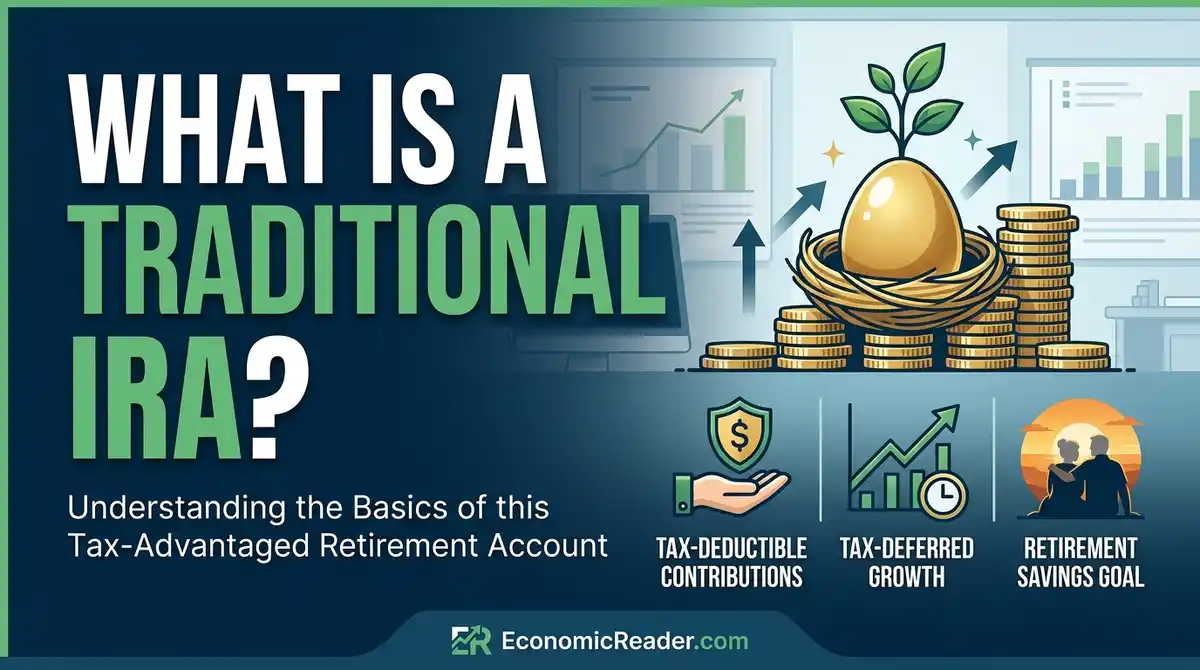
A Traditional IRA (Individual Retirement Account) is a tax advantaged retirement account that lets an individual save and invest for retirement.
The account itself is not an investment. Think of it as a container for investments.
Depending on the financial institution, a Traditional IRA can hold investments such as stocks, bonds, mutual funds, ETFs, and other eligible assets.
The tax treatment is what makes the account different from an ordinary brokerage account. Contributions may be deductible, depending on factors such as income, filing status, and whether you or your spouse participates in a workplace retirement plan. Money withdrawn from a Traditional IRA is generally included in taxable income, with special rules and exceptions applying in certain situations.
The Tax Benefit Comes First
The main attraction of a Traditional IRA is the possibility of receiving a tax deduction for contributions.
That does not mean every contribution is automatically deductible.
For 2026, the combined contribution limit for all of your Traditional and Roth IRAs is $7,500, or $8,600 if you are age 50 or older. The limit also cannot exceed your taxable compensation for the year. (IRS)
Whether a Traditional IRA contribution is deductible can depend on your income and workplace retirement plan coverage.
For example, in 2026, if you are single and covered by a retirement plan at work, the deduction begins to phase out when modified adjusted gross income reaches $81,000 and phases out completely at $91,000. For married couples filing jointly, the phaseout range is $129,000 to $149,000 when the spouse making the contribution is covered by a workplace plan. Different rules apply in other situations. (IRS)
So there are really two separate questions:
Can you contribute to a Traditional IRA?
and
Can you deduct that contribution?
Those are not always the same thing.
How the Account Fits Into Your Retirement Plan
Opening the account is only the beginning.
Suppose you open a Traditional IRA and transfer $5,000 into it. That $5,000 is now inside the retirement account, but it is not automatically invested.
You still need to decide how that money should be invested.
Depending on the provider, your choices might include:
Individual company shares can offer long term growth potential, but their prices can move substantially.
Exchange traded funds can give you exposure to a group of investments through a single fund.
Mutual Funds
Mutual funds pool money from investors and use it to purchase a portfolio of assets.
Bonds can provide income and may play a role in reducing the overall volatility of a portfolio.
The right mix depends on factors such as your time horizon, financial goals, and willingness to accept investment losses.
What Happens When You Withdraw the Money?
Traditional IRAs are designed for retirement, but you are not technically locked out of the account until retirement.
You can take money out at any time. The tax consequences depend on the type of distribution and your circumstances.
Generally, taxable Traditional IRA distributions are included in income. If you take a distribution before reaching age 59½, a 10% additional tax generally applies unless an exception covers the withdrawal. (IRS)
Once you reach age 59½, the 10% additional tax generally no longer applies to distributions, although the ordinary income tax rules still matter. (IRS)
This is one reason a Traditional IRA should generally be viewed as long term retirement money rather than an emergency savings account.
Traditional IRA Required Minimum Distributions
There is another rule that becomes important later in life.
Traditional IRA owners generally must begin taking required minimum distributions (RMDs) at age 73 under current federal rules. The first RMD generally must be taken by April 1 of the year following the year you reach the applicable starting age, with later RMDs generally due by December 31. (IRS)
That makes Traditional IRAs different from Roth IRAs in an important way. An original owner of a Roth IRA generally does not have lifetime RMDs while alive, while Traditional IRA owners generally do.
Traditional IRA vs. Roth IRA
The biggest difference between these two accounts is when the tax benefit generally happens.
| Traditional IRA | Roth IRA |
| Contributions may be deductible depending on eligibility | Contributions are not deductible |
| Taxes are generally paid when taxable withdrawals are made | Qualified withdrawals can generally be tax free |
| May appeal to someone seeking a potential tax benefit today | May appeal to someone seeking tax free qualified withdrawals later |
| Subject to lifetime RMD rules for the original owner | No lifetime RMDs for the original owner |
Neither account is automatically the better choice.
A person expecting to be in a lower tax bracket later may value the Traditional IRA’s potential deduction today. Someone who expects to face higher taxes later may place more value on Roth treatment.
Your income, workplace retirement plan, filing status, and long term tax expectations all matter.
Traditional IRA vs. 401(k)
A Traditional IRA and a 401(k) can both be used for retirement, but they work differently.
A 401(k) is generally offered through an employer, while an IRA is opened individually.
A 401(k) may also come with an employer match, which can be a major benefit. The contribution limits are different as well. For 2026, the employee contribution limit for a 401(k) is $24,500, considerably higher than the $7,500 IRA limit. (IRS)
Some people use both accounts rather than choosing only one.
For example, an employee might contribute enough to a 401(k) to take advantage of an available employer match and then use an IRA for additional retirement investing.
What Makes a Traditional IRA Useful?
A Traditional IRA can solve several practical problems for someone trying to build retirement savings.
You Control the Account
Because the IRA belongs to you, it is not tied to a particular employer.
Changing jobs does not mean losing the account.
You May Have More Investment Choices
An IRA at a brokerage may provide a broader range of investment options than some employer retirement plans.
You May Receive a Tax Deduction
Eligible contributions can potentially reduce taxable income for the year in which the contribution is made. The deduction depends on the applicable IRS rules and your circumstances.
You Get a Long Investment Horizon
Someone who starts investing in their 20s or 30s may have decades for the investments inside the account to compound.
That time can matter more than trying to find the perfect investment every year.
Where a Traditional IRA Falls Short
Traditional IRAs are useful, but they are not automatically the right answer for every investor.
The tax deduction is not guaranteed.
Higher income and participation in a workplace retirement plan can limit or eliminate the deduction in certain circumstances.
The investments can lose value.
An IRA can hold investments that rise and fall with financial markets. The account’s tax advantages do not protect you from investment losses.
Early withdrawals can be costly.
Taking money out before age 59½ can result in regular income tax plus an additional 10% tax unless an exception applies.
RMDs eventually matter.
Traditional IRA owners generally cannot leave the money untouched indefinitely. Required minimum distributions apply under current rules.
A Simple Example
Consider someone named Alex who is 32 and earns a salary from a full time job.
Alex already has a workplace retirement plan but wants another account for long term investing. Alex opens a Traditional IRA and contributes $5,000 during the year.
Instead of leaving the money in cash, Alex invests it in a diversified portfolio.
If the investments grow over the following decades, the account can become a meaningful part of Alex’s retirement savings.
The result will depend on investment performance, contributions, fees, taxes, and many other factors. There is no guaranteed return.
What matters is that the account gives Alex another place to build retirement assets under the IRA tax rules.
Mistakes Worth Avoiding
One common mistake is assuming that opening an IRA automatically means you are investing. It does not. The money still needs to be allocated to investments.
Another is assuming every Traditional IRA contribution is deductible. Deductibility depends on the individual’s circumstances and current tax rules.
It is also easy to overlook fees. A small difference in investment expenses can matter over a long retirement horizon.
Finally, some investors treat retirement accounts like ordinary checking accounts. Frequent withdrawals can undermine the purpose of using a tax advantaged account in the first place.
Who Might Find a Traditional IRA Useful?
A Traditional IRA may make sense for someone who wants an individual retirement account and may benefit from a current year tax deduction.
It can also be useful for investors who want greater control over their retirement investments or want to supplement an employer sponsored retirement plan.
But the right decision depends on the person’s income, tax situation, workplace retirement benefits, age, and long term goals.
There is no single retirement account that works equally well for everyone.
Frequently Asked Questions
1. Can I contribute to both a Traditional IRA and a Roth IRA?
Yes. You can contribute to both in the same year, but the combined contributions to your Traditional and Roth IRAs generally cannot exceed the annual IRA limit. For 2026, that combined limit is $7,500, or $8,600 for someone age 50 or older.
2. Can I have a Traditional IRA if I already have a 401(k)?
Yes. Having a 401(k) does not automatically prevent you from having a Traditional IRA. However, workplace retirement plan coverage can affect whether your Traditional IRA contribution is deductible.
3. Can I withdraw money from a Traditional IRA before retirement?
You can withdraw money at any time, but an early withdrawal may be taxable and may also be subject to a 10% additional tax if you are under age 59½ and no exception applies.
4. Do Traditional IRAs have required minimum distributions?
Yes. Under current federal rules, Traditional IRA owners generally must begin taking RMDs at age 73.
5. Is money inside a Traditional IRA automatically invested?
No. The IRA is an account that holds your money and investments. After contributing, you generally need to choose how the money will be invested.
Final Thoughts
A Traditional IRA is more than a place to put retirement money.
Its value comes from the combination of tax treatment, long term investing, and personal control.
For some investors, the potential deduction today can be attractive. For others, a Roth IRA or workplace retirement plan may fit better.
The important part is understanding the rules before deciding where your retirement dollars should go.
And because IRA limits and tax rules can change, it is worth checking the current IRS guidance when making a contribution or tax decision.
Continue Learning…
If you’d like to explore this topic further, check out these related guides from Economic Reader:
- What Is a 401(k)? – How Workplace Retirement Plans Work.
- What Is an IRA? – A Beginner’s Guide to Individual Retirement Accounts.
- What Is a Roth IRA? – A Beginner’s Guide to Tax-Free Retirement Investing.
Author Note: This article is crafted by “The Economic Reader editorial team”, dedicated to analyzing the latest market trends, financial updates, and global economic shifts to keep you informed with accurate and comprehensive insights.
Disclaimer: The information provided on this website is for educational and informational purposes only and should not be construed as professional financial, investment, or legal advice. Always consult with a certified financial advisor or professional before making any financial decisions based on this content.