

Crypto Market Weekly Update: August 31-September 4, 2026 Bitcoin Rebounds as ETF Demand Surges
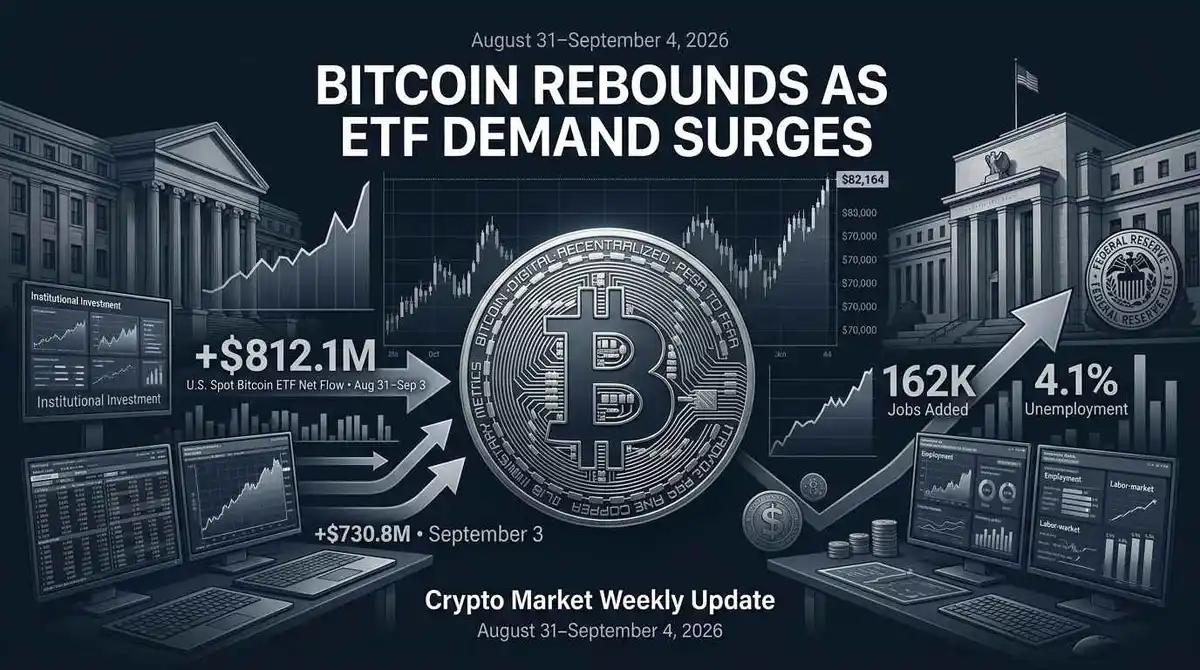
Crypto Market Weekly Update August 31-September 4 2026
Bitcoin began September under pressure, but the cryptocurrency market changed direction sharply as the week progressed.
After falling toward the $77,000 area early in the week, Bitcoin recovered above $81,000 on Thursday as investors responded to more supportive comments from Federal Reserve Governor Christopher Waller and a powerful return of institutional demand through U.S. spot Bitcoin exchange-traded funds.
The rally continued into Friday, when Bitcoin briefly reached about $82,164, its highest level since May. But the move did not last. A stronger-than-expected U.S. employment report revived expectations of another Federal Reserve interest-rate increase, pushing Bitcoin back below $80,000.
That left the crypto market with a familiar but increasingly important tension: institutional demand is strengthening, while monetary policy remains uncertain.
A Difficult Start Turned into a Strong Rebound
The first half of the week was dominated by caution.
Bitcoin entered September after a volatile August and remained sensitive to the Federal Reserve’s increasingly important debate over inflation and interest rates. Concerns that rates could remain higher for longer weighed on risk assets, including cryptocurrencies.
Bitcoin subsequently traded near the upper-$70,000s before the mood changed on Thursday.
Federal Reserve Governor Christopher Waller said he would be inclined to support keeping interest rates unchanged at the Fed’s September meeting if incoming inflation data continued to show progress. He also made clear that stronger inflation data could still justify a rate increase.
The comments reduced some of the pressure that had built up following Fed Chair Kevin Warsh’s more cautious tone at Jackson Hole.
Reuters reported that financial markets reduced the perceived probability of a September rate hike following Waller’s remarks. (Reuters)
Bitcoin responded quickly.
According to Reuters-linked market data, Bitcoin rose more than 5% on Thursday, reaching above $81,000 and recording its strongest intraday level since May. (Investing.com)
The move showed how closely Bitcoin is now tied to changes in expectations for U.S. monetary policy.
When investors see a lower probability of higher interest rates, demand for risk-sensitive assets can improve. When rate expectations rise again, the opposite can happen quickly.
The Biggest Story Was the Return of ETF Demand
The strongest fundamental signal of the week came from the U.S. spot Bitcoin ETF market.
Farside Investors reported the following daily net flows:
| Date | U.S. Spot Bitcoin ETF Net Flow |
| August 31 | +$216.7 million |
| September 1 | −$236.5 million |
| September 2 | +$101.1 million |
| September 3 | +$730.8 million |
Across those four trading days, the combined net flow was approximately +$812.1 million.
The most important number was Thursday’s $730.8 million inflow. Farside’s data shows that the inflow was spread across several major funds, led by BlackRock’s IBIT, which recorded a $454 million inflow that day. (Farside Investors)
The scale of the inflow was significant enough to become one of the week’s defining crypto stories. The Block reported that it was the largest single-day U.S. Bitcoin ETF inflow since January. (The Block)
This matters because ETF flows provide a useful indication of demand from investors using regulated market structures rather than directly holding cryptocurrency.
Economic Reader has previously explained how exchange-traded funds work in What Is an ETF?.
The ETF numbers also help put Bitcoin’s price recovery into perspective. The market was not relying solely on short-term speculative buying. Significant capital was flowing into Bitcoin investment products at the same time that prices were recovering.
One strong inflow day is not enough to establish a permanent trend, however. Investors will need to see whether large inflows continue during the coming weeks.
Friday’s Jobs Report Changed the Conversation Again
Just as the market appeared to be gaining momentum, Friday brought a new challenge.
The U.S. economy added 162,000 nonfarm jobs in August, substantially above the roughly 56,000 increase economists had expected. The unemployment rate remained at 4.1%. (Reuters)
The report changed interest-rate expectations almost immediately.
A stronger labor market gives the Federal Reserve less reason to worry about weakening economic activity. At the same time, it gives policymakers more room to maintain or increase interest rates if inflation remains above target.
Reuters reported that market expectations for a September rate increase rose following the employment report. (Reuters)
Bitcoin reacted accordingly.
After reaching roughly $82,164 overnight, Bitcoin pulled back as investors absorbed the stronger jobs data. Barron’s reported the cryptocurrency later trading around $80,848 after retreating from the high. (Barron’s)
The reaction was a useful reminder that crypto remains highly sensitive to changes in the broader interest-rate environment.
Why the Fed Is Becoming So Important for Crypto
The relationship between the Federal Reserve and cryptocurrency has become increasingly difficult for investors to ignore.
Bitcoin does not generate traditional cash flows like a company, and its valuation is therefore particularly sensitive to liquidity, investor risk appetite and the opportunity cost of holding speculative assets.
When interest rates are expected to decline or remain stable, financial conditions can become more supportive for risk assets.
When expectations shift toward higher rates, investors often become more selective.
This week’s price action illustrated that relationship almost perfectly.
On Thursday, Waller’s comments reduced rate-hike expectations and Bitcoin rallied.
On Friday, the stronger jobs report increased rate-hike expectations and Bitcoin retreated.
The important point is that the market did not receive a completely new economic reality between Thursday and Friday. Investor expectations simply changed.
Economic Reader’s What Is the Federal Reserve? explains the central bank’s role in the U.S. economy, while What Is Inflation? provides broader context for the inflation problem that continues to influence monetary policy.
Bitcoin’s $82,000 Area Is Becoming Important
Bitcoin’s move toward $82,000 has created an important technical test.
The cryptocurrency briefly reached around $82,164 on Friday before retreating. That level is close to the May high identified by Reuters as an important resistance area. (Barron’s)
A sustained move through that zone could strengthen the case that Bitcoin’s recent recovery is developing into a broader upward trend.
But a repeated failure around the same area would tell a different story.
The distinction matters because Bitcoin has already experienced several periods in which strong rallies were followed by sharp reversals.
For investors, the question is therefore not simply whether Bitcoin can touch $82,000.
The more important question is whether it can hold above major resistance while ETF demand remains strong.
If both happen together, the recovery would have a stronger foundation.
Ethereum and the Wider Crypto Market
Bitcoin remained the main focus of the week, but the broader digital-asset market also benefited from the improvement in sentiment.
Ethereum, Solana, XRP and other major cryptocurrencies participated in the recovery as risk appetite improved.
However, it is better to avoid treating short-term price movements in individual altcoins as evidence of a new broad-based bull market.
Crypto markets operate 24 hours a day, seven days a week, and prices can vary considerably depending on the exact timestamp and data provider. That makes precise weekly percentage comparisons less useful unless the measurement period is defined consistently.
The more important development this week was that Bitcoin’s recovery occurred alongside renewed institutional flows and improved sentiment across major digital assets.
That combination is more meaningful than any single day’s move in an individual altcoin.
What the Strong Jobs Data Means for Crypto
The August employment report created an unusual situation for investors.
The U.S. economy appears stronger than expected, which is positive from a growth perspective.
But for financial markets, strong economic data can sometimes be negative when the central bank is still concerned about inflation.
The report showed that nonfarm payrolls increased by 162,000 and unemployment remained at 4.1%. Wage growth was around 3.1% year over year, according to Reuters reporting. (Reuters)
That wage figure provides some offset to the stronger headline employment number because it does not suggest a major acceleration in wage-driven inflation.
As a result, the jobs report does not guarantee a September rate hike.
The next major piece of the puzzle will be inflation data.
Federal Reserve officials have indicated that the September decision will depend heavily on incoming economic information. Waller specifically tied his willingness to hold rates steady to continued improvement in inflation. (Reuters)
That makes the upcoming U.S. inflation report particularly important for Bitcoin and other risk assets.
Institutional Demand Versus Macro Pressure
The most interesting feature of this week’s crypto market was the contrast between two powerful forces.
Institutional demand was clearly improving.
The $812 million net Bitcoin ETF inflow across August 31 through September 3 showed that investors were willing to allocate substantial capital to Bitcoin investment products. (Farside Investors)
But monetary policy remained a potential headwind.
The stronger U.S. employment report pushed investors back toward the possibility of another Fed rate increase. (Reuters)
This creates an important test for the market.
If ETF inflows remain strong while inflation data continues to moderate, Bitcoin could have the conditions needed to challenge and potentially break through its current resistance zone.
If inflation proves stubborn and the Fed adopts a more hawkish stance, institutional buying may have to absorb considerably more selling pressure.
That is why the next few weeks could be more important than this week’s rally itself.
What Crypto Investors Should Watch Next
The market now has several clear signals to monitor.
Bitcoin Around $82,000
The recent high near $82,164 puts the $82,000–$83,000 area firmly on the radar. A sustained breakout would be more significant than a temporary intraday move. (Barron’s)
Bitcoin ETF Flows
The $730.8 million inflow on September 3 was exceptional. The next question is whether ETF demand remains strong after the initial surge. Farside’s daily data will remain one of the clearest indicators of institutional appetite. (Farside Investors)
U.S. Inflation
The upcoming inflation data could have a direct effect on September rate expectations. A softer inflation reading could support Waller’s argument for holding rates steady, while renewed inflation pressure could strengthen the case for tighter policy.
Federal Reserve Communication
Investors will continue watching comments from Waller, Warsh and other Fed policymakers. Differences in their views make monetary policy especially important for risk assets.
Ethereum and Major Altcoins
If major cryptocurrencies continue participating in the recovery, it would suggest that improving sentiment is spreading beyond Bitcoin.
Frequently Asked Questions (FAQ)
1. What happened to Bitcoin during August 31–September 4, 2026?
Bitcoin initially remained under pressure and traded toward the upper-$70,000s before recovering sharply. It moved above $81,000 on Thursday and briefly reached about $82,164 on Friday before retreating after the U.S. jobs report. (Barron’s)
2. How much money flowed into U.S. Bitcoin ETFs this week?
From August 31 through September 3, U.S. spot Bitcoin ETFs recorded approximately $216.7 million of inflows, a $236.5 million outflow, $101.1 million of inflows and $730.8 million of inflows respectively. The combined net flow was about $812.1 million. (Farside Investors)
3. Why did Bitcoin fall after the U.S. jobs report?
The U.S. added 162,000 jobs in August, much more than expected, while unemployment remained at 4.1%. The stronger labor-market data increased expectations for a possible Federal Reserve rate hike, putting pressure on risk-sensitive assets such as Bitcoin. (Reuters)
4. Does the ETF inflow mean Bitcoin has entered a new bull market?
Not necessarily. Strong ETF demand is a positive signal, but one week of inflows does not confirm a long-term bull market. Bitcoin still needs to overcome important resistance while maintaining institutional demand and navigating monetary-policy uncertainty.
5. What should crypto investors watch next?
The most important factors are Bitcoin’s ability to hold above the low-$80,000 range, continued Bitcoin ETF flows, upcoming U.S. inflation data and Federal Reserve policy signals.
Final Thoughts
The August 31–September 4 week gave the crypto market a much more complicated picture than a simple Bitcoin rally.
Bitcoin recovered strongly after starting the week under pressure. The biggest positive signal was the return of institutional demand, particularly the $730.8 million U.S. spot Bitcoin ETF inflow on September 3. (Farside Investors)
But Friday’s employment report showed why the recovery cannot be viewed in isolation.
The U.S. economy added 162,000 jobs, significantly exceeding expectations, and that pushed interest-rate expectations in a more hawkish direction. Bitcoin consequently pulled back after briefly reaching around $82,164. (Reuters)
The market therefore enters the next week with two competing forces.
On one side, institutional demand appears to be returning.
On the other, the Federal Reserve’s interest-rate path remains uncertain.
For Bitcoin, the next major test is whether strong ETF demand can continue while the market deals with potentially tighter monetary policy.
The upcoming inflation data may provide the next major clue.
For now, the clearest takeaway from this week’s market action is that Bitcoin’s recovery has gained momentum, but it has not yet escaped the influence of the Fed.
If you want to read last week’s
- Oil Market Weekly Update: please click here.
- Gold Market Weekly Update: please click here.
- Stock Market Weekly Update: please click here.
- Crypto Market Weekly Update: please click here.
Author Note: This article is crafted by “The Economic Reader editorial team”, dedicated to analyzing the latest market trends, financial updates, and global economic shifts to keep you informed with accurate and comprehensive insights.
Disclaimer: The information provided on this website is for educational and informational purposes only and should not be construed as professional financial, investment, or legal advice. Always consult with a certified financial advisor or professional before making any financial decisions based on this content.