Commodity Investing Mistakes to Avoid: Common Errors and How to Avoid Them
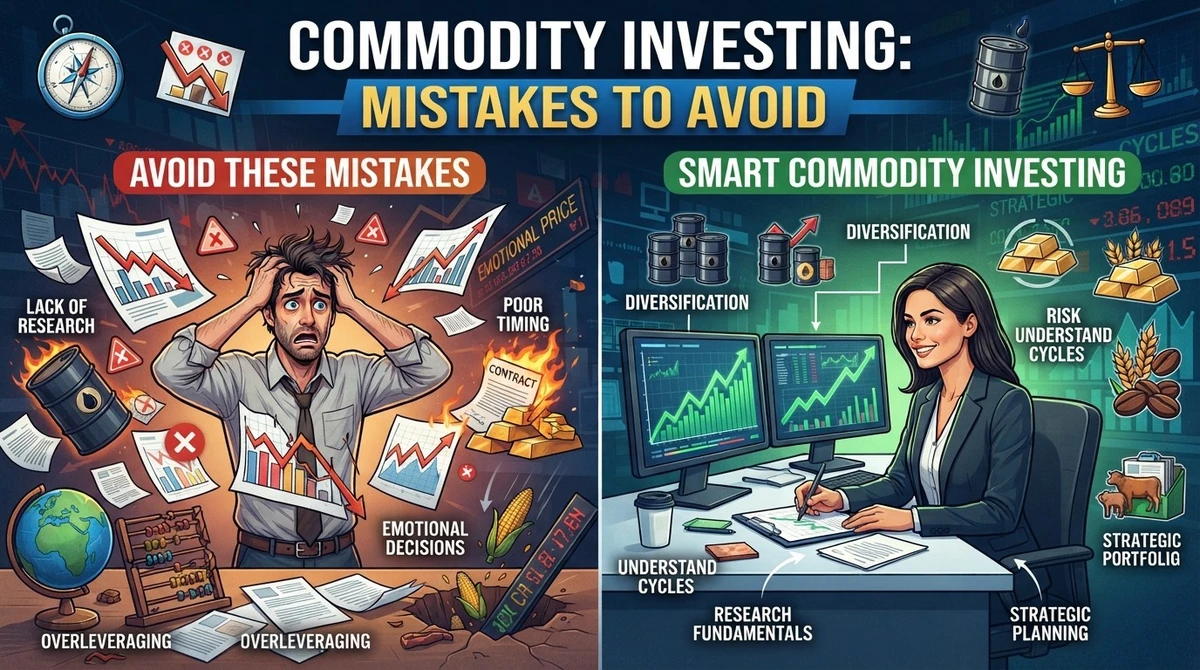
Commodity Investing Mistakes to Avoid
Commodity investing can give investors exposure to markets tied to energy, food, industrial production, inflation, and global trade. But commodities do not behave exactly like stocks or bonds, and that difference can create mistakes that are easy to miss.
An investor can correctly predict that oil prices will rise and still earn a disappointing return. A gold investor can buy a product without realizing how its structure affects returns or taxes. Someone trading commodity futures can understand the market direction but underestimate leverage, margin requirements, or contract expiration.
The issue is often not the commodity itself. It is the way the investment provides exposure.
For a broader introduction to the asset class, see Economic Reader’s guide to what commodities are. Here, the focus is narrower: the common mistakes investors can make after deciding to add commodities to a portfolio.
1. Confusing Commodity Prices with Investment Returns
One of the easiest mistakes is assuming an investment will rise by roughly the same percentage as the commodity it tracks.
That does not always happen.
An investor holding physical gold has a different return experience from someone holding a gold futures fund. An oil producer’s stock can behave differently from crude oil because the company also has operating costs, debt, production levels, capital spending, and other business risks.
Futures-based products introduce another layer. The fund may need to replace expiring contracts, and the cost or benefit of that process can affect the return.
Suppose crude oil rises 10% over a certain period. An investment linked to oil does not automatically gain 10%. Its structure, fees, futures exposure, and other factors can change the result.
Before buying a commodity investment, the more useful question is:
What exactly am I buying, and what determines its return?
That answer can matter more than simply having a view on the commodity’s price.
2. Ignoring Contango and Backwardation
The futures curve can have a major influence on commodity investment returns.
When later-dated futures contracts trade at higher prices than earlier contracts, the market is generally described as being in contango. When later-dated contracts are priced below earlier ones, the market is generally in backwardation.
The distinction matters because futures-based funds often replace contracts as they approach expiration.
Imagine a fund holding a futures contract that is approaching expiration. If it sells that contract and buys a later contract at a higher price, the roll can create a drag on returns. The opposite relationship can potentially benefit returns.
This is one reason the return of a futures-based commodity product can differ from the change in the commodity’s spot price.
Investors who look only at the headline commodity price can therefore miss an important part of the investment’s performance.
3. Using Too Much Leverage
Leverage can make commodity exposure significantly more volatile.
Futures contracts allow investors to control a relatively large amount of commodity exposure by posting a smaller amount of margin. That can magnify gains, but it also magnifies losses.
The CFTC describes commodity futures and options as volatile and complex and warns that losses can exceed the amount initially invested in some circumstances. (CFTC)
Margin should not be viewed as a down payment on the commodity. It functions as collateral supporting the futures position, and the account is adjusted as the market moves.
That distinction is important. A relatively small move in the underlying commodity can produce a much larger percentage change in the capital committed to the position.
Investors who use futures need to understand initial margin, maintenance margin, margin calls, and the possibility of losses beyond the initial amount deposited.
4. Treating Futures Like Stocks
Stocks and futures are both traded in financial markets, but their mechanics are very different.
A stock generally does not expire on a predetermined date. A futures contract does.
Futures also have standardized contract sizes, expiration dates, settlement procedures, delivery terms, and margin requirements. Most futures contracts are closed or offset before physical delivery, but the contract’s expiration and settlement terms still matter.
That changes how a position needs to be managed.
Someone holding a stock can generally decide to keep it for years. A futures trader has to understand what happens as the contract approaches expiration. Depending on the strategy, the position may be closed, rolled into another contract, or settled according to the contract’s terms.
The mistake is treating a futures position as if it were simply another way to own a stock.
5. Ignoring the Cost of Rolling Futures Contracts
Understanding that futures expire is only part of the equation. Investors also need to understand what happens when exposure is rolled forward.
Rolling involves moving from an expiring futures contract into another contract with a later expiration.
The price relationship between those contracts can affect the investment result. In contango, repeatedly moving into more expensive later contracts can create a headwind. In backwardation, the relationship can work differently.
The SEC and CFTC have also noted that futures-based exchange-traded products can experience changes in exposure as contracts are rolled into later expirations. (Investor.gov)
This is why a futures-based oil fund, for example, should not automatically be viewed as equivalent to owning barrels of oil.
6. Buying a Commodity ETF Without Understanding Its Structure
The label “commodity ETF” can make very different products sound similar.
Some exchange-traded commodity products may hold physical commodities. Others may obtain exposure through futures, derivatives, trusts, partnerships, or other structures.
Investor.gov notes that exchange-traded products include ETFs, commodity trusts, and ETNs, and that exchange-traded commodity trusts are not registered as investment companies under the Investment Company Act simply because they may be described as ETFs. (Investor.gov)
Those structural differences can affect:
- How the product tracks the commodity
- How returns are generated
- Tax treatment
- Distributions
- Reporting requirements
- Fees and expenses
- Counterparty or structural risks
That is why investors should look beyond the product name.
Economic Reader’s guide to the Best Commodity ETFs in the USA covers the different structures investors can encounter when comparing commodity funds and exchange-traded products.
7. Assuming Producer Stocks Track Commodity Prices Exactly
Commodity producer stocks offer indirect exposure to commodity markets, but they remain company shares.
Take an oil producer. Higher oil prices can improve revenue and profitability, but the company’s stock is also influenced by production costs, debt, capital spending, production volumes, hedging, management decisions, regulations, and the wider equity market.
The same principle applies to mining companies.
A gold-mining stock is not the same as owning gold. A copper producer is not the same as owning copper.
Producer stocks can benefit from higher commodity prices, but they combine commodity exposure with business-specific risk. That can produce very different returns from the underlying commodity.
8. Putting Too Much Money Into One Commodity
Commodity markets can react sharply to individual supply and demand shocks.
Oil can respond to production decisions, inventories, geopolitical developments, transportation disruptions, and global demand.
Agricultural commodities can move with weather, crop conditions, harvest expectations, trade policies, and inventories.
Industrial metals can respond to manufacturing activity, construction demand, mine production, inventories, and economic growth.
Because the drivers are different, concentrating heavily in one commodity can leave a portfolio dependent on a narrow set of conditions.
Diversifying across commodities or combining commodity exposure with other asset classes can reduce concentration risk, although it does not eliminate commodity-market volatility.
9. Ignoring Volatility and Position Size
A commodity investment does not need leverage to be volatile.
Prices can move significantly when markets suddenly reassess supply, demand, inventories, weather, geopolitical conditions, or economic growth.
That makes position size important.
Suppose an investor has a diversified portfolio but places a large portion of it into one highly volatile commodity. The overall portfolio may look diversified on paper, yet that single position can still have a disproportionate effect on short-term performance.
The CFTC advises futures participants to consider their financial resources, objectives, experience, and ability to withstand losses before entering the market. (CFTC)
Position size should reflect the role of the investment and the volatility of the underlying market, not simply the investor’s confidence in a particular price outlook.
10. Chasing Commodities After a Sharp Price Rally
Large commodity rallies can attract investors after much of the move has already taken place.
The pattern is familiar: prices rise, attention increases, recent performance looks impressive, and investors become interested because the market appears to be gaining momentum.
But commodity prices can change direction quickly.
A rally might reflect a temporary supply disruption, falling inventories, weather problems, changing production expectations, geopolitical developments, or stronger-than-expected demand. Some of those conditions can later reverse.
A commodity can certainly continue rising after a major gain. The mistake is assuming that recent performance by itself provides enough information about what comes next.
Looking at the conditions behind the price move is more useful than simply extrapolating the recent trend.
11. Ignoring Supply, Demand, and Inventory Data
Commodity markets are closely connected to physical markets, so fundamental information can matter greatly.
For energy markets, investors may follow production, consumption, inventories, exports, imports, and storage levels.
For agricultural commodities, weather, planting conditions, crop estimates, harvest expectations, exports, and inventories can influence prices.
For industrial metals, manufacturing activity, construction demand, inventories, mine production, and broader industrial conditions can matter.
This does not mean every investor needs to become a commodity-market specialist. But someone making a major commodity allocation without understanding the main forces affecting that market is working with incomplete information.
Price charts show what the market has done. Supply-and-demand data can help explain why it happened.
12. Overlooking Currency and Global-Market Effects
Many major commodities are traded internationally and priced in U.S. dollars.
That creates another variable for investors to consider, particularly those whose home currency is not the dollar.
A commodity can rise in dollar terms while producing a different result for an investor after exchange-rate movements are considered. Global interest rates, economic growth, trade flows, and changes in the dollar can also influence commodity markets.
Currency effects do not always dominate the investment result, but they can become more noticeable over longer holding periods.
Investors should therefore distinguish between the return of the commodity in its trading currency and the return ultimately experienced in their own currency.
13. Choosing a Product Without Checking Fees and Liquidity
Two products can provide similar commodity exposure while producing different results because of their costs and trading characteristics.
Before buying, investors can examine:
- Expense ratios and other ongoing costs
- Bid-ask spreads
- Trading volume and liquidity
- Futures-related costs
- Tracking differences
- Premiums or discounts where relevant
- Tax reporting requirements
A low expense ratio is useful, but it is not the entire cost of ownership.
A product with limited trading activity may have wider bid-ask spreads, increasing the effective cost of entering or exiting a position. Other products may have structural or futures-related costs that are not obvious from the headline fee.
Investor.gov similarly advises investors to understand both the risks and fees associated with investment products before investing. (Investor.gov)
The better question is not simply, “Which product has the lowest fee?”
It is:
What will it cost to obtain and maintain the commodity exposure I actually want?
14. Using a Short-Term Strategy With a Long-Term Investment Goal
A commodity strategy designed for short-term trading may behave very differently from an investment intended to be held for several years.
Short-term traders may focus on price movements, inventories, economic releases, technical signals, or specific market events.
A long-term investor may be more concerned with diversification, inflation exposure, structural supply trends, portfolio construction, and the long-term behavior of the investment vehicle.
Futures expiration and rolling costs can become particularly relevant when exposure is maintained over a long period.
The mistake is not choosing a short-term or long-term approach. It is using an investment vehicle without checking whether its structure fits the intended holding period.
15. Ignoring Tax Treatment
Taxes can be easy to overlook when the main focus is commodity prices.
Yet different commodity investments can have different tax characteristics depending on how they are structured.
Physically backed precious-metals products, futures-based funds, partnership structures, and commodity-related stocks can all involve different tax considerations.
That means investors should not assume every commodity ETF or exchange-traded product receives identical tax treatment.
For U.S. investors, the product’s offering documents and tax reporting information can be particularly important before making a purchase.
Tax treatment is not the only factor in choosing a commodity investment, but ignoring it can change the after-tax return significantly.
16. Thinking Diversification Automatically Makes Commodities Safe
Commodities are sometimes added to portfolios for diversification, but diversification does not remove the risks of the underlying investment.
A commodity can experience large price swings even when it represents only a small part of a portfolio.
There is also no guarantee that commodities will rise whenever stocks fall or inflation increases. Relationships between asset classes can change across different economic environments.
The role of commodities in a portfolio should therefore be separated from the question of whether commodities themselves are volatile.
Diversification can change a portfolio’s overall risk profile. It does not make a volatile asset risk-free.
A Simple Commodity Investing Mistake Checklist
Before investing in a commodity or commodity-related product, it helps to answer a few basic questions.
1. What exposure am I actually buying?
Is it physical commodity exposure, futures, options, producer stocks, or another structure?
2. How does the investment generate its return?
Does performance depend on spot prices, futures prices, company earnings, or another mechanism?
3. Can contango or backwardation affect the result?
This is particularly important for futures-based products.
4. Does leverage exist?
If so, understand the potential size of gains and losses and the applicable margin requirements.
5. What happens when contracts expire?
Know whether the strategy closes, rolls, or settles positions.
6. What are the total costs?
Look beyond the advertised expense ratio.
7. What are the tax implications?
Check the product structure and applicable tax documents.
8. How volatile is the underlying market?
A highly volatile commodity may warrant a smaller allocation.
9. What physical factors are driving the market?
Consider supply, demand, inventories, weather, production, and economic conditions where relevant.
10. Does the investment fit the intended holding period?
A product designed around short-term exposure may not behave as expected over a much longer period.
This checklist cannot predict whether a commodity will rise or fall. It can help prevent an investor from entering a position without understanding its basic mechanics.
Commodity Investing Works Better When the Exposure Is Understood
Most commodity investing mistakes come down to a mismatch between what an investor thinks they are buying and what the investment actually provides.
A futures-based commodity fund is not the same as owning the physical commodity. A mining stock is not the same as owning the metal it produces. A leveraged futures position is not the same as an unleveraged commodity fund. And a rise in a commodity’s price does not automatically translate into the same percentage gain for every investment product.
That is why the first step is not simply predicting the commodity price.
It is understanding the exposure, structure, costs, risks, and return mechanism behind the investment.
Once those pieces are clear, investors can make more informed decisions about whether a particular commodity investment fits their portfolio, time horizon, and risk tolerance.