What Is Protectionism? Understanding Trade Barriers, Tariffs and Economic Policy
What Is Protectionism?
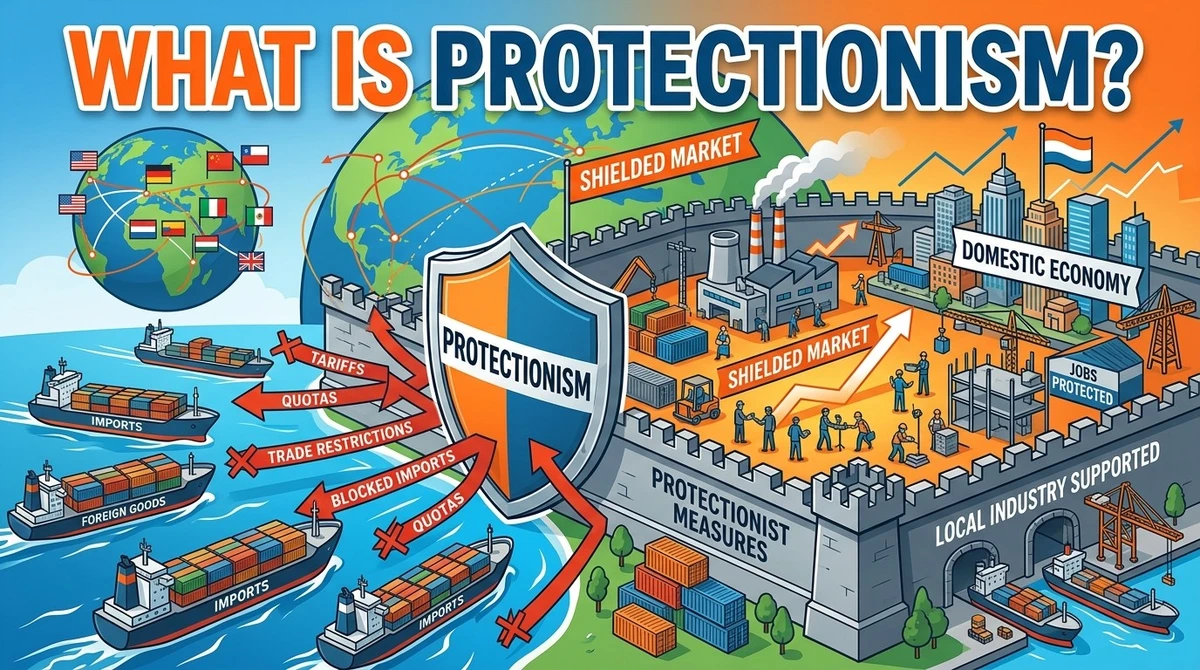
Protectionism is an economic policy approach in which a government uses trade measures to give domestic producers some protection from foreign competition.
The most familiar example is a tariff, which places a tax on imported goods. But protectionism can also involve import quotas, subsidies, licensing requirements, local-content rules, and other policies that influence how foreign products compete in a domestic market.
The basic idea is straightforward: if imported products become more expensive or harder to bring into a country, domestic businesses may have more room to compete.
The economic effects are much more complicated.
Protection can support particular industries, encourage domestic production, or reduce dependence on foreign suppliers. At the same time, it can raise costs for consumers and businesses that rely on imported goods or inputs. Trading partners may also respond with their own restrictions, changing export opportunities and supply chains.
Understanding protectionism therefore means looking beyond the trade barrier itself and following how it changes prices, production, investment, employment, productivity, and international economic relationships.
What Does Protectionism Mean?
Protectionism refers to government policies that restrict or influence international trade in ways intended to protect domestic economic activity from foreign competition or achieve broader strategic objectives.
Governments can use protectionist measures for different reasons.
A country might want to:
- Support a domestic industry facing strong import competition
- Protect employment in an important sector
- Encourage local production
- Give an emerging industry time to develop
- Reduce dependence on foreign suppliers
- Strengthen domestic supply chains
- Protect strategically important industries
- Respond to another country’s trade restrictions
Protectionism does not mean a country stops trading with the rest of the world.
A country can remain deeply integrated into global trade while protecting selected industries through tariffs, quotas, subsidies, or other measures.
This is why protectionism is better understood as a degree and structure of government intervention in trade, rather than a simple choice between trading and not trading.
The IMF identifies tariffs and quotas as traditional trade barriers that can raise the price or limit the availability of imports. (IMF)
Why Do Governments Use Protectionism?
The reasons behind protectionist policies can differ substantially across countries and industries.
One common reason is competition.
Suppose domestic steel producers face cheaper imported steel. If foreign producers can supply steel at a lower price, domestic companies may lose market share. A government could impose a tariff on imported steel, increasing the cost of foreign steel in the domestic market.
That can give domestic producers more room to compete.
Another reason is industrial development.
A government may believe that a new industry needs time to become competitive. Temporary protection can theoretically give domestic firms an opportunity to build production capacity, develop technology, and achieve economies of scale.
Strategic considerations can matter as well.
Semiconductors, energy equipment, critical minerals, pharmaceuticals, food supplies, and defense-related products can have importance beyond their immediate commercial value. A government may therefore place a higher value on domestic capacity even when importing a product would be cheaper under normal market conditions.
Protectionism can also become a response to foreign policy.
If another country imposes trade restrictions, a government may introduce measures of its own. At that point, protectionism can become part of a broader trade dispute rather than simply a domestic industrial policy.
Tariffs Are the Most Visible Form of Protectionism
A tariff is a tax imposed on imported goods.
Suppose a country imports a product worth $100 and applies a 20% tariff. The tariff would create a $20 charge associated with the import.
The economic burden does not necessarily remain with the foreign producer.
Depending on market conditions, the cost can be distributed among importers, foreign suppliers, domestic businesses, and consumers.
An importer might respond to a tariff by:
- Raising the price paid by customers
- Accepting a lower profit margin
- Negotiating a lower price with the foreign supplier
- Switching to another supplier
- Purchasing from a domestic producer
The final result depends on competition, supply conditions, consumer demand, and how easily buyers can substitute other products.
That is why saying that a country simply “charges another country a tariff” can be misleading. The tariff is imposed by the importing country’s government, while its economic effects can spread across businesses and households within that country.
Import Quotas Restrict Quantity Instead of Adding a Tax
A quota limits the amount of a particular product that can be imported.
Instead of allowing unlimited imports subject to a tariff, a government might permit only a specified quantity to enter the country.
The mechanism differs from a tariff, but the objective can be similar: reduce competitive pressure from foreign suppliers.
When demand exceeds the permitted import quantity, the restriction can create scarcity and push domestic prices higher. Domestic producers may then gain more room to sell.
Quotas can also create economic value for firms that receive permission to import within the restricted quantity.
This shows why protectionism is not only about the volume of trade. Trade restrictions can also determine who receives access to a market and who captures the resulting economic value.
Subsidies Can Protect Domestic Producers Without Taxing Imports
Protectionism does not always involve restricting imports.
Governments can also support domestic industries through subsidies.
A subsidy can take several forms, including direct financial support, tax incentives, subsidized financing, or other forms of government assistance.
The IMF identifies subsidies as one of the instruments governments can use as part of industrial and trade policy. (IMF)
Imagine two companies producing similar products. One operates domestically while the other is located overseas.
If the domestic producer receives government support that lowers its effective production costs, it may compete more successfully with imported goods without the government imposing a tariff.
The result can still be protection of domestic production, but the cost appears differently.
Instead of being concentrated at the border through an import tax, the policy may involve government spending, forgone tax revenue, or other fiscal costs.
Non Tariff Barriers Can Also Restrict Trade
Some trade barriers do not involve tariffs at all.
These are often described as non-tariff measures or non-tariff barriers, depending on their purpose and context.
They can include:
- Import licensing requirements
- Quantitative restrictions
- Technical standards
- Product certification requirements
- Sanitary and phytosanitary rules
- Administrative procedures
- Local-content requirements
- Restrictions on government procurement
Not every regulation is protectionist.
A country may impose food-safety rules, environmental standards, or product-quality requirements for legitimate domestic reasons.
The economic question is whether a measure serves a legitimate policy objective, creates an unintended barrier to trade, or is deliberately designed to disadvantage foreign suppliers.
This distinction has become increasingly important. The WTO’s 2026 World Trade Report notes that non-tariff measures now have a greater impact on trade costs for most economies than tariffs do, while also emphasizing that many such measures serve legitimate domestic objectives such as health and safety. (World Trade Organization)
Protectionism Changes Relative Prices
One of the clearest ways to understand protectionism is through prices.
Imagine a domestic market where an imported product costs $100 while a comparable domestic product costs $115.
Without a trade barrier, consumers may prefer the imported product because it is cheaper.
Now imagine the government imposes a 20% tariff on the imported product.
If the tariff is fully passed through, the imported product could cost roughly $120 before other costs are considered. The domestic product at $115 suddenly becomes more competitive.
The government has changed the relative price between the two products.
That is the central economic mechanism behind many protectionist policies.
The government does not necessarily tell consumers which product to buy. Instead, it changes the incentives facing consumers and businesses.
Who Benefits From Protectionism?
The benefits of protectionism are usually concentrated.
Domestic producers competing directly with imports can benefit because foreign competition becomes more expensive or restricted.
Workers in protected industries may also benefit if production and employment increase or remain higher than they otherwise would have been.
Suppliers to those industries can gain as well.
For example, a policy supporting domestic steel production could affect steel companies, local suppliers, transportation businesses, contractors, and workers.
These benefits can be particularly important in regions where a specific industry represents a large share of economic activity.
This concentration helps explain why protectionist policies can attract strong support from affected businesses and workers.
But the same policy can create costs elsewhere.
Who Bears the Cost?
Consumers may face higher prices when imported products become more expensive.
Businesses that use imported materials can also face higher production costs.
A manufacturer might rely on imported steel, aluminum, machinery, electronics, or chemicals. A tariff on those inputs can increase costs even if the manufacturer is not the industry directly targeted by the policy.
The company then has several choices:
- Raise prices
- Accept lower profit margins
- Find another supplier
- Substitute another input
- Reduce production
- Invest in domestic capacity
Consumers can face a similar trade-off. If a protected product becomes more expensive, households have less money available for other purchases.
The cost of protection can therefore be spread across a much larger part of the economy than the protected industry itself.
The IMF notes that trade barriers can raise domestic prices and shift resources away from activities that might otherwise be more efficient. (IMF eLibrary)
Protectionism Can Protect Jobs, But the Employment Effect Is More Complicated
One of the strongest arguments for protectionism is employment.
If imports put pressure on domestic producers, protecting those producers may help preserve jobs.
Suppose a domestic factory is competing with cheaper imported products. A tariff could reduce import competition and allow the factory to maintain or expand production.
The workers at that factory may benefit.
The wider employment effect, however, can be harder to determine.
If the protected industry uses imported inputs, higher costs can put pressure on employment elsewhere. Consumers also have less purchasing power when prices rise, reducing the amount they can spend on other goods and services.
Retaliatory trade measures can create another channel. If trading partners impose tariffs on the country’s exports, workers in export-oriented industries may face weaker demand.
The more useful question is therefore not simply whether protectionism creates or protects jobs.
It is which jobs are affected, how many are affected, for how long, and what happens to employment elsewhere in the economy?
Protectionism Can Change Investment Decisions
Trade policy also influences where businesses choose to invest.
A company deciding where to build a factory may consider tariffs, market access, labor costs, energy prices, taxes, infrastructure, and supply-chain reliability.
A government that raises tariffs on imported products may make domestic production more attractive.
A foreign manufacturer that previously exported into a country might decide to build a local factory instead.
That can create domestic investment and employment.
But businesses can also react in the opposite direction.
If trade policy becomes unpredictable, companies may postpone investment, change supply chains, or avoid expanding in the affected market.
This matters because major investment decisions often involve commitments lasting many years.
Trade-policy uncertainty can therefore influence the economy even before a tariff or other restriction has its full effect. IMF analysis has highlighted investment and output effects associated with tariff shocks and trade-policy uncertainty. (IMF)
Protectionism Can Reshape Supply Chains
Modern manufacturing rarely takes place entirely within one country.
A product may be designed in one country, assembled in another, and depend on components from several others.
Trade barriers can disrupt this structure.
A tariff on one component can increase the cost of the final product. A restriction on another input can force companies to find alternative suppliers.
Businesses may respond by:
- Changing suppliers
- Moving production
- Increasing inventories
- Building domestic capacity
- Diversifying across countries
- Redesigning products
This can make supply chains more resilient in some cases, but it can also make production more expensive.
The result may be a shift away from highly cost-focused global supply chains toward systems that place greater value on geographic diversification or domestic capacity.
The WTO’s 2026 assessment highlights global value chains, geopolitical tensions, technology, and greater government intervention as forces making trade policy increasingly complex. (World Trade Organization)
Protectionism Can Lead to Retaliation
Trade restrictions rarely exist in isolation.
If Country A imposes a tariff on imports from Country B, Country B may respond with tariffs of its own.
That can create a cycle of retaliation.
A simplified sequence might look like:
Country A → tariff on imports from Country B
Country B → retaliatory tariff on exports from Country A
Country A → additional trade restrictions
Exporters are particularly exposed because they can lose access to foreign customers.
Agriculture, manufacturing, energy, and other internationally traded sectors can be affected depending on which products are targeted.
This is one reason international trade agreements establish rules governing tariffs and other trade measures.
The broader economic problem is that each government may have an incentive to protect its own market while mutual escalation makes international trade more expensive and less predictable.
Protectionism vs. Free Trade
Protectionism and free trade represent different approaches to international commerce.
Free trade generally means reducing government-imposed barriers so goods and services can move more freely across borders.
Protectionism involves using trade or related economic policies to protect selected domestic industries or pursue other domestic objectives.
Neither concept should be reduced to “trade” versus “no trade.”
A protectionist economy can still import and export large amounts of goods and services.
Likewise, a country with relatively open trade can still maintain tariffs, subsidies, standards, safeguards, or other restrictions in particular sectors.
The practical difference is the degree and purpose of government intervention.
International trade can shift labor and capital toward industries where they are used more efficiently, but that adjustment can also create concentrated costs for firms, workers, and communities exposed to foreign competition. (IMF)
That tension is central to the economic debate over trade policy.
Protectionism Can Be Temporary or Long Term
Not every protective measure is intended to remain permanently.
Governments sometimes describe protection as temporary support while domestic industries adjust.
This is particularly relevant to the idea of an infant industry.
A newly developing industry may initially struggle against established foreign producers that already have larger production networks, technology, infrastructure, or economies of scale.
Temporary protection can theoretically give the domestic industry time to develop.
The difficult question is whether the industry eventually becomes more competitive.
If protection leads to investment, productivity improvements, and stronger domestic capabilities, its effects can differ from a policy that simply keeps foreign competition out indefinitely.
Permanent protection can reduce the pressure on firms to cut costs, innovate, or improve productivity.
The distinction between temporary adjustment and long-term protection is therefore important when evaluating a policy.
Strategic Protectionism Has a Different Objective
Some governments protect industries not because they are currently the lowest-cost producers, but because they consider certain products strategically important.
Semiconductors are one example.
A country may value domestic semiconductor capacity because chips are essential to technology, communications, automobiles, defense systems, and other industries.
Similar arguments can apply to:
- Critical minerals
- Energy infrastructure
- Pharmaceuticals
- Food production
- Advanced technology
- Defense-related goods
In these cases, the objective may involve resilience or national security rather than simply lowering the price of domestic products.
That creates a more difficult economic calculation.
Importing from the cheapest global supplier can minimize costs during normal conditions. Maintaining domestic capacity can become more valuable if supply is disrupted during a crisis.
The relevant question is therefore not simply, “Is domestic production cheaper?”
It may also be, “What is the economic cost of losing access to this product?”
Protectionism Can Affect Inflation
Trade barriers can also influence inflation.
If a tariff raises the cost of imported goods, businesses may pass some of that increase to consumers.
The effect on overall inflation depends on the size of the affected products, how much prices rise, how long the measure remains in place, and how much of the cost businesses absorb.
The effect can spread through supply chains as well.
A tariff on an intermediate input can raise the cost of producing other goods.
For example:
Tariff on imported steel → higher steel costs → higher manufacturing costs → potentially higher prices for finished products
The effect is not necessarily large enough to create economy-wide inflation by itself.
But trade restrictions can contribute to price pressures when they affect widely used consumer goods or important production inputs.
Protectionism Can Also Influence Productivity
One of the longer-term questions is productivity.
Protection can give domestic companies more room to operate because foreign competition is reduced. That can support investment in certain industries.
But competition can also encourage firms to improve productivity, lower costs, adopt technology, and develop better products.
If protection becomes permanent, domestic producers may face less competitive pressure.
The result depends on how firms use the protection they receive.
A protected industry may use the additional space to invest and become more competitive.
Or it may become dependent on continued government support.
That is why measuring the success of protectionism requires more than asking whether domestic production increased.
A fuller assessment should consider productivity, investment, innovation, prices, exports, and whether the industry can eventually compete without continued protection.
The Trade Off Between Resilience and Efficiency
One of the most important economic questions surrounding protectionism is the balance between efficiency and resilience.
Global trade can allow companies to source goods from low-cost suppliers, reducing production costs and expanding consumer choice.
But highly concentrated supply chains can become vulnerable when wars, pandemics, natural disasters, political disputes, or transportation disruptions interrupt trade.
Domestic production can provide an alternative source.
Maintaining additional production capacity, however, can also be expensive.
This creates a genuine trade-off.
Efficiency asks: Where can this product be produced most cheaply?
Resilience asks: What happens if that source becomes unavailable?
Protectionist policies can therefore place a value on resilience that may not be fully reflected in normal market prices.
Whether that value justifies the additional economic cost depends on the product, the probability of disruption, the availability of alternatives, and the design of the policy.
How Protectionism Changes Different Parts of the Economy
Protectionism rarely affects only the industry directly targeted by a policy.
Its effects can spread through prices, supply chains, employment, investment, government finances, and foreign trade.
| Economic group | Potential effect |
| Protected producers | Less foreign competition and potentially stronger domestic sales |
| Workers in protected industries | Potentially stronger employment or job protection |
| Consumers | Potentially higher prices and fewer choices |
| Businesses using imported inputs | Higher production costs |
| Domestic suppliers | Potentially stronger demand |
| Exporters | Risk of retaliation and weaker foreign demand |
| Government | Tariff revenue or higher spending on subsidies |
| Foreign producers | Reduced access to the protected market |
| Investors | New incentives to locate production domestically |
| Economy overall | A combination of production gains, higher costs, and resource shifts |
These effects can occur at the same time.
A policy can help one industry while increasing costs for another.
That is why broad claims such as “tariffs help producers” or “tariffs hurt consumers” each describe only part of the economic picture.
How Should a Protectionist Policy Be Evaluated?
Looking only at the tariff rate is not enough.
A more complete analysis can ask seven questions.
1. What problem is the policy trying to solve?
Is the objective employment, supply-chain resilience, national security, industrial development, or a response to foreign trade restrictions?
2. Who receives the protection?
Is the policy supporting a small industry, a major employer, or a strategically important supply chain?
3. Who bears the additional cost?
Consumers, importers, manufacturers, taxpayers, exporters, or some combination may ultimately carry the burden.
4. How do trading partners respond?
Retaliatory measures can significantly change the original policy’s economic effect.
5. Does domestic production become more competitive?
Higher production alone does not necessarily mean the policy succeeded. Productivity, innovation, investment, and international competitiveness also matter.
6. How long will the protection remain?
Temporary adjustment support and permanent protection can produce very different incentives.
7. What happens to the rest of the economy?
A policy that benefits one industry may impose costs on other industries that use its products as inputs.
This framework provides a more useful way to analyze protectionism than simply asking whether tariffs are good or bad.
Protectionism in the Modern Global Economy
Protectionism has existed for centuries, but its economic implications have changed as international production has become more interconnected.
A modern product can depend on suppliers across multiple countries. Services have also become an increasingly important part of international commerce.
As a result, trade policy now extends beyond traditional customs duties.
Rules covering technology, data, standards, subsidies, investment, intellectual property, and supply chains can all influence international economic relationships.
The WTO’s 2026 World Trade Report describes the global trading system as being at a critical juncture, with shifting economic power, global value chains, digitalization and artificial intelligence, environmental challenges, geopolitical tensions, and growing government intervention creating new pressures on the rules governing international commerce. (World Trade Organization)
This does not mean every new trade measure is protectionist in the same way.
It means the boundary between trade policy and broader economic policy is becoming increasingly important.
Protectionism Is About More Than Tariffs
Protectionism is the use of government policies to protect domestic economic activity from foreign competition or to pursue other domestic economic objectives through trade intervention.
Tariffs are the most visible tool, but quotas, subsidies, licensing restrictions, local-content requirements, and other measures can also affect trade.
The immediate effect of protection is often easy to see: imported products become more expensive or less available, giving domestic producers more room to compete.
The broader effects are harder to measure.
Consumers may pay higher prices. Businesses may face higher input costs. Domestic production and investment may increase. Exporters may face retaliation. Supply chains may change. Some strategic industries may become more resilient, while other parts of the economy may become less efficient.
That is why protectionism is best understood as a system of economic trade-offs rather than a single policy instrument.
The most useful questions are not simply whether a government is protecting domestic industry.
They are what the protection is intended to achieve, who gains from it, who bears the cost, how other countries respond, and whether the resulting changes make the economy more productive, resilient, and competitive over time.