What Is the IMF? Understanding the International Monetary Fund and Its Role in the Global Economy
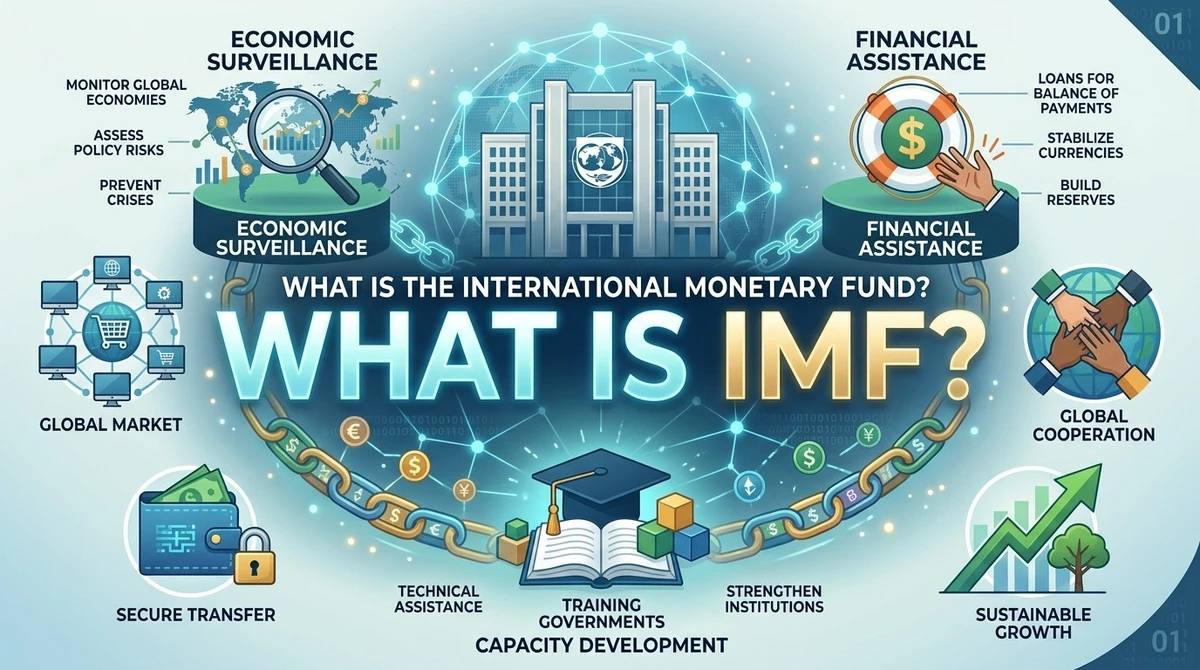
The International Monetary Fund, commonly known as the IMF, is one of the most important institutions in the global financial system. It works with countries on economic policy, provides financial assistance when they face serious external financing problems, monitors economic and financial developments, and helps governments strengthen their economic institutions.
The IMF was created in 1944 as part of the international economic system developed after the Great Depression and World War II. Today, it works with member countries on issues ranging from inflation and exchange rates to sovereign debt, financial stability, and international reserves.
But the IMF is often misunderstood. It is not a global central bank, it does not lend money directly to individuals or businesses, and it does not operate like a commercial bank.
Its work is mainly connected to governments and the stability of the international monetary system.
Understanding the IMF helps explain what happens when countries face currency shortages, debt pressures, financial crises, or major external shocks.
What Is the IMF?
The International Monetary Fund is an international organization whose member countries cooperate on monetary and financial issues.
Its core purpose is to promote international monetary cooperation and financial stability while supporting sustainable economic growth. The IMF monitors economic conditions in member countries and at the global level, provides policy advice, offers financial assistance to countries facing economic difficulties, and helps governments strengthen their economic institutions.
The IMF’s work can broadly be grouped into three areas:
- Economic surveillance and policy advice
- Financial assistance and lending
- Capacity development through technical assistance and training
These functions are connected. The IMF may identify economic vulnerabilities through surveillance, provide financing when a country faces a serious external financing problem, and help strengthen the institutions needed to implement economic reforms.
That makes the IMF more than a lending institution. It is part of the international system designed to reduce the risk that economic and financial problems become wider disruptions.
Why Was the IMF Created?
The IMF emerged from the economic instability of the first half of the 20th century.
During the Great Depression, countries adopted policies that contributed to falling international trade, currency instability, and economic fragmentation. Governments also used competitive currency devaluations and trade restrictions as they attempted to protect their domestic economies.
Against this background, representatives from 44 countries met at the Bretton Woods Conference in 1944 to create a framework for greater international economic cooperation. The IMF was one of the institutions established through that process.
The basic idea was that international monetary stability required countries to cooperate rather than manage currency and external-financing problems entirely on their own.
The world economy has changed dramatically since then, but the IMF’s underlying role remains connected to international monetary and financial stability.
The IMF Is Not a Global Central Bank
One of the easiest ways to misunderstand the IMF is to think of it as a central bank for the world.
It is not.
A national central bank, such as the Federal Reserve in the United States, manages monetary policy within its jurisdiction. It can influence interest rates, provide liquidity to financial institutions, and operate within a country’s monetary system.
The IMF does not set a single interest rate for the global economy.
Instead, it works with sovereign governments and focuses on international monetary cooperation, economic surveillance, financial assistance, and institutional capacity.
This distinction matters because the IMF generally becomes most visible when a country faces a serious economic or financial problem rather than during normal day-to-day monetary policy operations.
What Does the IMF Actually Do?
The IMF’s three main functions show how its role works in practice.
Economic Surveillance
The IMF regularly monitors the economies of its member countries.
This process is known as surveillance. IMF staff examine economic developments and policies and assess potential risks to economic and financial stability.
The IMF looks at issues such as:
- Economic growth
- Inflation
- Fiscal policy
- Monetary policy
- Exchange rates
- Financial stability
- External balances
- Debt vulnerabilities
- Risks that could spread across borders
The purpose is not simply to describe what has already happened. Surveillance is intended to identify vulnerabilities and provide policy recommendations that may help countries respond to emerging risks.
Because economies are interconnected, a problem in one major economy can affect other countries through trade, capital flows, exchange rates, commodity prices, and financial markets.
That gives IMF surveillance a global dimension.
Financial Assistance
The IMF also provides financial assistance to member countries experiencing serious economic difficulties.
A country may seek IMF support when it faces a balance-of-payments problem or lacks sufficient external financing to meet its international obligations while maintaining economic stability.
For example, a country may experience a sharp decline in foreign-exchange earnings while still needing to pay for essential imports, service external debt, or stabilize its financial system.
An IMF-supported program can provide financing while the country implements economic policies intended to restore stability and address the underlying problem.
This is an important distinction: IMF financing is generally not designed simply to fund ordinary government spending. It is connected to restoring external and macroeconomic stability.
Capacity Development
The IMF’s third major function receives less public attention but can be important over the longer term.
Through capacity development, the IMF provides technical assistance and training to government institutions, including central banks, finance ministries, tax authorities, statistical agencies, and financial-sector supervisors.
This work can help countries improve:
- Tax administration
- Public financial management
- Monetary and exchange-rate frameworks
- Financial regulation
- Economic statistics
- Debt management
- Institutional governance
Economic policy depends partly on institutional capacity. A government may know that it needs stronger tax collection, better economic statistics, or more effective financial supervision, but implementing those changes requires people, systems, technology, and institutions.
Capacity development addresses that part of the problem.
What Is an IMF Program?
When people hear that a country has entered an “IMF program,” they are usually referring to an arrangement under which the IMF provides financial assistance in exchange for an agreed economic program.
The details vary depending on the country’s circumstances and the IMF facility involved.
An IMF-supported program can include policy measures involving areas such as:
- Government finances
- Monetary policy
- Exchange-rate policy
- Financial-sector stability
- State-owned enterprises
- Revenue collection
- Public-sector management
- Debt sustainability
The exact conditions depend on the program.
This is why an IMF program should not be understood as a single fixed package that every country receives. Countries enter different arrangements based on their economic circumstances, financing needs, and policy objectives.
Why Does IMF Lending Come With Conditions?
IMF lending generally comes with policy conditions because the Fund needs a credible path toward restoring economic stability.
If a country has a large external financing gap, simply providing money without addressing the causes of that gap may not solve the underlying problem.
For example, imagine a country consistently spends more foreign currency than it earns through exports, services, investment inflows, and other external sources.
Additional financing can provide temporary relief. But if the underlying imbalance remains, the country could face another crisis once that financing is exhausted.
An IMF program therefore typically combines financing with policy measures intended to improve the country’s economic position.
Those measures can involve difficult choices. A government may need to reduce a fiscal deficit, strengthen tax collection, reform subsidies, restructure state-owned enterprises, or address weaknesses in the financial system.
The economic effects can also differ across households, businesses, and sectors.
That is why IMF programs can become the subject of significant public debate. The central question is not simply whether reforms are required, but how they are designed, implemented, and distributed across the economy.
What Are IMF Quotas?
IMF quotas are central to how the institution is financed and governed.
Each IMF member is assigned a quota that broadly reflects its position in the world economy. Quotas are denominated in Special Drawing Rights, or SDRs.
A country’s quota has several functions. It helps determine how much financial resources the country contributes to the IMF, its voting power, its access to IMF financing under normal arrangements, and its share in general SDR allocations.
This means the IMF is not funded like a normal commercial lender.
Member countries provide the institution with resources, primarily through quotas, while additional resources can come from borrowing arrangements.
The quota system therefore connects the IMF’s financial capacity with its governance structure.
Why Do Quotas Matter?
Quotas matter because they influence both financial contributions and decision-making.
A country’s economic size and position in the global economy are important factors in determining its quota, although the quota formula incorporates several economic variables.
Quotas also affect voting power.
The IMF’s highest decision-making body is the Board of Governors, with one governor and one alternate governor representing each member country. The Executive Board handles much of the institution’s day-to-day work.
This creates an important connection between economic weight and institutional influence.
It also explains why IMF quota reforms can become significant international policy issues. As the global economy changes, countries can debate whether the distribution of quotas and voting power adequately reflects the current structure of the world economy.
What Are Special Drawing Rights?
The IMF also plays an important role through Special Drawing Rights, commonly called SDRs.
An SDR is an international reserve asset created by the IMF. It is not a currency.
Its value is based on a basket of five currencies:
- U.S. dollar
- Euro
- Chinese renminbi
- Japanese yen
- British pound sterling
IMF members can use SDRs as part of their official reserves and exchange them for currencies through transactions between members.
The SDR therefore provides another layer of international liquidity.
The most recent general SDR allocation occurred in 2021, when the IMF approved an allocation of about SDR 456 billion, equivalent at the time to around $650 billion. The allocation was designed to increase global liquidity and strengthen countries’ reserve positions during the pandemic.
SDRs are particularly important because they show that the IMF’s role extends beyond traditional lending.
IMF Lending and Foreign Exchange Reserves
To understand why IMF financing matters, it helps to look at the relationship between foreign-exchange reserves and external payments.
Countries need foreign currencies to pay for imports, service external obligations, and conduct international transactions.
If a country experiences a sudden shortage of foreign currency, its economy can come under severe pressure.
For example, a country that depends heavily on imported fuel may struggle if its foreign-exchange reserves fall sharply while global energy prices rise.
The government may then face difficult choices:
- Reduce imports
- Allow the currency to depreciate
- Raise interest rates
- Seek bilateral financing
- Seek support from international institutions
- Introduce fiscal or monetary adjustments
IMF financing can provide additional external resources while broader policies address the underlying imbalance.
This is one of the main reasons the IMF becomes important during balance-of-payments crises.
For a broader explanation of how currencies affect trade, inflation, investment, and businesses, see Economic Reader’s How Currency Exchange Rates Work.
How the IMF Influences the Global Economy
The IMF’s influence extends beyond countries that borrow from it.
Its research, forecasts, surveillance, and policy analysis contribute to how governments, investors, businesses, and international organizations understand global economic risks.
The IMF publishes major reports covering areas such as:
- Global economic growth
- Inflation
- Fiscal policy
- Financial stability
- Regional economic conditions
- External imbalances
- Sovereign debt
Its global surveillance also examines how policies in one country can create spillovers for others.
For example, a major change in monetary or fiscal policy in a large economy can affect global capital flows, exchange rates, commodity prices, and financing conditions.
The IMF’s role is partly to analyze these connections and assess where vulnerabilities may emerge.
This wider network of connections is also why international trade matters. Economic Reader’s How Does International Trade Work? explains how trade connects businesses, financial institutions, governments, and consumers across borders.
The IMF and Sovereign Debt
Sovereign debt is another major area where the IMF becomes important.
Governments borrow for many reasons, including infrastructure, public services, economic stabilization, and responses to emergencies.
Debt itself is not necessarily a problem.
The issue is whether a country can continue servicing its debt without creating unsustainable economic or financial pressures.
If debt-service costs become too large relative to government revenue and foreign-exchange earnings, a country may face increasing difficulty accessing international financing.
In severe cases, IMF support can become part of a broader debt-restructuring and stabilization process.
The IMF therefore often operates at the intersection of sovereign debt, fiscal policy, exchange rates, and external financing.
IMF vs. World Bank: What Is the Difference?
The IMF and World Bank are often mentioned together, but they have different core roles.
The IMF is primarily focused on international monetary and financial stability, macroeconomic policy, balance-of-payments problems, and related institutional capacity.
The World Bank is primarily focused on long-term development and poverty reduction, including projects and programs involving infrastructure, health, education, institutions, and economic development.
The distinction is not absolute because both institutions work across a wide range of economic issues and may cooperate on country programs.
But their central purposes are different.
A useful way to think about the distinction is:
IMF → macroeconomic and financial stability
World Bank → long-term development and poverty reduction
Understanding that difference helps explain why countries may work with both institutions at the same time.
How Much Influence Does the IMF Have Over Countries?
The IMF does not govern countries or replace their governments.
Member governments remain responsible for their own economic policies.
However, IMF financing can create significant policy constraints because financial assistance is generally linked to agreed policy commitments and program reviews.
A government seeking IMF assistance may agree to policy changes because it needs financing and wants to restore economic stability.
This creates an important relationship between national policy choices and international financing.
The IMF’s influence therefore comes primarily through its financial relationship with member countries, its policy advice, surveillance, and the conditions attached to financial assistance.
Whether particular conditions are appropriate, how quickly reforms should occur, and how the costs of adjustment should be distributed can remain subjects of debate.
Why IMF Programs Can Be Economically Difficult
Economic stabilization often involves trade-offs.
A country facing a large fiscal deficit, high inflation, falling reserves, or unsustainable debt may need to make difficult adjustments.
For example, reducing government spending can improve public finances but may also weaken demand in the short term.
Increasing taxes can raise government revenue but may place additional pressure on households or businesses.
Removing broad subsidies can improve fiscal sustainability while simultaneously increasing the prices faced by consumers.
Currency adjustment can improve external competitiveness but can also raise the domestic cost of imports.
These trade-offs explain why IMF programs need to be considered in the context of the country’s starting conditions, policy objectives, implementation capacity, and social effects.
The same policy can have very different consequences depending on whether an economy is experiencing high inflation, a currency shortage, weak growth, a banking crisis, or a combination of several problems.
The IMF in a Connected Global Economy
The IMF exists partly because economic problems rarely remain completely inside national borders.
A banking crisis can affect capital flows.
A currency crisis can affect imports and inflation.
A sovereign debt crisis can affect international lenders.
A major recession can reduce demand for exports in other countries.
A sharp change in global interest rates can alter financing conditions for emerging markets.
A commodity shock can affect inflation and current-account balances around the world.
These connections explain why the IMF’s work extends beyond individual countries.
Its surveillance attempts to identify risks. Its lending provides financing when countries face serious external pressure. Its capacity development helps strengthen institutions. Its research analyzes how economic developments spread across countries.
Together, these functions make the IMF part of the infrastructure of the global economy.
Why the IMF Matters to Ordinary People
The IMF may seem distant from everyday life, but its work can eventually affect households.
When a country experiences a financial crisis, the consequences can include:
- Higher inflation
- Currency depreciation
- More expensive imports
- Higher interest rates
- Reduced government spending
- Changes in taxes
- Lower economic growth
- Changes in employment conditions
If an IMF-supported program is part of the country’s response, some of the associated policies can therefore affect household finances.
The connection is indirect but important.
The IMF does not set the price of groceries or determine an individual’s salary. But the economic conditions that lead a government to seek IMF support can influence inflation, employment, interest rates, exchange rates, and public finances.
For a wider explanation of how countries, businesses, financial markets, and households are connected, see Economic Reader’s How Does the Global Economy Work?
The IMF’s Role Is Broader Than Emergency Lending
Looking only at IMF loans misses much of the institution’s role.
Its activities form a connected system:
Surveillance → identifies economic vulnerabilities
Policy advice → assesses possible responses
Financial assistance → provides resources when financing pressures become severe
Capacity development → strengthens institutions and policy implementation
SDRs → provide an international reserve asset
These functions address different parts of the same problem: how countries can maintain economic and financial stability in an interconnected international system.
A country may interact with the IMF through regular surveillance without ever borrowing from it. Another may require financial assistance after a sudden external shock. A third may work with the IMF mainly on strengthening tax administration, financial regulation, statistics, or other institutions.
The IMF’s role therefore differs from country to country.
The IMF Is Part of the Global Financial System
The International Monetary Fund is one of the central institutions of the international monetary system.
Its role extends well beyond providing loans. The IMF monitors economies, advises governments, provides financial assistance, develops economic institutions, manages the SDR system, and analyzes risks that can spread across borders.
Its importance becomes especially visible when countries face currency shortages, balance-of-payments problems, debt pressures, financial instability, or major external shocks.
For anyone trying to understand the global economy, the IMF is therefore an important institution to follow. Its reports and programs can provide insight into economic vulnerabilities, policy changes, financing conditions, and the pressures facing countries around the world.
The IMF does not control the global economy, nor does it operate like a global central bank. Its role is more specific: it provides a framework through which countries cooperate on monetary and financial stability while offering financing, policy analysis, and institutional support when economic conditions become difficult.