Why Is the WTO Struggling Today? Challenges Facing Global Trade
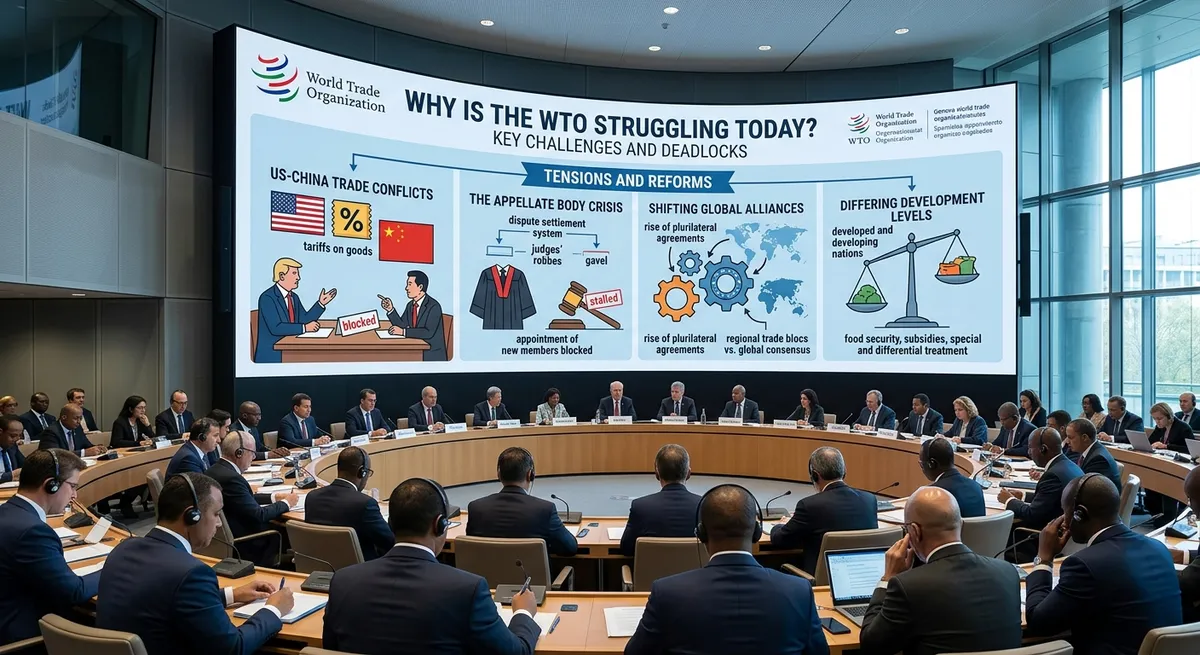
Why Is the WTO Struggling Today?
The World Trade Organization is facing one of the most difficult periods in its history.
That does not mean global trade has stopped working. Goods continue to cross borders, companies continue to build international supply chains, and services increasingly move across countries through digital networks.
The problem is more fundamental: the global economy has changed faster than the rules and institutions created to govern it.
The WTO’s 2026 Annual Report describes a trading system under pressure from rapid technological change, geopolitical tensions, higher trade-policy uncertainty and shifting patterns of global commerce. At the same time, the organization remains central to the trading system: its 166 members account for about 98% of world trade, while roughly 72% of global goods trade continues to take place under core most-favored-nation terms. (World Trade Organization)
That creates an important distinction.
The WTO is not simply failing, nor is the rules-based trading system disappearing. Instead, the organization is struggling to adapt an existing framework to a world in which trade is increasingly connected to industrial policy, national security, technology, climate policy and geopolitical competition.
Understanding that tension is essential to understanding the future of global trade.
The World Economy Has Changed Faster Than the Trade Rules
The WTO was established in 1995, when international commerce looked very different from today’s economy.
Global supply chains were already developing, but they were not nearly as extensive. Digital services were much smaller. Artificial intelligence did not exist as a major commercial force. China had not yet reached its current position in global manufacturing and trade, and national-security concerns over semiconductors and critical minerals were not central to most trade-policy debates.
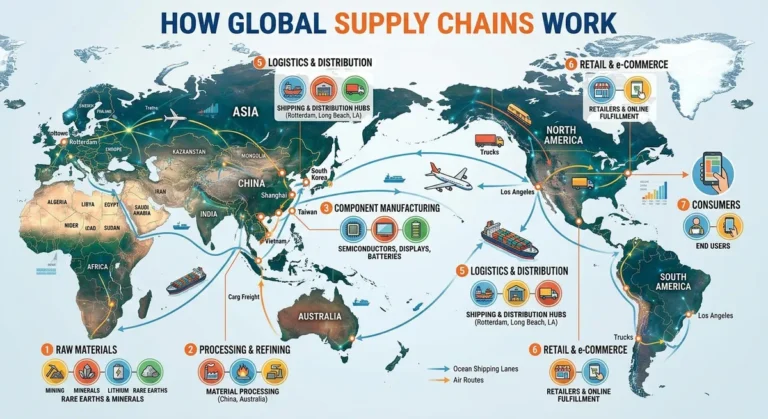
Today, a single product can involve raw materials from one country, components from several others, software developed somewhere else and final assembly in another economy.
Economic Reader’s How Does International Trade Work? explains how these networks connect producers, suppliers, governments and consumers across borders.
The WTO now has to operate within that much more complicated system.
The organization’s latest analysis identifies several structural changes putting pressure on rules created in an earlier era: the shift in global economic power, greater government intervention, increasingly complex global value chains, digitalization and artificial intelligence, environmental challenges and geopolitical tensions. (World Trade Organization)
The challenge is therefore not simply that countries have become less interested in trade.
It is that trade itself has become more complicated.
Economic Power Is More Widely Distributed
One of the biggest changes is the shift in where global economic activity takes place.
Low- and middle-income economies accounted for about 45% of global merchandise trade in 2024, compared with 23% in 1995. That represents a major change in the balance of the world economy. (World Trade Organization)
Emerging economies now have far greater influence over global production, commodities, manufacturing and trade flows.
That is a positive development in many respects. More economies are participating in international commerce and gaining access to global markets.
But it also makes international negotiations harder.
A wealthy industrial economy may argue that a large emerging economy should accept stronger disciplines on subsidies or market access because its economic weight has increased.
The emerging economy may respond that it still needs room to develop domestic industries and raise productivity.
Neither position can be dismissed as purely unreasonable.
The difficulty is finding rules that accommodate very different economic circumstances without allowing governments to use development policy as a justification for permanently distorting competition.
That is one reason WTO negotiations have become more politically difficult.
Trade Policy Is No Longer Just About Lower Tariffs
For much of the globalization era, the broad direction of trade policy was toward reducing tariffs and other barriers.
That objective still matters, but governments increasingly have additional priorities.
They want to protect strategic industries, strengthen domestic manufacturing, secure critical supplies, reduce dependence on geopolitical rivals and encourage investment in technologies they consider essential to future economic competitiveness.
As a result, trade policy is increasingly being used as an instrument of industrial policy and economic security.
Tariffs are one example.
Subsidies are another.
Export controls and investment restrictions are others.
This creates a difficult problem for the WTO because many of these policies can serve legitimate domestic objectives while also affecting foreign competitors.
A government may believe it is protecting economic resilience.
Its trading partner may see the same policy as protectionism.
The disagreement is no longer simply about whether a tariff is too high.
It is about how much freedom governments should have to intervene in markets while remaining inside a rules-based trading system.
Tariffs Have Returned to the Center of Global Trade
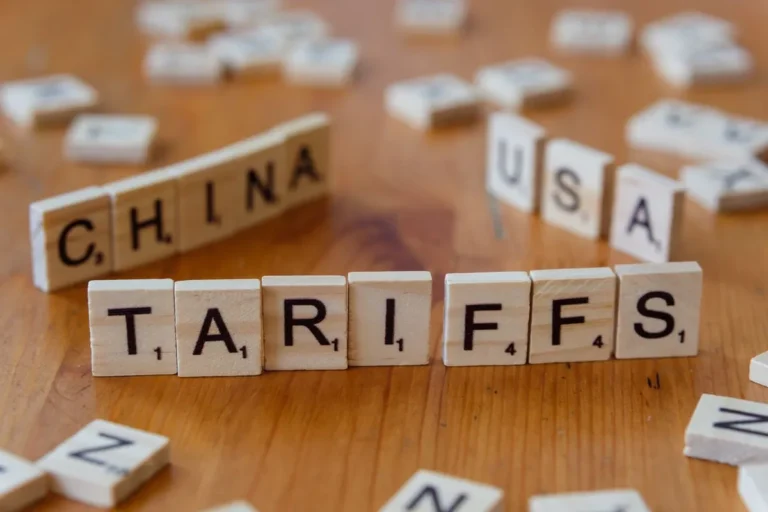
The renewed use of tariffs has made that conflict particularly visible.
Countries have increasingly used tariffs to protect domestic industries, address trade imbalances, respond to foreign policies and create leverage in negotiations.
From a government’s perspective, a tariff may encourage companies to produce more domestically.
But tariffs can also increase costs for businesses that depend on imported inputs.
Those businesses may then raise prices, reduce margins, change suppliers or move production.
The effects can therefore spread well beyond the product directly targeted by the tariff.
This is one reason modern tariff policy cannot be evaluated only by looking at the customs duty itself.
It has to be considered alongside supply chains, investment, inflation and competitiveness.
For the WTO, the return of tariffs creates a broader institutional problem: countries are increasingly pursuing national economic objectives through trade measures at precisely the time when the global economy needs predictable international rules.
Industrial Policy Is Creating a Difficult Balancing Act
Government support for strategic industries has also become much more important.
Semiconductors, electric vehicles, batteries, artificial intelligence infrastructure, renewable energy and critical minerals are all areas where governments increasingly want domestic production capacity.
There is a reasonable economic argument behind this.
A country may decide that losing an entire strategic industry creates risks that are greater than the cost of supporting domestic production.
But industrial policy can create international spillovers.
If one government provides large subsidies to domestic producers, those companies may gain an advantage over foreign competitors.
Other countries may respond with their own subsidies or trade restrictions.
The result can be a cycle of government intervention.
This puts the WTO in a difficult position.
It needs to discourage policies that unfairly distort international competition without preventing governments from pursuing legitimate development, environmental or national-security objectives.
That is not an easy line to draw.
National Security Is Changing the Meaning of Trade
Perhaps the most difficult change is the growing connection between trade and national security.
Governments increasingly worry about dependence on foreign suppliers for products such as:
- Advanced semiconductors
- Artificial-intelligence technologies
- Critical minerals
- Telecommunications equipment
- Energy technologies
- Defense-related goods
In the past, economic efficiency was often the dominant consideration when companies decided where to source products.
Now governments are increasingly asking a different question:
What happens if an important supply suddenly becomes unavailable because of a geopolitical conflict?
That has changed the meaning of supply-chain resilience.
A company may once have chosen the cheapest supplier.
Today it may accept a higher cost to diversify suppliers or produce strategically important goods closer to home.
The result can be greater resilience, but also higher costs.
For the WTO, the problem is that national-security arguments are difficult to separate from economic policy.
One country may consider a trade restriction necessary for security.
Another may argue that the same restriction is simply protectionism.
The boundary between trade policy and security policy has therefore become increasingly difficult to define.
Technology Is Moving Faster Than the Rules
Digitalization presents another major challenge.
International trade is no longer limited to physical goods crossing borders.
Software, cloud services, digital platforms, financial services and other forms of intangible commerce can reach customers around the world almost instantly.
Artificial intelligence is accelerating that transformation.
AI can change how services are produced, how businesses interact with customers and how companies organize international operations.
But many of the trade rules that govern today’s economy were designed before these technologies became economically significant.
That creates questions around cross-border data flows, digital services, technology standards, AI-related commerce and intellectual property.
The WTO’s latest analysis identifies digitalization and AI as major forces reshaping international trade. (World Trade Organization)
The difficulty is that technology does not wait for governments to finish negotiating.
Businesses adopt new technologies first.
International rules often come later.
That creates a growing gap between economic reality and the regulatory framework.
Environmental Policy Creates Another Trade Off
Climate policy is creating a similar challenge.
Governments increasingly want to reduce emissions and accelerate investment in cleaner technologies.
That can involve environmental standards, carbon-related trade measures and subsidies for green industries.
These policies can have legitimate environmental objectives.
But they can also affect international competition.
If producers in different countries face different environmental costs, governments may worry that domestic companies are placed at a disadvantage.
At the same time, trading partners may object if environmental rules effectively discriminate against their exports.
The WTO therefore faces a difficult question:
How can countries pursue climate goals without turning environmental policy into another source of trade fragmentation?
The answer will become increasingly important as governments combine climate policy with industrial strategies.
The Dispute Settlement System Has Lost Some of Its Strength
A rules-based system needs a credible way to resolve disputes.
This is another area where the WTO has faced prolonged institutional pressure.
The organization’s Appellate Body has been unable to operate normally because of the long-running dispute over appointments.
WTO dispute settlement itself has not disappeared, but the weakness at the appellate stage has reduced confidence in the system’s ability to provide a complete and final resolution of disputes.
That matters because enforcement is part of what makes international rules meaningful.
If governments believe that disputes can be resolved predictably, they have stronger incentives to use common institutions.
If they believe the system cannot provide an effective final outcome, unilateral action can become more attractive.
That creates a potentially damaging cycle:
Weaker enforcement → more unilateral action → more trade disputes → greater pressure on the system.
Rebuilding confidence in dispute settlement is therefore more than a technical institutional reform. It is central to the credibility of the rules-based trading system.
Developing Countries Face a Different Challenge
The WTO’s difficulties also have different consequences for economies of different sizes.
For developing countries, international trade can provide access to larger markets, investment, technology and employment.
But smaller economies can struggle when trade becomes more complicated.
The WTO’s 2026 analysis notes that least-developed countries still account for less than 1% of world trade. It also points to the relatively high trade costs faced by poorer economies. (World Trade Organization)
That makes predictability particularly important.
Large multinational companies can often absorb the cost of new customs procedures, certification requirements or changing trade rules.
Smaller exporters may not have the same resources.
If the global trading system becomes increasingly fragmented, smaller economies may therefore face a disadvantage even when they are not directly involved in geopolitical disputes.
This is an important reason why WTO reform is not simply about improving negotiations between major powers.
It is also about keeping global markets accessible to economies with less bargaining power.
The Gains From Trade Have Not Been Evenly Shared
There is another pressure on the trading system that comes from inside countries themselves.
International trade can generate large overall economic benefits, but those benefits do not automatically reach every worker, company or region equally.
Consumers may benefit from lower prices.
Exporting industries may gain access to larger markets.
Businesses can become more productive through international specialization.
But workers in industries facing intense import competition may experience job losses or weaker wage growth.
The WTO’s 2026 analysis recognizes that the gains from trade have been unevenly distributed across workers, firms and regions. (World Trade Organization)
That matters politically.
When communities believe that globalization has benefited other regions more than their own, support for open trade can weaken.
This means the future of the WTO cannot be separated entirely from domestic economic policy.
Trade rules can create opportunities, but governments also need policies that help workers and regions adjust when the structure of the economy changes.
Globalization Is Changing Rather Than Simply Ending
These pressures have led to frequent claims that globalization is reversing.
That is too simple.
International trade remains enormous, and global supply chains have not disappeared.
Instead, companies and governments are placing greater weight on resilience alongside efficiency.
A business may still source internationally but avoid relying on a single supplier.
A manufacturer may maintain production in multiple countries rather than concentrating everything in the lowest-cost location.
A government may accept some additional cost in exchange for greater control over strategically important production.
Economic Reader’s What Is Globalization? provides broader context on how trade, investment, technology and supply chains have integrated national economies.
The emerging model is therefore better described as more cautious globalization, rather than the end of globalization.
That shift creates a new challenge for the WTO because its rules must operate in a world where efficiency is no longer the only objective.
Fragmentation Could Make Global Trade More Expensive
When multilateral negotiations become difficult, countries naturally look for alternatives.
They may negotiate bilateral agreements, regional trade deals or sector-specific arrangements.
These agreements can be useful.
They allow countries to move faster and address specific economic relationships.
But there is a cost to excessive fragmentation.
Businesses may face different rules of origin, tariff schedules, product standards and documentation requirements depending on the market they serve.
Large corporations may be able to manage that complexity.
Smaller businesses may struggle.
More fragmented trade can also encourage companies to duplicate production facilities simply to avoid geopolitical or regulatory risks.
That can make supply chains more resilient, but it can also make them more expensive.
This is one reason the WTO still has value even as regional and bilateral agreements expand.
A common multilateral framework can reduce the complexity created by multiple overlapping arrangements.
Why WTO Reform Is So Difficult
The central problem is that countries broadly agree that the system needs improvement, but they disagree about what that improvement should look like.
A country facing subsidized imports may want stronger rules on industrial subsidies.
A developing economy may want more freedom to support domestic industries.
One government may want stronger limits on protectionism.
Another may argue that national security requires greater freedom to restrict trade.
One economy may prioritize rapid environmental action.
Another may worry about the competitiveness costs of new environmental requirements.
These disagreements make comprehensive reform extremely difficult.
The WTO’s 14th Ministerial Conference in Cameroon in March 2026 produced decisions on areas including fisheries subsidies, small economies and special and differential treatment for developing economies. Members also continued discussions on WTO reform and e-commerce. (World Trade Organization)
That outcome captures the WTO’s current position quite well.
The institution can still make progress, but the most important reforms are also the hardest to negotiate.
What Would a Stronger WTO Need to Do?
WTO reform does not necessarily mean rebuilding the entire organization.
A more realistic goal would be to make the existing system better suited to today’s economy.
That means addressing several areas.
Modernize trade rules. The framework needs to better reflect digital services, AI, global supply chains and environmental policy.
Restore confidence in dispute settlement. Members need a credible mechanism for resolving disagreements.
Clarify industrial-policy rules. Governments need room to support legitimate strategic objectives without creating unlimited opportunities for trade-distorting subsidies.
Improve development opportunities. Smaller and poorer economies need practical access to global markets rather than a system that becomes increasingly difficult to navigate.
Increase transparency. Businesses and governments need better information about tariffs, subsidies, restrictions and other policy changes.
Set clearer boundaries around national security. Genuine security concerns need to be recognized without allowing national-security arguments to become an unrestricted justification for protectionism.
The objective should not be to return to the trade environment of the 1990s.
It should be to make rules-based trade work for the economy of the 2020s and beyond.
What Happens If the WTO Cannot Adapt?
The most likely outcome would not be the disappearance of international trade.
Businesses would continue trading.
Countries would continue importing and exporting.
Companies would continue operating international supply chains.
The bigger risk is that trade becomes less predictable, more expensive and more dependent on economic power.
That could mean more tariffs, more retaliation, more complex agreements, higher compliance costs and greater uncertainty for investment.
Smaller economies could be particularly vulnerable because they have less bargaining power than major trading nations.
The WTO’s latest analysis warns that greater fragmentation can carry significant economic costs and that smaller economies may be particularly exposed when trade becomes divided into competing blocs. (World Trade Organization)
For businesses, that uncertainty matters.
A company deciding where to build a factory or source a critical component is not making a decision only about today’s costs.
It is also making a bet on what trade rules will look like several years from now.
Predictable rules therefore have economic value even when they do not directly reduce tariffs.
The Bigger Economic Question
The WTO’s struggle is ultimately a reflection of a much larger transformation in the global economy.
For decades, international trade policy was heavily influenced by the idea that greater economic integration and lower trade barriers would create broader prosperity.
That approach generated enormous gains.
The WTO’s latest World Trade Report notes that the rules-based trading system helped support an almost 50-fold expansion in global trade over the postwar period while contributing to greater economic integration and development. (World Trade Organization)
But the success of that system also changed the environment in which it operates.
Trade became more important to domestic economies.
Supply chains became more interconnected.
Economic power shifted toward emerging markets.
Technology transformed commerce.
Governments became more concerned about strategic dependence.
And geopolitical competition became increasingly connected to economic policy.
The WTO now has to manage all of those developments at once.
That is why saying the WTO is simply “failing” misses the real issue.
The institution remains important.
The problem is that the world it was designed to govern has changed.
The WTO Still Matters But It Cannot Stay the Same
The strongest evidence that the WTO remains relevant is that countries continue to use it.
Its 166 members account for about 98% of world trade, and around 72% of global goods trade still takes place under core MFN tariff terms. The organization also continues to provide a forum where large and small economies can negotiate, exchange information and address trade concerns. (World Trade Organization)
The challenge is that its importance has not disappeared while its operating environment has become much harder.
That leaves the WTO in an unusual position.
It remains too important to ignore, but the old model cannot simply be preserved unchanged.
The future of the organization will depend on whether its members can find practical compromises around issues that increasingly sit outside traditional tariff negotiations: industrial policy, national security, digital commerce, environmental measures, supply-chain resilience and geopolitical competition.
That will not be easy.
But the alternative is not a world without global trade.
It is a world where trade rules become increasingly fragmented, negotiated through economic power and shaped by unilateral decisions.
That could leave businesses facing greater uncertainty and consumers ultimately bearing some of the cost.
The real challenge for the WTO is therefore not to preserve the past. It is to build a rules-based trading system that reflects the economy the world has already become.