What Is SWIFT? Understanding SWIFT Codes and How to Read Them
When you send money internationally, your bank may ask for a SWIFT code. At first glance, it can look like a random combination of letters and numbers. In reality, the structure is standardized.
A SWIFT code is commonly used to identify a financial institution in an international payment. Technically, the standardized identifier is called a Business Identifier Code (BIC) under ISO 9362. SWIFT acts as the BIC registration authority and operates the financial messaging infrastructure that many banks use to communicate about cross-border transactions. (Swift)
That distinction matters because a SWIFT/BIC is not the same thing as a bank account number or an IBAN. The BIC identifies the business party, while other payment information identifies the specific customer account.
The easiest way to understand SWIFT is to break the code apart and see what each section actually represents.
What Is SWIFT?
SWIFT was originally named the Society for Worldwide Interbank Financial Telecommunication. Today, it is a cooperative financial infrastructure that banks, financial institutions, and other eligible organizations use to communicate securely about cross-border financial transactions. (Swift)
One common misunderstanding is that SWIFT itself transfers your money.
It generally does not.
Instead, SWIFT provides messaging and standards that allow financial institutions to communicate payment instructions and other financial information. In a simplified international payment, the sender’s bank sends a message through the SWIFT network to the recipient bank. The recipient bank then processes the payment and credits the beneficiary’s account, subject to its own procedures, local regulations, compliance checks, and other factors. (Swift)
This makes SWIFT easier to understand as financial communication and identification infrastructure, rather than as a bank or a conventional money-transfer company.
That infrastructure sits inside the wider banking system. Economic Reader’s guide to How Do Banks Work? explains the payment, lending, liquidity, and settlement relationships that sit behind ordinary banking transactions.
What Is a SWIFT Code?
A SWIFT code is the common name used for a BIC.
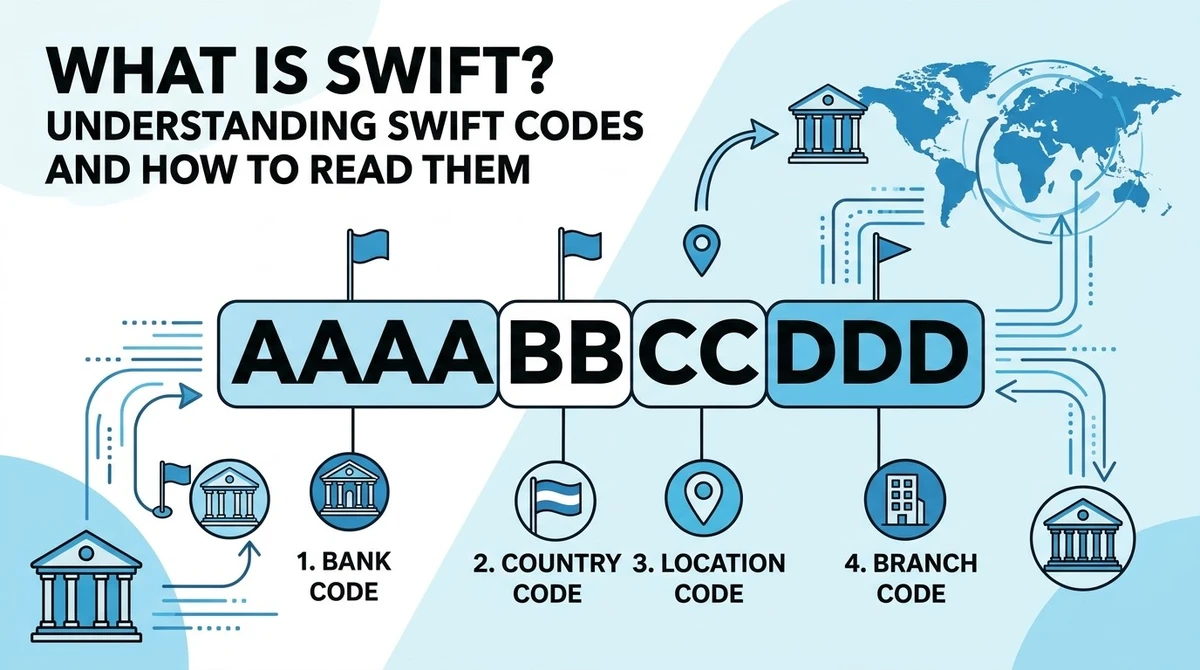
Under ISO 9362, a BIC contains 8 characters, with an optional additional 3-character branch identifier. This means a BIC can appear as either an 8-character or 11-character code.
The basic structure is:
AAAA BB CC DDD
Where:
- AAAA = business party prefix
- BB = country code
- CC = business party suffix
- DDD = optional branch identifier
The first eight characters identify the business party. The final three characters, when used, identify a particular organizational unit such as a location, department, service, or other branch of that business party.
This current terminology is slightly different from older explanations that described the third section as a “location code.” Older SWIFT materials did use that terminology, but the revised BIC standard defines the two-character section as the business party suffix.
That distinction is worth knowing if you want to understand the code accurately rather than simply memorize a formula.
How to Read an 8 Character SWIFT Code
Consider this fictional example:
ABCDUS33
This example is only for explaining the structure. It does not represent a real bank.
Break it into three parts:
ABCD | US | 33
1. First Four Characters: Business Party Prefix
The first four characters are the business party prefix.
They identify the business party together with the country code and business party suffix that follow.
For example:
ABCD → business party prefix
Under SWIFT’s implementation of the BIC standard, this four-character prefix is alphabetic. The broader ISO structure allows an alphanumeric definition, while SWIFT’s implementation is more restrictive. (Swift)
For readers, the important point is simple: the first four characters are part of the institution’s standardized identifier.
They are assigned within the BIC registration system rather than being something customers create themselves.
2. Characters Five and Six: Country Code
The next two characters identify the country.
In:
ABCDUS33
the country code is:
US
The country code follows ISO 3166-1, the international country-code standard referenced by the BIC specification.
This is usually the easiest section to recognize.
For example:
- US = United States
- GB = United Kingdom
- DE = Germany
The code refers to the country associated with the identified business party. It does not tell you where the person sending the money lives.
3. Characters Seven and Eight: Business Party Suffix
The next two characters form the business party suffix.
In:
ABCDUS33
the suffix is:
33
The prefix, country code, and suffix work together to identify the business party within the relevant country.
This is the part where older explanations can cause confusion. You may still see the seventh and eighth characters described online as a “location code.” That terminology comes from earlier versions of the BIC explanation. The current structure defines them as the business party suffix. (Swift)
So if you are writing or researching SWIFT codes today, business party suffix is the more accurate current terminology.
What Does an 11 Character SWIFT Code Mean?
An 11-character BIC adds three characters to the basic eight-character identifier.
For example:
ABCDUS33XXX
The structure becomes:
ABCD | US | 33 | XXX
The first eight characters identify the business party.
The final three characters are the branch identifier.
SWIFT says this optional identifier can be used for a specific location, department, service, or organizational unit of the same business party.
This explains why you may encounter both eight-character and eleven-character versions of what appears to be the same bank identifier.
The last three characters do not automatically mean “physical branch.” They can represent a wider organizational unit.
Why Do SWIFT Codes Matter for International Payments?
Cross-border payments involve more than simply sending money from one account to another.
A bank in one country needs a standardized way to identify the financial institution on the other side of the transaction. The BIC provides that standardized identifier.
A simplified payment flow looks like this:
Sender → Sending Bank → Financial Messaging → Recipient Bank → Beneficiary
A transaction may also involve one or more correspondent banks or other financial institutions.
SWIFT describes its network as a way for banks and other financial institutions to communicate securely about cross-border transactions. It says its network connects more than 11,500 members and supports more than 40,000 possible payment routes. (Swift)
This is where the SWIFT code becomes useful. It provides standardized identification within a financial system that crosses national borders.
International trade depends on similar financial infrastructure. When companies import goods, pay overseas suppliers, or receive money from foreign customers, the physical movement of products and the financial movement of money have to work together. Economic Reader’s How Does International Trade Work? looks at the broader system connecting trade, payments, logistics, and businesses.
SWIFT Code vs. Account Number
A SWIFT/BIC and a bank account number serve different purposes.
A SWIFT/BIC identifies the financial institution or business party.
An account number identifies the customer’s account within that institution.
For example, an international payment may require:
- Beneficiary name
- Beneficiary account number
- Bank name
- SWIFT/BIC
- IBAN, where applicable
- Payment reference
- Other information required by the banks involved
This is why having the correct SWIFT code does not automatically provide everything needed to complete an international transfer.
The BIC answers one important question:
Which financial institution or business party is involved?
It does not answer:
Which customer’s account should receive the money?
That requires additional payment information.
SWIFT Code vs. IBAN
SWIFT/BIC and IBAN are also commonly confused.
They are not interchangeable.
SWIFT/BIC: identifies a financial institution or business party.
IBAN: identifies a particular bank account using an internationally standardized account-number structure in countries that use IBAN.
A simplified way to remember the difference is:
BIC → Which institution?
IBAN → Which account?
An international payment may use both.
However, not every country uses IBAN, so the information required for an international transfer depends on the countries and banks involved.
Does Every Bank Have Only One SWIFT Code?
Not necessarily.
A business party can have additional BICs, and an 11-character BIC can include an optional branch identifier for a particular organizational unit. SWIFT’s own BIC services distinguish between 8-character BICs and branch identifiers used for 11-character BICs.
That means you should not assume that a SWIFT code found in an old transaction is automatically the correct identifier for a new payment.
The safest approach is to obtain the payment instructions directly from the recipient’s bank or another reliable banking source.
How to Check Whether a SWIFT Code Is Correct
Understanding the structure of a BIC is useful, but decoding a code is not the same as validating it.
A code may have the correct number of characters and still be the wrong identifier for your particular payment.
SWIFT maintains BIC registration and reference data, including information such as the legal name, registered address, status, publication date, and update information associated with a BIC record. SWIFT also states that BIC owners are responsible for keeping their information accurate.
SWIFT provides a BIC Directory for looking up BIC information.
Before sending an international payment, it is sensible to verify:
- The exact SWIFT/BIC supplied by the receiving bank.
- The beneficiary’s name and account details.
- Whether an IBAN is required.
- Whether a correspondent or intermediary bank is involved.
- The currency being sent.
- Any additional information requested by the sending bank.
For large or important transfers, relying on a code copied from an old invoice, search result, or third-party website can create unnecessary risk.
What a SWIFT Code Does Not Tell You
A SWIFT code contains useful identification information, but it does not tell you everything about a payment.
It does not tell you:
- The beneficiary’s account balance
- The amount being transferred
- The exchange rate
- The transfer fee
- Whether the beneficiary has received the funds
- Whether the payment has passed compliance checks
- How long the entire transaction will take
This last point is particularly important.
SWIFT says that 90% of payments sent over its network reach the end bank within an hour, but fraud checks, compliance procedures, local regulations, and other processes can delay when the money becomes available to the final customer. (Swift)
So a fast financial message does not necessarily mean an instant bank transfer.
The messaging stage and the final availability of funds are related, but they are not the same process.
Why the Structure of a SWIFT Code Matters
A SWIFT/BIC code may look like a small technical detail on an international payment form, but it represents a much larger piece of financial infrastructure.
The structure is designed around a simple identification problem:
Business party → Country → Business party suffix → Optional branch
That standardized format allows financial institutions in different countries to identify organizations consistently.
It also explains why a SWIFT code should not be treated as a random collection of characters.
The code has a defined architecture, and that architecture reflects the way international financial institutions are identified.
SWIFT Is More Than a Code
The biggest misconception about SWIFT is that the word refers only to a code.
It actually helps to separate three related ideas:
SWIFT is the financial messaging organization and network.
BIC is the standardized business identifier defined under ISO 9362.
SWIFT code is the common term people often use when referring to a BIC in international banking.
The BIC itself is not limited to identifying banks either. The standard applies to financial and non-financial organizations that require an international identifier.
That distinction makes the system easier to understand.
The Real Role of a SWIFT Code
A SWIFT/BIC code is essentially a standardized identifier within the international financial system.
It helps financial institutions identify one another and supports the routing and processing of financial messages. But it does not replace the beneficiary’s account information, guarantee a payment, determine the exchange rate, or control how quickly the recipient receives the funds.
Once the structure is understood, the code becomes much less mysterious:
4 characters → business party prefix
2 characters → country code
2 characters → business party suffix
3 optional characters → branch identifier
The most important lesson is therefore not simply to memorize what a SWIFT code looks like. It is to understand what the code identifies and what it does not.
That distinction matters whenever money crosses borders, because international payments depend on several layers working together: standardized identification, financial messaging, correspondent relationships, payment systems, compliance checks, and final account settlement.
A SWIFT code is one piece of that larger system an important one, but only one piece.