Commodity Market Trends Investors Should Watch
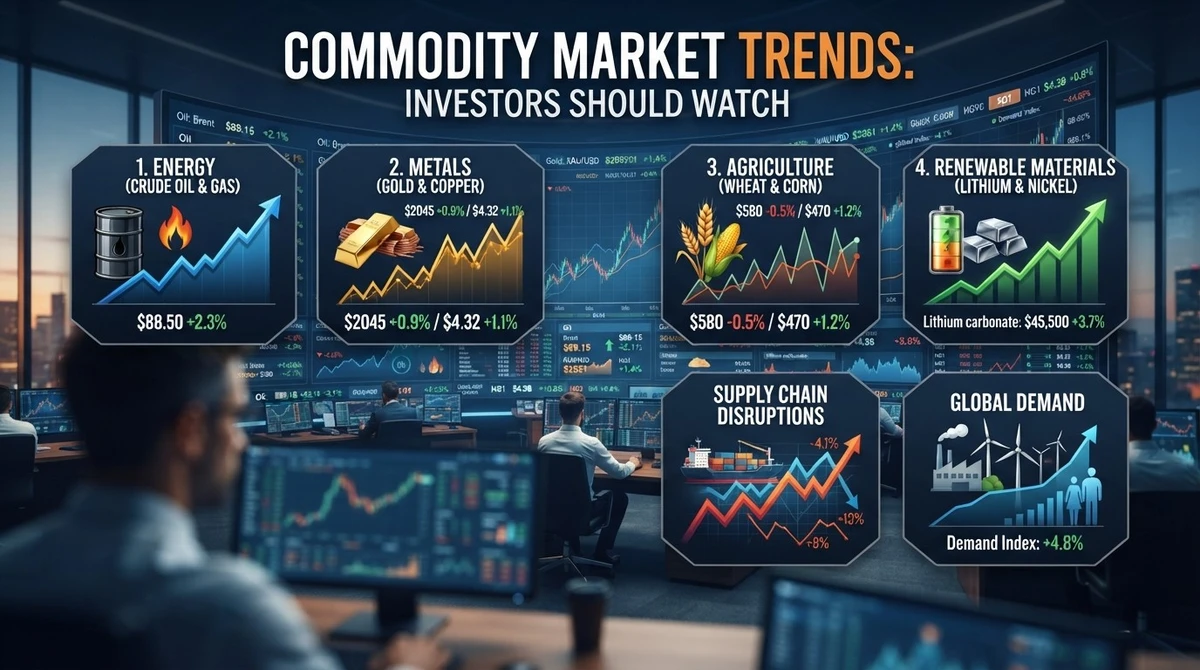
Commodity Market Trends Investors Should Watch
Commodity markets can change quickly.
Oil prices can move because of a supply disruption. Metal prices can respond to stronger industrial demand. Agricultural commodities can react to weather before the impact appears in production data. Gold can respond to interest rates, the U.S. dollar, and investor demand.
For investors, watching the commodity price itself is only part of the picture.
A more useful question is: What is changing underneath the market, and could that change persist?
Global demand, production capacity, inventories, weather, geopolitical risks, currency movements, futures curves, and the energy transition can all influence commodity prices and the performance of commodity-related investments.
Understanding these signals can also explain why different commodities sometimes move in opposite directions.
Global Commodity Demand Is a Starting Point
Demand is one of the most important forces behind commodity prices.
When global economic activity is strong, businesses tend to use more energy, metals, transportation services, and industrial materials. Stronger construction and manufacturing can increase demand for commodities such as copper, aluminum, steelmaking materials, and energy.
A slowdown can have the opposite effect.
Oil and industrial metals are particularly sensitive to changes in economic activity because they are closely connected to transportation, manufacturing, construction, and investment.
But demand is not simply about global GDP.
Investors can also watch:
- Industrial production
- Manufacturing activity
- Construction spending
- Vehicle production
- Electricity consumption
- Global trade
- Infrastructure investment
- Consumer demand
The useful indicator depends on the commodity.
Copper, for example, is closely connected to industrial activity, construction, electrical equipment, and infrastructure. Oil reflects transportation and energy demand. Agricultural commodities depend more heavily on food consumption, weather, inventories, and production conditions.
That makes commodity demand a sector-by-sector story rather than a single global number.
Supply Constraints Can Matter More Than Demand
A commodity can rise even when demand is not particularly strong if supply becomes difficult to increase.
This is especially important in markets where production capacity cannot respond quickly.
Mining projects can take years to develop. Oil production requires investment in exploration and infrastructure. Agricultural output depends on land, weather, fertilizer, water, and planting decisions.
When supply becomes constrained, relatively small changes in demand can produce much larger price movements.
The World Bank’s April 2026 Commodity Markets Outlook highlighted tight conditions in several commodity markets. It projected average base-metal prices at record levels for the year, supported partly by strong demand and limited short-term production flexibility. (The World Bank)
For investors, the question is therefore not only whether demand is rising.
It is whether producers can increase supply quickly enough to keep up with that demand.
Inventories Can Reveal Pressure in the Physical Market
Inventories provide another useful signal.
Stocks act as a buffer between supply and demand. When inventories are high, a temporary disruption may have a smaller immediate effect because buyers can draw from existing supplies.
When inventories are already low, the same disruption can produce a much larger price reaction.
A simple framework is:
High inventories → larger supply cushion → less immediate price pressure
Low inventories → smaller supply cushion → greater sensitivity to disruptions
This matters particularly for oil, natural gas, metals, and agricultural commodities.
Energy markets provide a current example. The EIA’s September 2026 analysis showed continued constraints in global oil flows and highlighted strategic inventory levels across major economies. (U.S. Energy Information Administration)
Inventory data should still be interpreted alongside production and demand. A falling stockpile can signal tightening conditions, but the reason for the decline matters.
Energy Markets Remain a Major Commodity Signal
Energy deserves particular attention because oil and natural gas affect transportation, electricity generation, manufacturing, fertilizers, and household energy costs.
Energy markets can also transmit shocks into other commodity groups.
The World Bank’s April 2026 outlook projected energy prices to rise sharply during 2026 as the Middle East conflict disrupted energy supply and trade. It also identified significant spillovers into fertilizer and other commodity markets. (World Bank)
More recent EIA data showed Brent crude averaging about $91 per barrel in August 2026, up from July, as Middle Eastern export constraints continued to affect global oil markets. (U.S. Energy Information Administration)
For investors, energy should therefore be viewed as more than one commodity sector.
Changes in oil and natural gas can influence:
- Transportation costs
- Fertilizer prices
- Food production
- Industrial production
- Inflation
- Consumer spending
- Corporate profit margins
Energy can become a transmission channel between commodity markets and the wider economy.
China’s Demand Still Matters Across Commodity Markets
China is a major consumer of many commodities, particularly industrial metals, energy, and raw materials used in construction and manufacturing.
Changes in Chinese industrial activity can therefore affect global commodity markets even when global supply has not changed.
Investors can monitor:
- Manufacturing activity
- Industrial production
- Construction activity
- Infrastructure investment
- Property-sector conditions
- Imports of major commodities
- Electricity demand
The relationship is not always straightforward.
A slowdown in one part of China’s economy may reduce demand for some commodities while infrastructure spending or investment in newer industries increases demand for others.
That makes the composition of Chinese growth important, not just the headline growth rate.
The Energy Transition Is Changing Commodity Demand
The expansion of electric vehicles, renewable energy, battery storage, electricity networks, and digital infrastructure is creating new sources of commodity demand.
Copper, aluminum, lithium, nickel, and other materials can benefit from investment in power systems, batteries, renewable-energy projects, and data centers.
The World Bank’s 2026 outlook identified strong demand from areas including data centers, electric vehicles, and renewable energy as one factor supporting base-metal prices. (World Bank)
That does not mean every transition-related commodity will continuously rise.
New mining capacity, technological changes, substitution, recycling, changes in battery chemistry, and slower investment can all affect the eventual balance between supply and demand.
The more useful question is:
Is demand growing faster than producers can expand supply?
That is where a long-term structural trend can become economically important for commodity prices.
Agricultural Commodities Have Their Own Set of Signals
Agricultural commodities behave differently from industrial commodities because production depends heavily on biological and weather conditions.
Investors can monitor:
- Rainfall
- Temperature
- Drought conditions
- Crop yields
- Planting and harvesting progress
- Global inventories
- Fertilizer prices
- Export restrictions
- Shipping conditions
- Currency movements
Recent data shows how quickly agricultural conditions can change. The FAO Food Price Index averaged 133.3 points in August 2026, up 1.9% from July, while its cereal index reached its highest level since May 2024. (FAOHome)
Weather can become especially important because agricultural supply cannot always respond quickly to changing conditions.
A recession may weaken demand for some goods, but a drought, flood, crop failure, or export restriction can create a supply shock at the same time.
Geopolitical Risk Can Move Commodity Markets Quickly
Commodity production and transportation are geographically concentrated.
That creates exposure to geopolitical events.
A conflict can disrupt:
- Oil and gas production
- Mining operations
- Shipping routes
- Ports
- Pipelines
- Agricultural exports
- Fertilizer supplies
The effects can extend beyond the commodity directly affected.
The World Bank’s 2026 analysis found that oil-supply shocks driven by geopolitical risk can spill into natural-gas and fertilizer prices, creating effects that spread through other commodity markets. (World Bank)
This is why commodity investors need to watch production regions and transportation routes, not just commodity exchanges.
Trade Restrictions Can Change Commodity Flows
Tariffs, export controls, sanctions, quotas, and export restrictions can alter the movement of commodities between countries.
A country that restricts exports can reduce global availability even if total production has not changed.
Import restrictions can also reduce demand from a major buyer.
Trade policy may change where commodities are sourced, how inventories are managed, and which transportation routes businesses use.
For investors, the relevant question is not simply:
“Did a new trade policy appear?”
It is:
“Could this policy change physical commodity flows?”
That question connects commodity markets directly to international trade and supply chains. Economic Reader’s How Does International Trade Work explains how tariffs, transportation, exchange rates, and cross-border trade affect businesses and markets.
The U.S. Dollar Can Change Commodity Conditions
Many major commodities are priced internationally in U.S. dollars.
That makes currency movements important.
When the dollar strengthens, dollar-denominated commodities can become more expensive for buyers using other currencies, all else equal. When the dollar weakens, the opposite effect can occur.
The relationship is not mechanical. Supply shortages, geopolitical disruptions, and changes in demand can easily overwhelm currency effects.
Still, the dollar is worth monitoring alongside commodity prices.
For example, if a commodity continues rising despite a stronger dollar, that can suggest that another force such as a supply shortage or geopolitical disruption is exerting greater pressure on the market.
Interest Rates Can Influence Commodity Investment
Interest rates affect commodity markets through several channels.
Higher borrowing costs can reduce investment and economic activity, potentially weakening demand for industrial commodities.
Financial conditions can also affect investor demand.
Gold is particularly sensitive to interest rates and real yields because it does not generate interest income. Changes in real yields can alter the opportunity cost of holding gold.
Interest rates can therefore influence commodity markets even when physical supply and demand have not changed immediately.
Watch the Futures Curve, Not Just the Spot Price
For investors using commodity futures or futures-based exchange-traded products, the futures curve is especially important.
The spot price represents the price of a commodity for immediate delivery. Futures prices reflect contracts for delivery at later dates.
When later-dated futures trade above nearer-term prices, the market is generally in contango. When nearer-term prices are higher than later contracts, it is in backwardation. (CME Group)
The shape of the curve can provide information about inventory conditions, supply availability, and market expectations.
It can also affect investment returns.
A futures-based product generally has to replace expiring contracts. Depending on the shape of the curve, that process can create a positive or negative roll effect.
CME research has highlighted how strongly the oil futures curve can change during supply disruptions and how backwardation or contango can affect the return from maintaining futures exposure. (CME Group)
That is why an investor can be correct about the direction of a commodity’s spot price and still receive a different return from a futures-based investment product.
Economic Reader’s Best Commodity ETFs in the USA provides additional context on physical and futures-based commodity products.
Global Manufacturing Can Signal Commodity Demand
Manufacturing activity provides another useful window into commodity demand.
A strong manufacturing environment can support demand for:
- Copper
- Aluminum
- Steelmaking materials
- Energy
- Industrial chemicals
- Transportation fuels
A broad manufacturing slowdown can have the opposite effect.
Investors can therefore follow manufacturing surveys and industrial-production data from major economies.
But the signal should be matched to the commodity.
A weak manufacturing reading may be highly relevant to copper but much less useful for wheat.
The closer the connection between an economic indicator and a commodity’s end use, the more informative that indicator becomes.
Shipping and Supply Chain Conditions Can Become Price Signals
Physical commodities need to move.
Oil, metals, grains, fertilizers, and other raw materials depend on ports, ships, pipelines, railways, roads, and storage facilities.
When transportation becomes more expensive or difficult, commodity prices can respond even if production remains unchanged.
Shipping disruptions can also create differences between regional markets. A commodity may be available in one location but difficult or expensive to deliver to another.
That can create regional price premiums and temporary shortages.
Economic Reader’s How Global Supply Chains Work explains how raw materials, production, transportation, storage, and distribution connect across countries.
For commodity investors, supply-chain data can therefore provide an early signal that a physical market is becoming tighter or more fragmented.
Commodity Prices Can Move Together – Until They Don’t
Commodity markets sometimes experience broad rallies or declines when a major macroeconomic force affects several sectors at once.
A global economic expansion can support energy and industrial metals simultaneously. A major geopolitical shock can affect energy, fertilizers, agricultural products, and some metals at the same time.
But those relationships can break down.
The World Bank’s April 2026 outlook illustrates the point. Its baseline forecast projected overall commodity prices to rise 16% in 2026, but the expected direction differed by category: energy prices were projected to rise 24%, metals and minerals 17%, precious metals 42%, while agricultural commodity prices were projected to decline 6%. (World Bank Blogs)
The lesson is straightforward:
“Commodity prices” is not one single market.
Broad commodity indexes can hide large differences between individual sectors.
A Practical Commodity Market Watchlist
Investors do not need to track every commodity statistic available.
A more useful approach is to build a repeatable watchlist.
Demand: Is economic activity strengthening or weakening?
Supply: Are producers expanding output, cutting production, or facing disruptions?
Inventories: Are stockpiles building or declining?
Weather: Are agricultural or energy markets facing unusual conditions?
Geopolitics: Could conflicts, sanctions, or shipping disruptions affect supply?
China and other major economies: Is industrial activity supporting or weakening demand?
The dollar: Are currency movements adding pressure or support?
Interest rates: Are financial conditions changing the economic or investment environment?
Futures curves: Are markets in contango or backwardation?
Investment structure: If using an ETF or other product, does its structure provide the exposure you actually want?
This framework is more useful than reacting to every daily price move.
Why Trends Matter More Than Individual Headlines
Commodity markets can be noisy.
A single day’s price movement may reflect a headline, a positioning adjustment, currency movements, or a temporary supply concern.
A trend becomes more informative when several indicators point in the same direction.
For example, sustained tightening in the oil market may become more significant when inventories are falling, production is constrained, demand remains firm, and the futures curve shows persistent backwardation.
Similarly, an agricultural price increase becomes more meaningful when weather conditions, inventories, crop forecasts, and export data all point toward tighter supply.
The goal is not to predict every price movement.
It is to understand which underlying conditions are changing and whether those changes appear temporary or structural.
Commodity Markets Are Easier to Read as a System
Commodity prices are visible in the market every day, but the forces behind them are more complicated.
Demand determines how much the world wants. Supply determines how much producers can provide. Inventories provide a buffer. Weather affects agricultural output. Geopolitical events can disrupt production and transportation. Currency and interest rates influence financial conditions. Futures markets provide information about expected supply, demand, and inventory conditions.
These forces can also interact.
A geopolitical shock can reduce oil supply, increase energy prices, raise fertilizer costs, and eventually affect agricultural markets. Strong investment in data centers and renewable energy can increase demand for electricity and metals. A stronger dollar can alter the purchasing power of commodity buyers outside the United States.
That interconnectedness is what makes commodity markets difficult to analyze and why a single price chart rarely tells the whole story.
For investors, the most useful habit is to maintain a consistent watchlist rather than react to individual headlines.
Watch demand. Watch supply. Watch inventories. Watch the dollar. Watch geopolitics. Watch the futures curve. And most importantly, understand how those signals connect to the specific commodity or investment product you own.
That provides a more useful framework for following commodity markets than simply asking whether prices are going up or down.